A Reg 114 trust is a reinsurance trust that meets New York's Regulation 114, 11 NYCRR Part 126: an account at a qualifying bank, set up by an unauthorized reinsurer as grantor for the sole benefit of one ceding insurer, holding U.S.-dollar assets that the cedant can withdraw without the reinsurer's consent. New York cedants use it to take credit for reinsurance placed with reinsurers that are not authorized in the state, and many cedants elsewhere ask for it by name because New York's terms are the strictest. The Department has said so in terms: it "strictly interprets the provisions of Regulation 114". Over the last two decades it has refused an investment-manager account, a multi-cedant master trust and foreign-currency assets, each on the regulation's literal words. For a ceding insurer, monitoring such a trust means checking that its structure still qualifies as well as that its balance still covers the reinsurer's liabilities. Botminds' Reinsurance Counterparty Risk Monitoring values each trust at every statement against its requirement and keeps it on the same row as the reinsurer's ratings and payment record.
What New York has refused and allowed in a Regulation 114 trust, opinion by opinion
2003
May the trustee place trust assets in an account with an investment manager, in the trustee's name?
No
The Department "strictly interprets" the regulation: assets must be held by the trustee directly, and the extra account would add conditions and references outside the trust. Opinion
2003
Is an income fund rated AAA, holding some assets rated below A, an eligible trust asset?
Depends
Not on the fund's rating but on whether its investments meet the Insurance Law's test for investment companies. Opinion
2005
May one reinsurer use a master trust, with sub-accounts for several cedants who join by participation agreement?
No
The regulation does not contemplate multiple beneficiary trusts, and the master agreement would reference other documents. Opinion
2008
May a reinsurer fund its trust with collateral notes issued by a Delaware statutory trust backed by eligible assets?
Yes
On the facts presented, the notes are obligations of an American institution; what matters is the cedant's unfettered access to the assets. Opinion
2008
May trust assets be denominated in a currency other than the U.S. dollar?
No
Foreign currency adds exchange-rate and possible exchange-control risk to collateral meant to be readily liquidated. Opinion
2009
When is an asset's rating requirement tested?
On purchase
Under Insurance Law § 1401(b), financial tests are satisfied if met on the date of acquisition, absent a rule saying otherwise. Opinion
What is a Reg 114 trust?
A Reg 114 trust is a trust agreement among three parties, a beneficiary, a grantor and a bank as trustee, that creates an account holding assets for the beneficiary's sole use. The beneficiary is the ceding insurer; the grantor is the reinsurer, and the regulation's definition, as New York's Office of General Counsel quoted it in 2005, reads: "When established in conjunction with a reinsurance agreement, the grantor is the unlicensed, unaccredited reinsurer." (OGC Opinion 05-07-22). The trust is one of the ways a cedant may take credit for reinsurance with an unauthorized reinsurer under New York's Regulation 20, which points to Regulation 114 for the trust's terms (OGC Opinion 08-10-09).
The NAIC's model regulation contains the same kind of trust in its Section 12, with similar conditions, and most states' versions follow the model. New York's matters disproportionately because of how many cedants, reinsurers and banks write their trust agreements to New York's standard. When a treaty calls for a "Reg 114 trust", it usually means a single-beneficiary trust meeting New York's terms whatever the cedant's domicile.
Trusts hold nearly half the collateral on a Reinsurance Counterparty Risk Monitoring sample panel
$128.6M held by 12 reinsurers that post collateral
- Letters of credit $66.4M · 52%
- Trusts $62.2M · 48%
Strictly means strictly: the investment manager opinion
The clearest statement of New York's approach came in 2003, when a bank acting as trustee asked whether it could hold a trust's assets in an account with an investment manager, in the trustee's own name, for faster reporting. The answer was no: "The Department strictly interprets the provisions of Regulation 114 and thus would not allow the Trustee to place the assets of the Trust into an account with an investment manager." (OGC Opinion 03-08-03).
The reasoning matters more than the result. The Department read the requirement that assets be "held by the trustee at the trustee's office in the United States" literally, "thus mandating that the Trust assets be held by the Trustee directly and not through an intermediary custodian". It added that the new account would make the agreement refer to the documents establishing it and add conditions to the trust's operation, contrary to the requirement that the trust agreement be clean and unconditional, and that it would breach the duty to "receive and hold all assets in a safe place". Convenience for all the parties did not count against the text.
Can a Reg 114 trust have multiple beneficiaries?
No. In 2005 a bank proposed a master trust: one reinsurer as grantor, several ceding insurers joining as beneficiaries through participation agreements, separate sub-accounts for each, pooled investment. The Department refused it: "No, the proposed Master Trust Arrangement would not be viewed by the Department as acceptable under Regulation 114." (OGC Opinion 05-07-22). Every reference to beneficiary and grantor in the regulation is singular; the trust must be "for the sole use and benefit of the beneficiary"; and a master agreement that refers to participation agreements breaks the rule against references to other documents.
Multi-beneficiary trusts exist in credit for reinsurance law, but on a different route. The NAIC model allows credit where a reinsurer maintains a single trust for all its U.S. cedants, holding its U.S. liabilities plus trusteed surplus of at least $20 million for a single reinsurer (Model Regulation #786, Section 7). That is a trust for the reinsurer's whole U.S. book, approved by a regulator, not a way to share one cedant's security with others.
What assets can be held in a Regulation 114 trust?
Only U.S.-dollar cash, certificates of deposit issued by a U.S. bank, and investments of the types in paragraphs (1), (2), (3), (8) and (10) of New York Insurance Law § 1404(a), provided they are not issued by a parent, subsidiary or affiliate of the grantor or beneficiary, according to Section 126.5(a)(2) as the Department quoted it in 2008 (OGC Opinion 08-06-14). Those paragraphs cover government obligations, obligations of American institutions, preferred or guaranteed shares, certain equity interests and registered investment companies, each with its own quality test; for obligations of American institutions, a rating of A or higher is one route.
The Department's rulings fill in the edges. A mutual fund qualifies or not on whether its holdings meet the investment-company test in § 1404(a)(10), "not on the rating of the Fund or the rating of the Fund's holdings" (OGC Opinion 03-07-27). Collateral notes issued by a Delaware statutory trust and backed by eligible assets were accepted on the facts presented; the reinsurer need not own the assets it deposits, because, in the Department's words, "What is required is that the ceding insurer have unfettered access to the contributed assets." (OGC Opinion 08-06-14). And every asset must be in U.S. dollars, even though the regulation's text names the currency only for cash and certificates of deposit.
"Regulation 114 is intended to protect domestic insurers that have ceded business to unauthorized reinsurers by affording to cedants unfettered access to readily liquidatable collateral."
New York Insurance Department, Office of General Counsel, Opinion 08-10-09 (27 October 2008)
That sentence is the key to every opinion in the frame above. An investment manager's account, a pooled master trust and a foreign-currency bond each put something between the cedant and cash on the day it needs it: an intermediary, other beneficiaries, an exchange rate. The 2008 currency opinion said so directly: denomination in a foreign currency "introduces the risk of exchange rate fluctuation (and possibly the imposition of exchange controls)".
Ratings are measured on the day of purchase
An asset's rating requirement is tested when the asset is acquired, not continuously. In 2009 an investment manager pointed out that Regulation 114 is silent on when the rating test applies; the Department answered with Insurance Law § 1401(b), under which financial tests "are satisfied if complied with on the date of acquisition by the insurer", so assets contributed to a trust "must meet any applicable statutory rating requirement as of the asset's acquisition date" (OGC Opinion 09-09-06).
For a monitor, that splits the work in two. Eligibility is checked at deposit and at each substitution: was the asset eligible, in dollars, unaffiliated, when it went in? Value is checked at every statement: what is the eligible asset worth now, against the requirement? A bond downgraded below A after purchase may stay eligible under that reading, but its market value falls, and the trust's coverage with it. The trust agreement can also be stricter than the regulation, and many security committees ask for that.
Who can be trustee, and where do the assets sit?
As quoted by the Department in 2003, the regulation requires a bank that is "either a member of the Federal Reserve System, or a New York State-chartered bank or trust company", which "shall not be a parent, subsidiary or affiliate of the grantor or the beneficiary", with all assets "held by the trustee at the trustee's office in the United States" (OGC Opinion 03-08-03). The NAIC model's trustee is a qualified U.S. financial institution: organised or licensed in the United States, granted fiduciary powers and supervised by U.S. bank regulators.
The trustee is not a passive custodian. Under the model it must hold assets in a safe place, keep them in a form the beneficiary can negotiate without the grantor's signature, send the grantor and beneficiary a statement of assets at least at the end of each calendar quarter, notify both within ten days of any deposit or withdrawal, and allow no substitution or withdrawal without the beneficiary's written instruction, except to reinvest maturing assets in the account (#786, Section 12B(6)). Each of those is a fact a monitor can check against the trustee's own reports.
How a cedant withdraws, and how a trust ends
The cedant withdraws by written notice to the trustee, at any time, without notice to the reinsurer and without presenting any other document except, if the agreement requires it, an acknowledgement of receipt (#786, Section 12B(4)). The treaty may limit what withdrawn assets can be used for: paying the reinsurer's share of losses and unearned premiums the reinsurer has not paid, returning any excess over 102% of what the specific agreement requires, or moving the assets to a separate account when the trust is about to end.
How a single-beneficiary reinsurance trust ends under the model regulation
- Notice window45 to 30 days
- Replace, or plan withdrawal30 to 10 days
- Cedant may withdrawlast 10 days
A trust ends on written notice from the trustee to the beneficiary "at least thirty (30) days, but not more than forty-five (45) days" before termination (#786, Section 12B(7); the published PDF runs the last number together as "fortyfive"). The window is short and the consequence is final: if the reinsurer's obligations are still outstanding ten days before the end, the cedant may withdraw an amount equal to them into an account in its own name. A termination notice is therefore a deadline of the same kind as a bank's notice that a letter of credit will not be renewed, and it arrives the same way, in a mailbox.
Monitoring a trust is reading its structure, not only its balance
A trust can fail as collateral in two ways: it can be worth less than the requirement, or it can stop qualifying at all. The first shows up in the quarterly statement; the second shows up in the agreement, an amendment or a trustee's notice. In the solution's fictional sample carrier, with 34 reinsurers on its panel, one collateralized reinsurer's trust stood at 97% of its requirement after the 30 September valuation, $0.3 million short, and the credit controller asked for a top-up. That is the visible kind of failure. The structural kind, an asset moved to a manager's account or a foreign-currency bond substituted in, would not change the balance at all.
What to check on every Reg 114 trust, and when
- At set-up: one grantor, one beneficiary, a qualifying bank
Unaffiliated with either party; assets held at its own U.S. office.
- At set-up: the agreement is clean and stands alone
No conditions outside it and no references to other agreements.
- At each deposit or substitution: eligible, U.S. dollar, unaffiliated
Ratings tested on the date of acquisition.
- At each statement: market value against the requirement
Statements at least quarterly; the requirement moves with recoverables.
- Within ten days of any movement: the trustee's notice
A withdrawal or substitution you did not instruct is an immediate question.
- On any termination notice: the 30 to 45 day window
Plan the withdrawal of open obligations before the last ten days.
- Before approving a release to the reinsurer: the 102% test
Or replacement with assets of equal value, under the treaty's terms.
Trusts and letters of credit against each reinsurer's requirement in Reinsurance Counterparty Risk Monitoring
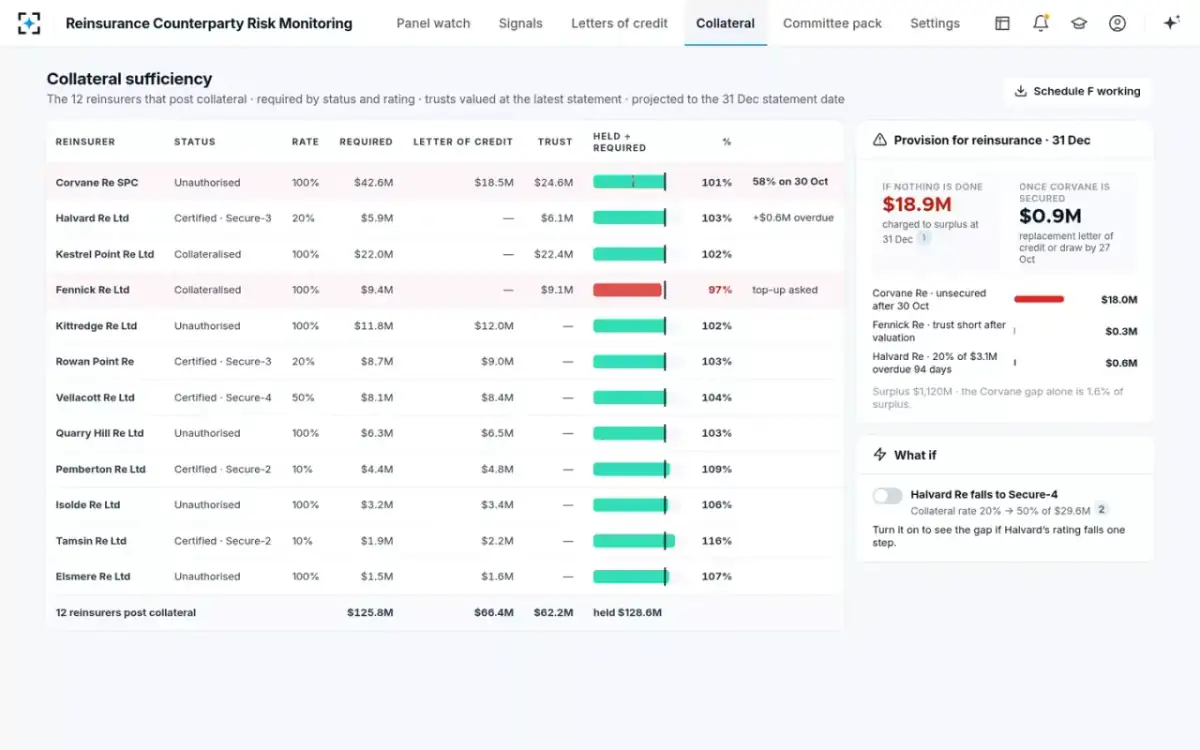
Reinsurance Counterparty Risk Monitoring reads trust statements as they arrive, values each trust at market value against the reinsurer's requirement by status and rating, and flags a shortfall with the statement that showed it. The collateral checker never moves trust assets or instructs a trustee; those stay with the cedant's authorised signatories. Structural checks at set-up and substitution remain a job for treasury and counsel, and the watch notes when they were done. See the panel view on the Reinsurance Counterparty Risk Monitoring page, the letter of credit pre-mortem for the other half of most collateral registers, and the comparison with loan collateral trackers.
Questions people ask
What does Regulation 114 stand for?
It is the common name for New York's insurance regulation on trust accounts for credit for reinsurance, codified at 11 NYCRR Part 126 (sections 126.1 onward). The Department's opinions refer to it as Regulation 114, and treaties use "Reg 114 trust" for a single-beneficiary trust meeting its terms.
Can a Reg 114 trust hold letters of credit?
The New York opinions on this page list cash, certificates of deposit and § 1404(a) investments and do not address letters of credit. Under the NAIC model, a letter of credit can be a trust asset only if the trustee has the right and the obligation to draw it in full if it will expire unrenewed; check New York's current text and the trust agreement.
Can the reinsurer take assets out of a Reg 114 trust?
Not on its own. Under the model regulation no withdrawal or substitution happens without the beneficiary's written instruction, except reinvestment of maturing assets in the account. A treaty may let the reinsurer seek the cedant's approval to withdraw assets if it replaces them with assets of equal value or leaves at least 102% of the required amount, and that approval may not be unreasonably withheld.
Are Reg 114 trust assets valued at book or market?
At market. The NAIC model requires assets to be valued at current fair market value, and a cedant's reduction from liability at a statement date is capped at the fair market value of acceptable assets it could withdraw then. A trust that met its requirement at book value can fall short at market.
Does a Reg 114 trust protect the cedant if the reinsurer becomes insolvent?
That is its purpose: the assets are held for the beneficiary's sole benefit, and the model lets the treaty stipulate that withdrawn assets be applied without diminution because of the insolvency of either party. What the trust cannot protect is value it never held, which is why the balance against the requirement matters at every statement.