A letter of credit used as reinsurance collateral is a bank's undertaking to pay the ceding insurer on demand, posted by a reinsurer so the cedant can take credit for the reinsurance on its statutory balance sheet. To count, it must be clean, irrevocable and unconditional, issued or confirmed by a qualified U.S. financial institution, payable on a sight draft with no other documents, and evergreen with at least 30 days' notice before it ends. The risk this guide examines is the one that matters most and is checked least: that the instrument in the file is not a qualifying letter of credit at all. In an April 2026 decision, the Fifth Circuit revived an insurer's claim that its broker mishandled a "collateral letter" that stood in for a letter of credit a bank never issued; the insurer was later placed under state supervision. Botminds' Reinsurance Counterparty Risk Monitoring checks every letter of credit's terms, issuer and notices against the rules on every night's run, so a document that does not qualify shows up as a gap rather than as security.
The facts below come from the court's opinion in Porch.com v. Gallagher Re, No. 25-10489 (5th Cir. 2 April 2026). The case was decided on a motion to dismiss, so the court accepted the insurer's well-pleaded allegations as true; none of them has been proven, and the broker disputes its responsibility. They are used here as a scenario, not as findings.
The collateral, as alleged, and where the checks sit
- A collateral letter, not a bank letter of credit2021
- $25M released2022
- A second "letter"early 2023
- Bank denies itJul 2023
- Checks 1 and 2: the letter, the issuerplacement
- Check 5: release testwithdrawal
- Checks 3 and 6renewal
- Check 4every night
What a letter of credit does as reinsurance collateral
A letter of credit lets an unauthorized or certified reinsurer secure what it owes without handing over assets: a bank promises to pay the cedant up to a stated amount whenever the cedant presents a draft, and the reinsurer reimburses the bank. For the cedant, its value lies in three properties. It is independent of the reinsurance dispute, because the bank pays on demand. It is liquid, because the cedant can draw the full amount on a sight draft. And it is backed by a regulated U.S. bank, whose strength replaces the reinsurer's. Remove any of the three and the paper is a promise, not security.
That is why the model law allows credit for a letter of credit only when it is "issued or confirmed by a qualified U.S. financial institution", effective by 31 December of the statement year and in the cedant's possession, or in trust for it, by the filing date (Model Law #785, Section 3C). A qualified institution is one organised or licensed in the United States, supervised by U.S. bank regulators, and found by the commissioner or the NAIC's Securities Valuation Office to meet its standards of financial condition (#785, Section 4A).
What must a reinsurance letter of credit say?
The model regulation specifies the instrument closely. It must be "clean, irrevocable, unconditional and issued or confirmed by a qualified United States financial institution"; it must carry an issue date and an expiry date; and it must "stipulate that the beneficiary need only draw a sight draft under the letter of credit and present it to obtain funds and that no other document need be presented" (Model Regulation #786, Section 13A). It must say it is not subject to conditions outside itself, and it may not refer to other agreements, documents or entities, except for a boxed reference section marked as for identification only.
It must also state that the bank's obligation is not contingent on reimbursement, run for at least a year with an evergreen clause giving at least 30 days' notice before expiry or non-renewal, name its governing law or the ICC rules it follows, and be presentable at a U.S. office of a qualified bank (#786, Sections 13C to 13E). Each of those is something a reader can check on the face of the document. A letter that promises a future letter of credit, from a finance company rather than a bank, fails on the first line.
The case, as alleged: a collateral letter in the place of a letter of credit
According to the opinion, Homeowners of America Insurance Company, a property and casualty insurer wholly owned by Porch.com, signed a reinsurance intermediary authorization agreement in 2017 with the broker now known as Gallagher Re, then Willis Re. In 2021 Gallagher brokered a reinsurance agreement between the insurer, a reinsurer named Whiterock, and Vesttoo, a reinsurance-finance company that raised funding for the cover. An addendum signed by the insurer and the broker said the reinsurer was "not approved . . . for the risk being placed" and that the broker "ha[d] not assessed the collateral required to support obligations in the above contract", recommending specialist advice on the security available (5th Cir. opinion, part I).
The agreement stated that China Construction Bank would provide a letter of credit. The insurer alleged that it received instead "only a collateral letter stating that Yu Po Finance would eventually provide a letter of credit from CCB", while the broker kept calling it a letter of credit and assuring the insurer the cover was funded. In 2022, believing it was secured, the insurer authorized Vesttoo to remove $25 million from the reinsurance account. Ahead of the 2023 renewal the broker provided a second letter "purporting to be from CCB that differed significantly from the original Yu Po letter."
In July 2023 media reports said Vesttoo had posted invalid letters of collateral and had filed for bankruptcy. The insurer contacted the bank, which said it had never issued any such letter. The insurer bought replacement cover at a higher cost; the Texas Department of Insurance placed it under temporary supervision, and its parent injected tens of millions of dollars. The parent then sued the broker for breach of the intermediary agreement.
Pre-mortem: six checks, and where each one sits
A pre-mortem asks how a failure could have happened and which control would have caught it. The frame below sets six checks against the allegations. None assumes the broker was at fault; each is a check the cedant can run itself, because the credit for reinsurance it takes is its own.
Six checks on a reinsurance letter of credit, set against the allegations
1Is it a letter of credit at all?
What the rule or practice asksClean, irrevocable, unconditional; payable on a sight draft with no other document; no reference to other agreements (Model Regulation #786, Section 13A).
Where the allegations place itThe insurer received "only a collateral letter stating that Yu Po Finance would eventually provide a letter of credit" from the bank.
2Does the issuer qualify?
What the rule or practice asksIssued or confirmed by a qualified U.S. financial institution; a foreign issuer needs a qualified U.S. confirming bank as its agent (#786, 13A and 13G).
Where the allegations place itThe treaty named a bank that would provide a letter of credit; the opinion does not describe a U.S. confirmation.
3Has the bank confirmed it, directly?
What the rule or practice asksAsk the issuing or confirming bank, through contact details you source yourself, whether it issued this instrument.
Where the allegations place itThe insurer asked the bank only in July 2023, and the bank said it had issued no such letter.
4Do you hold the original?
What the rule or practice asksIn the cedant's possession, or in trust for it, by the annual statement filing date (Model Law #785, Section 3C).
Where the allegations place itThe insurer alleged the letter was in the broker's possession and that verifying it was a service brokers ordinarily perform.
5Is security still sufficient after any release?
What the rule or practice asksBefore approving a withdrawal, test what remains against what the reinsurer owes.
Where the allegations place itIn 2022 the insurer authorized a $25 million withdrawal from the reinsurance account, on the broker's assurance it was safe.
6Does the renewal instrument match the original?
What the rule or practice asksTreat any change of issuer, applicant or wording as a new instrument to verify from the start.
Where the allegations place itAhead of the 2023 renewal a second letter "purporting to be from CCB" differed significantly from the original.
The first check is the cheapest and, on these allegations, decisive. A document from a finance company promising that a bank will issue a letter of credit later is not clean, not unconditional, not from a qualified bank, and cannot be drawn on a sight draft. Reading it against Section 13A takes minutes. The fifth check is the expensive one to skip: a release of $25 million should be tested against what the remaining security covers, and the model regulation's trust rules show the standard regulators expect, replacement with assets of equal value or a remaining balance of at least 102% of the requirement (#786, Section 12D(2)).
How do you verify a reinsurance letter of credit?
Verify a reinsurance letter of credit in four steps: read its face against the regulatory terms, confirm the issuer or confirming bank is qualified, confirm issuance directly with that bank through contact details you obtain independently, and hold the original. After that, watch it: every expiry, every notice window, every change in the bank's standing, and every amendment or replacement, which is a new instrument to verify from the start.
Verifying a letter of credit offered as reinsurance collateral
- Read the face of the instrument against Section 13
Clean, irrevocable, unconditional; sight draft only; issue and expiry dates; no outside conditions or references; evergreen with at least 30 days' notice.
- Identify the issuer and any confirming bank by legal name
A finance company, broker or reinsurer is not an issuer. A non-U.S. issuer needs a qualified U.S. confirming bank designated as its agent.
- Check the bank against the qualified institutions list
The NAIC's Securities Valuation Office maintains the list; record the date you checked.
- Confirm issuance with the bank directly
Use contact details from the bank's own published sources, not from the document or the person who sent it.
- Hold the original, or have it held in trust for you
Possession or trust by the filing date is a condition of credit.
- Record the notice window as a deadline
The bank's last day to give notice of non-renewal is when replacement work must be able to start.
- Re-verify every replacement and amendment
A changed issuer, applicant or wording is a new instrument; compare it with the one it replaces line by line.
- Test every release of collateral against the requirement
Approve only if what remains still covers what the reinsurer owes.
Who checks reinsurance collateral: cedant, broker, trustee
The ceding insurer checks its own collateral, because the credit and the statutory consequences are its own; others may check on its behalf, and contracts decide how far. A broker's duties come from its authorization agreement. A trustee's come from the trust: where letters of credit sit inside a trust, the model regulation gives the trustee "the right and the obligation" to draw them in full if they will expire unrenewed, and states that a failure to draw when required "shall be deemed to be negligence and/or willful misconduct" (#786, Section 12B(9) and (10)). Auditors and examiners test the result after the fact.
The case shows why a carrier should not rely on the line between those roles holding in a crisis. The district court had held that the allegations concerned placement, not the post-placement services the contract covered; the appeals court found the insurer had plausibly alleged lapses after placement and held the contract at least ambiguous. On what the insurer alleged, the court was precise:
"Porch did not allege that Gallagher needed to conduct a forensic audit of any reinsurer or third party to uncover that the Yu Po collateral letter was not a letter of credit."
U.S. Court of Appeals for the Fifth Circuit, Porch.com v. Gallagher Re, 2 April 2026
No forensic work was needed to tell the documents apart; the difference was on their face. A reinsurance broker's responsibilities covers what brokers hold and record. For the cedant, the lesson is that the reading must happen inside its own controls, whoever else also reads.
What the court decided, and what it did not
The Fifth Circuit affirmed the dismissal of two claims and reversed one. It agreed that the broker's duty to "retain" records did not oblige it to procure documents from the bank, which in any case was not a reinsurer, and that a clause about economic or trade sanctions laws did not import Texas insurance law. It reversed on the administrative-services clause, holding that the insurer plausibly alleged post-placement lapses, that the clause was at least ambiguous, and that what servicing duties are customary for a reinsurance intermediary is a fact question unsuitable for a motion to dismiss (5th Cir. opinion, part III).
It decided nothing about whether the broker breached its contract, whether the letters were forged or by whom, or what the insurer lost. The case went back to the district court. A guide that told the story as proven would be wrong; told as allegations, it is still the clearest public account of how a document that is not a letter of credit can be treated as one for about two years.
Building the checks into Reinsurance Counterparty Risk Monitoring's overnight run
Most of the six checks are rules a machine can apply every night once an instrument is loaded: required terms present, issuer on the qualified list, expiry and notice window recorded, original held, security sufficient after any change. The rest, reading a new instrument and confirming with the bank, are steps a person takes once per instrument, which a watch can insist are recorded before the instrument counts.
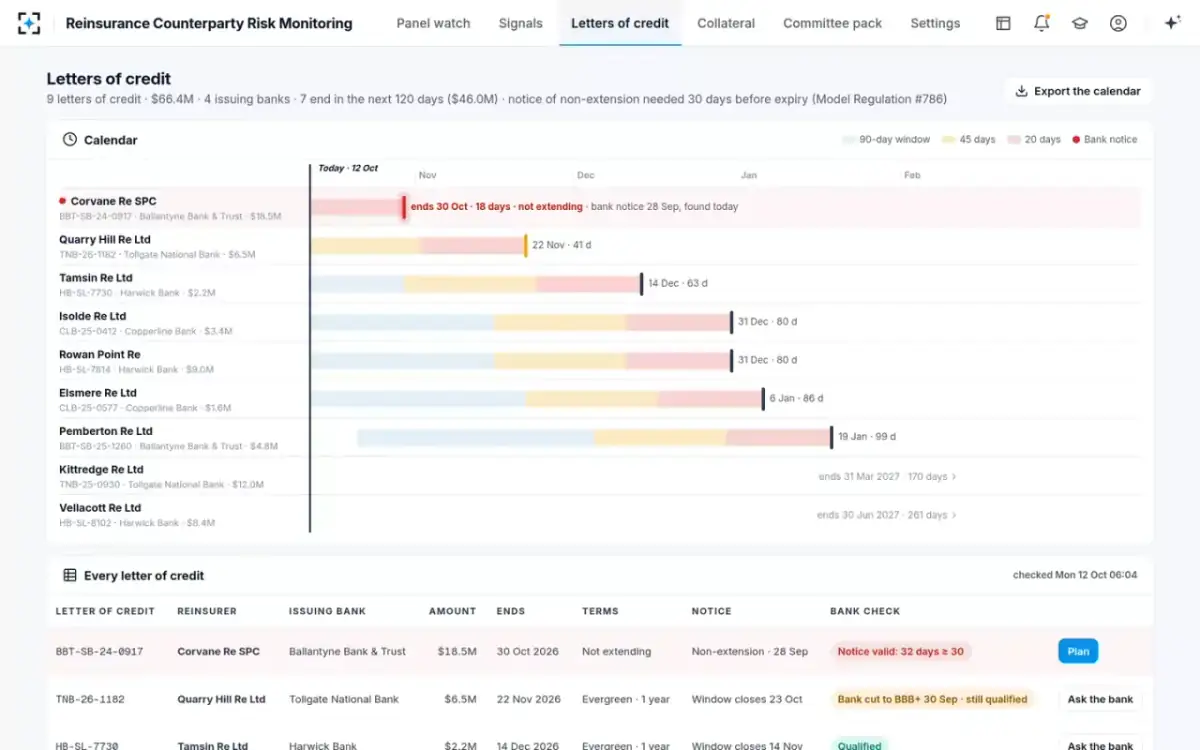
Every letter of credit in Reinsurance Counterparty Risk Monitoring, with its bank check and notice status
When a letter will lapse: the plan, the request and the draw certificate, drafted
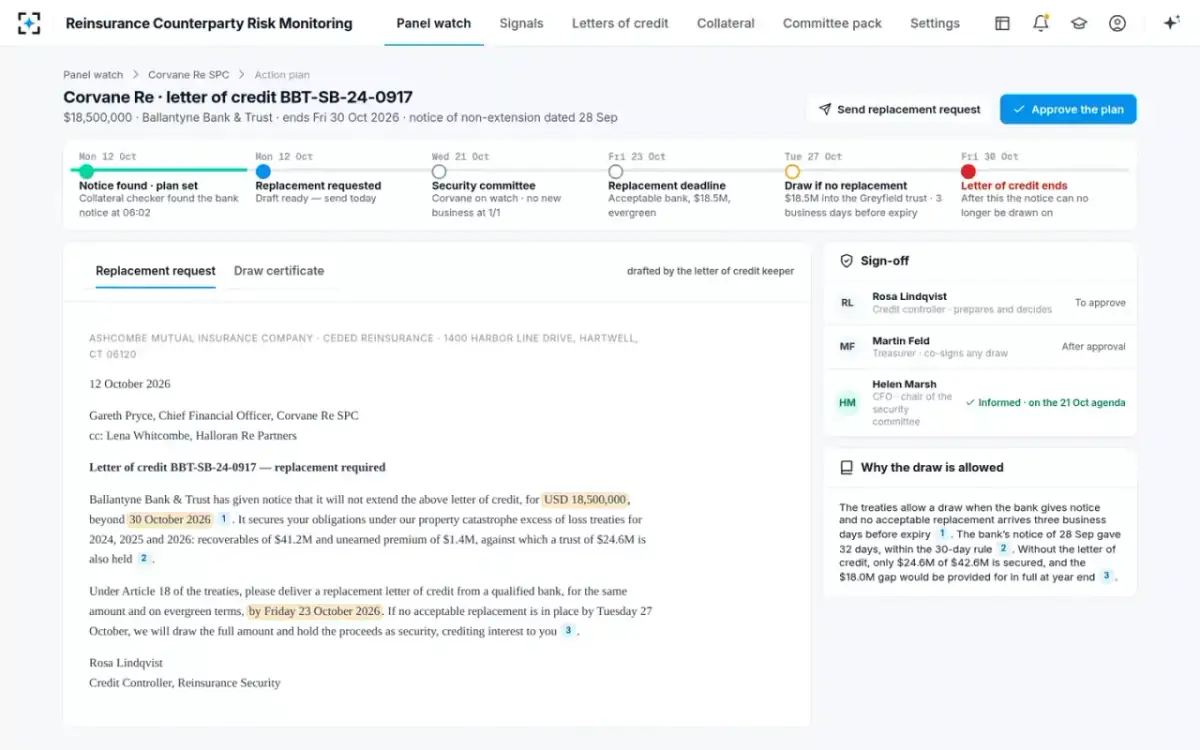
In Reinsurance Counterparty Risk Monitoring the letter of credit keeper holds every letter's issuer, amount, expiry, evergreen terms and notice period, checks the issuing bank's standing and the notice against the 30-day rule, and drafts replacement requests and draw certificates; it never sends or presents them. In the solution's fictional sample, the keeper confirmed a bank's notice of non-extension gave 32 days, at least the 30 required, and flagged another bank cut to BBB+ but still qualified. Start from the Reinsurance Counterparty Risk Monitoring page, or see why a loan collateral tracker misses these deadlines.
Questions people ask
What is an evergreen clause in a reinsurance letter of credit?
A clause that extends the letter automatically unless the bank gives notice that it will not. Model Regulation #786 requires a qualifying letter to run for at least a year with an evergreen clause giving no less than 30 days' notice before expiry or non-renewal, which gives the cedant time to obtain a replacement or draw.
What happened with the Vesttoo letters of credit?
According to the Fifth Circuit's summary of one insurer's allegations, media reports in July 2023 said Vesttoo had posted invalid letters of collateral and had filed for bankruptcy, and the bank named in the insurer's arrangement said it had never issued the letter. The court's April 2026 decision concerned the insurer's claims against its broker, accepted as true only for a motion to dismiss; it made no finding on what happened.
Can a letter of credit from a foreign bank be reinsurance collateral?
Only if a qualified U.S. financial institution confirms it. Model Regulation #786 requires the issuing bank to designate the confirming U.S. bank as its agent for receiving and paying drafts, and the evergreen clause to give 30 days' notice before expiry.
Can a cedant draw on a letter of credit before it expires?
Yes, if the treaty allows. Model Regulation #786 lets the agreement provide that the letter may be drawn at any time for listed purposes, including moving funds into a separate account in the cedant's name when the letter will expire or shrink and the reinsurer's obligations remain undischarged ten days before termination.
Does a bank's downgrade make its letters of credit worthless?
No. Under Model Law #785, a letter that met the issuer standard when issued stays acceptable until its expiry, extension, renewal, modification or amendment, whichever comes first. The next extension is therefore the deadline for a replacement from a bank that still qualifies.