A reinsurance broker's responsibilities are to place the cedant's program on the terms the client ordered, with reinsurers the client accepts, and then to account for every line and every dollar. The legal core is short: under the NAIC's Reinsurance Intermediary Model Act a broker may act for an insurer only under a written authorization that obliges it to render accurate accounts, remit funds due within 30 days, hold the insurer's money in a fiduciary capacity, disclose any relationship with the reinsurers it uses, follow the insurer's written standards for ceding risk, and keep a complete file on every contract for ten years. Everything else that fills the fortnight before 1 January (chasing authorisations, laying lines against the firm order, signing down an over-placed layer, drafting advices) is market practice built around those duties. Botminds' Reinsurance Placement Management is an agentic solution for treaty brokers that reads each authorisation as it arrives, checks it against the firm order and the client's buying instructions, and works out the signing, so the broker spends the fortnight on the decisions only a broker can make.
The examples below follow a fictional sample program as it runs through the solution: Northmoor Re Partners placing Ashgrove Mutual's property catastrophe excess of loss program for 1 January 2027, $330 million excess of $20 million in four layers. The people, brokers and reinsurers are invented; the rules are quoted from the regulators and courts that wrote them.
Five people carry one program to 1 January, and each has a different fortnight
Today
Re-keys authorisations from email, portal and scan into a line sheet, signs down by hand, and starts again when a new line arrives.
With agents
Starts the morning from lines already read and laid against the firm order; reviews the proposed signing instead of building it.
Still theirs: Which differences to raise, what to propose to the client, when to go back to market.
Today
Rebuilds the quote grid from dozens of emails to see who quoted what on which layer.
With agents
Works from every quote by layer against the firm order price and expiring, with reinsurers who quoted but never wrote flagged.
Still theirs: The view on price and capacity the broker takes to market.
Today
Assembles the placement report from the spreadsheet the night before the client meeting.
With agents
Reviews a report drafted from the live signing, panel and signed lines included.
Still theirs: The conversation with the client about panel, price and open points.
Today
Learns about a line on different terms after the signing has gone out.
With agents
Sees each open point named in the proposal and approves the signing with it stated.
Still theirs: The buying instructions, and every acceptance of a difference.
Today
Asks each broker, program by program, which layers are short or over-placed.
With agents
Sees every 1 January program layer by layer and decides the exceptions to buying instructions.
Still theirs: Exceptions, escalations and the team's priorities in the last days.
What does a reinsurance broker do?
A reinsurance broker solicits, negotiates and places reinsurance on behalf of a ceding insurer, and represents that insurer rather than the reinsurers. The NAIC model act defines the role in exactly those verbs: a reinsurance intermediary-broker is anyone, other than the ceding insurer's own officers and employees, who solicits, negotiates or places reinsurance for a ceding insurer (NAIC Model Act #790). Florida's enacted version adds what the broker cannot do, which is bind the cedant (Fla. Stat. § 626.7492; the exact words are quoted below).
In practice the job runs in three phases. Before the order, the broker builds the submission with the cedant, takes it to market and collects quotes. At the order, the cedant chooses the terms it will buy on, the firm order terms, and the broker asks reinsurers to write lines on them. After the order, the broker lays every line against those terms, signs down any layer written over 100%, issues signed-line advices, collects collateral and wording signatures, and then runs the accounts for the life of the contract. The last fortnight before 1 January is where the second and third phases collide.
The Bureau of Labor Statistics does not publish a reinsurance broker series. It counts brokers inside insurance sales agents, and its description of the broker's position is the one that matters here: brokers "represent their clients, rather than insurers, and may offer advice about competing companies' rates, coverage, and reputation" (BLS Occupational Outlook Handbook). A placement broker's day is that sentence applied to forty lines at once.
The duties written into law, and the habits that grew around them
The statutory duties of a reinsurance broker are few and specific, and they are owed to the insurer it represents. The model act requires the authorization between broker and insurer to say, at a minimum, that the insurer may end the broker's authority at any time, that the broker will keep accurate accounts of every material transaction, including what supports its own commissions and fees; pass on money due to the insurer within 30 days of receiving it; hold that money as a fiduciary in a qualified U.S. bank; follow the insurer's written standards for ceding risk; and disclose any tie to a reinsurer it places business with (Model Act #790, Section 4). The model act, read section by section, quotes each requirement.
Duties a reinsurance broker owes the insurer, and the December work each one drives
- Act only under a written authorization that names each party's responsibilities
The authorization is the first page of the placement file; a program placed without one is placed outside the act.
- Follow the insurer's written standards for ceding risk
In a renewal these are the buying instructions: rating floor, collateral rule, maximum share, the signing method. Every line is checked against them.
- Disclose any relationship with a reinsurer on the program
An affiliated reinsurer, a facility or a services contract has to be on the client's desk before the line is signed, not after.
- Render accurate accounts, including support for every commission and fee
The signed lines and signed premiums become the accounts; a signing error becomes an accounting error.
- Hold the insurer's funds as a fiduciary and remit within 30 days of receipt
Premium collected for the cedant and claim money received from reinsurers both run on this clock.
- Keep a complete file for ten years after each contract expires
Including proof of placement and written evidence that each reinsurer agreed to assume the risk.
The habits are everything the law does not mention: the line sheet, the morning chase, the quote grid, the hand-built signing. None is required, and none is optional either, because each one produces evidence for a duty that is. A line sheet is how the broker shows a reinsurer agreed; a signing is how the accounts get their numbers. The model act's ten-year placement file is set out item by item in its own guide.
Fourteen days before inception: the broker's fortnight
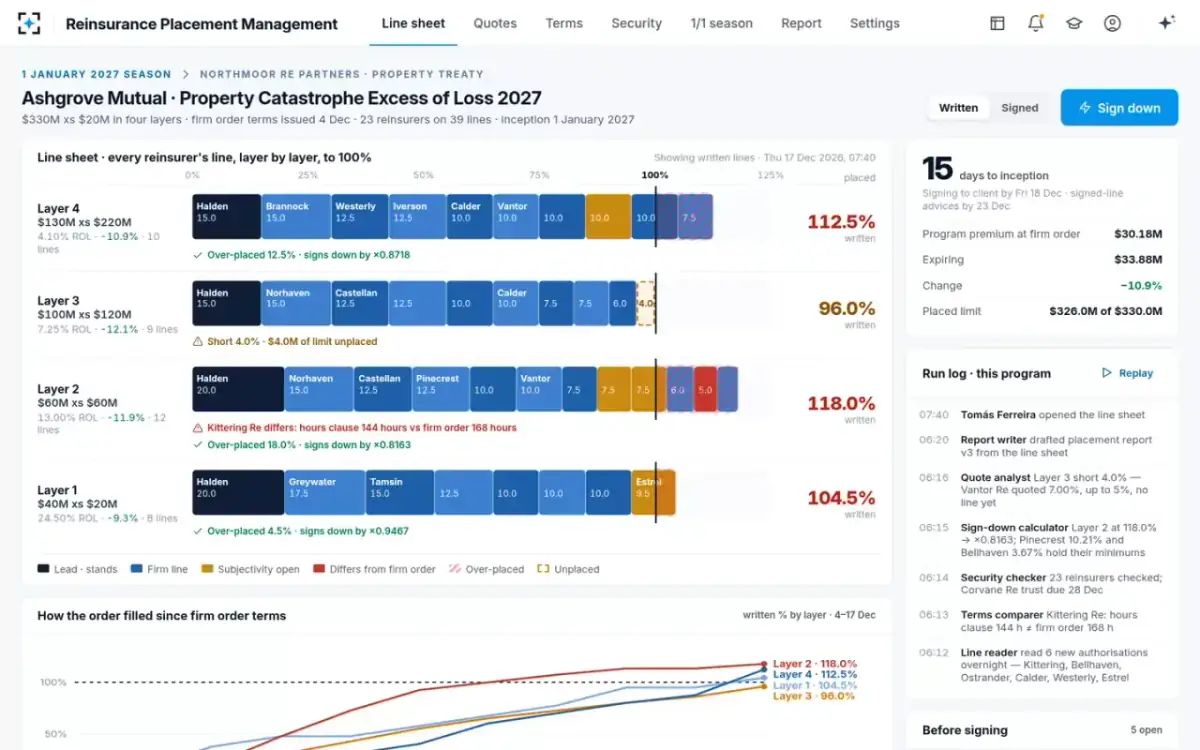
Two weeks before a 1 January inception, a placement broker on a program like the sample's is finishing the order, not starting it. In the sample program, firm order terms went out on 4 December. By Thursday 17 December, 15 days before inception, three of four layers were written over 100% and one was 4% short, six new authorisations had arrived overnight, and the client had asked for the signing by Friday so advices could go out by 23 December.
The last four weeks of one 1 January program, from firm order to inception
- Lines written against the firm order terms4–17 Dec
- Signing approved; advices out17–23 Dec
- Collateral, wording and close-outto 1 Jan
- Conditions recorded as lines arrive4–20 Dec
- Model, wording due21–22 Dec
- Trust fundedby 28 Dec
- Inception1 Jan
Each day of that fortnight has the same shape. In the morning, new authorisations from overnight have to be read, entered and compared with the firm order; in the sample, one reinsurer's authorisation for Layer 2 arrived at 01:36. Midday is the market: chasing the reinsurers whose subjectivities are open, asking the ones who quoted but never wrote for capacity on the short layer. The afternoon is the signing, rebuilt whenever a line moves, and the conversation with the client about what it shows.
The pressure is arithmetic, not volume. When a layer is over-placed, every line that does not stand is cut by the same factor, and one new or withdrawn line changes every other line's share. A signing built at 3 p.m. is wrong by 4 p.m. if a reinsurer increases its line, and a signing error that reaches a signed-line advice has to be corrected with every reinsurer on the layer. The difference between a written and a signed line, and how signing down works, has its own guide.
Reinsurance Placement Management: the fortnight on one screen, every layer against 100%
Who does a reinsurance broker work for?
A reinsurance broker works for the ceding insurer, and the duties in the model act run to that insurer. The act's money rules make the point: funds collected for the insurer are held as a fiduciary, and the insurer may inspect, copy and audit every account and record the broker keeps on its business (Model Act #790, Sections 4C and 5B). The insurer has duties too: it may not use an unlicensed broker, and it must "annually obtain a copy of statements of the financial condition of each RB with which it transacts business."
This matters in the last fortnight because the broker is also the reinsurers' main channel to the client. A reinsurer that writes a line "subject to" a shorter hours clause is asking for a change to the client's cover, and the broker's job is to put that to the client, not to fold it into the signing. In the sample program, Kittering Re wrote 5% on Layer 2 subject to 144 consecutive hours where the firm order says 168. The broker cannot accept that for the cedant; it can ask Kittering to confirm 168, or put the difference to the client with what it costs.
A reinsurance intermediary broker places cessions for a ceding insurer "without the authority or power to bind reinsurance on behalf of the ceding insurer."
Florida Statutes § 626.7492(2)(f), defining a reinsurance intermediary broker
The same logic covers concentration. A domestic cedant must tell its regulator within 30 days after ceding more than 20% of its prior-year gross written premium to a single reinsurer or affiliated group, and within 30 days after recoverables from one reinsurer group exceed 50% of its surplus (NAIC Credit for Reinsurance Model Law #785). The notice is the cedant's duty, but the broker is the one who sees the shares form line by line, and buying instructions can cap any one reinsurer's share well below those thresholds. The sample client's cap is 20% of a layer and 20% of the program limit, checked on signed lines.
Chasing authorisations is not the same as having them
A line is placed when the reinsurer has agreed in writing, not when the broker has a verbal indication. The model act's file requires, for a contract procured directly from a reinsurer, "written evidence that the assuming reinsurer has agreed to assume the risk", and where it is placed through the reinsurer's representative, written evidence that the reinsurer delegated binding authority to that representative (Model Act #790, Section 5A(11)).
That rule decides what the broker does with the overnight inbox. An email that says "we can support 5%" is a quote or an indication; an authorisation that names the layer, the share, the rate and the conditions is a written line. The broker's working list on any morning is therefore three lists: lines written on the firm order terms, lines written with conditions that still have to clear, and lines promised but not yet in writing. Only the first goes into a signing without a note against it.
In the sample, four conditions were open on 17 December, each with a date: one reinsurer's line subject to the wording being agreed by 22 December, one subject to final catastrophe model output by 21 December, and one unrated reinsurer's lines on two layers subject to a collateral trust funded at 100% of its share of limit by 28 December. A subjectivity left open at inception is a line that may not respond, which is why firm order terms and subjectivities get their own annotated guide.
After the order: post-placement duties a court took seriously
A broker's responsibilities do not end when the slip is signed, and a 2026 appeal shows how much a cedant can claim about what comes after. In Porch.com v. Gallagher Re, decided by the Fifth Circuit on 2 April 2026, the facts are the insurer's allegations, taken as true because the appeal concerned a motion to dismiss. As alleged, a brokered 2021 agreement said a bank "would provide a letter of credit", the bank later "stated it had never issued any such letter", and the Texas Department of Insurance placed the insurer under temporary supervision (Porch.com v. Gallagher Re, No. 25-10489).
The broker's agreement with the insurer defined administrative services as "all servicing duties customarily performed by a reinsurance intermediary-broker after the placement of the reinsurance contract", including "preparing and handling, through completion of the signing process, reinsurance contracts and any addenda thereto" and "administering all reserve funding." The district court had dismissed the claim, reasoning that the insurer complained only about the placement itself. The Fifth Circuit disagreed on that point and sent it back.
Porch plausibly alleged lapses by Gallagher that occurred after it had placed the reinsurance contract.
U.S. Court of Appeals for the Fifth Circuit, Porch.com v. Gallagher Re, 2 April 2026
The court did not decide that the broker failed; it decided that what servicing duties are "customarily performed" by an intermediary broker is a question of fact for trial. The same opinion affirmed the dismissal of a records claim: a duty to "retain" written evidence, the court held, cannot be read as a duty to procure documents the broker never had. For a placement team the practical reading is narrower and harder: whatever its agreement says it will service after placement (signing, collateral, reserve funding) is work a court may later measure against custom, and the file is how a broker shows what it did.
Where the hours go, and what Reinsurance Placement Management changes
Most of a broker's last fortnight is spent turning other people's documents into one consistent picture, and that is the part agents can take. Botminds estimates that one property catastrophe program's signing work in the final fortnight takes about 17 hours by hand: about 4 re-keying authorisations and line slips, 3 checking each condition against the firm order, 2 checking security, shares and collateral, 3 signing down and checking minimum lines, 4 writing the placement report and advices, and 1 of client review. With the solution doing the reading, comparing, checking and calculating, the same work is estimated at about 4.5 hours, most of it review. These are Botminds' estimates for the solution's design, not a measured result at any broker.
In Reinsurance Placement Management, six agents divide that work: a line reader that records each written line and condition with the passage it came from, a terms comparer that lays each authorisation against the firm order clause by clause, a quote analyst, a security checker that applies the client's buying instructions, a sign-down calculator and a report writer. The limits are written into each one: the terms comparer never clears a subjectivity or accepts a difference, the sign-down calculator only proposes, and no agent sends a signed-line advice. The design target is a checked signing proposal on the same day the order closes.
Every 1 January program the team is placing, layer by layer
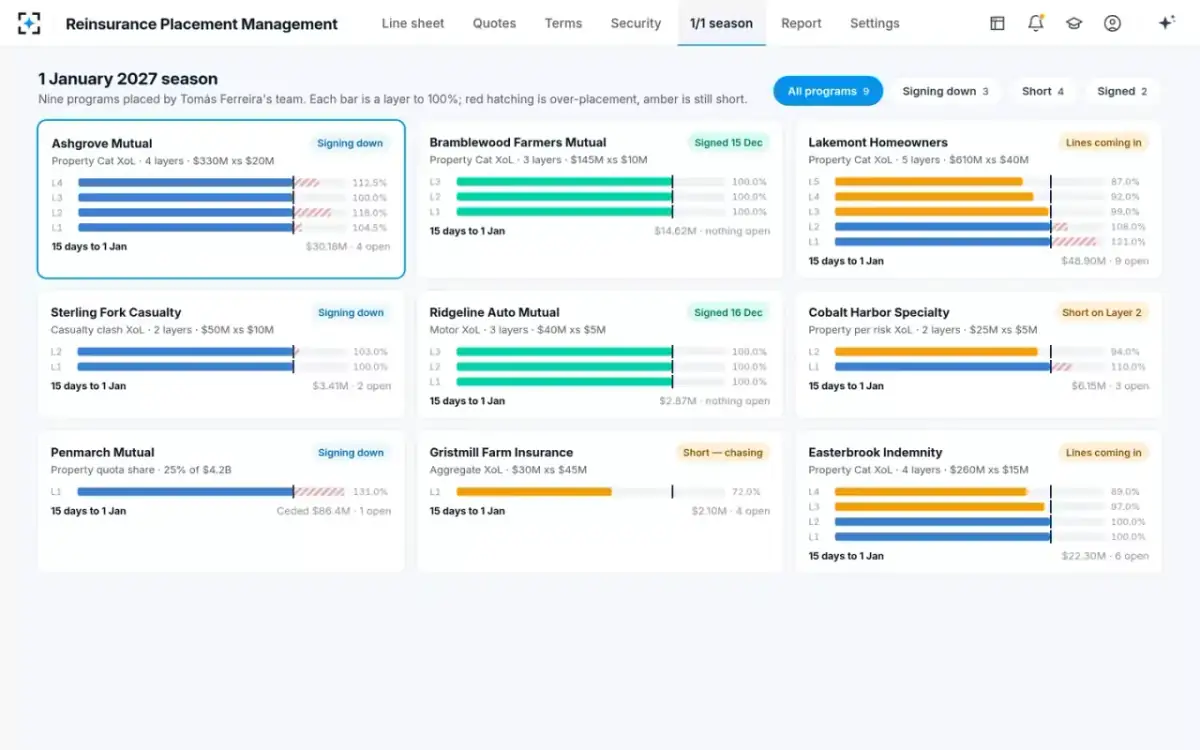
What does not move is the judgement. Which reinsurer to ask for the short 4% on Layer 3, whether to recommend that the client accept a 144-hour clause or wait for the reinsurer to confirm 168, and how to explain to the client that a line will be signed only "subject to" a confirmation: those are broker responsibilities, and the solution hands the broker the evidence for each without making the call. Which placement tasks move to agents, and which stay with the broker, is the subject of its own guide.
How long before inception is a treaty placed?
There is no fixed rule, but the accounting rules set an outer limit and the market sets a working one. Statutory accounting presumes that a reinsurance contract not finalized, written and signed within nine months of the start of the period it covers is retroactive, unless, on a contract with several reinsurers, the lead reinsurer that set the terms has signed within those nine months (NAIC Issue Paper No. 75, the rule carried into SSAP No. 62R; the 9 month rule in plain words). That deadline is for the paper; the cover itself has to be agreed before inception.
Working back from 1 January, a program like the sample's has its firm order terms in the first week of December, its lines written over the following two weeks, its signing approved a fortnight out and its advices issued in the week before Christmas. The broker who is still collecting lines in the last week is usually filling a short layer, and the buying instructions decide who can fill it: in the sample, only reinsurers rated A− or better, or an unrated one with a collateral trust funded before inception.
The cedant's own calendar is set earlier still, by its regulator's data calls and any state fund, and the submission work that feeds the broker's market is a separate job. For the cedant's side of the season, see the cedant's renewal dates and what each late week costs; for the broker's, start from Reinsurance Placement Management.
Questions people ask
What is the difference between a reinsurance broker and a reinsurance intermediary manager?
A broker places reinsurance on behalf of a ceding insurer and cannot bind it. A reinsurance intermediary-manager acts for the reinsurer: under the NAIC model act it binds or manages some or all of a reinsurer's assumed business, and its contract must be approved by the reinsurer's board and filed with the commissioner at least 30 days before business flows through it.
Does a reinsurance broker need a license?
Yes, in states that adopted the model act or a similar law. A broker with an office in the state must be a licensed producer or reinsurance intermediary there, and a broker with an office elsewhere must be licensed in the state or in another state with a substantially similar law. The insurer is barred from using a broker that is not licensed as required.
How fast must a reinsurance broker pass money to the insurer?
Within 30 days of receipt, under the model act and Florida's enacted version. Until then the money is held in a fiduciary capacity in a bank that is a qualified U.S. financial institution, and the broker's accounts must detail every material transaction, including the information that supports its own commissions and fees.
What can a regulator do if a reinsurance broker breaks the act?
The model act lets the commissioner order a penalty of up to $5,000 for each separate violation, revoke or suspend the broker's license, and, where the insurer suffered loss, bring a civil action for damages on its behalf. Florida's statute adds restitution to the insurer or its receiver for net losses attributable to the violation.
Can a reinsurance broker accept a reinsurer's changed terms for the client?
No. A broker without binding authority for the cedant can only put the change to the client. A line written on terms that differ from the firm order, such as a shorter hours clause, is either confirmed back to the firm order by the reinsurer, accepted by the client, or left out of the signing.