Reinsurance renewal dates are the inception dates programs renew on, 1 January above all, with mid-year dates such as 1 June for many Florida property programs, and each renewal's timeline runs backwards from that date: firm order terms a few weeks before, quotes and negotiation before that, a roadshow, and before everything the cedant's submission, which takes weeks to build from systems that do not agree. On the 1 January program used in this guide, the submission is due to the broker 63 days before inception and the market's whole look at the program fits into the 35 days between submission and firm order terms. Every week the submission is late comes out of those 35 days, not out of the cedant's. The cost is hard to measure directly, but the stake is not: Florida's insurance regulator has measured risk-adjusted reinsurance price changes ranging from a 27.03% rise to cuts of 15–25% in the space of four seasons.
This guide sizes that stake and the weeks behind it. It uses a fictional sample cedant, Harborline Mutual, whose 2027 property catastrophe program carries an expiring premium of $43.2M, as it runs through Reinsurance Submission Preparation, Botminds' software that builds the renewal submission with six agents and keeps the model, the trend factors and the release with named people. The company and its figures are invented; the price data is the regulator's.
Risk-adjusted reinsurance cost change for Florida insurers, as measured by the regulator
How long before inception should a reinsurance submission go out?
No rule sets it; the broker's calendar and the market's capacity to read submissions do. On the sample, the broker asked for the submission on 30 October for a 1 January inception: 63 days ahead, ten days before a roadshow in the week of 9 November and 35 days before firm order terms on 4 December. Those intervals are the broker's choice for this program, not a market standard, and a cedant should ask its own broker for the dates and the reasons behind them.
The one renewal timeline written into public law points the same way. Florida requires its hurricane fund to publish capacity and aggregate retention by 1 January, adopt its reimbursement contract by 1 February and have insurers execute it by 1 March, three months before the contract year starts on 1 June (s. 215.555(16)). The legislature chose those dates so that private reinsurance could be negotiated with the public layer already known.
What happens if a reinsurance submission is late?
The market's time shrinks while the cedant's does not. A submission that reaches the broker a week late on the sample calendar leaves three days instead of ten before the roadshow, so reinsurers arrive at the meetings having modelled less and with more questions open. Questions that cannot be answered in the room go into email, and answers sent after the roadshow arrive while quotes are being formed. The program can still be placed; what changes is how much of the price reflects the cedant's data and how much reflects the reinsurer's uncertainty about it.
The Florida legislature wrote the same reasoning into its findings on the state fund, describing what happens when buyers are short of time:
"…the last-minute rush by insurers only weeks before the start of the hurricane season to procure adequate coverage in order to meet their capital requirements can result in higher costs that are passed on to Florida consumers. However, if more time is available, residential property insurers should experience greater competition for their business with a corresponding beneficial effect for Florida consumers."
Florida Statutes s. 215.555(16)(a)1.d
That finding concerns capital-short years and the timing of the public layer, not one insurer's submission. But the mechanism it names, more time producing more competition for the business, is the one a late submission works against.
How much did reinsurance prices change in 2026?
In Florida residential property, the Office of Insurance Regulation's preliminary 2026 data shows nearly half of the insurers in its data call with risk-adjusted price reductions of between 15% and 25%, and at least a 10% average decrease across most layers from 2025 (OIR, July 2026). The earlier seasons, from the office's January report, were a 27.03% average increase from 2022 to 2023, a 1.70% decrease in 2024 and a 0.46% decrease in 2025 (OIR, January 2026). It is the only reinsurance price series we found published by a government body, and it covers Florida programs only.
Two features of the series matter for timelines. The moves are large: from a 27.03% average rise in 2023 to cuts of 15% to 25% for nearly half of insurers three seasons later. And they are averages over many insurers, so an individual cedant's outcome can sit far from them in either direction. Where a cedant lands inside the range is partly its exposure and partly how well the market understands it, which is what the submission is for.
What is a risk-adjusted reinsurance price change?
It is the change in what a cedant pays for reinsurance after allowing for changes in what it bought and in the risk underneath. A raw premium comparison mixes three things: price, the exposure ceded and the structure. If insured values grew 9.5%, as on the sample, a flat rate on line would still mean more premium; if the retention rose, less. Risk-adjusting tries to isolate the price. The regulator's stability reports publish the results of its data call but not its method, so a cedant comparing itself with the Florida averages should state its own adjustment explicitly: what it held constant and how it measured exposure change.
Rate on line is the simplest per-layer measure. On the sample's expiring program, the first layer of $50M excess of $50M carried a 22.0% rate on line ($11M), the second $100M excess of $100M 12.0% ($12M), the third $200M excess of $200M 6.5% ($13M) and the top $200M excess of $400M 3.6% ($7.2M), together the $43.2M expiring premium.
Sizing the stake: one point of price on a $43.2M program
No public data measures what a week of lateness costs in price, and we do not claim a figure for it. What can be measured is the size of what is being negotiated in the weeks a late submission gives away. Applying the regulator's measured moves to the sample's expiring premium is our arithmetic, for illustration; Harborline is a fictional north-eastern writer, not a Florida insurer.
What the measured price moves would mean on the sample's $43.2M expiring premium
$432K
one point of risk-adjusted price
1% of $43.2M
$11.7M
a move the size of Florida’s 2023 average
27.03% of $43.2M
$6.5–10.8M
the 2026 preliminary range for nearly half of Florida insurers
15% to 25% of $43.2M
35days
from submission to firm order terms on the sample calendar
30 Oct to 4 Dec
Set against those amounts, the cost of building the submission faster is small. A ceded team that wins back one point of price on the sample program pays for a good deal of analyst time. The more important comparison, though, is within the 35 days: each day the market spends modelling the cedant's actual data is a day it is not pricing the cedant's uncertainty.
Where the weeks go when a submission is built by hand
Most of the time goes into reconciling, not writing. Our estimate for one property catastrophe submission built by hand is about 24 working days, nearly a third of it pulling and reconciling exposure across systems. The solution's design target for the same work is six days from first source file to a submission ready for the market. Both rows below are our estimate and a target, not measured customer results.
Working days to build one property catastrophe submission, by hand and with agents
- Exposure7
- Losses5
- Model4
- Changes3
- Questions3
- Review2
- Exposure1
- Losses1
- Model1.5
- Changes1
- Questions
- Review1
The estimate's shape matters more than its total. The first three rows are where late discoveries come from: a model input that predates the extract, a loss that has developed, a premium figure that differs between two documents. Finding those on day one leaves time to fix them; finding them in the last week before the deadline means sending the submission with a known gap or sending it late. A ceded team can see its own version of this split by timing one renewal against these six headings.
When do reinsurers quote for 1/1?
After they have modelled the submission and heard the roadshow, and the broker sets the window. On the sample calendar, quotes are formed between the roadshow week of 9 November and firm order terms on 4 December, 25 days. No public source tracks market-wide quoting dates. What a cedant controls is how complete the submission is when that window opens, and whether last year's questions are already answered in it.
Price history adds a reason to be ready. Research by Kenneth Froot for the National Bureau of Economic Research found that catastrophe reinsurance "premiums are high relative to expected losses, especially after cat events", and the NAIC's primer records that after Hurricane Andrew "the prices charged by reinsurers also increased" (NAIC). In a season after a major event, market capacity is tighter and time is worth more.
When must Florida insurers sign the FHCF contract?
By 1 March, for a contract year that begins on 1 June. The statute requires the State Board of Administration to adopt the reimbursement contract by 1 February and insurers writing covered policies to execute it by 1 March of the immediately preceding contract year (s. 215.555(16)(b)–(c)). For a Florida residential writer that puts a hard date in the middle of the private renewal timeline, and the exposure the fund bills against comes later, from the insured values reported by 1 September; that filing is covered in the FHCF data call.
A timeline built from the data date, not the deadline
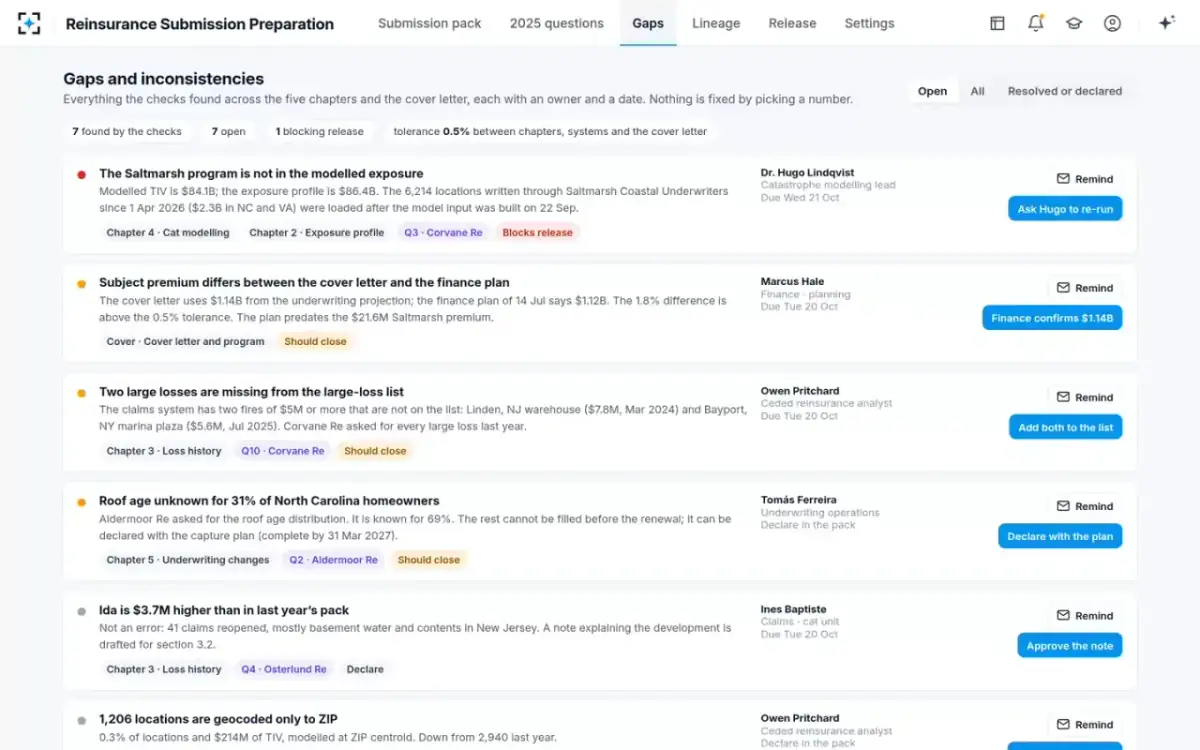
The usual timeline is set from the broker's deadline backwards. A sturdier one is set from the data forwards: the date the in-force extract is cut, the date the model input is built from it, and the dates by which each owner signs. On the sample, the gap that blocked release came from exactly that ordering: the model input was built on 22 September and the extract on 13 October, so 6,214 locations of a new coastal program were in one and not the other.
Seven gaps found on assembly day, one blocking release, each with an owner and a due date
Six dates to fix before the broker's deadline
- The in-force cut-off date
One date for the exposure chapter, the model input and any regulator filing that quotes the same book.
- The model input build date
On or after the extract, or a reconciliation of the difference before the run is used.
- Trend factors approved
Before losses are trended, by the pricing actuary; on the sample, 2 October.
- Finance plan confirmed
The subject premium in the cover letter must match the plan, or the plan must be updated first.
- Cat modelling chapter signed
With time for one re-run between assembly and the deadline.
- Release, with open answers declared
A question that cannot be closed goes out with its owner and plan, not silently.
Reinsurance Submission Preparation runs the checks that turn those dates into a working timeline: the exposure is tied to the model input, every figure to its source, last year's questions to the sections that answer them. It does not move the broker's deadline or decide the price. How the season looks from each seat is described in the cedant's renewal season, week by week, and how to judge a tool that claims to save these weeks in twelve questions before you buy.
Questions people ask
What is rate on line in reinsurance?
It is the layer's premium divided by its limit. On the sample's expiring program, the $50M excess of $50M layer cost $11M, a 22.0% rate on line, and the top $200M excess of $400M layer cost $7.2M, 3.6%.
Do reinsurance prices rise after a catastrophe?
Historically they have. Froot's NBER study found catastrophe reinsurance premiums high relative to expected losses, especially after events, and the NAIC primer records that reinsurers' prices rose after Hurricane Andrew in 1992. Florida's measured 27.03% average increase in 2023 followed Hurricane Ian in 2022.
How long does a reinsurer take to quote?
No public body measures it. On the sample calendar, reinsurers have 25 days between the roadshow and firm order terms; a submission that arrives with last year's questions answered gives them more of that time for pricing than for correspondence.
Why do Florida programs renew on 1 June?
Because the Florida Hurricane Catastrophe Fund's contract year runs from 1 June to 31 May under s. 215.555, and the Atlantic hurricane season begins on 1 June. Private layers are bought around the fund's coverage, so they share its year.
Can a submission be sent before every figure is final?
It can, if the open items are declared rather than hidden. On the sample, one of last year's 18 questions, roof age for 31% of North Carolina homeowners, went to the market declared with an owner and a plan completing on 31 March 2027.