Reinsurance renewal season is the run of weeks before a program's inception date in which the cedant builds its submission, the broker takes it to market, reinsurers ask questions and quote, and the buyer signs firm order terms. For a 1 January program that means October to December; for a Florida homeowner writer it means January to May, because the state's hurricane fund starts its contract year on 1 June and the Atlantic hurricane season begins the same day. The hard part sits at the front. The submission draws on policy, claims, catastrophe modelling and finance systems that rarely agree, and every week spent reconciling them is a week the market does not have.
Reinsurance Submission Preparation is Botminds' software for that front end: six agents build the submission's chapters from the cedant's own systems, tie every figure to its source and answer last year's reinsurer questions, while the catastrophe modelling lead and the head of ceded reinsurance sign. To make the calendar concrete, this guide follows a fictional sample cedant, Harborline Mutual, renewing a 2027 property catastrophe program; the company, its broker, its reinsurers and its people are invented.
Two renewal seasons, counted in days: a 1 January program and a Florida 1 June program
- Extract13 d
- Build17 d
- Roadshow10 d
- Quotes25 d
- Terms to inception28 d
- Contract adopted31 d
- Contract signed28 d
- Private program placed92 d
When is reinsurance renewal season?
It is the quarter before your own inception date, and the part a ceded team controls comes first. Renewals cluster on a few dates by market custom, but no regulator publishes the list, and the date that governs a given cedant's season is simply the day its treaties incept. One date comes with deadlines written into law. A Florida residential writer's program is built around the Florida Hurricane Catastrophe Fund, whose statute defines its contract year as "the period beginning on June 1" of one year and ending on 31 May of the next. Other programs, like the 1 January sample here, run on a calendar the broker sets: submission, roadshow, quotes, firm order terms.
The season is therefore not one window but several overlapping ones. A cedant with a 1 January property catastrophe program and a 1 June Florida book runs two seasons a year, with the data work for the second beginning before the first has closed. A team that treats renewal as an autumn event finds itself rebuilding exposure in March for a fund contract it had to execute on 1 March.
The 1 January season, counted back from inception
Counting backwards is the only way the calendar works, because every step depends on the one before. In the sample, Harborline's program of $550M excess of $50M in four layers incepts on 1 January 2027. The broker wants the submission by Friday 30 October so it can go to seven reinsurers ahead of a roadshow in the week of 9 November. Firm order terms are due by 4 December. Working back from 30 October, the in-force policy extract has to exist by mid-October, and it has to describe the book as at a cut-off date, here 30 September.
The renewal's own calendar, set once and checked against every chapter
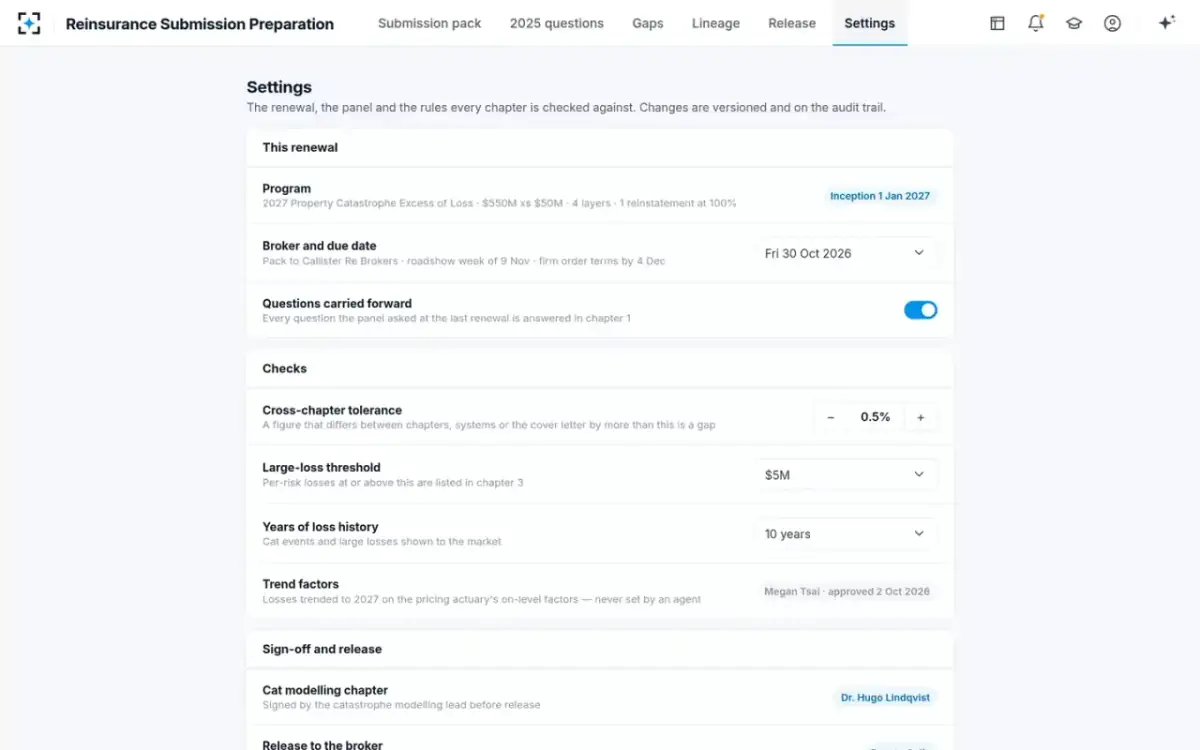
That leaves 17 days between a usable extract and a submission the head of ceded reinsurance will sign. In those days the exposure profile has to be built and compared with last year's, ten years of catastrophe events and large losses trended to 2027, the cat model output tied to the same exposure, the underwriting changes written with their rate filings, and last year's questions answered. On the sample, the model input had been built on 22 September, three weeks before the extract, and it left out 6,214 locations written through a new coastal program. Found on day one of the build, that is a re-run for the catastrophe modelling lead. Found at roadshow week, it is a question a reinsurer asks in the room.
The 1 June season in Florida runs on two outside calendars
A Florida residential writer does not set its own season; the legislature and the regulator set it. The state fund must publish its maximum capacity and the aggregate retention used to calculate each insurer's retention no later than 1 January, adopt the reimbursement contract by 1 February, and have insurers execute it by 1 March. Those dates exist so that the private placement can be priced around a known public layer, and the statute says so in terms:
"It is the intent of the Legislature to provide insurers with the terms and conditions of the reimbursement contract well in advance of the insurers’ need to finalize their procurement of private reinsurance or other sources of capital, and thereby improve insurers’ negotiating position with reinsurers and other sources of capital."
Florida Statutes s. 215.555(16)(a)2, Florida Hurricane Catastrophe Fund
The second calendar is the Office of Insurance Regulation's. Its Annual Reinsurance Data Call collects, first, an estimate of what each insurer plans to buy, then what it actually bought, then the reinsurers and contracts, and finally how storms hit those contracts. The schedule is announced each year rather than fixed in rule; the office lists the call as "Due annually according to announced schedule". The 1 July 2026 report recorded that 69 percent of insurers had filed by 15 June. Because the plan and the purchase are filed separately, any gap between them is visible to the regulator, and the reasons for it sit in the submission and the placement. The four stages are set out in Florida's annual reinsurance data call, stage by stage.
The fund adds a third, quieter deadline after inception. Each insurer reports its insured values by ZIP code as at 30 June by 1 September, and that file sets its premium, retention and maximum recovery. The same book appears in the private submission, so the two exposure figures meet in the autumn, as the guide to the FHCF data call explains.
What happens at 1/1 reinsurance renewals?
The submission goes to the broker, the broker takes it to the panel and to new markets, reinsurers model the exposure and ask questions, quotes come back, the lead terms are agreed and the panel signs its lines against firm order terms. On the sample calendar the broker has ten days between receiving the submission and the roadshow, then 25 days of quoting and negotiation. Every unanswered question from the year before tends to reappear in that window. Harborline's panel asked 18 questions during the 2026 renewal's roadshow week, logged by the broker on 2 December 2025, and each one is a test of whether this year's submission has learned anything.
After firm order terms, the season is not over. Lines have to be signed, the wording finalised and the program's structure carried into the accounting systems; the contract-wording side has its own discipline, set out in the slip against the wording, and signing the lines has its own, in written and signed lines. This guide stays with the part that decides how the market sees the cedant: the submission and the questions it does or does not answer.
Who prepares the reinsurance submission?
The ceded reinsurance team prepares it, but at least five other people own numbers inside it. The head of ceded reinsurance signs and releases it. A ceded analyst assembles it. The catastrophe modelling lead owns the model run and the view of risk. The pricing actuary owns the trend factors that bring old losses to the renewal year. Finance owns the plan that the subject premium must agree with. And the broker's account executive carries it to the panel. No government statistic counts ceded reinsurance staff; the nearest official figure is for actuaries as a whole, who held about 31,200 jobs in 2025, according to the Bureau of Labor Statistics.
Six people carry one renewal submission, and four of them own a number in it
Today
Learns at roadshow week which figures do not tie, and hears last year’s questions asked again.
With agents
Sees every chapter’s state, every gap with an owner, and last year’s questions answered before signing.
Still theirs: Signs and releases the submission
Today
Spends most of October reconciling insured value between three systems in spreadsheets.
With agents
Starts from a built submission and a list of gaps, each with an owner and a due date.
Still theirs: Closes the gaps
Today
Discovers late that the exposure in the model is not the exposure in the submission.
With agents
Is told on the day the submission is assembled that the model input is short, re-runs and signs.
Still theirs: Runs the model, signs the cat chapter
Today
Is asked for the development behind a number after the market has seen the number.
With agents
Sees every event trended on the factors she approved, with development since last year explained.
Still theirs: Sets the trend factors
Today
Finds the cover letter quoting a premium the plan does not show.
With agents
Gets a gap with the two figures side by side and confirms one.
Still theirs: Owns the plan
Today
Chases answers by email while the panel waits.
With agents
Receives a released version with last year’s questions answered and flagged where the answer sits.
Still theirs: Takes it to the panel
Who is busy in which week before a 1 January inception
The load moves from data to judgement to negotiation, and it moves between people. The table below lays the sample calendar against the roles that carry each stretch and the failure each stretch tends to produce. The pattern it shows is that the expensive surprises are created early, in the extract and the model input, and discovered late, at roadshow week.
Weeks before inception: who carries the work, and what goes wrong there
| Weeks out (sample) | Milestone | Who is busy | What tends to go wrong |
|---|---|---|---|
| 13 (30 Sep) | Policy data cut-off | Ceded analyst, policy systems | A cut-off date the model input does not share |
| 11 (13 Oct) | In-force extract taken; build starts | Analyst, cat modelling lead, pricing actuary | A program written mid-year missing from the model input |
| 9 (30 Oct) | Submission to the broker | Head of ceded reinsurance, finance | Subject premium differing between cover letter and plan |
| 7.5 (9 Nov) | Roadshow week | Head of ceded, cat modelling lead, broker | Last year’s questions asked again |
| 4 (4 Dec) | Firm order terms | Head of ceded, finance, broker | Price set with an uncertainty load nobody can trace |
| 0 (1 Jan) | Inception | Ceded accounting | Structure carried into systems from an unsigned draft |
Are reinsurance prices falling in 2026?
In Florida property, the regulator's own preliminary data says yes, and by a wide margin. The Office of Insurance Regulation reported in July 2026 that nearly half of the insurers in its data call were seeing risk-adjusted reinsurance price reductions of between 15% and 25%, and at least a 10% average decrease across most layers from 2025 (OIR, 1 July 2026). In London, the Prudential Regulation Authority told insurers' chief executives in January that it observes "a continuing softening underwriting cycle" in many general insurance lines, pointing to "the recent reinsurance renewal seasons".
A softening market changes what the season is for. When capacity is scarce, the submission's job is to get a program placed at all. When it is plentiful, reinsurers compete on price and terms, and a submission that leaves questions open hands them a reason to hold back. Florida's measured price swings, from a 27.03% increase in 2023 to the 2026 reductions, are charted in what each late week costs a cedant.
How long does a reinsurance renewal take?
From data cut-off to inception, the sample season runs 93 days; the part that a ceded team controls is the 17 days between extract and submission. Our estimate for one property catastrophe submission built by hand is about 24 working days of analyst and specialist time, split across exposure reconciliation (7), loss history and trending (5), tying the cat model to the exposure (4), underwriting changes and the cover letter (3), last year's questions (3) and review (2). The solution's design target is six days from first source file to a submission ready for the market. Both are estimates and a target, not measurements from a customer.
The point of compressing the build is not to send the submission earlier for its own sake. It is to put the slack where it is useful: before the broker's deadline, so that a re-run, a missing loss or a disputed premium can be resolved by the person who owns it, instead of being explained to a reinsurer.
Where Reinsurance Submission Preparation changes the season
It changes the 17 days. On the sample, the submission opens with every chapter waiting and the broker's deadline counting down; one instruction starts six agents. The exposure profile builder reads the in-force extract, the loss history builder reads the claims listings and trends them on the actuary's approved factors, the cat model reconciler compares the model input with the exposure, the underwriting change writer cites each rate filing, the question answerer works through last year's log, and the consistency and lineage checker ties every figure across chapters at a 0.5% tolerance.
Before assembly: sources in, chapters waiting, 11 days to the broker
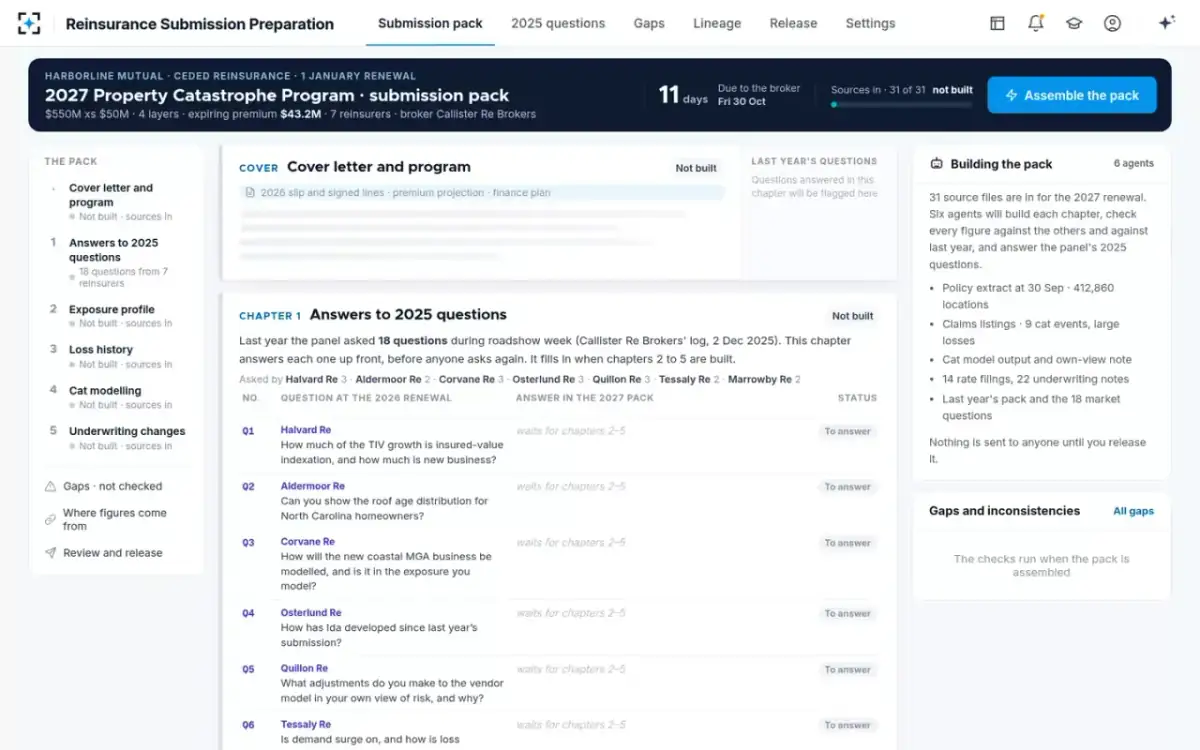
What it does not change is who decides. No agent runs the catastrophe model, sets a trend factor or changes a reserve; a difference above tolerance becomes a gap with a named owner and a date, never a number picked by software. The season's judgement calls stay with the people in the table above. The steps themselves are traced one by one in a reinsurance submission, built step by step.
Questions people ask
What are the main reinsurance renewal dates?
Each program renews on its own inception date, and no regulator publishes a market list. The one fixed in U.S. law is 1 June, when the Florida Hurricane Catastrophe Fund's contract year begins under s. 215.555. Other dates are set by contract and by the broker's calendar; the sample in this guide incepts on 1 January.
When do June 1 reinsurance renewals start?
For Florida residential writers, the season starts on 1 January, when the state fund must have published its capacity and aggregate retention. The fund adopts its contract by 1 February and insurers execute it by 1 March, so the private layers above and around it are negotiated in March, April and May.
What is the reinsurance renewal cycle?
It is the annual loop of submission, roadshow, quotes, firm order terms, signed lines and inception, followed by a year of claims and questions that feed the next submission. On the sample, the panel's 18 questions from the 2026 renewal became chapter 1 of the 2027 submission.
What is a reinsurance roadshow?
It is the meeting week in which the cedant and its broker present the program to reinsurers and answer their questions before quotes. On the sample calendar it falls in the week of 9 November, ten days after the submission reaches the broker.
What are firm order terms in reinsurance?
They are the price and conditions the cedant accepts, against which reinsurers then commit their shares. On the sample they are due by 4 December, four weeks before a 1 January inception, which leaves the remaining weeks for signed lines and the wording.
Does Florida check what an insurer plans to buy before the season?
Yes. The Office of Insurance Regulation's Annual Reinsurance Data Call collects an estimate of what each insurer plans to purchase, then the actual purchase, then the reinsurers and contracts. By 15 June 2026, 69 percent of insurers had filed it, according to the office's July report.