The FHCF data call is the annual exposure filing every insurer writing residential property in Florida makes to the Florida Hurricane Catastrophe Fund: insured values under covered policies as at 30 June, reported by ZIP code with construction, deductible, year built, roof and opening-protection codes, submitted through the fund's WIRE system and signed by two officers by 4:00 p.m. Eastern on 1 September. It sets the insurer's reimbursement premium, its retention and its maximum recovery from the fund. It is also examined: the statute lets the fund inspect insurers' records to validate the exposure reported and charge a reasonable fee for reprocessing inaccurate, incomplete or untimely data. The same book appears, at another date and in another shape, in the cedant's private reinsurance submission, and the two descriptions have to be reconcilable.
This guide reads the 2026 Data Call instructions and the statute behind them, and sets out where the state filing and the private submission part ways. It refers to Reinsurance Submission Preparation, Botminds' software in which six agents build a cedant's reinsurance renewal submission from its own systems and tie every figure to its source. Where it uses that solution's sample, Harborline Mutual, note that the company is fictional and a north-eastern writer, not a Florida insurer: the sample illustrates the checks, not an FHCF filing.
The data call's fields, and where the private submission describes the same thing differently
| Data call field | What the fund asks for | The private submission’s version | Where they part ways |
|---|---|---|---|
| Type of business | Commercial (habitational), residential, mobile home, tenants, condominium unit owners | Lines and programs in the exposure chapter | Commercial covers habitational structures only |
| Line of business | Fire and allied, homeowners, farmowners, commercial multiple peril, mobile homeowners, inland marine | Annual Statement lines in the subject premium | The cedant chooses the most appropriate code |
| Construction type | FHCF codes; a mapping worksheet approved by the administrator if yours differ | Model construction codes in the model input | Two mappings of one field, each needing its own check |
| Deductible group | FHCF deductible codes | Policy deductibles applied in the model’s financial module | Grouped codes against policy-level terms |
| County and ZIP code | At least 95% of exposure with a valid ZIP code | Geocoded coordinates, by match resolution | Aggregated by ZIP against located by address |
| Insured risks and values | Risks; building, appurtenant structures, contents and additional living expense values | Insured value by coverage and location | Covered residential policies only; whole dollars |
| Year built, roof year | Four-digit years; 0 if unknown | Building age and roof age in the model input | Unknown entered as 0, not estimated |
| Roof covering, opening protection, roof shape | FHCF codes | Mitigation features in the model’s vulnerability inputs | Coded twice, to two schemes |
| Policy dates and numbers | Effective and expiration dates; policy and assumed policy numbers | In-force status at the submission’s cut-off | In force at 30 June against the private cut-off date |
What is the FHCF data call?
It is the fund's rule-based exposure report, adopted each year as Form FHCF-D1A under Rule 19-8.029 of the Florida Administrative Code. The statute requires it in one sentence: "No later than September 1 of each year, each insurer shall notify the board of its insured values under covered policies by zip code, as of June 30 of that year." The fund's premium formula specifies, for each ZIP code, the premium per $1,000 of insured value by type of business, construction, deductible group, year built, opening protection and roof shape, so the file is the premium calculation's whole input.
The 2026 instructions spell out what the file drives: the fund uses it "to calculate a Company’s Premium, Retention, and maximum FHCF coverage under the applicable Reimbursement Contract." Premium is billed provisionally before the file arrives and adjusted afterwards, so an error in the file is an error in what the insurer pays and what it can recover after a hurricane.
The FHCF layer in the 2025–26 contract year
$3.6T
insured value reported to the fund
as of 31 December 2025
138
participating insurers
$1.286B
reimbursement premium
88
exposure examinations conducted in 2025
When is the FHCF data call due?
By 4:00 p.m. Eastern Time on 1 September, for exposure as at 30 June, with no extensions. The 2026 instructions say a submission must be signed off electronically by two officers by that time "or the submission will be considered late", and, under the heading on extensions, "Extensions will not be granted." Two earlier dates matter as much. Files can be uploaded to WIRE for validation from 1 July, and any construction mapping or other reporting methodology that needs approval must reach the fund's administrator by 1 August.
The 2026 data call calendar: one as-at date, three deadlines
- Book as at 30 Jun; validation opens 1 Jul
- Mapping proposals due 1 Aug31 d
- Two officers sign by 1 Sep, 4 p.m.31 d
The as-at date creates its own discipline. The instructions accept that a company must choose the date on which it captures its data, so that policies effective on or before 30 June are included while the 1 September deadline is still met. A policy effective on 1 July is not reported, though its losses are reportable later. And if a resubmission is needed, transactions processed after the original capture date should not be added without the fund's approval. The file is a snapshot of a stated moment, and the insurer must be able to reproduce it.
What exposure data does the FHCF collect?
A pipe-delimited file with twenty fields per line, shown in the table above: type and line of business, construction, deductible group, county and ZIP code, insured risks, four insured-value fields (building, appurtenant structures, contents and additional living expense), year built, roof year, roof covering, opening protection, roof shape, policy dates and policy numbers. At least 95% of exposure must carry a valid ZIP code. Unknown year built and roof year are entered as 0. Exposure may be rounded, but to no more than the nearest $1,000.
Several clarifications matter for anyone reconciling the file with other descriptions of the book. Only habitational commercial structures are covered. A multi-location policy whose blanket limit is below the insurable value is excluded, and for blanket policies the company "must maintain a copy of the Statement of Values to support the policy exposure reported". If the company's construction definitions do not closely match the fund's, it must complete the construction mapping worksheet and have it approved before submitting.
Can the FHCF charge for bad exposure data?
Yes, by statute and by the data call's own fee schedule. The statute gives the board the power directly:
"In order to assure the equitable operation of the fund, the board may impose a reasonable fee on an insurer to recover costs involved in reprocessing inaccurate, incomplete, or untimely exposure data submitted by the insurer."
Florida Statutes s. 215.555(7)(e)
The 2026 instructions turn that into fixed amounts. A company whose file does not comply may be required to resubmit within 30 calendar days. Each resubmission that is not the result of an examination carries a $1,000 fee; one required by an examination report carries $2,000, and so does every further resubmission if the first is inadequate. The automated checks in WIRE catch format errors, invalid codes and ZIP-to-county mismatches, but the instructions warn that the system "cannot identify errors caused by data which was coded incorrectly according to the policy details". Those are found in examination.
Resubmission fees, and the year-on-year change that requires an explanation
| Item | Threshold or amount | What triggers it |
|---|---|---|
| Resubmission, not from an examination | $1,000 each | A file not in compliance with the specifications |
| Resubmission required by an examination report | $2,000 each | Errors found by the State Board of Administration’s examiners |
| Further resubmission after an inadequate one | $2,000 each | An examination-required resubmission that is itself inadequate |
| Residential exposure change | ±$50M and ±40%, or ±$1B | Explanation required in WIRE before submission |
| Commercial exposure change | ±$25M and ±40%, or ±$200M | Explanation required in WIRE before submission |
| Mobile home, condominium unit owners | ±$25M and ±40%, or ±$40M | Explanation required in WIRE before submission |
| Tenants | ±$20M | Explanation required in WIRE before submission |
Does the FHCF examine insurers?
Yes, routinely. The statute requires the board to "inspect, examine, and verify the records of each insurer’s covered policies" for the specific purpose of validating the exposures and losses reported, and lets it recover the extra cost when an insurer is unprepared or fails to provide requested information. The fund's 2025 annual report records 88 exposure examinations in that year, carried out by contracted examiners to evaluate the accuracy and completeness of data call files (SBA, 2025).
Examination reaches back to the source. The instructions require insurers to keep the exposure filing, policy files, supporting documentation and the computer runs that produced the submission until the fund has completed its exposure and claims examinations for the contract year, and to keep the file so that errors found can be corrected and resubmitted. An insurer that cannot rerun its own data call from its own records has a problem before any examiner arrives.
What two officers certify when they sign
A data call is complete only when two officers sign it in WIRE, and the statements are specific. The first reads: "I, the undersigned, do state that, to the best of my knowledge, the file submission provided to the SBA under Section 215.555(5)(c), Florida Statutes, is complete, accurate, and in compliance with the requirements of Section 215.555, Florida Statutes, and all Florida Administrative Code rules." A later statement confirms that the officer has conducted, or had conducted, a diligent review of the company's records and systems. Officers who sign that in late August will want the private reinsurance submission, which their reinsurers modelled months earlier, to describe the same book in a way they can reconcile.
One book, two exposure files: where the data call and the submission part ways
They differ for legitimate reasons, which is why the differences have to be explained rather than eliminated. The data call reports covered residential exposure at 30 June, aggregated by ZIP code and rating codes, for the fund's premium. The private submission reports the whole catastrophe-exposed book, often including commercial and non-habitational risks, at its own cut-off, by location, for the reinsurers' models. A Florida writer renewing its private program on 1 June builds its submission from an extract taken before the data call's 30 June date.
A reconciliation between them therefore runs in three steps: bring both to a common scope (covered residential only), roll the private extract forward or back to 30 June with the policies written and cancelled in between, and compare by ZIP code and type of business. What remains should be explicable line by line. On Botminds' sample renewal, the consistency and lineage checker ties figures across chapters and systems at a 0.5% tolerance and keeps the trail for each, and the same discipline is what an insurer needs between these two files. The trail for the sample's insured value names the policy system, the extract file, its row count and the time it was taken:
A figure's trail: system, extract, rows, date and who produced it
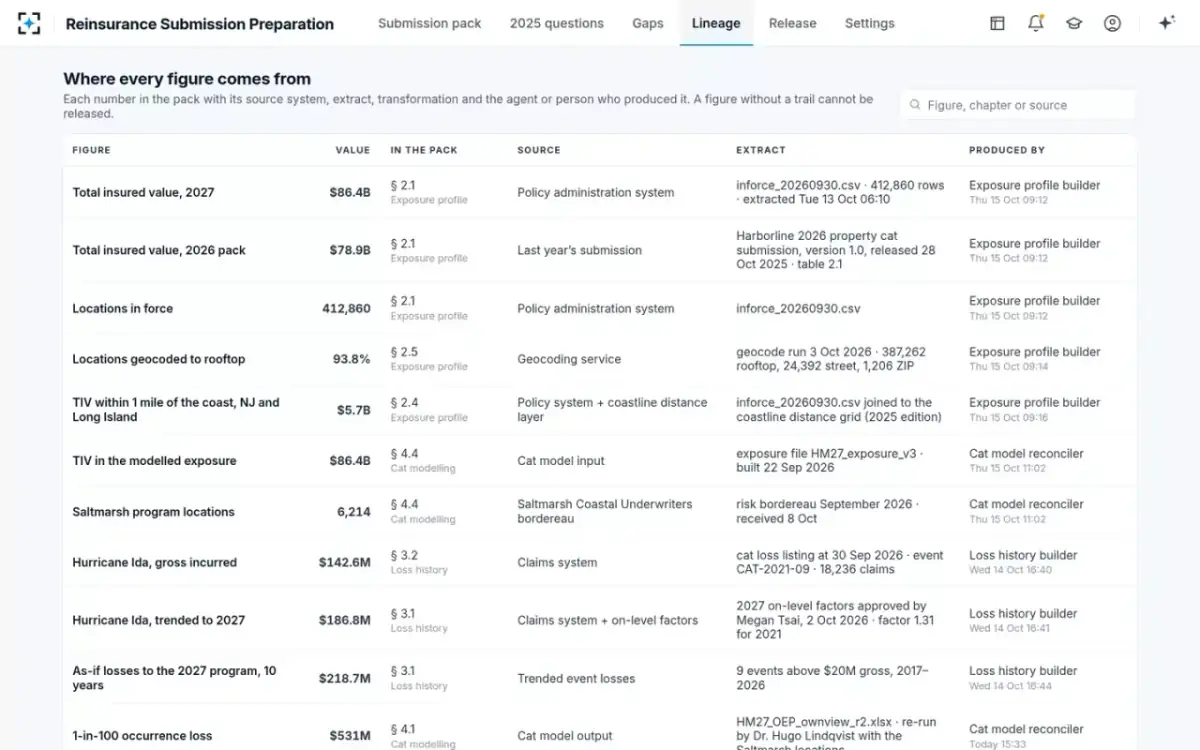
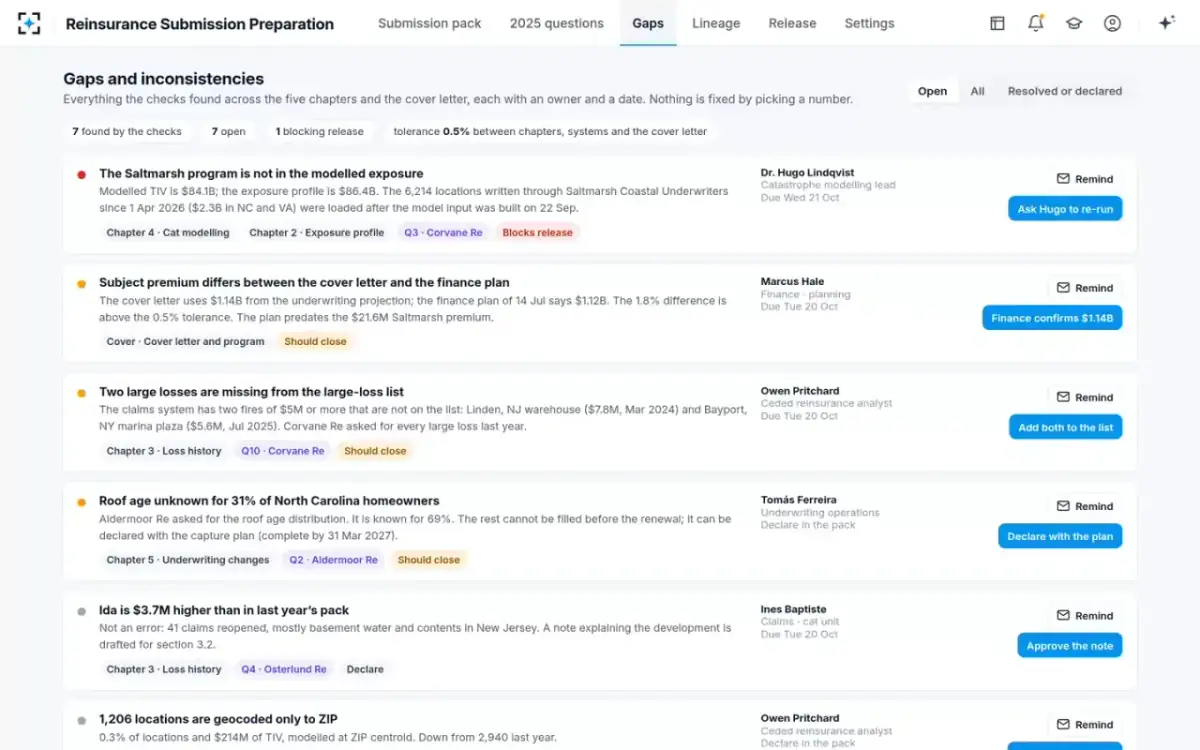
Two codes deserve particular care. Construction and roof characteristics are coded once to the fund's scheme and again to the catastrophe model's, and a mapping that changes in one place but not the other produces two different books. And unknown values behave differently: the data call takes 0 for an unknown roof year, while a catastrophe model fills the gap with a default. On the sample, roof age is unknown for 31% of North Carolina homeowners; a Florida writer with a similar gap would show it as zeros in one file and as a modelling assumption in the other.
Gaps a reinsurer and an examiner would both ask about: unknown roof age, ZIP-only locations
How does the FHCF layer fit a private reinsurance program?
Underneath and alongside it. Under the statute, the fund reimburses a chosen 45%, 75% or 90% of an insurer's losses from each covered hurricane above its retention, plus an allowance for loss adjustment expense, up to the insurer's share of the fund's capacity; its premiums count as premium for approved reinsurance for accounting and regulatory purposes, and its reimbursements are not reduced by reinsurance paid or payable from other sources. The private program is bought around that layer, which is why the statute sets the fund's contract dates early. The reimbursement contract itself, and the loss reports it requires after a storm, are the subject of the guide to the FHCF reimbursement contract; here the point is narrower. Because the fund's retention and recovery are computed from the data call, a cedant's private layers attach to a number that the exposure filing sets.
A reconciliation routine before 1 September
Nothing in the data call requires a reconciliation with the reinsurance submission. Everything about examination makes one sensible. A routine like the one below can be run by hand; Reinsurance Submission Preparation's checks automate the tying and the trail for the reinsurance submission itself, and do not file with WIRE.
Before the officers sign: reconcile the data call with the reinsurance submission
- Fix the capture date
Write down the date the 30 June book was extracted, and keep the run that produced it.
- Bring both files to one scope
Covered residential policies only, by ZIP code and type of business.
- Roll the reinsurance extract to 30 June
Add policies written and remove those cancelled between the two dates; explain what remains.
- Check both construction mappings
The fund’s approved mapping and the catastrophe model’s, against the same policy codes.
- Count the unknowns
Zeros for year built and roof year in the data call, defaults in the model input: the counts should match.
- Explain the fluctuation before WIRE asks
Compare with last year’s file at the fund’s thresholds and write the reason, not "reviewed and correct".
- Have the officers see the reconciliation
They certify the file complete and accurate after a diligent review.
Florida's regulator also collects the private program itself, in four stages from plan to storm impact; that filing is covered in the Florida annual reinsurance data call. How the fund's dates shape the rest of the Florida season is set out in the cedant's renewal season.
Questions people ask
What is FHCF WIRE?
The Web Insurer Reporting Engine, the fund's secure online system for exposure reporting. All 2026 data call files are uploaded, validated and submitted through it, each company may register up to seven users, and the submission is complete when two officers sign it there.
Can the FHCF data call deadline be extended?
No. The 2026 instructions state that extensions will not be granted for the 1 September, 4:00 p.m. Eastern deadline. An extension may be granted for a required resubmission if the company shows the need arises from circumstances beyond its reasonable control.
Are policies written on 1 July included in the data call?
No. Exposure is reported as at 30 June, so a covered policy effective on 1 July is not in that year's file. Its losses can still be reported to the fund under the policy terms in force at the time of loss.
What happens if roof year is unknown?
The data call layout asks for 0 in the roof year field when it is unknown, and the same for year built. The gap then shows as zeros in the file, visible to the fund and its examiners, rather than hidden behind an estimated year.
How big is the FHCF exposure?
For the 2025–26 contract year, $3.6 trillion of insured value from 138 participating insurers, with $1.286 billion of reimbursement premium, according to the fund's 2025 annual report. Palm Beach was the largest county at $291.4 billion, 8% of the total.