A reinsurance submission is the set of documents a cedant sends, through its broker, to the reinsurers it wants on a program before renewal. For a property catastrophe treaty it carries the program structure and a cover letter, an exposure profile, ten years of catastrophe events and large losses, the catastrophe model output, the underwriting changes since last year and, in a well-run renewal, answers to the questions the market asked last time. It is hard to build because each part comes from a different system with a different as-at date, and the reinsurer pricing it will test every figure against the others.
Reinsurance Submission Preparation is Botminds' software for building that document: six agents assemble the chapters from the cedant's own sources and check them, and named people own the model, the trend factors and the release. This guide follows one submission through it, using a fictional sample: Harborline Mutual's 2027 property catastrophe program of $550M excess of $50M in four layers, seven reinsurers on the panel, broker Callister Re Brokers. Every company, reinsurer and person named here is invented; the figures are sample data.
Nine steps from source files to the broker: seven by agents, the decisions by people
Agent
Exposure profile builderReads the in-force extract and program bordereaux; builds insured value and locations by state, construction, occupancy, coast distance and geocode quality.
Never: edits an extract, or fills a missing field with an estimate
A person decides
Pricing actuary approves trend factorsSets the factors that bring each historical loss to the renewal year, before any agent uses them.
Agent
Loss history builderPulls catastrophe events and large losses, trends them on the approved factors and applies each as-if to the program.
Never: sets a trend factor or changes a reserve
Agent
Underwriting change writerWrites rate, appetite, deductible and program changes from filings and notes, each item cited.
Never: states a change without its filing or note
Agent
Question answererFinds where the new submission answers each of last year’s questions and drafts the answer with its figure.
Never: answers without a cited figure
Agent
Consistency and lineage checkerTies every figure across chapters, cover letter and finance plan at a 0.5% tolerance; lists gaps with owners.
Never: resolves a gap by choosing a number
Agent
Cat model reconcilerCompares the model input with the exposure profile, reads the EP curves and builds the bridge from last year.
Never: runs or alters the model or the view of risk
A person decides
Catastrophe modelling leadRe-runs the model when the input is short and signs the cat modelling chapter.
A person decides
Head of ceded reinsuranceSigns and releases the submission to the broker once every check has passed.
What is a reinsurance submission?
It is the underwriting file a reinsurer prices from, prepared by the buyer. The actuarial textbooks treat it as the starting material of pricing. In the Casualty Actuarial Society's study note on reinsurance pricing, a worked property quota share begins with a cedant's request and the line "The submission includes six years of historical experience, rate changes, and a loss development triangle." Everything the reinsurer does next, from developing losses to loading for catastrophes, rests on what the submission contains and on whether its parts agree.
A property catastrophe submission adds the parts that a per-occurrence treaty turns on: where the insured values sit, how well each location is geocoded, and what a catastrophe model says the book could lose at each return period. It also has an audience problem. The same document goes to every reinsurer on the panel, each of which models it independently and asks its own questions. A figure that does not tie in the cover letter is not one error; it is seven sets of questions.
What goes into a reinsurance submission
The sample submission has a cover letter and five chapters, and each chapter has one source of truth and one owner. Setting it out this way is what makes the build traceable: a figure in chapter 2 that also appears in the cover letter must come from the same extract, or the difference becomes a question.
The cover letter and five chapters of one property catastrophe submission
| Part | What it shows | Built from | Owner of the numbers |
|---|---|---|---|
| Cover letter and program | Layers, retention, reinstatements, expiring premium, subject premium | Signed lines, premium projection, finance plan | Head of ceded reinsurance; finance |
| 1. Answers to last year’s questions | Each question, its answer, its figure and where it sits | Broker’s question log from the last roadshow | Whoever owns the figure |
| 2. Exposure profile | Insured value and locations by state, construction, coast distance, geocode quality | In-force policy extract, program bordereaux, geocoding | Ceded analyst |
| 3. Loss history | Catastrophe events and large losses, trended and as-if to the program | Claims listings, approved trend factors | Pricing actuary (factors); claims |
| 4. Cat modelling | Return-period losses, average annual loss, the bridge from last year, the own view | Model output and the own-view note | Catastrophe modelling lead |
| 5. Underwriting changes | Rate, appetite, deductibles, programs written or exited | Rate filings, underwriting notes, non-renewal lists | Underwriting |
Step one: every source file in, nothing built
The build starts from the sources, not from last year's spreadsheet. On the sample, the submission opens on the program with eleven days to the broker's deadline: the in-force extract at 30 September, the claims listings, the cat model output and the own-view note, the rate filings and underwriting notes, and last year's submission with the 18 questions the panel asked. Every chapter reads as not built. That state is deliberate. A submission that starts as a copy of last year's file inherits last year's numbers in every cell nobody remembers to refresh.
One instruction then starts the agents, and each step lands in a run log in view of the analyst, with what it read and what it found.
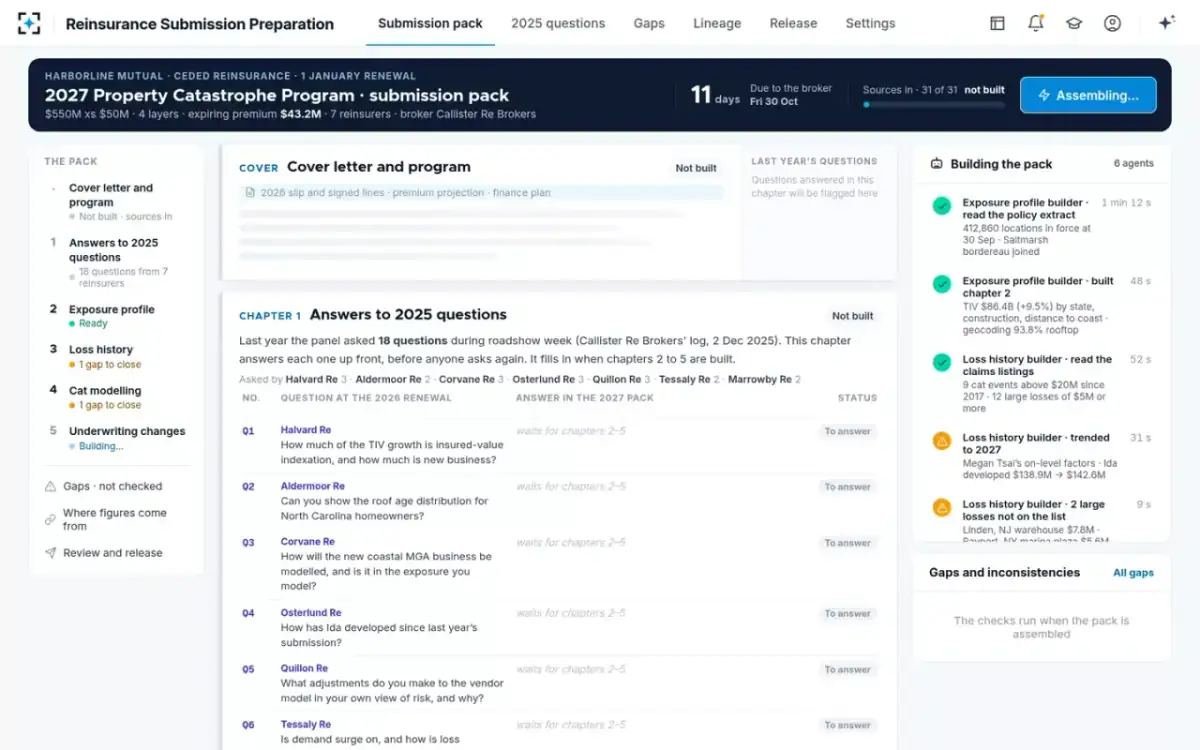
The run log as the chapters build: what each agent read and found
Step two: the exposure chapter, read from the in-force extract
The exposure profile builder reads the policy administration extract and joins the bordereau of any program written through a managing agent. On the sample that is 412,860 locations in force at 30 September with a total insured value of $86.4B, against $78.9B in last year's submission. The +9.5% is split in the chapter itself: 4.1 points from indexation of insured values and 5.4 points from more policies. Every change over 2% against last year is explained in the text, because an unexplained change is the first thing a reinsurer's modeller queries.
Two limits matter here. The agent never edits the extract, and it never fills a missing field with an estimate; it reports the gap. On the sample, roof age is unknown for 31% of North Carolina homeowners. That cannot be fixed before the renewal, so it is declared in the submission with a capture plan rather than smoothed over.
Step three: losses trended on the actuary's factors, not the agent's
The loss history builder pulls ten years of catastrophe events and every per-risk loss above the threshold, then trends them to the renewal year on factors the pricing actuary approved. On the sample, Hurricane Ida's gross incurred has developed from $138.9M in last year's submission to $142.6M, because 41 claims reopened. Trended to 2027 at a factor of 1.31 it becomes $186.8M, and applied to a $50M retention it puts $136.8M into the program. The development is explained, not just restated, because a number that moved without a reason reads as a number nobody checked.
The same pass finds two fires of $5M or more in the claims system that are not on last year's large-loss list: a warehouse in Linden, New Jersey at $7.8M and a marina plaza in Bayport, New York at $5.6M. A reinsurer asked last year for every large loss. The professional literature is blunt about why reinsurers keep asking:
"Often the claims and exposure data are not as they first seem. So you must continually ask questions in order to discover their true nature."
Gary S. Patrik, “Reinsurance”, Foundations of Casualty Actuarial Science (Casualty Actuarial Society)
Step four: last year's questions, answered before they are asked
The question answerer reads the broker's log from the last roadshow, finds the section of the new submission that answers each question, drafts the answer with its figure and places a flag in that section's margin. On the sample, 15 of the 18 questions were answered when the chapters were first assembled, two partly and one was waiting on another chapter. Halvard Re had asked how much of the insured-value growth was indexation and how much new business; the answer is the 4.1 and 5.4 points from chapter 2, with a link to section 2.3.
Chapter 1: each of last year's questions with its answer, its figure and where it sits
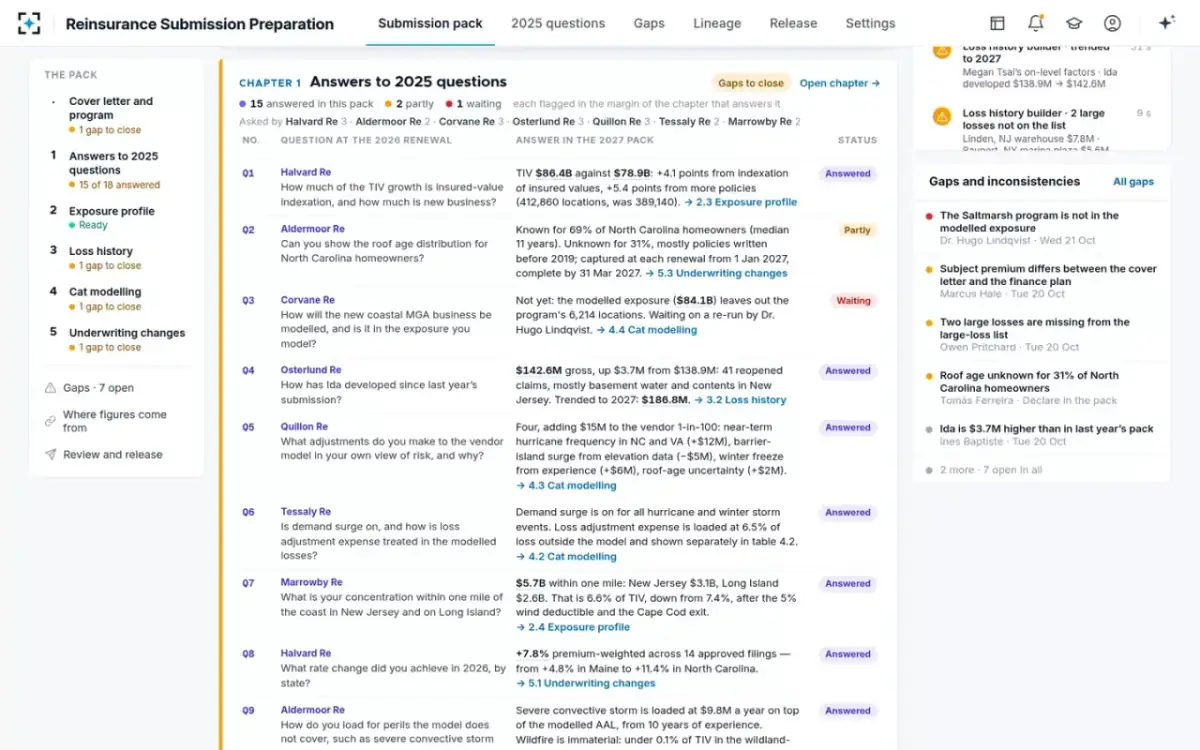
The rule that keeps this honest is that the agent never answers without a figure the submission itself contains. If the figure is not there, the question stays open with an owner. That is the difference between drafting answers and inventing them.
Step five: every figure tied, and seven gaps with owners
The consistency and lineage checker ties every figure across the chapters, the cover letter and the finance plan at a 0.5% tolerance, and keeps a trail for each: source system, extract, transformation, and the agent or person who produced it. On the sample it finds seven gaps. Subject premium is $1.14B in the cover letter and $1.12B in the finance plan of 14 July, a 1.8% difference; the plan predates the premium of the new coastal program. The two fires are missing from the large-loss list. Ida needs its development note. And one gap blocks release outright.
None of these is closed by the software picking the right number. Finance confirms the premium; the analyst adds the fires; claims approves the Ida note. Each gap shows the chapters it touches, the owner, a due date and the action that would close it.
Step six: the cat chapter goes back to the person who owns the model
The blocking gap is in the catastrophe model input. The cat model reconciler compares the modelled exposure with the exposure profile and finds $84.1B against $86.4B: the 6,214 locations of a coastal program written since 1 April were loaded after the model input was built on 22 September. As run, the 1-in-100 occurrence loss is $512M and the program's $600M top is reached at 1-in-169. Corvane Re asked about exactly this business last year.
The reconciler does not re-run the model or adjust the curve. It shows the gap and asks the catastrophe modelling lead to re-run. With the missing locations, the 1-in-100 becomes $531M and the program exhausts at 1-in-148, against 1-in-226 in last year's submission. The lead signs chapter 4. How a single return-period loss moves through those steps is traced in probable maximum loss in a reinsurance submission.
Who signs off a reinsurance submission?
Two people sign, and nothing leaves before both have. The catastrophe modelling lead signs the cat modelling chapter; the head of ceded reinsurance signs the submission as a whole and releases it to the broker. Release itself is conditional on six checks, and the released version is frozen: any later change goes out as a new version with a change note, so the panel never prices from two different files without knowing it.
Six checks a submission must pass before it can be released to the broker
- Every chapter and the cover letter built
A chapter still waiting on a source is a reason not to send, not a placeholder.
- The cat modelling chapter signed by its owner
On the sample, after the re-run with the missing locations.
- Every figure has a source trail
On the sample, 1,284 of 1,284 figures, each naming its system, extract and producer.
- Last year’s questions answered or declared
At release on the sample, 17 of 18 answered and one declared with its plan.
- No gap blocking release
A modelled-exposure shortfall above tolerance blocks release until the model is re-run.
- No policyholder names or street addresses
Locations go to the market by ZIP code and grid, not by address.
The broker then receives a defined set: the submission document (64 pages on the sample), exposure data by ZIP and grid, catastrophe events and large losses, the EP curves with the own-view note, and a letter answering last year's questions. What happens to those files in the weeks that follow is the subject of the cedant's renewal season, week by week.
Can AI build a reinsurance submission?
Agents can build most of it; they should not decide the parts that carry judgement. Supervisors' surveys describe the same split. In EIOPA's survey of European insurers, 65% were already using generative AI, mostly at proof-of-concept stage, and they named inaccurate outputs as the main risk (EIOPA). In the Bank of England and FCA's 2026 survey of UK financial firms, 80% reported AI agents in production for decision support, where agents recommend and humans decide and execute, and only 2% reported agents with broad autonomy (Bank of England and FCA).
A submission divides along that line naturally. Reading an extract, summing insured value by state, applying approved factors, finding the section that answers a question and tying a figure across chapters are mechanical and checkable. Choosing a trend factor, adjusting the vendor model to an own view of risk, deciding whether a premium figure or a plan is right, and choosing what to tell the market are not. The agents in this solution do the first list and are barred from the second; the inaccurate-output risk is handled by refusing any answer that cannot cite a figure in the submission. The inputs the agents need on day one are listed in reinsurance submission data requirements.
Questions people ask
What data do reinsurers want in a submission?
For a property catastrophe program: insured values by location with construction, occupancy and geocode quality, ten years of catastrophe events and large losses with their development, the catastrophe model output and any own-view adjustments, rate and underwriting changes, and the program structure. Patrik's chapter for the Casualty Actuarial Society asks for exposure by ZIP code wherever catastrophe potential is significant.
How long does it take to build a reinsurance submission?
No public body measures it. Our estimate for one property catastrophe submission built by hand is about 24 working days across exposure, losses, the model, underwriting changes, last year's questions and review; the solution's design target is six days from first source file to a submission ready for the market.
What is a property catastrophe submission?
It is a submission for a treaty that pays when one event's losses across many risks exceed the retention. It leans on exposure location data and catastrophe model output more than a per-risk or proportional submission does, because the price depends on how the book accumulates in a single storm or earthquake.
What is the cover letter in a reinsurance submission?
It is the summary the panel reads first: the structure, retention, reinstatements, expiring premium, subject premium and what changed. On the sample it states the retention as 4.4% of 2027 subject premium of $1.14B, down from 4.9%, which is why the subject premium has to match the finance plan.
Does a reinsurance submission include policyholder names?
It should not need to. Reinsurers model locations, values and characteristics, not identities. On the sample, a release check blocks any submission containing policyholder names or street addresses, and location data goes by ZIP code and grid.
What happens to a submission after release?
The broker distributes it to the panel and new markets, reinsurers model it and send questions, and quotes follow. On the sample the released version 1.0 is frozen, and any change after release goes out as a new version with a change note, so every reinsurer knows which file it priced.