Reinsurance submission data requirements come down to five inputs: an in-force exposure extract with location-level values and building characteristics, a loss history of catastrophe events and large losses with their development, the catastrophe model output together with the model input it was run on, the rate filings and underwriting notes that explain what changed, and last year's submission with the questions the market asked about it. The difficulty is not the list; it is that each input comes from a different system, at a different date, owned by a different person, and no industry standard says what each must contain. A reinsurer finds the gaps between them in the first week it models the business.
This is the guide for a ceded reinsurance manager or a data lead scoping that work, whether by hand or with software. It uses a fictional sample, Harborline Mutual's 2027 property catastrophe renewal, as built in Reinsurance Submission Preparation, Botminds' software in which six agents read these inputs, build the submission's chapters and check every figure, while the catastrophe modelling lead, the pricing actuary and the head of ceded reinsurance keep their decisions. The company and all its figures are invented.
What to bring on day one: the inputs a property catastrophe submission reads
- In-force policy extract at a stated cut-off date
Location-level insured values by coverage, construction, occupancy, year built, roof details and address or coordinates. On the sample, 412,860 locations at 30 September.
- Bordereaux for business written through managing agents
Every program the model input should contain; the sample’s new coastal program came in a September risk bordereau.
- Claims listings for catastrophe events and large losses
Gross incurred by event and per risk, with claim counts and reopenings, at a stated date; ten years for events on the sample.
- The pricing actuary’s approved trend factors
Signed and dated before any loss is trended; never set by whoever builds the submission.
- Catastrophe model output and the model input it used
EP curves for the vendor model and the own view, the own-view note, and the exposure file the run was built from, with its build date.
- Rate filings, underwriting notes and non-renewal lists
Each change the submission describes must cite one. On the sample, 14 approved filings.
- Last year’s submission and the broker’s question log
The figures the market already holds, and the questions it asked about them.
- The finance plan
The subject premium the cover letter quotes must agree with it.
What data is needed for a reinsurance submission?
For a property catastrophe program, the eight items above; for any program, enough to let a reinsurer rebuild your numbers from your inputs. The test a reinsurer applies is whether the same book appears consistently everywhere it is described. Insured value in the exposure chapter, in the model input and in the cover letter should be one number or a reconciled set. The loss history should be on the same basis as the program, net of any reinsurance that applies before it. Subject premium should match the plan finance will be judged on.
The inputs are not exotic. Most cedants hold all of them. What makes the work slow is that they are held in policy, claims, modelling and finance systems with different cut-off dates and different definitions, and that the people who own them are busy with their own year-end. The systems themselves, and where reconciliation breaks between them, are mapped in reinsurance data management.
Why no two reinsurers ask for the same data
Because the profession has never agreed a standard, and says so. Each reinsurer prices with its own models and assumptions, so each asks for the data its methods need, and a cedant's submission tries to satisfy all of them at once. In January 2026 the Casualty Actuarial Society's reinsurance working group opened a call for papers whose list of wanted research included this:
"Data guidelines: A survey and/or broadly applicable guidelines on data requirements for reinsurance pricing would be valuable, especially for reinsurance deals that currently lack standardization…"
Casualty Actuarial Society, Reinsurance Working Group, 2026 call for papers
For a buyer, that has a practical consequence. No software can ship "the standard reinsurance submission format", because there is none. A tool or a process has to be configured to the cedant's own data and to the questions its own panel asks, and the most reliable specification of those questions is last year's question log.
What exposure data do reinsurers need?
Enough to run a catastrophe model on your book: location, value, building characteristics and policy terms. The Casualty Actuarial Society's study note on reinsurance pricing lists what a catastrophe model requires, beginning with a measure of exposure: "This should be insured values, construction types, occupancies, along with attachment points for excess contracts." It goes on to geographic information converted to coordinates by a geocoding engine, the deductible and coinsurance terms of the original policies, and the details of any reinsurance that inures to the benefit of the catastrophe cover.
The NAIC's catastrophe modelling primer adds the characteristics that move a model's vulnerability curves: occupancy, construction, age and height of the building, and features such as roof age, roof-to-wall connection and opening protection. Where they are missing, the model uses defaults. On the sample, roof age is known for 69% of North Carolina homeowners and unknown for 31%, which is why one reinsurer asked for the distribution and why the submission declares the gap rather than filling it.
How precisely 412,860 sample locations are placed: geocode resolution in the exposure chapter
Locations by geocode match
- Rooftop · 93.8%
- Street · 5.9%
- ZIP only · 0.3%
Geocode resolution belongs in the exposure chapter, not just in the model run, because it is a direct statement about the model's uncertainty. Reinsurers can then see that a change in the 1-in-100 came partly from placing locations better. How resolution feeds the probable maximum loss is traced in one PML, traced.
What is a statement of values in reinsurance?
It is the location-level schedule of what is insured: each property's address or coordinates, its values by coverage (building, other structures, contents, loss of use or business interruption) and its characteristics. Commercial property buyers produce one for their insurer; for a reinsurance submission the equivalent is the in-force exposure extract, usually far larger and aggregated before it leaves the cedant. On the sample, the exposure profile builder sums building, other structures, contents and loss-of-use limits by location to reach $86.4B across 412,860 locations, and the data sent to the broker goes by ZIP code and grid with no policyholder names or street addresses.
Two checks make a statement of values usable. Values must be current, which for a homeowner book means indexation is applied and stated; on the sample, 4.1 of the 9.5 points of insured-value growth came from indexation. And the extract's cut-off date must be the same one the model input uses, or the difference must be reconciled before anyone quotes a PML.
How many years of loss history do reinsurers want?
Ten years is the common answer for property, and the textbooks give it. For experience rating a property per-risk treaty, the CAS study note says to gather premium and losses "for as many recent years as possible" and adds: "Ten years should be sufficient, though the number of years relied upon in the final analysis should be a balance between credibility and responsiveness." Patrik's chapter for the same society describes proportional data as aggregate claims for the past five to ten policy years, plus individual large claims and a development triangle (Patrik).
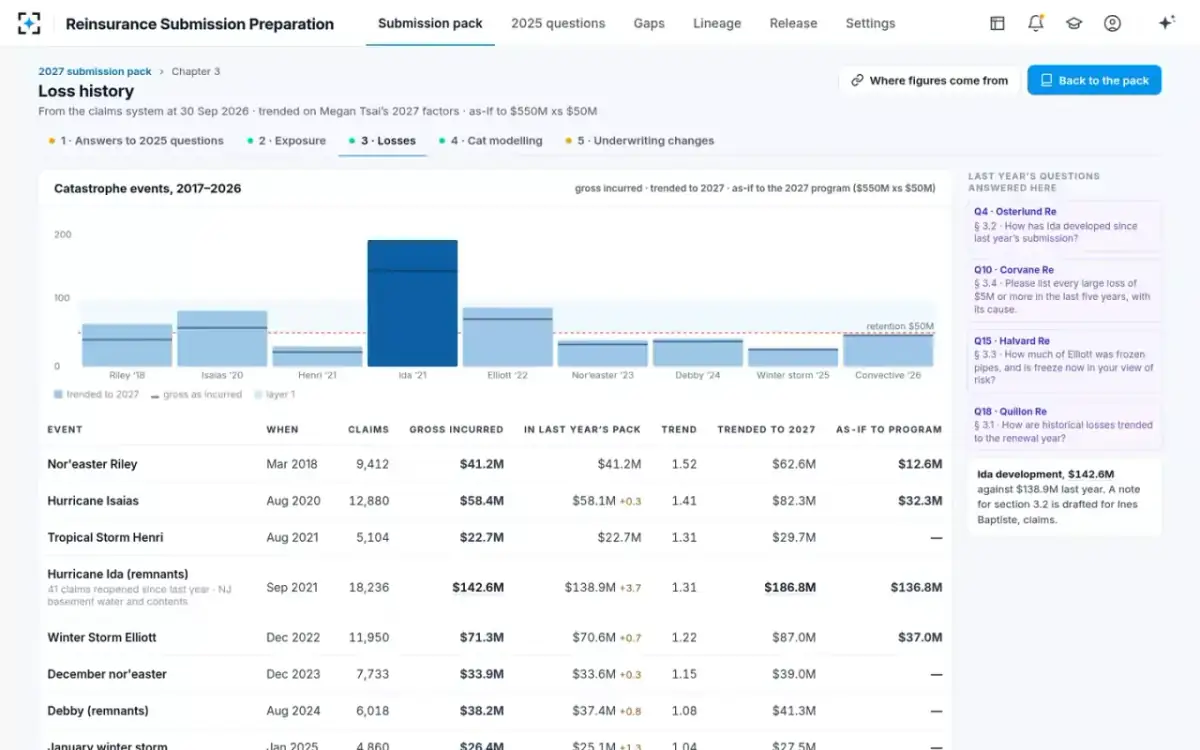
For catastrophe events the history is context rather than the price; the model carries the price. On the sample, the loss chapter shows ten years of events above $20M gross, 2017 to 2026, with nine events and two years without one. Each event is shown gross as incurred, against the figure in last year's submission, trended to 2027 and applied as-if to the program. Ida, the largest, developed by $3.7M since last year because 41 claims reopened, and the chapter says so.
Ten years of catastrophe events: gross, last year's figure, trended and as-if to the program
What is a large loss listing?
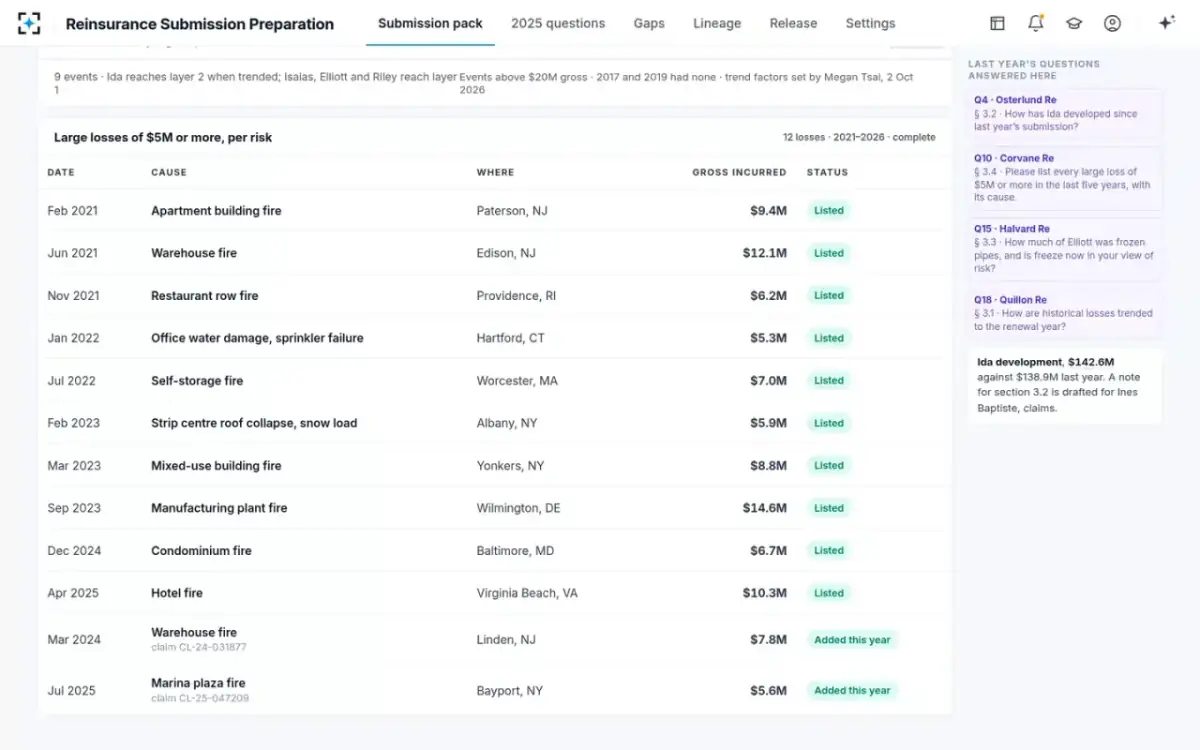
It is the list of every individual loss above a stated threshold, with date, cause, location and amount, so that a reinsurer can test per-risk exposure and see what the catastrophe history leaves out. The CAS study note sets the rule for what belongs in it: "The historical losses should include all losses that would pierce the layer being priced after the application of trend factors." That means the threshold has to be set on trended values, and the list has to be pulled from the claims system, not copied forward from last year.
On the sample the threshold is $5M per risk and the list covers the five years one reinsurer asked about. Pulling it from the claims system found two fires that were not on last year's list: a warehouse in Linden, New Jersey at $7.8M and a marina plaza in Bayport, New York at $5.6M. Both were added before release, making twelve losses.
Large losses of $5M or more, with the two found in the claims system this year
Who owns the trend factors in a submission?
The pricing actuary, and nobody else. Trend factors bring old losses to the cost level of the renewal year; they encode judgements about inflation, building costs and claims practice, and the CAS study note points to the cedant's own rate filings as one source for them. They are also the easiest number in a submission to change quietly. On the sample, the factors were approved by the pricing actuary on 2 October, the settings name her, and the loss history builder applies them without being able to alter them: 1.52 for a 2018 event, 1.31 for 2021, 1.04 for early 2025.
The same principle covers the model and the reserves. The catastrophe modelling lead owns the model run and the view of risk; claims owns case reserves. A data requirements list that names an owner for every input is the clearest defence against a submission in which nobody can say who decided a number.
What if our exposure data is incomplete?
Declare what is missing, say how it was treated, and give a date by which it will be fixed. The catastrophe model will fill gaps with defaults whether you declare them or not, and the NAIC primer is clear about the effect: inaccurate or gappy input, filled by assumption, widens the uncertainty of what the model puts out (NAIC primer). A declared gap lets the reinsurer weigh that uncertainty; an undeclared one is found in its own modelling and treated as a sign of others.
On the sample, three gaps were handled three ways. Roof age for 31% of North Carolina homeowners could not be captured before the renewal, so it was declared with a capture plan completing on 31 March 2027. The 1,206 ZIP-only locations were reported with their share of value. And the missing coastal program in the model input could be fixed, so it was: the release was blocked until the model was re-run.
The inputs, their checks and their owners
A data requirements document is most useful when each line carries the check that will be run on it and the person who will answer for it. The table below is that document for the sample renewal.
Each input, the check it must pass, and who answers for it
| Input | Minimum content | Check before use | Owner |
|---|---|---|---|
| In-force extract | Location values by coverage, characteristics, address or coordinates, cut-off date | Insured value ties to the policy system; changes over 2% from last year explained | Ceded analyst |
| Bordereaux | Every program written through an agent, at the same cut-off | Each program present in both exposure chapter and model input | Underwriting operations |
| Claims listings | Events and per-risk losses, gross incurred, claim counts, reopenings | Every loss over the trended threshold listed; development since last year explained | Claims |
| Trend factors | Factor by year, approval date | Approved before use; unchanged by the build | Pricing actuary |
| Model output and input | OEP and AEP curves, AAL, own-view note, input file and build date | Modelled insured value within tolerance of the exposure chapter | Catastrophe modelling lead |
| Rate filings and notes | Approved filings, appetite and deductible changes, non-renewals | Every stated change cites a filing or note | Underwriting |
| Last year’s submission and questions | Released version, question log by reinsurer | Each question mapped to a section that answers it, or declared | Head of ceded reinsurance |
| Finance plan | Subject premium by line for the renewal year | Matches the cover letter within tolerance | Finance planning |
What Reinsurance Submission Preparation needs on day one, and what it does not replace
It needs the inputs above as files or extracts from the systems that already hold them, last year's released submission and the broker's question log. It reads them; it does not replace the system that holds any of them. The policy administration system stays the source of insured values, the claims system the source of losses, and the catastrophe model platform the place where models are run. The solution never runs or alters the model, never sets a trend factor and never changes a reserve.
That shapes how to scope a project. The first renewal is the one where the inputs are mapped: which extract, which date, which owner, which tolerance. On the sample, those choices sit in the renewal's settings: a 0.5% cross-chapter tolerance, a $5M large-loss threshold, ten years of history, the named owner of the trend factors and the two people who sign. A team with messy data is not disqualified; the gaps become the first list of work, each with an owner and a date. A team that wants the tool to fix its policy data at source should look elsewhere: this is a submission builder, not a data warehouse. Questions to put to any vendor are collected in reinsurance submission software: twelve questions before you buy.
Questions people ask
What format should exposure data be in for a reinsurance submission?
There is no single standard; ask each lead reinsurer and the broker what their models read. Location-level values with coordinates or full addresses, construction and occupancy codes, and policy deductibles and limits cover what the CAS study note lists as catastrophe model inputs.
Should a submission include incurred or paid losses?
Incurred, with the evaluation date and the development since the last submission. On the sample, Ida is shown at $142.6M gross incurred against $138.9M a year earlier, with the 41 reopened claims that explain the difference.
Do reinsurers need policyholder names or addresses?
Not for catastrophe pricing. They need where risks are and what they are worth. On the sample, release is blocked if the submission contains policyholder names or street addresses, and the location data goes to the broker by ZIP code and grid.
What is subject premium, and why must it match the plan?
It is the premium base the reinsurance applies to, used to express the retention and price as a share. On the sample, the cover letter's $1.14B differed from the finance plan's $1.12B by 1.8%, above the 0.5% tolerance, so finance had to confirm one before release.
How long does it take to assemble the data for a submission?
No public body measures it. Our estimate for a property catastrophe submission built by hand is about 24 working days in total, of which roughly seven go on pulling and reconciling exposure across systems; the solution's design target for the whole build is six days.