The Florida annual reinsurance data call is the Office of Insurance Regulation's yearly collection of each property insurer's catastrophe reinsurance program, run with a catastrophe stress test under the state's insurer examination statute. It comes in four stages: what the insurer plans to buy, what it actually bought, which reinsurers and contracts it placed, and how storms affected those contracts. The stress test then applies the purchased program to modelled losses from historical hurricanes to see whether the insurer would keep its required surplus. For a Florida domestic writer the result is that its reinsurance program is read by the regulator as well as the market, and the first coherent description of that program, its layers, its retention and the exposure underneath, is the renewal submission.
This guide works through what the office collects and publishes, using its stability reports, the data call's own forms and the statute it rests on. It refers to Reinsurance Submission Preparation, Botminds' software in which six agents build a cedant's reinsurance submission from its own systems and tie every figure to its source, with the catastrophe modelling lead and the head of ceded reinsurance signing. Its sample cedant, Harborline Mutual, is fictional and not a Florida insurer; it illustrates the documents, not a Florida filing.
Four stages, from the plan to the storm, and the document each one draws on
Stage 1
“Collect estimate of what insurers plan to purchase for reinsurance.”
The program as planned: layers, retention and limits. In a cedant’s own files, the cover letter of its submission.
Stage 2
“Collect the actual amount of reinsurance purchased by insurers.”
The program as placed: what the market actually wrote, against the plan.
Stage 3
“Collect information on participating reinsurers and reinsurance contracts placed.”
The panel, shares and treaty terms: the placement file and each treaty summary.
Stage 4
“Collect data reporting the impact of storms on insurers’ reinsurance contracts.”
After landfall: what each event did to each layer and its reinstatements.
What is the Florida annual reinsurance data call?
It is the regulator's annual account of how Florida property insurers finance hurricane losses. The office's stability report states its basis and purpose: "OIR conducts the Annual Reinsurance Data Call (ARDC) and Catastrophe Stress Test (CST) pursuant to section 624.316, Florida Statutes, to evaluate the reinsurance programs that companies have in place to respond to catastrophic events that may occur during the Atlantic hurricane season." It is filed through the office's IRFS portal and, unlike several of the office's other data calls, has no fixed annual date: the office lists it as "Due annually according to announced schedule."
The reason for the attention is stated in the same report. Florida, the office writes, is the most catastrophe-prone state in the country, with 8,436 miles of shoreline, and its domestic property insurers are "especially reliant on reinsurance to finance the payment of catastrophe losses". A program that fails in a storm season fails policyholders, which is why the regulator wants to see the plan before the season and the results after it.
What are the four stages of the ARDC?
The office lists them in its reports in these words: Stage 1, "Collect estimate of what insurers plan to purchase for reinsurance"; Stage 2, "Collect the actual amount of reinsurance purchased by insurers"; Stage 3, "Collect information on participating reinsurers and reinsurance contracts placed"; Stage 4, "Collect data reporting the impact of storms on insurers’ reinsurance contracts" (OIR, July 2026). The sequence follows the season: the plan in spring, the purchase around the 1 June inception that Florida programs share with the state hurricane fund, the contracts once placed, and the storms once they come.
The stages matter to a ceded team because they put two versions of the program side by side in the regulator's files. Stage 1 is what the insurer intended to buy; Stage 2 is what the market sold it. Any difference, a layer not filled, a retention raised, a reinsurer replaced, is visible to the office, and the explanation sits in the submission that went to market and in what the market did with it.
Who must file the ARDC?
The office's reports describe the stress test as required of "domestic property insurers, commercially domiciled insurers, and other selected companies", and the data call is conducted alongside it under the same statute; the reports give filing rates for both. As of 15 June 2026, 69% of insurers had filed the ARDC and 66% the stress test. A company unsure whether it is in scope should go by the office's notice for the year rather than by this summary.
The data call and stress test in the regulator's July 2026 report
69%
of insurers had filed the 2026 ARDC by 15 June
66%
had filed the 2026 catastrophe stress test by 15 June
61of 67
insurers rated high recovery potential in the 2025 stress test
19
insurers referred to the Stability Unit, 3 Dec 2025 to 11 Jun 2026
The data call is an examination, and an officer swears to it
The data call rests on the examination statute, not on a reporting rule. Section 624.316 requires the office to "examine the affairs, transactions, accounts, records, and assets of each authorized insurer" as often as it deems advisable, and the office's sample affidavit for the data call frames each filing as part of that examination. An officer who must be NAIC-recognised signs it before a notary:
"…the responses on the attached report are true and accurate regarding the Company’s Compliance with the examination being conducted by the Office for the collection of data regarding annual reinsurance purchases."
Florida OIR, Certification of Information, Annual Reinsurance Data Call (sample affidavit)
The stress test has its own sample affidavit. For the officer signing, the practical question is whether every figure in the report, from the planned limits to the reinsurers' shares, can be traced to a document the company would show an examiner. The renewal submission is the document most of those figures first appeared in.
Stage 1 is your submission's cover letter, in the regulator's hands
Stage 1 asks what the insurer plans to buy. The fullest statement of that plan a ceded team produces is the cover letter of the submission it takes to market: layers, retention, reinstatements and expected cost. On Botminds' sample renewal, the cover letter carries exactly those: four layers of $550M excess of $50M, one reinstatement at 100% on each, a $50M retention equal to 4.4% of 2027 subject premium of $1.14B, an expiring premium of $43.2M and the return period at which the program is exhausted.
A submission's cover letter: the program a Stage 1 plan describes
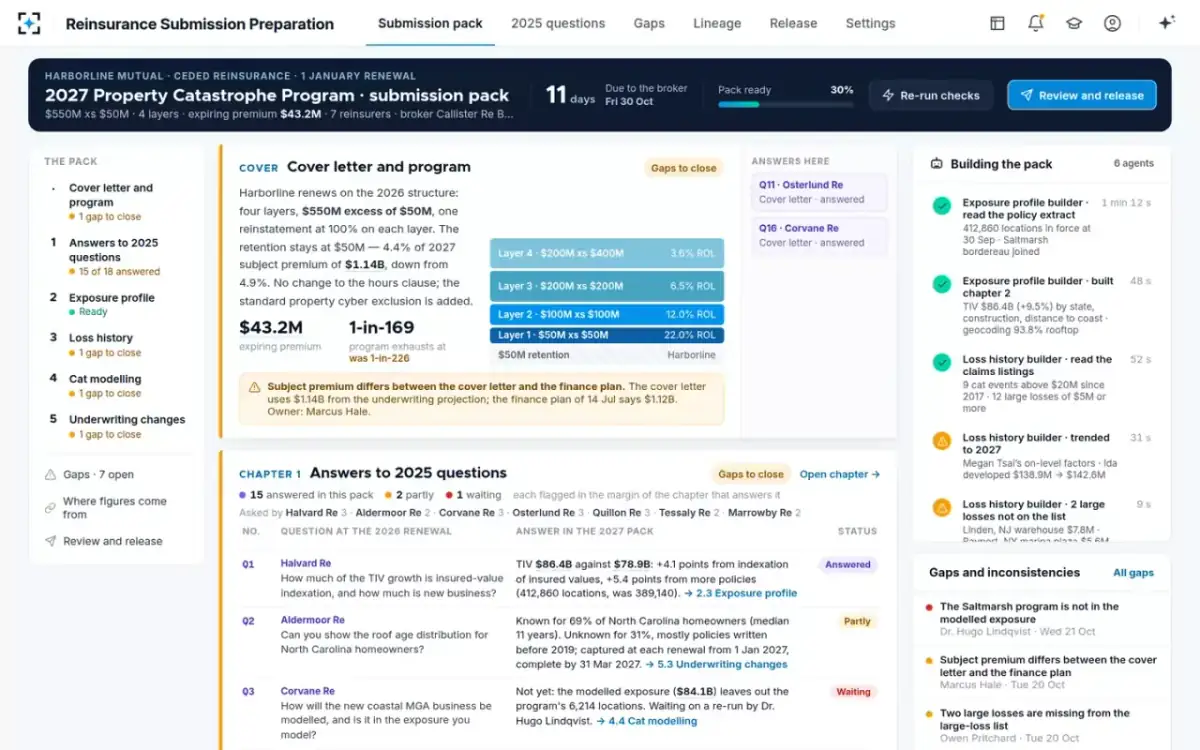
That is why the consistency checks inside a submission matter beyond the market. On the sample, the cover letter's subject premium of $1.14B differed from the finance plan's $1.12B by 1.8%, above the 0.5% tolerance; the gap went to finance with a due date before release. A Florida writer whose plan, cover letter and regulator filing quote different bases has three versions of one program in circulation.
Stage 3: every treaty summarised, field by field
Stage 3 collects the reinsurers and contracts placed, and the office publishes the form Florida uses to summarise a treaty, the Reinsurance Summary Statement. Its fields read like an index to the placement file. The table below sets them against where a well-built submission and placement already hold the answer.
The Reinsurance Summary Statement's fields, and where a cedant already holds the answers
| Fields on the form | Where the answer already sits |
|---|---|
| Treaty number; effective and expiration dates | The signed program and its inception date |
| Reinsurers, with percentage participation | Signed lines from the placement |
| Broker and broker fee | The broker’s terms of engagement |
| Type of treaty; types of risks ceded; territorial limit | The cover letter and the wording |
| Attachment point; loss triggers; reinsurer’s limits | The layer structure in the submission |
| Commission; expense allowance; profit commission; deposit premium | The firm order terms |
| Report and remittance requirements; written or earned basis; amounts and due dates | The wording and the premium schedule |
| Cancellation, commutation, special clauses, conditions, exclusions and terminations | The final wording |
The form's fields that come from the wording, special clauses, exclusions, terminations, are where a submission ends and the contract begins. Comparing those terms across years is reinsurance contract review, the work of Botminds' Treaty Wording Comparison; recording the panel and the shares is the broker's placement file, the subject of Reinsurance Placement Management.
What is the Florida catastrophe stress test?
It is a structured test of whether each insurer's purchased reinsurance would keep it above its minimum surplus after a severe hurricane season. The office requires insurers to model a series of historical storms and apply their purchased reinsurance program to the modelled losses of their current or projected exposures, and uses the results to estimate surplus after each scenario. In the office's words, the test "is not a forecast or prediction, but rather a structured exercise designed to test insurers’ resilience under severe, hypothetical hurricane scenarios."
The 2026 scenarios pair historical storms: the 1945 Homestead hurricane followed by the 1947 Fort Lauderdale hurricane; Hurricane Hermine (2016) followed by Hurricane Ian (2022); and Hurricanes Frances and Jeanne, both from 2004. Results are due in the office's report of 1 January 2027. In 2025 the office moved from a simple surplus-requirement test to a gradient scale of high, moderate and low recovery potential, which also weighs confidential factors such as parent support and pooling.
Because each scenario is a sequence of storms in one season, the test exercises reinstatements and aggregate limits, not just the per-occurrence layers. That is the aggregate question set out in aggregate vs occurrence exceedance probability: whether a second storm finds limit left.
How much does reinsurance reduce modeled hurricane losses?
In the 2025 stress test, by between roughly two-thirds and more than three-quarters of the gross loss, depending on the scenario. Based on insurers' own modelling, the first scenario produced about $39.9 billion of insured losses, reduced to about $12.7 billion net of reinsurance; the second $78.1 billion to $18.4 billion; the third $74.6 billion to $21.2 billion (OIR, July 2026).
Insured losses before and after reinsurance in Florida's three 2025 stress scenarios
The arithmetic behind those bars is our own: reinsurance absorbed about 68% of scenario 1's gross loss, 76% of scenario 2's and 72% of scenario 3's. Two cautions apply. The figures are the insurers' own modelled results aggregated by the office, so they inherit every input issue a catastrophe model has. And the share absorbed depends on how much of each scenario fell into purchased layers, so a program's structure, not only its size, decides the result.
What does OIR do with reinsurance data?
Four things, on the evidence of its reports. It estimates each insurer's surplus after the stress scenarios and grades recovery potential. It measures the market: its January 2026 report gave year-on-year risk-adjusted cost changes of +27.03% for 2023, −1.70% for 2024 and −0.46% for 2025, and its July report preliminary 2026 cuts of 15% to 25% for nearly half of insurers, a series charted in what each late week costs a cedant. It takes the results to the market: before the 2025 season, the office "met with London, Bermuda, and New York based reinsurers to provide an update on the state of the market". And it acts on what it finds through the Property Insurer Stability Unit.
Two of the unit's statutory referral triggers concern reinsurance directly: an agreement that creates a substantial risk of insolvency, and one that does not create a meaningful transfer of risk; the statute allows no credit for reinsurance without "a meaningful transfer of risk of loss to the reinsurer". Between 3 December 2025 and 11 June 2026, 19 insurers were referred, including one referral for a reinsurance agreement without meaningful risk transfer and 15 for exceeding written-premium ratios, where the office reviews mitigating factors including intercompany pooling and other reinsurance the company uses.
Keeping the plan, the purchase and the submission in one story
The data call rewards a ceded team that can show one consistent account of its program from plan to storm. The submission is where that account starts, and its quality decides how much explaining Stage 2 needs. Reinsurance Submission Preparation builds the submission with every figure traced to its source, the model input checked against the exposure, last year's questions answered and the release signed by named people. On the sample, release required six checks, including that all 1,284 figures had a source trail and that no gap was blocking release.
Release: six checks, two signatures, a frozen version
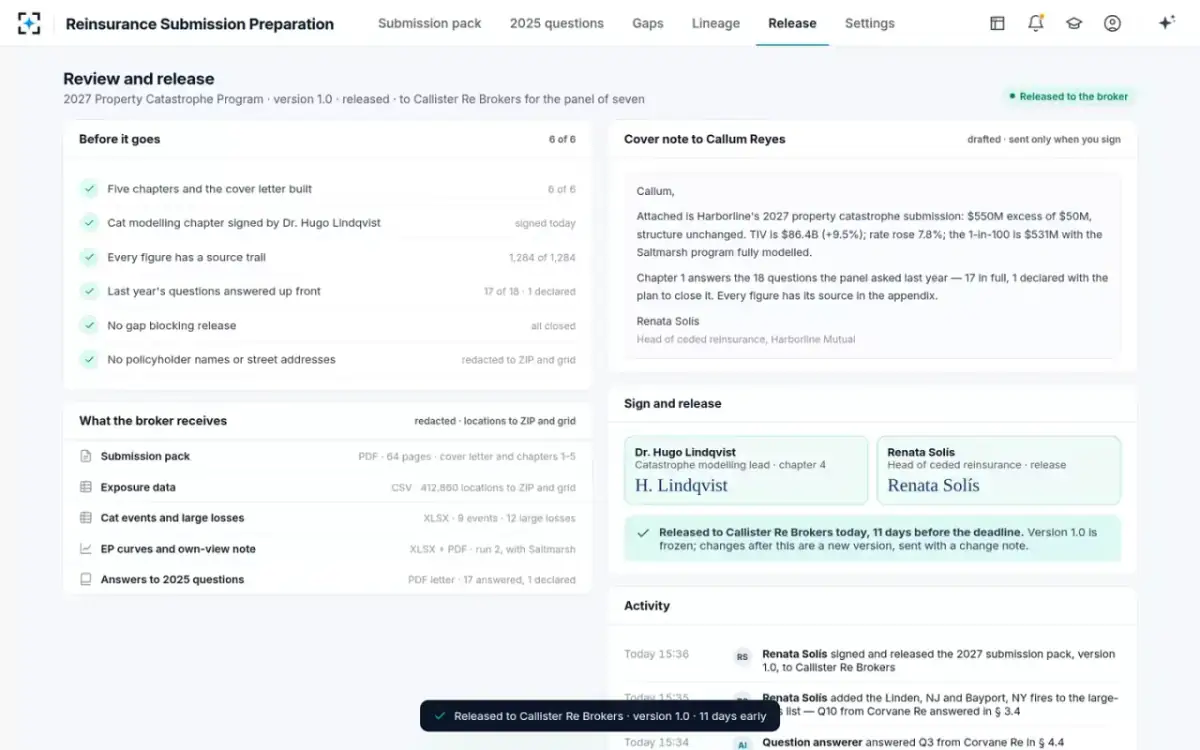
The solution does not file the data call, run the stress test or decide the program. It produces the traced, signed account of the program that those filings will be compared with. Florida's other exposure filing, to the state hurricane fund by 1 September, is covered in the FHCF data call.
Questions people ask
Is the ARDC the same as the FHCF data call?
No. The ARDC is the Office of Insurance Regulation's collection of each insurer's whole reinsurance program, in four stages. The FHCF data call is the state hurricane fund's exposure report of insured values by ZIP code as of 30 June, due by 1 September, which sets the fund's premium, retention and coverage.
When are the stress test results published?
In the office's Property Insurance Stability Reports, published each January and July. The July 2026 report gives the 2025 results; the 2026 results are scheduled for the report of 1 January 2027.
Does the catastrophe stress test predict hurricane losses?
No. The office describes it as a structured exercise, not a forecast, and calls its scenarios extremely rare with intentionally excessive losses. For comparison, the three storms that hit Florida in 2024 caused an estimated $8.2 billion of insured losses.
What is a Reinsurance Summary Statement?
It is Florida's form OIR-D0-1433 summarising one treaty: dates, reinsurers and their shares, broker and fee, attachment point, limits, triggers, commissions, deposit premium, remittance terms and special clauses. A company officer signs it before a notary.
What is the Florida Property Insurer Stability Unit?
It is a unit within the Office of Insurance Regulation, created in 2022, that gives enhanced monitoring to insurers referred under statutory triggers, two of which concern reinsurance agreements. It received 19 referred insurers between 3 December 2025 and 11 June 2026.