The reinsurance intermediary model act is the NAIC's Reinsurance Intermediary Model Act (#790), a model law that states adopt to license reinsurance brokers and managers and to set what they must do with an insurer's business and money. For a broker it comes down to three obligations: act only under a written authorization that specifies each party's responsibilities; account for and remit the insurer's funds within 30 days, holding them as a fiduciary; and keep, for at least ten years after each contract expires, a complete record of the transaction, from the rate used to compute the premium to proof of placement and written evidence that each reinsurer agreed to assume the risk. A file that meets the act is also the file that answers a client's auditor, a regulator's examiner or a court. Botminds' Reinsurance Placement Management is an agentic solution for treaty brokers that records every written line with the reinsurer's own words, every check against the firm order and every human approval, so much of that evidence exists the day the program is signed.
The act is quoted below from the NAIC's October 2007 edition; each state's enacted version governs, and Florida's, § 626.7492 of the Florida Statutes, is quoted where it differs. Product examples come from a fictional sample program in the solution.
What is the reinsurance intermediary model act?
It is a template statute for regulating the people who stand between insurers and reinsurers. The NAIC adopted it in 1990 and amended it in 1993, 2001 and 2006, according to the chronology printed with the model, and its own short title is the "Reinsurance Intermediary Act" (NAIC Model Act #790). It does four things: it defines two kinds of reinsurance intermediary, it requires them to be licensed, it prescribes what their contracts with insurers and reinsurers must contain, and it gives the commissioner examination powers and penalties.
Because it is a model, the operative text is whatever a state enacted. Florida's version, first enacted in 1992 and amended as recently as 2026 according to its history note, follows the model closely on brokers' contracts and records and adds its own definitions and remedies (Fla. Stat. § 626.7492). A broker licensed in several states works to the strictest version that applies to each program.
What is a reinsurance intermediary broker, and what is a manager?
The act licenses two different jobs. A reinsurance intermediary-broker (RB) "solicits, negotiates or places reinsurance cessions or retrocessions on behalf of a ceding insurer without acting as a RM on behalf of the insurer." A reinsurance intermediary-manager (RM) works for the other side: it "has authority to bind or manages all or part of the assumed reinsurance business of a reinsurer" and "acts as an agent for the reinsurer" (Model Act #790, Section 2). Employees of the reinsurer, the U.S. manager of an alien reinsurer's U.S. branch, certain affiliated underwriting managers not paid on premium volume, and managers of examined pools are excluded from the manager definition.
The rules follow the direction of the duty. A broker's contract is with the insurer, takes the form of a written authorization, and is about accounts, funds, records and disclosure. A manager's contract is with the reinsurer, must be approved by the reinsurer's board and filed with the commissioner "at least thirty (30) days before the reinsurer assumes or cedes business through the producer", and adds underwriting controls: claims reporting, limits on settlement authority, a bar on ceding retrocessions except under guidelines, and a rule that interim profit shares wait one year after each underwriting period for property business and five years for casualty.
Licensing turns on where the intermediary keeps an office. A broker with an office in the state must be a licensed producer or reinsurance intermediary there; one with an office in another state must be licensed in this state or in another state "having a law substantially similar to this law." The commissioner may require a resident manager to file a bond and carry errors and omissions cover, and may refuse a license if anyone named on the application "is not trustworthy". Attorneys acting as such are exempt.
The written authorization: six terms every broker agreement needs
A broker may act for an insurer "only … pursuant to a written authorization, specifying the responsibilities of each party" (Model Act #790, Section 4). The authorization must provide, at a minimum, that the insurer may terminate the broker's authority at any time; that the broker will render accurate accounts of all material transactions, with what supports its own commissions and fees, and remit funds due within 30 days of receipt (Florida's enacted wording is quoted in the guide to the reinsurance statement of account); that funds collected for the insurer are held as a fiduciary in a qualified U.S. bank; that the broker will keep the Section 5 records; that it will "comply with the written standards established by the insurer for the cession or retrocession of all risks"; and that it will disclose any relationship with a reinsurer it uses, the duty how reinsurance brokers are paid turns on.
Two of those terms reach into the placement itself. The insurer's written standards are, in a renewal, its buying instructions: the rating floor, the collateral rule for unrated reinsurers, the maximum share any one reinsurer may take, the signing method. A broker that signs a line the standards exclude has broken its authorization, whatever the market practice. And the relationship disclosure covers more than ownership; any tie to a reinsurer on the program is for the client to weigh before the line is signed.
What records must a reinsurance broker keep?
For at least ten years after each contract expires, a broker must keep "a complete record for each transaction" showing eleven things, and the insurer may inspect, copy and audit all of it (Model Act #790, Section 5). The list is the anatomy of a placement file.
The ten-year placement file the reinsurance intermediary model act requires, item by item
- The type of contract, limits, underwriting restrictions, classes or risks and territory
The program structure as placed: each layer, its limit and retention, exclusions and territory.
- Period of coverage, effective and expiration dates, cancellation provisions and notice of cancellation
From the firm order terms and the final wording.
- Reporting and settlement requirements of balances
Deposit premium, adjustments and the settlement timetable.
- Rate used to compute the reinsurance premium
The firm order rate on line for each layer, and any line written at a different rate.
- Names and addresses of assuming reinsurers
The panel as signed, not as quoted.
- Rates of all reinsurance commissions, including on retrocessions the broker handles
The ceding commission and the broker's own brokerage.
- Related correspondence and memoranda
Including the quotes, the chasers and the client's instructions.
- Proof of placement
The act does not define it; a signed slip or contract and the signed lines are the usual evidence.
- Details of retrocessions the broker handles, with the retrocessionaires and each one's percentage
Where the broker also places the reinsurer's own protection.
- Financial records, including premium and loss accounts
The accounts the broker must render under the authorization.
- Written evidence that each reinsurer agreed to assume the risk, or delegated binding authority to its representative
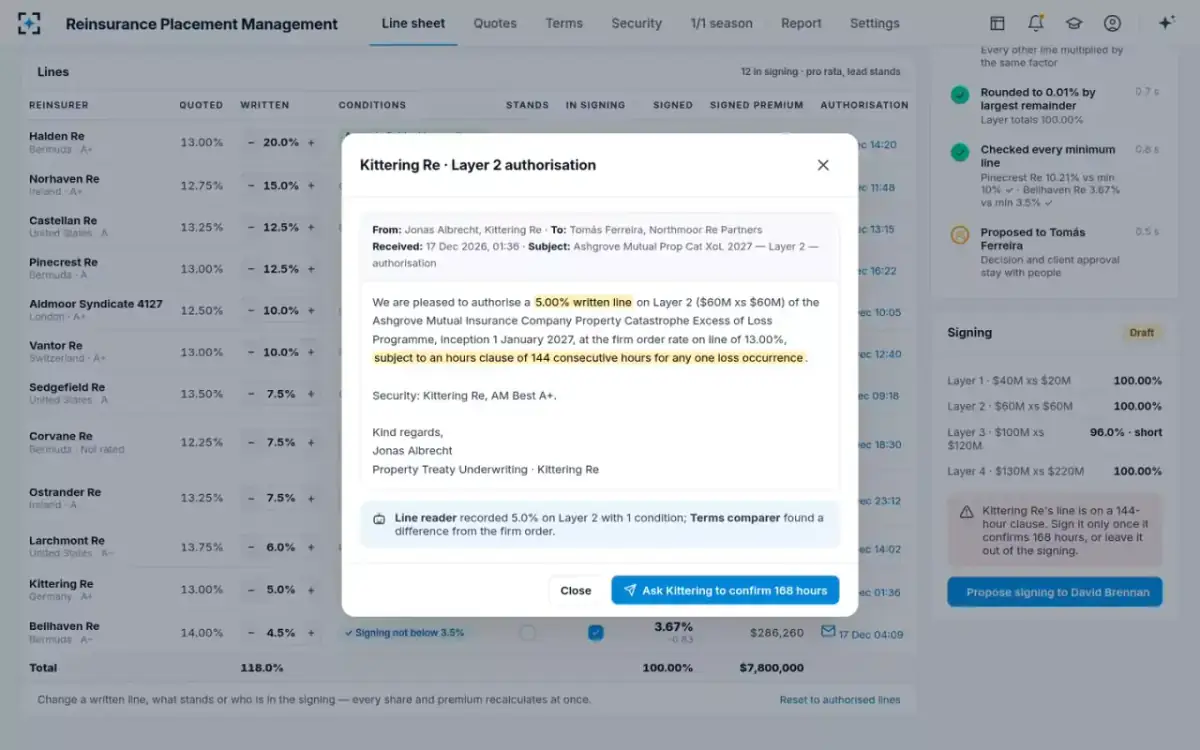
An authorisation in the reinsurer's own words for every line.
The reinsurance intermediary model act in four numbers
10years
after each contract expires, the broker keeps a complete record of the transaction
30days
from receipt, the broker remits funds due to the insurer
11items
the record must show, from limits and territory to proof of placement
$5,000
maximum penalty for each separate violation, before license and civil remedies
Three items do most of the work in a dispute. The rate used to compute the premium decides whether the accounts are right. The names of the assuming reinsurers decide who owes the claim. And written evidence that each reinsurer agreed decides whether there is a contract at all. A verbal "we're on for 5%" at 11 p.m. is not that evidence; the authorisation that follows it is.
Proof of placement, line by line
The act asks for "proof of placement" without defining it, so the file has to prove it from parts. For a subscription program the parts are the firm order terms, each reinsurer's written authorisation on those terms or with stated conditions, the signing that reduced over-placed layers to 100%, the client's acceptance of that signing, the signed-line advices, and the signed contract. Statutory accounting adds a deadline: a multi-reinsurer contract not signed within nine months of the period's start is presumed retroactive unless the lead reinsurer signed within that time, the rule carried into SSAP No. 62R.
Where each piece of proof comes from in a 1 January placement
| Proof | Comes from | What breaks it |
|---|---|---|
| Each reinsurer agreed | Its written authorisation, naming layer, share, rate and conditions | A line recorded from a phone call, or a condition left off |
| Agreed on what terms | The firm order terms, compared clause by clause with each authorisation | A shorter hours clause or a different exclusion signed as if it were the firm order |
| How much each one took | The signing: written lines reduced to 100% by the agreed method | A minimum line broken, a line that should stand cut, rounding that leaves 99.99% |
| The client accepted it | The client's approval of the signing, with any open point stated | Advices sent before approval |
| Each reinsurer was told | Signed-line advices, one per reinsurer | An advice that differs from the signing |
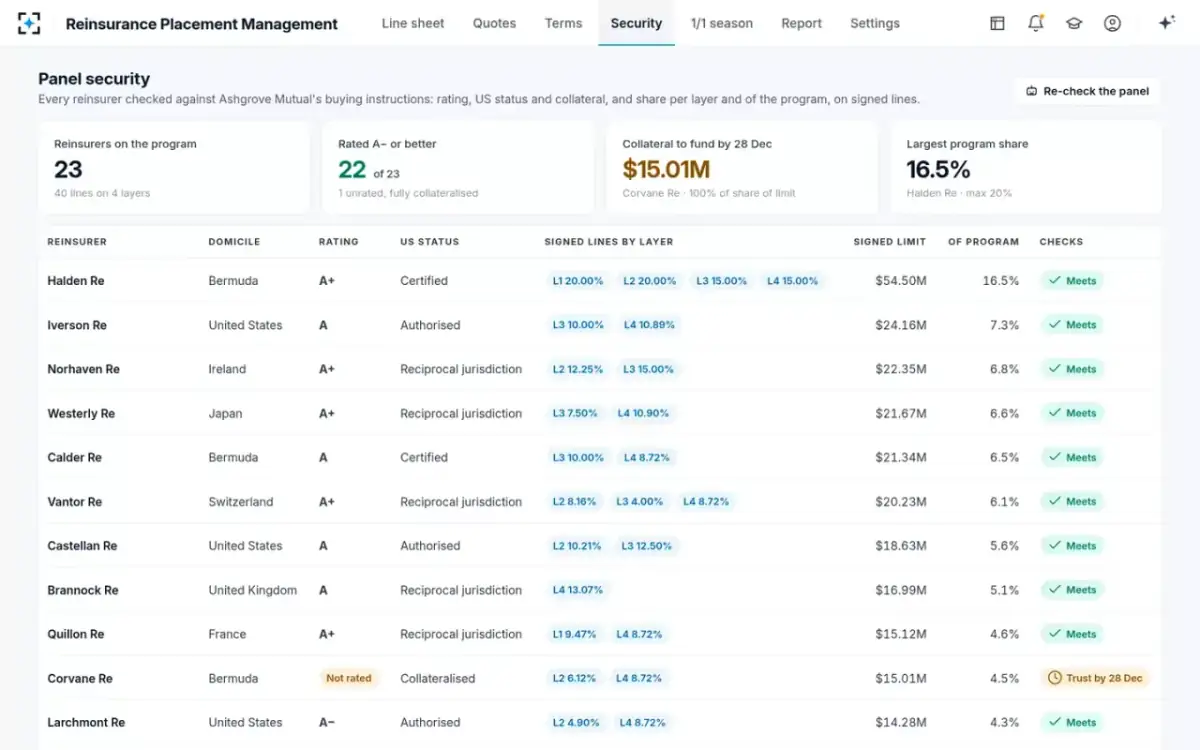
| Security was in place | Ratings, collateral and trust funding checked against the buying instructions | An unrated reinsurer signed before its trust was funded |
Reinsurance Placement Management: written evidence that a reinsurer agreed, opened from its line
What the 2026 Porch appeal says about the placement file
A broker's agreement can promise more than the act, and the Fifth Circuit read one such agreement closely in April 2026. In Porch.com v. Gallagher Re, an insurer's reinsurance intermediary authorization agreement copied the act's record-keeping language and added an administrative-services clause. The facts are the insurer's allegations, accepted as true because the appeal concerned a motion to dismiss: a brokered contract promised a bank letter of credit, the bank later said it had never issued one, and the insurer's regulator placed it under temporary supervision (Porch.com v. Gallagher Re, No. 25-10489).
Three claims about one broker agreement, and how the appeal court treated each
Section 5 · records
What it saidRetain for at least ten years records "in relationship to the reinsurance placed and serviced", including written evidence from any assuming reinsurer that it agreed to assume the risk.
What the insurer allegedThe broker should have obtained from the bank documents showing it agreed to underwrite the risk.
What the court heldDismissal affirmed. "Retain" cannot mean procure documents the broker never had, and a bank is not a reinsurer.
Section 11 · laws
What it saidComply with "U.S., E.U., U.K., and any other applicable economic or trade sanctions laws."
What the insurer allegedThe word "economic" brought Texas insurance law within the clause.
What the court heldDismissal affirmed. "Economic" belongs to the phrase "economic or trade sanctions laws."
Section 13 · servicing
What it saidProvide the servicing a reinsurance broker customarily performs after placement, including administering reserve funding.
What the insurer allegedAfter placement the broker called a collateral letter a letter of credit, ignored red flags and said a $25 million withdrawal was safe.
What the court heldReversed and sent back. What servicing is "customarily performed" is a question of fact for trial.
The records holding is the one brokers should copy into their procedures. The agreement required the broker to retain, from any reinsurer it dealt with directly, written evidence that the reinsurer had agreed to take the risk, and the court held that to retain means to "hold in possession or under control", not to obtain documents the broker never had; the bank, moreover, was not a reinsurer. Read the other way round, the act's file is only as good as what the broker collected at the time. If the written evidence was never obtained, there is nothing to retain.
The servicing holding is the one that should change contracts. Because what is "customarily performed" after placement is a question of fact, a broker that promises post-placement servicing, from completing the signing process to administering reserve funding, may have to prove at trial what it did and that it matched custom. A reinsurance broker's responsibilities in the weeks around inception are set out in a companion guide.
What a regulator or receiver can do with a thin file
The act gives the commissioner direct access to the file and a set of remedies when it falls short. "A reinsurance intermediary shall be subject to examination by the commissioner," who "shall have access to all books, bank accounts and records of the reinsurance intermediary in a form usable to the commissioner" (Model Act #790, Section 10). An intermediary must also comply with court or arbitration-panel orders to produce non-privileged documents or testimony about any transaction it handled, and failing to comply is "deemed to be a material non-compliance with this Act."
For material non-compliance, the commissioner may order a penalty of up to $5,000 for each separate violation, revoke or suspend the license, and, where the insurer or reinsurer suffered loss, bring a civil action for compensatory damages on its behalf. If the insurer is in rehabilitation or liquidation, the receiver may sue the intermediary for damages. Florida's version adds that an intermediary in violation must "make restitution to the insurer, reinsurer, rehabilitator, or liquidator … for the net losses incurred by the insurer or reinsurer attributable to the violation" (Fla. Stat. § 626.7492(11)).
The model act and Florida's enacted text, where they differ
| Point | NAIC Model Act #790 | Florida § 626.7492 |
|---|---|---|
| Who is a broker | Places cessions for a ceding insurer "without acting as a RM on behalf of the insurer" | Places cessions with no power to bind the ceding insurer |
| Licensing | Licensed producer or reinsurance intermediary | Licensed producer, or an insurance agency appointed as a reinsurance intermediary |
| Who enforces | The commissioner | The department for intermediaries; the office for insurers and reinsurers |
| Remedy for loss | Commissioner may bring a civil action for damages | Intermediary must make restitution for net losses attributable to the violation |
| Manager exclusions | Four listed | Adds an underwriting manager whose facultative business is under 10% of the reinsurer's assumed premium |
Building the file as the placement happens
The cheapest placement file is the one assembled during the placement, because every item on the act's list exists in the broker's inbox at some point in December. The expensive one is rebuilt years later from email archives, when a claim, an examination or a receivership asks who agreed to what. The difference is whether each written line was recorded, at the time, against the message that created it.
In Reinsurance Placement Management, the line reader records each written line, its layer and every condition with the passage it came from, and never records a line without the reinsurer's written authorisation. The terms comparer records each clause-by-clause comparison with the firm order. The security checker records each test against the buying instructions. The broker's proposal and the client's approval of the signing are recorded with the person, the time and what was approved, and signed-line advices are released only after that approval. Each step, by agents or people, sits on the program's activity trail. The solution keeps that evidence for each program; the broker's own records policy still decides how it is retained for the ten years the act requires.
The panel as signed in Reinsurance Placement Management: rating, U.S. status, collateral, share
Two items stay outside any placement tool. The written authorization between broker and insurer is a contract the broker's own counsel drafts, and the financial records of premium and loss accounts live in the broker's accounting system. How firm order terms are set and checked, the standard every line in the file is measured against, is annotated in a separate guide.
Questions people ask
How long must reinsurance placement records be kept?
At least ten years after the expiration of each contract under the NAIC model act and Florida's statute. The model's drafting note invites states to shorten the period for contracts limited to first-party property and lengthen it for some third-party liability lines such as medical malpractice, so check the enacted text in each state.
Is the reinsurance intermediary model act law in every state?
It is a model, not a law, until a state enacts it, and enacted versions differ. Florida's § 626.7492 follows the model's broker provisions closely but adds its own definitions, a split between the department and the office for enforcement, and restitution for net losses.
Does a reinsurance broker have to disclose its relationships with reinsurers?
Yes. The written authorization must oblige the broker to tell the insurer of any relationship it has with a reinsurer that will receive the business. The broker's accounts must also carry the information that supports its own commissions, charges and fees.
What does an insurer owe when it uses a reinsurance broker?
It may use only a broker licensed as the act requires, may not employ someone who works for its broker unless the two are under common control, and must annually obtain a copy of the broker's statements of financial condition. It also has the right to audit and copy the broker's records about its business.
Can a broker's records be ordered into an arbitration?
Yes. The model act requires a broker or manager to comply with an order of a court or a duly constituted arbitration panel to produce non-privileged documents or testimony about any reinsurance transaction it handled, subject to objections on scope and timing. Failure to comply counts as material non-compliance with the act.