The NFIP reinsurance placement is the annual "traditional" reinsurance FEMA buys for the National Flood Insurance Program from private reinsurers, alongside multi-year catastrophe bonds placed in the capital markets. For 2026, the honest answer to most questions is the published record up to 2025: FEMA's reinsurance program page, last updated on 30 April 2026, lists traditional placements and public notices through 2025 and no 2026 placement figures. The latest placement FEMA has published, for 2025, transferred $757.835 million of NFIP risk to 27 private reinsurers, up from 18 the year before, for $139.9 million of premium, covering 12.0334% of losses between $7 billion and $9 billion and 25.8584% of losses between $9 billion and $11 billion from a single qualifying flood event. Because FEMA publishes the panel size, the premium and the layer percentages every year, the NFIP is the one property catastrophe placement anyone can study over time. Botminds' Reinsurance Placement Management is an agentic solution for treaty brokers that tracks exactly these facts (every reinsurer's line, layer and premium) on private programs, where nobody publishes them.
What we know about the NFIP reinsurance placement in 2026
Three things are on the public record and one is not. On the record: the authority to buy reinsurance, which FEMA says comes from the Biggert-Waters Flood Insurance Reform Act of 2012 and the Homeowner Flood Insurance Affordability Act of 2014; the program's structure, "1) “traditional” reinsurance for a one-year term and 2) Insurance-Linked Securities reinsurance (“ILS” reinsurance) involving 3-year catastrophe bonds"; and every traditional placement from 2017 to 2025 (FEMA, NFIP Reinsurance Program). Not on the record when checked: any 2026 traditional placement. The page's list of public notices for traditional placements runs from 2017 to 2025, and its summary tables carry no 2026 row.
The capital-markets side has moved on its own clock. FEMA's table shows a bond covering 7 March 2023 to 7 March 2026, now expired, and one covering 7 March 2024 to 7 March 2027, which paid $88.43 million of premium in its first year for 10% of losses between $8 billion and $9 billion and 23.75% of losses between $9 billion and $11 billion. Separately, the program's own authorization is short-dated: FEMA's reauthorization page says "Congress must now reauthorize the NFIP by no later than 11:59 p.m. on Dec. 11, 2026" after legislation extending it was signed on 2 September 2026 (FEMA, Congressional Reauthorization).
How many reinsurers are on the NFIP program?
Twenty-seven on the 2025 traditional placement, the latest published. FEMA's Assistant Administrator for Federal Insurance put it in panel terms when announcing it: "We now have 27 reinsurers, up from 18 last year" (FEMA, 15 January 2025). Over nine placements the panel has ranged from 18 to 32 reinsurers, and its size has moved with the amount of risk FEMA chose to transfer.
Reinsurers on each NFIP traditional placement, 2017–2025
Read with the risk transferred, the panel tells a second story. In 2018, $1.46 billion was spread across 28 reinsurers, about $52 million each on average; in 2025, $757.8 million was spread across 27, about $28 million each. The 2025 panel is as wide as the 2018 one with lines roughly half the size, which is what a broader market appetite for smaller lines looks like from the cedant's side. Those averages are our arithmetic on FEMA's figures; FEMA does not publish individual reinsurers' shares.
How much does FEMA pay for reinsurance?
For 2025, $139.9 million for $757.835 million of cover, which is about 18.5% of the risk transferred. Dividing premium by limit gives a rate on line for the whole placement, and FEMA's published figures allow it to be computed for every year. It rose from about 14% in 2017 to a high of about 19.5% in 2024, and eased to about 18.5% in 2025.
What FEMA paid per dollar of flood risk transferred, 2017–2025
The ratio is not a market index. Each year's cover sits at a different height and takes a different share of each band, so a higher ratio can mean a lower attachment rather than a harder market. What it does show is the cost FEMA accepted for the structure it chose. Across the nine placements, FEMA's published premiums add up to about $1.49 billion, by our sum; how a broker's pay relates to premiums like these is the subject of how reinsurance brokers make money.
The 2025 layers, read like a slip
The 2025 placement is a percentage share of two bands of NFIP losses, which makes it easy to read the way a broker reads a slip. Each percentage, applied to the width of its band, gives the limit in dollars, and the two limits add up to the risk transferred.
The 2025 NFIP traditional placement, layer by layer
| Band of NFIP losses (one flood event) | Width | Share placed | Limit placed |
|---|---|---|---|
| $7 billion to $9 billion | $2 billion | 12.0334% | $240.7 million |
| $9 billion to $11 billion | $2 billion | 25.8584% | $517.2 million |
| Both bands | $4 billion | — | $757.8 million (FEMA: $757.835 million) |
The latest published NFIP traditional reinsurance placement, 2025
$757.8M
of NFIP risk transferred to private reinsurers
27
reinsurers on the panel, up from 18 the year before
$139.9M
total premium FEMA pays for the cover
$7B
of NFIP losses from one flood event before the cover attaches
Three things on that slip are worth a broker's attention. The cover is per occurrence, "arising from a single qualifying flood event", so the event definition is the trigger, just as the hours clause is in a private property catastrophe program. The shares carry four decimal places, which is what a signed percentage looks like once a placement has been finalised. And FEMA keeps most of each band: 87.97% of the first and 74.14% of the second, before counting any capital-markets cover on the same losses. How a written share becomes a signed one is explained in its own guide.
Has FEMA collected on its reinsurance?
Yes, once, in full. FEMA's program page states that "FEMA recovered the entire $1.042 billion in reinsurance under the 2017 traditional reinsurance coverage" after Hurricane Harvey, for which it had paid NFIP policyholders "over $9.03 billion" as of 31 July 2021 (FEMA, NFIP Reinsurance Program). The page adds that "since the 2017 hurricane season, no qualifying events occurred under either of FEMA's existing reinsurance agreements", and that several capital-markets placements "terminated without a covered event".
FEMA also says what the cover is for. Reinsurance "provides the NFIP an additional method to fund payment of flood claims to policyholders and decreases the likelihood that the NFIP will need congressional action to increase its borrowing authority with the U.S. Treasury," and it "does not reduce the size of NFIP's current debt to the U.S. Treasury; rather, it is intended to reduce the accumulation of future debt." A cedant reading its own program the same way would ask the same question: which events would this panel pay for, and how fast?
Traditional and capital-markets cover side by side
FEMA buys two kinds of cover for the same losses, with different triggers and terms. The traditional placement is one-year property catastrophe per occurrence excess of loss cover from reinsurers. The capital-markets placements are three-year catastrophe bonds, written through a transformer reinsurer, and FEMA's page says they "only cover risk from “named storms”", so "a major flood event that is not a named storm would not trigger" them. Reading a trigger like that against a loss is contract-search work; for placement, the point is that two covers on the same band of losses can respond to different events.
Two kinds of NFIP reinsurance, as FEMA describes them
| Traditional reinsurance | Capital-markets (catastrophe bonds) | |
|---|---|---|
| Term | One year | Three years |
| Counterparties | Private reinsurers (27 in 2025) | Capital-market investors, through a transformer reinsurer |
| Trigger | Losses from a single qualifying flood event | Flooding resulting directly or indirectly from a named storm |
| Latest published layers | 2025: 12.0334% of $7–9 billion; 25.8584% of $9–11 billion | 2024 bond: 10% of $8–9 billion; 23.75% of $9–11 billion |
| Latest published price | $139.9 million total premium (2025) | $88.43 million premium for the first year (2024 bond) |
How much of each band of NFIP losses is reinsured?
Stacking FEMA's published covers shows how thin the protection is at the bottom and how much thicker it gets higher up. Between March 2025, when the 2022 bond had expired, and March 2026, three covers sat on the same losses: the 2025 traditional placement and the 2023 and 2024 catastrophe bonds. Adding their published shares band by band gives the share of each $1 billion of NFIP losses that was reinsured.
Share of each $1 billion band of NFIP flood losses reinsured, March 2025 to March 2026
Two things follow for anyone reading the 2026 position. The 2023 bond's three-year term ended on 7 March 2026, so its 5% and 11.25% shares are no longer in the stack unless something replaced them, and FEMA's page, as last updated, shows no replacement. And because the bonds and the traditional cover use different triggers, the same flood can be 60% reinsured or 26% reinsured depending on whether the National Hurricane Center named the storm. A broker stacking a private program has the same job: every cover on a band, its share, its term and its trigger, in one view.
What a private placement can learn from a public one
FEMA's record answers in public the questions every cedant asks its broker in private: who is on the panel, how many of them, what share each takes, and what it costs. A private cedant has to rely on its broker's line sheet, placement report and signed-line advices for the same answers. In states that adopted the NAIC's Reinsurance Intermediary Model Act, the broker's file must hold "names and addresses of assuming reinsurers", the "rate used to compute the reinsurance premium" and each reinsurer's written agreement to the risk (NAIC Model Act #790), so the facts exist. The question is whether they can be read as easily as FEMA's.
Panel breadth has a regulatory side for private cedants too. Under the NAIC's credit for reinsurance model law, a domestic cedant must notify its regulator within 30 days after ceding more than 20% of its prior-year gross written premium to a single reinsurer or affiliated group (NAIC Model Law #785). A 27-reinsurer panel like FEMA's 2025 one is unlikely to come near that; a narrow private panel can.
A private panel, read the way FEMA publishes its own, in Reinsurance Placement Management
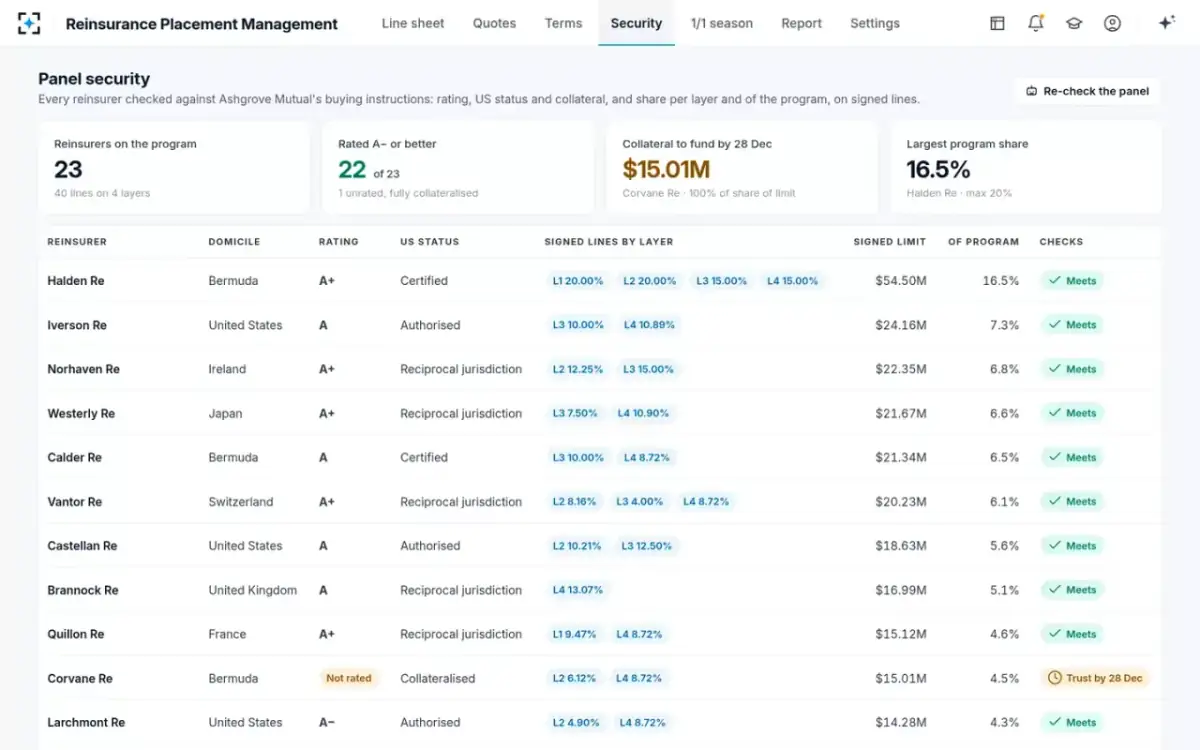
The other lesson is about timing. FEMA's traditional cover in recent years has run on a calendar-year cycle (the 2023 placement, for example, ran from 6 January 2023 to 1 January 2024), so its placement work sits in the same weeks as the private 1 January renewals. What regulators' own numbers say about the 2026 reinsurance market is set out in a companion guide.
What FEMA does not publish: each reinsurer's written and signed line
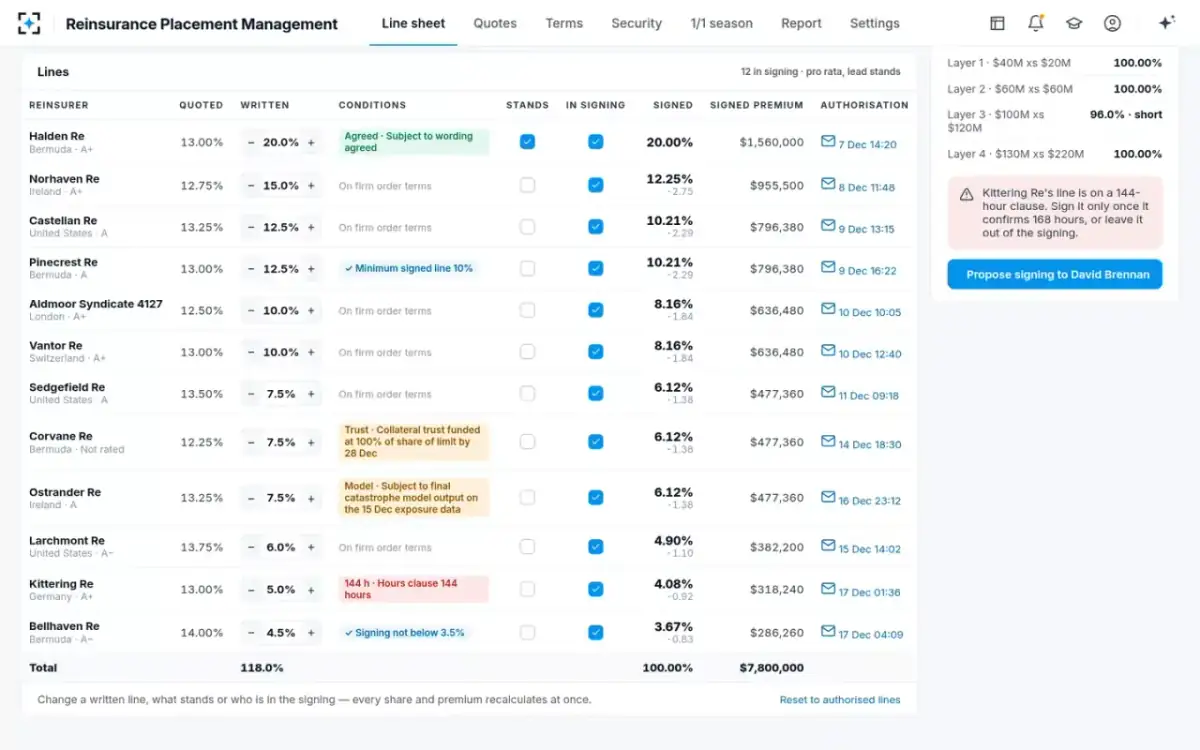
Questions people ask
How much reinsurance does FEMA buy for the NFIP?
The latest published traditional placement, for 2025, transferred $757.835 million of NFIP risk, and FEMA said that with its 2022–2024 capital-markets placements it had transferred $2.058 billion of flood risk in total. Traditional placements since 2017 have ranged from $502.5 million (2023) to $1.46 billion (2018).
Who is FEMA's reinsurance broker?
FEMA hires a private reinsurance broker under contract and names it in each placement announcement; its 15 January 2025 release identifies the broker it engaged "to provide broker services to assist in securing the reinsurance placement." The broker places the cover with the reinsurers; FEMA, as the cedant, decides what to buy.
When does the NFIP reinsurance renew?
The traditional placement is a one-year cover, and recent placements have been announced in January: the 2025 placement on 15 January 2025, and the 2023 placement ran from 6 January 2023 to 1 January 2024. The capital-markets bonds run three years from their own start dates, recently in February or March.
Does NFIP reinsurance affect flood insurance policyholders?
FEMA says it does not change policyholders' contracts: the agreements are between FEMA and reinsurers, and the timing of reinsurance payments "does not impact claims payments to insured flood survivors." It also says reinsurance has a cost, which FEMA will work with the Administration and Congress to cover as the program grows.
Where can I find FEMA's 2026 reinsurance placement?
FEMA's NFIP reinsurance page, last updated on 30 April 2026, lists traditional placements through 2025 and no 2026 placement. FEMA has historically announced each traditional placement by press release and added it to that page's summary table.