A signed lines calculator turns the written lines on an over-placed reinsurance layer into signed lines that total exactly 100%. The core is one formula: lines that stand keep their written share; every other line is multiplied by the factor (100% − standing lines) ÷ (total written − standing lines). Four rules then decide whether the answer is usable: the results are rounded to the agreed precision so the layer still totals 100.00%, every reinsurer's own minimum signed line and the client's minimum are checked, any line written on terms that differ from the firm order is left out or signed only as the client decides, and the whole calculation re-runs when any line changes. On a twelve-line layer written to 118%, with a 20% lead line standing, the factor is 80 ÷ 98 = ×0.8163; rounding each result to the nearest 0.01% leaves the layer at 99.97%, and only a largest-remainder rule brings it back to 100.00%. Botminds' Reinsurance Placement Management includes a sign-down calculator agent that does this on every change and proposes the result to the broker; the broker decides and the client approves.
The worked example is Layer 2 of a fictional sample program in the solution: Ashgrove Mutual's 2027 property catastrophe excess of loss, $60 million excess of $60 million at a 13.00% rate on line, placed by Northmoor Re Partners. All names are invented; the arithmetic is exact. What written and signed lines are, and why layers are over-placed, is explained in a companion guide.
How is signing down calculated?
Signing down is a pro rata reduction with exceptions. Start with the total written on the layer and the lines that the client's instructions say must stand, usually the lead and any line written "to stand". The rest of the layer, 100% minus the standing lines, is shared among the other lines in proportion to what each wrote. The factor that does it is (100 − S) ÷ (W − S), where W is the total written and S the total of standing lines. Each non-standing line's signed share is its written share times that factor.
The factor is the same for every non-standing line, which is why one change moves them all. If a reinsurer increases its line by 1%, W rises, the factor falls, and every other non-standing line shrinks. If a line is withdrawn, the factor rises and every other line grows. A spreadsheet that is not rebuilt after each authorisation is signing yesterday's layer.
Not every client signs pro rata with the lead standing. Some sign every line pro rata, including the lead; some give a preferred order, filling the layer from the reinsurers they most want and cutting the rest. A calculator has to apply whichever method the client agreed, and the method belongs in the client's written buying instructions, not in a broker's memory.
The formula, worked on a twelve-line layer
Take the sample's Layer 2 at the moment the order closed: twelve reinsurers had written 118.0%, the lead's 20.0% stands, so the other eleven lines share 80.0% of a layer they wrote to 98.0%. The factor is 80.0 ÷ 98.0 = 0.816327. The table carries each line through: its written share, the exact product, the result rounded down to 0.01%, the remainder that rounding dropped, and the signed line after the largest remainders are given back their hundredths.
Signing down a twelve-line layer from 118.0% to exactly 100.00%, step by step
| Reinsurer | Written | Written × 0.816327 | Rounded down | Remainder (0.01%) | Signed |
|---|---|---|---|---|---|
| Halden Re (lead, stands) | 20.0% | 20.0000 (stands) | 20.00% | — | 20.00% |
| Norhaven Re | 15.0% | 12.2449 | 12.24% | 0.49 | 12.25% |
| Castelian Re | 12.5% | 10.2041 | 10.20% | 0.41 | 10.21% |
| Pinecrest Re (minimum 10%) | 12.5% | 10.2041 | 10.20% | 0.41 | 10.21% |
| Aldmoor Syndicate 4127 | 10.0% | 8.1633 | 8.16% | 0.33 | 8.16% |
| Vantor Re | 10.0% | 8.1633 | 8.16% | 0.33 | 8.16% |
| Sedgefield Re | 7.5% | 6.1224 | 6.12% | 0.24 | 6.12% |
| Corvane Re | 7.5% | 6.1224 | 6.12% | 0.24 | 6.12% |
| Ostrander Re | 7.5% | 6.1224 | 6.12% | 0.24 | 6.12% |
| Larchmont Re | 6.0% | 4.8980 | 4.89% | 0.80 | 4.90% |
| Kittering Re (144-hour clause, differs) | 5.0% | 4.0816 | 4.08% | 0.16 | 4.08% |
| Bellhaven Re (not below 3.5%) | 4.5% | 3.6735 | 3.67% | 0.35 | 3.67% |
| Layer total | 118.0% | 100.0000 | 99.96% | 4 hundredths to give back | 100.00% |
The money follows the shares. At a 13.00% rate on line the layer's 100% premium is $7.80 million, so the lead's 20.00% carries $1,560,000 and Norhaven's 12.25% carries $955,500; the signed premiums total exactly $7,800,000 only because the signed lines total exactly 100.00%. Pinecrest wrote 12.5% subject to a minimum signed line of 10% and signs at 10.21%; Bellhaven wrote 4.5% subject to signing not below 3.5% and signs at 3.67%. Both minimums hold, and a calculator has to show that it checked them, not merely that they happened to hold.
Reinsurance Placement Management's sign-down calculator, every step shown
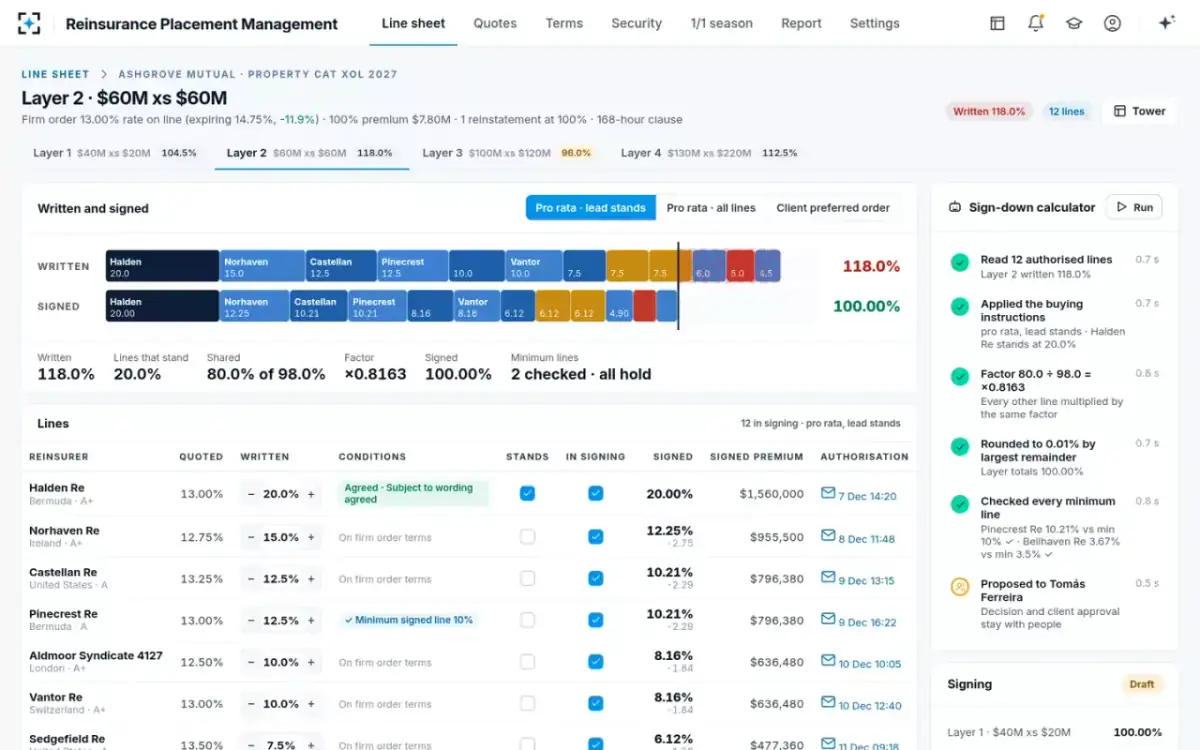
Rounding to exactly 100.00%: why plain rounding fails
Rounding each line to the nearest 0.01% does not guarantee a 100.00% layer, and on this layer it fails. Rounded half up, the eleven non-standing lines total 79.97%, so the layer signs at 99.97%: 0.03% of a $60 million layer, $18,000 of limit, belongs to nobody. Rounded down, the layer signs at 99.96%. Rounded up, it signs over 100%, which no signing may do.
One layer, four rounding rules, four different totals
99.96%
every line rounded down to 0.01%
99.97%
every line rounded half up to 0.01%
>100%
every line rounded up: an over-signed layer
100.00%
rounded down, then 0.01% given back to the largest remainders
The largest remainder method fixes it. Round every non-standing line down to the agreed precision, count how many hundredths are missing (here four), and give one back to each of the lines whose dropped remainders were largest. The total is exact by construction, no line moves by more than 0.01% from its exact share, and the result can be reproduced by anyone with the same inputs.
The method needs one more rule that buyers forget to ask about: ties. If the Layer 2 signing is re-run without Kittering's 5.0% line, the factor becomes 80 ÷ 93 = ×0.8602, two hundredths are missing, and Castelian and Pinecrest, both written at 12.5%, have identical remainders. Only one of them can receive the second hundredth. In the solution's sample, Pinecrest signs at 10.75% in this what-if, so the hundredth went to Castelian. A calculator must apply a stated tie-break, and the same inputs must always give the same signing.
When a minimum line breaks the arithmetic
A minimum line is a floor written into the authorisation: "subject to a minimum signed line of 10%", "signing not below 3.5%". Pro rata arithmetic ignores it, so a calculator has to test every line's result against its floor after rounding and decide what happens when one fails. In the sample both minimums held; the useful case is the one where they would not.
Suppose, as an illustration only, Bellhaven had written 4.5% "not below 4.0%". Its pro rata share, 3.67%, is below its floor. There are two defensible answers, and the client's instructions should say which applies. The line can be held at 4.0%, with the remaining 76.0% (80.0 − 4.0) shared among the other ten lines by a new factor of 76.0 ÷ 93.5 = ×0.8128; or the line can be left out of the signing and the reinsurer told why. Either changes every other signed line, which is why a minimum cannot be checked by eye at the end.
The client's own minimum works the same way from the other side. The sample client's buying instructions set a minimum signed line of 2.5%: "Below this a line is left out, unless the reinsurer's own minimum is higher." A small line written on a heavily over-placed layer can fall under it, and leaving it out raises everyone else's share. A calculator that applies the client's minimum and the reinsurers' minimums in one pass, and re-checks after each, is the only kind that gives the same answer twice.
Lines that stand, and lines left out of the signing
Two kinds of line are outside the pro rata arithmetic. A line that stands keeps its full written share: the lead's, under the sample's instructions, and any line written "to stand". A standard English textbook states the market rule, and a 2024 Commercial Court judgment records its words: Colinvaux's Law of Insurance describes a contract's security details as setting out the subscribing insurers' shares and the "terms of signing down (so that if a line is written “to stand” it may not be signed down)" (Tyson International v GIC Re [2024] EWHC 236 (Comm)). And in a 1998 placement the Commercial Court examined in 2011, the leading underwriter crossed out 25% and wrote "30% to stand", and once a last 4.5% line was scratched the lines came to 101.5% and were later signed down to 100% (Beazley Underwriting v Travelers [2011] EWHC 1520 (Comm); written and signed lines reads the slip).
A standing line changes the factor for everyone else. On the sample layer, if the lead's 20.0% were signed pro rata with the rest instead of standing, every line would be multiplied by 100 ÷ 118 = ×0.8475 and the lead would sign at 16.95%. Standing the lead keeps 3.05% of the layer with the lead that a pure pro rata signing would have spread across the followers, which is why "lead stands" is a client decision written into the buying instructions and not a broker's habit.
A line written on terms that differ from the firm order is the second kind. It is not a share of the layer the client ordered until the reinsurer confirms the firm order terms or the client accepts the difference. The calculator has to sign it in one of three ways the broker chooses: left out, with the layer re-signed without it; included, marked "subject to" the confirmation, as the sample's proposal does for Kittering's 144-hour clause; or included as accepted, once the client has accepted the difference. How firm order terms are set and where lines drift from them is annotated in its own guide.
What a spreadsheet signed lines calculator gets wrong
Spreadsheets get the formula right and the circumstances wrong. A workbook can multiply by a factor perfectly and still sign a layer from a stale list of lines, round to 99.97%, miss a minimum written in an email's last paragraph, or include a line on a shorter hours clause as if it were on the firm order. None of those is an arithmetic error; each is a failure to keep the inputs current and checked.
A spreadsheet calculator and Reinsurance Placement Management's sign-down calculator
Spreadsheet: Keyed in from emails, portal messages and slips, by whoever is on the program.
Sign-down calculator: Read by the line reader from each authorisation, with the passage it came from.
Spreadsheet: When someone remembers to update it.
Sign-down calculator: On every change: a new line, a withdrawn line, a change to what stands or who is in the signing.
Spreadsheet: Whatever the cell format does; often half up, sometimes 99.97%.
Sign-down calculator: 0.01% by largest remainder, so each layer totals exactly 100.00%.
Spreadsheet: Checked by eye, if the condition was noticed.
Sign-down calculator: Every reinsurer's minimum and the client's minimum checked on every run.
Spreadsheet: Included unless someone caught the condition.
Sign-down calculator: Flagged by the terms comparer; signed only as the broker and client decide.
Spreadsheet: Whatever the person sending it does.
Sign-down calculator: Propose only. The broker decides, the client approves, and no agent sends an advice.
Ten test cases for any signed lines calculator
Test a calculator on cases where you know the answer, including the awkward ones. The ten below cover the failures that reach signed-line advices. Each can be built from a layer you signed last season; the first two can be checked against the table on this page.
Ten test cases a signed lines calculator should pass
- A layer written to 118% with a standing lead
Expect the factor 80 ÷ 98 and the signed lines in the table above, totalling 100.00%.
- The same layer with one line removed
Expect the factor to rise to 80 ÷ 93 and every other line to grow; check the tie-break.
- A layer where half-up rounding gives 99.97%
The calculator must still sign exactly 100.00%.
- A reinsurer's minimum that pro rata would break
Expect the line held at its minimum or left out, as instructed, and the rest re-signed.
- A line below the client's minimum signed line
Expect it left out, unless the reinsurer's own higher minimum is the governing rule.
- Two lines written to stand
Both keep their full share; the factor is computed on the rest.
- A layer exactly at 100%
Factor ×1.0000; nothing moves.
- A short layer
Nothing is scaled up; the layer signs short and shows the gap.
- A line on different terms from the firm order
It is flagged, and signed only as left out, "subject to" or accepted.
- A late authorisation that supersedes an earlier one
The newer line replaces the older in the signing; both stay on file.
Where the sign-down calculator fits in Reinsurance Placement Management
The sign-down calculator is one of six agents in the solution, and it works on what the other five have checked. The line reader supplies the written lines and their conditions; the terms comparer marks which lines differ from the firm order; the security checker confirms each reinsurer meets the client's rating, collateral and maximum-share rules on signed lines; the calculator then applies the client's signing method, rounds by largest remainder, and checks every minimum. Its result is a proposal. The broker decides, proposes the signing to the client, and the client approves; signed-line advices are drafted by the report writer and released only after that approval.
Every over-placed layer signed down to 100.00%, the lead standing
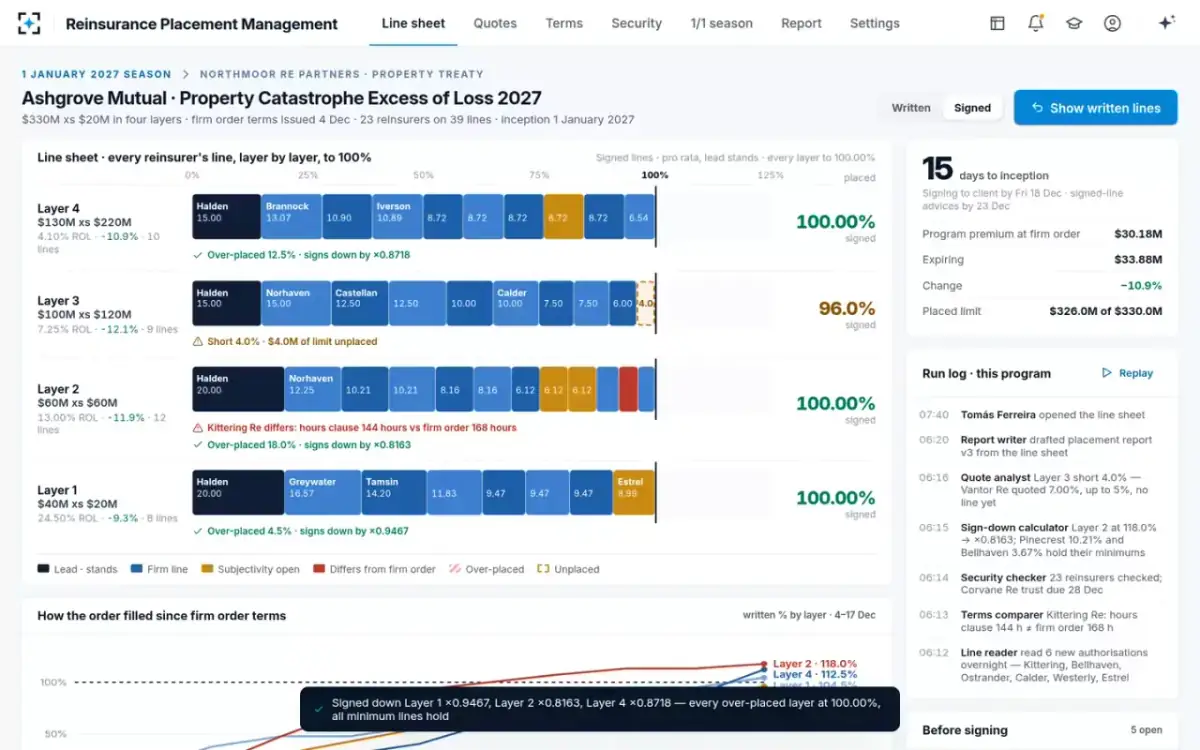
The design target is a checked signing proposal on the same day the order closes. Botminds estimates that signing down and checking minimum lines takes about 3 hours per program by hand in the final fortnight and about half an hour of review with the calculator; that is Botminds' design estimate, not a measured result. The bigger gain is that the signing is never stale: when the sample's short layer was filled by a late 4.0% line, the tower re-signed at once. How a placing team adopts a tool like this is the subject of the reinsurance broking software guide; the solution itself is on the solution page.
Questions people ask
What is the formula for signing down?
For a layer signed pro rata with some lines standing: factor = (100% − standing lines) ÷ (total written − standing lines), and each non-standing line's signed share = its written share × the factor. On a layer written to 118% with a 20% lead standing, the factor is 80 ÷ 98 = 0.8163.
Why do signed lines not add up to 100%?
Usually because each line was rounded on its own. On the sample layer, rounding every line half up to 0.01% gives 99.97%. Rounding down and then giving 0.01% back to the lines with the largest remainders makes the layer total exactly 100.00%.
Is the lead line signed down?
Only if the client's signing method says so. Many programs sign pro rata with the lead standing, so the lead keeps its full written line; others sign every line pro rata. On the sample layer, signing the lead pro rata would cut it from 20.00% to 16.95%.
What happens if signing down takes a reinsurer below its minimum line?
The line cannot simply be signed below the reinsurer's condition. Depending on the client's instructions it is held at its minimum, with the rest re-signed by a new factor, or left out of the signing. Either way every other signed line changes, so the check has to run before the signing is proposed.
Can a signing go over 100%?
No. An over-placed layer is signed down to exactly 100%, and a short layer is signed short; no line is scaled up to fill it. The sample client's settings say it plainly: signed lines over 100% are never allowed on a layer.