AI reinsurance brokers, in the sense of software that places a treaty on its own, do not exist and would not be lawful in most of the placement: a broker cannot bind the cedant, a reinsurer's line counts only when the reinsurer agrees in writing, and the client decides what it buys. What AI agents can do is the work between those decisions. They can read every quote and authorisation as it arrives, lay each line against the firm order terms clause by clause, build the quote comparison by layer, check every reinsurer against the client's buying instructions, compute the signing down to exactly 100%, and draft the placement report and signed-line advices. Botminds' Reinsurance Placement Management is built that way: six agents read, compare, check and calculate, the broker proposes, and the client approves. The supervisors' own evidence points the same way: in the Bank of England and FCA's 2026 survey, 80% of firms using AI agents ran them for decision support, and 2% gave them broad autonomy.
Examples below come from a fictional sample program in the solution, Northmoor Re Partners placing Ashgrove Mutual's property catastrophe excess of loss for 1 January 2027; every company and person in it is invented.
Will AI replace reinsurance brokers?
No, and the reason is legal as much as practical. A reinsurance broker's value sits in three things an agent cannot hold: the client's authority, the market's trust and the judgement to say which reinsurer, at what price, on which terms. The NAIC model act makes the broker the insurer's representative under a written authorization; Florida's enacted text defines the broker as one who places cessions with no power to bind the ceding insurer (Fla. Stat. § 626.7492; a broker's responsibilities quotes it). Binding is a promise between cedant and reinsurer, evidenced by the reinsurer's written agreement and the client's acceptance of the signing.
The FCA's study of London wholesale broking described the broker's role in terms no agent meets: to "place their clients' risks with insurers with the capacity, risk appetite and financial strength to underwrite them", a service "requiring expert knowledge of the risks faced by each client" (FCA, Wholesale Insurance Broker Market Study, February 2019). That study covered facultative reinsurance and excluded treaty, but the sentence describes the treaty broker's market knowledge as well. Software can make that knowledge faster to apply; it cannot supply it.
What AI does replace is a particular kind of hour. In the fortnight before inception a placement broker spends much of the day turning other people's documents into one consistent picture: an authorisation in an email, a written line on a portal, a scanned line slip with a condition in the third paragraph. That conversion work is where agents are already useful, and where errors are easiest to make by hand.
Where a broker's signing hours go, by hand and with Reinsurance Placement Management
By hand · about 17 hours
- Re-keying authorisations and slips · 23.5%
- Checking conditions against the firm order · 17.6%
- Security, shares, collateral · 11.8%
- Signing down, minimum lines · 17.6%
- Report and advices · 23.5%
- Client review · 6%
With the agents · about 4.5 hours of people's time
- Reviewing what was read · 11.1%
- Deciding on differences · 22.2%
- Security exceptions · 11.1%
- Reviewing the signing · 11.1%
- Reviewing report and advices · 22.2%
- Client review · 22.3%
The placement, task by task: what moves and what stays
The useful line is between producing evidence and making a commitment. Every task that turns documents into a checked fact can move to an agent, provided the agent shows where each fact came from. Every task that commits the client, the broker or a reinsurer stays with a person. The table applies that line to a treaty placement from firm order to signed lines.
A treaty placement in Reinsurance Placement Management, task by task: agent or person
| Task | What an agent can do | Who decides |
|---|---|---|
| Reading quotes and authorisations | Read email, portal messages and scanned slips; record the layer, share, rate and each condition with the passage it came from. | Broker reviews; a newer authorisation supersedes, never edits. |
| Laying lines against the firm order | Compare each authorisation with the firm order clause by clause: reinstatements, hours clause, exclusions, wording, premium, security. | Broker and client: a difference is accepted, confirmed back or left out. |
| Quote comparison by layer | Price every quote against the firm order and expiring; find reinsurers who quoted but never wrote. | Broker sets strategy; the client sets the firm order price. |
| Capacity for a short layer | Check a candidate against the buying instructions and draft the request. | Broker chooses whom to ask and sends it. |
| Security checks | Test rating, US status, collateral, maximum share and sanctions on every change to the signing. | Exceptions go to the head of placement. |
| Signing down | Apply the client's signing method, round to 0.01% so each layer totals 100.00%, check every minimum line. | Broker proposes; client approves. |
| Report and signed-line advices | Draft both from the live signing in the broker's template. | Sent only after the client approves. |
| Panel, advice and binding | Nothing. | Broker, client and reinsurers. |
Two tasks look like judgement but are not. Finding capacity for a short layer starts as a search: who quoted this layer below or at the firm order price, with capacity left, and passes the client's security rules? In the sample, Layer 3 was 4% short, $4.0 million of limit and $290,000 of premium; the quote analyst found a reinsurer that had quoted 7.00% against the 7.25% firm order rate with capacity up to 5% and had never written a line. Choosing to ask it is the broker's call; finding it in 11 quotes is not.
The signing is the other. Signing down is a rule applied to numbers: the lines that stand keep their share, every other line is cut by the same factor, the results are rounded so the layer totals exactly 100.00%, and each reinsurer's minimum line is checked. How a signed lines calculator has to work is set out step by step in its own guide.
Can AI read reinsurance quotes and authorisations?
Yes, if it is held to the standard a broker's file is held to: every recorded line must point to the reinsurer's own words. An authorisation is short, but the facts that matter are often buried in a clause. In the sample program, an authorisation received at 01:36 granted a 5.00% written line on Layer 2 at the firm order rate on line of 13.00%, but only on a 144-hour hours clause; the firm order said 168 hours (firm order terms, annotated line by line, shows the slip it departs from). A shorter hours clause can split one storm into more loss occurrences, each with its own retention, which is less cover for the client.
The reinsurer's own words, with the written line and the condition highlighted
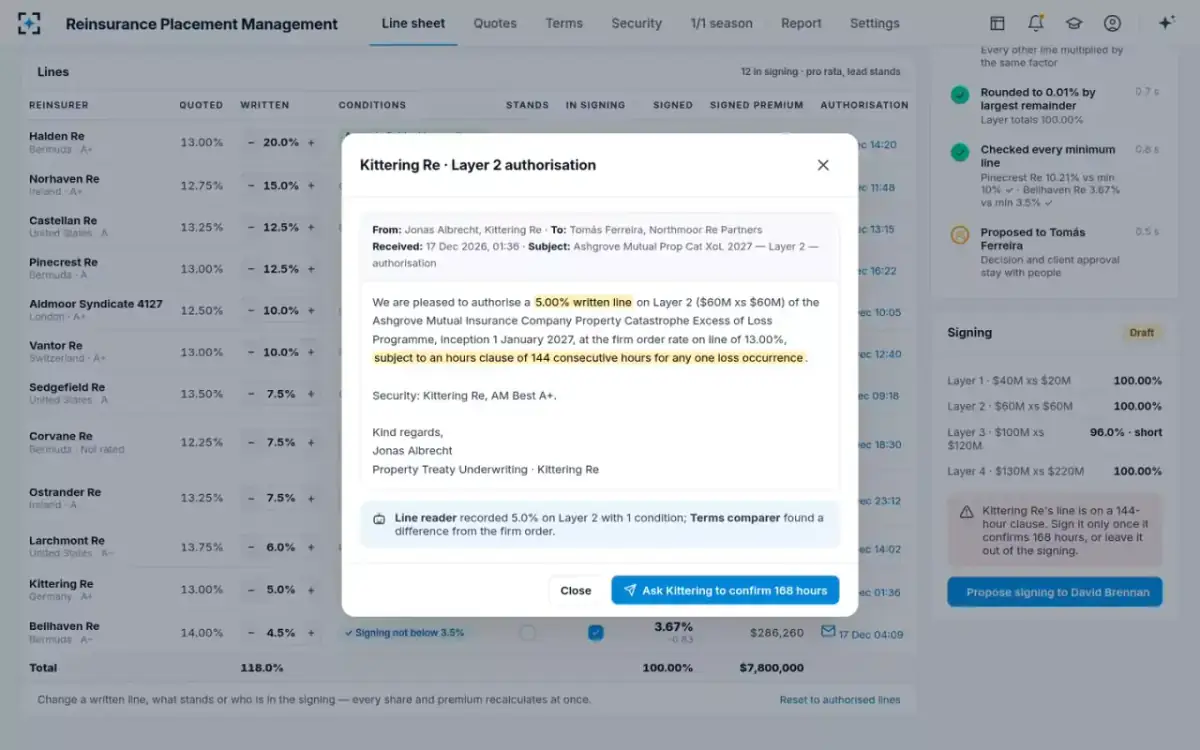
Three design rules make that reading safe to rely on. The agent never records a line without the reinsurer's written authorisation, which mirrors the model act's demand for written evidence that each reinsurer agreed to take its share of the risk (NAIC Model Act #790, Section 5). Every recorded line cites its source passage, so the broker can check it in one click. And a revised authorisation supersedes the old one rather than editing it, so the file shows what the reinsurer said on each date.
What supervisors found firms actually let AI agents do
Firms use agents widely and trust them narrowly. The Bank of England and FCA surveyed 196 UK financial firms in 2026, including insurers, and reported that 80% had AI agents deployed while a further 14% planned to deploy them within a year. But the autonomy was limited: 80% had agents in production for decision support, where agents recommend and people decide and execute, and only 2% had deployed agents with broad autonomy (Bank of England and FCA, AI in UK financial services 2026; what supervisors expect of AI in reinsurance reads the survey in full).
What UK financial firms let AI agents do, 2026
80%
have AI agents in production for decision support: agents recommend, humans decide and execute
22%
have agents with conditional autonomy, acting alone but needing human approval for certain actions
2%
deploy agents with broad autonomy
≤9%
expect, within a year, agents to approve or decline customer outcomes, execute trades or place orders, or move payments
The fourth figure is the one a broker should read twice. Even counting plans over the next 12 months, no more than 9% of firms expected agents to approve or decline customer outcomes, place orders, move or block payments, or change limits and controls (Bank of England and FCA, 2026). Binding a reinsurance line, sending a signed-line advice or releasing premium is that kind of action. The firms' own appetite matches what the law already requires of a placement.
EIOPA's survey of European insurers found the same pattern from the other side: about two-thirds of insurers were already using generative AI, mostly in proofs of concept, and close to two-thirds of the reported uses were internal back-office work (EIOPA, Generative AI market survey; the figures are read in full in the guide to AI in reinsurance underwriting). Placement support is back-office work in that sense: it serves the broker, not the client directly.
Who binds a reinsurance placement?
The reinsurer binds itself by writing a line on agreed terms, and the cedant binds itself by accepting the placement; the broker carries the agreement between them. Under the model act the broker must hold the reinsurer's written agreement to the risk or, where it dealt with the reinsurer's representative, written evidence that the reinsurer delegated binding authority to that representative (Model Act #790). The cedant's side runs through its own buying instructions and its approval of the signing.
The accounting rules add a deadline on the paper. A contract not finalized, written and signed within nine months of the start of its period is presumed retroactive, unless, on a contract with more than one reinsurer, the lead reinsurer that set the terms signed within the nine months (NAIC Issue Paper No. 75, the rule carried into SSAP No. 62R; the 9 month rule explained). No agent signs anything in that chain. In the solution the broker proposes the signing, the client approves it in the client view, and only then are the signed-line advices released, each step recorded with the person, the time and what was approved.
Every authorisation laid against the firm order, clause by clause
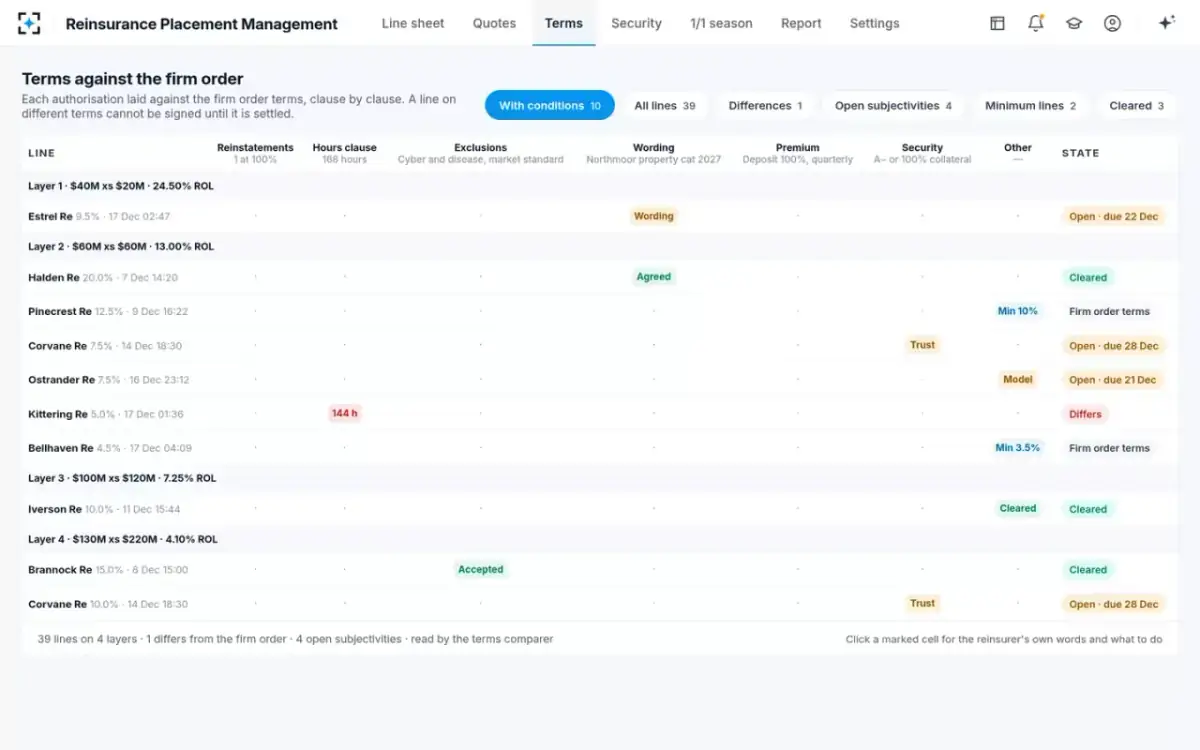
Where AI agents fail in a placement, and how to see it
The main risk is a confident wrong answer, and insurers say so themselves. EIOPA's survey found that insurers "identify inaccurate outputs as the main risk of Gen AI systems, followed by cybersecurity risks, data protection, and lack of explainability" (EIOPA, Generative AI market survey). In a placement, an inaccurate output is a written line read as 5.0% when the reinsurer wrote 0.5%, a condition missed, or a minimum line not applied. Each one flows into the signing, then into the advices, then into the accounts.
The defence is to make every output checkable and every commitment human. The Bank of England survey shows firms leaning on controls before deployment more than after it: human approval, pre-deployment review and vendor due diligence were each reported by more than 90% of respondents, while ongoing monitoring, leakage testing and periodic recertification were each reported by around half (Bank of England and FCA, 2026). For a placement tool that means two questions: can the broker see the source of every number, and does every action that commits anyone wait for a named person?
Six checks before trusting an AI tool with a placement
- Every written line opens on the reinsurer's own words
If a line cannot be traced to a passage in an authorisation, it is not evidence of placement.
- A changed authorisation creates a new version, never an edit
The file has to show what each reinsurer said on each date.
- Differences from the firm order are shown, never silently accepted
A line on different terms goes into the signing only as the client decides.
- The signing recalculates on every change, with every minimum re-checked
A signing built by hand at 3 p.m. is wrong if a line moves at 4 p.m.
- Nothing is sent to a client or reinsurer without a person releasing it
Requests, proposals and advices are drafts until a named person sends them.
- Every agent step and human decision is on the program's trail
Who read, compared, recalculated and approved, and when.
How to test an AI tool on last season's placements
Test it on a renewal you have already finished, where the right answer is known. Take two or three programs from the last 1 January or 1 June season, give the tool the same authorisations, slips and portal messages your team received, in the order they arrived, plus the firm order terms and the client's buying instructions. Then compare what it produces with what your team actually did.
Measure four things. First, reading: for every line, did it record the right layer, share and rate, and every condition, with the passage? Second, comparison: did it flag every line your team treated as differing from the firm order, and how many flags were wrong? Third, the signing: does its signing match the signed-line advices you sent, to 0.01%, and where it does not, which one was right? Fourth, time: how long did your broker spend reviewing its output against building the same picture by hand? A tool that cannot be tested this way, on your own documents, has not earned a place in a live renewal. Getting a placing team to actually use the tool after the test is its own problem, with its own guide.
Capacity for a short layer, found among the reinsurers who already quoted
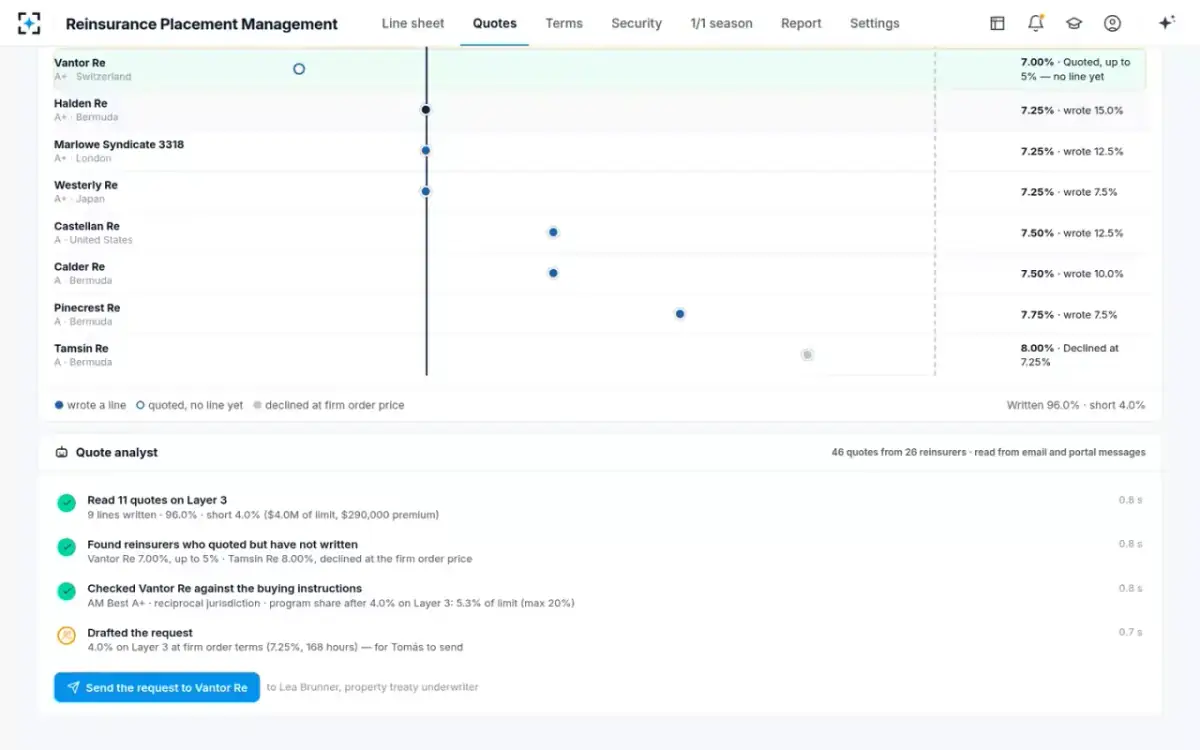
What do clients still need a reinsurance broker for?
For the decisions and the relationships. A cedant needs someone to tell it whether a 144-hour clause is worth accepting to keep a reinsurer on the panel, whether the price on a short layer will come down if it waits, and which reinsurers will pay quickly after a storm. It needs someone who answers for the accounts and the money under a written authorization, and who keeps the file a regulator or receiver will ask for. A reinsurance broker's responsibilities are listed in law, and none of them moves to software.
What changes is the shape of the broker's day. With reading, comparing, checking and arithmetic done by agents that show their sources, the broker's last fortnight is spent on the open points and the client, not the spreadsheet. The design target for Reinsurance Placement Management is a checked signing proposal on the same day the order closes; how a placing team gets there is set out on the solution page.
Questions people ask
How are reinsurance brokers using AI?
Mostly as decision support, as across UK financial services, where 80% of firms using AI agents deploy them to recommend actions that people decide and execute. In placement, the useful jobs are reading authorisations and slips, laying lines against the firm order, building quote comparisons, checking security against buying instructions and computing the signing.
Can AI choose the reinsurance panel?
It can narrow the field, not choose. An agent can test every quoting reinsurer against the client's buying instructions (rating floor, US status, collateral, maximum share, sanctions) and show who has capacity left. Which reinsurers the client wants on its program, and at what concentration, is the client's decision on the broker's advice.
Is it safe to let AI send signed-line advices?
Not without a person releasing them. A signed-line advice tells a reinsurer its final share, and an error has to be corrected with every reinsurer on the layer. In Reinsurance Placement Management the advices stay drafts until the client has approved the signing and the broker sends them.
Do regulators allow AI in reinsurance broking?
None of the supervisory papers cited on this page prohibits it; they focus on governance. In the 2026 Bank of England and FCA survey, more than 90% of firms reported human approval, pre-deployment review and vendor due diligence as data-risk controls. The broker's own legal duties, from accurate accounts to the ten-year placement file, apply whatever tools it uses.
What can AI not do in a treaty placement?
It cannot bind the cedant, accept a difference from the firm order, clear a subjectivity, waive a buying instruction or advise the client. Those acts commit someone, and in the solution each one waits for a named person.