The reinsurance market in 2026 is a buyer's market, and regulators' own figures show it without relying on any broker's or reinsurer's index. Florida's Office of Insurance Regulation, which collects domestic property insurers' planned and actual reinsurance purchases each season, found in its preliminary 2026 data that nearly half of the insurers in its data call saw risk-adjusted pricing reductions of 15% to 25%, and at least a 10% decrease in risk-adjusted costs across most layers on average, after a 27.03% rise in 2023 and two flat years. The Bank of England's Prudential Regulation Authority told insurers' boards in January 2026 that it saw a continuing softening cycle, most pronounced in some London Market wholesale lines and visible in recent reinsurance renewals. EIOPA's supervisory data shows European reinsurers ending 2025 with lower combined ratios and higher solvency than a year before. For a placing broker, a softer market means more capacity chasing each layer, more over-placed layers to sign down, and less brokerage per program. Botminds' Reinsurance Placement Management is an agentic solution for treaty brokers that reads every quote and written line and works out the signing, which is the work a soft market multiplies.
Every number below comes from a regulator, a supervisors' association or a U.S. federal agency, linked where it is used. Where a regulator restates a commercial estimate, this guide leaves it out.
What is happening in the reinsurance market in 2026?
Prices are falling and capacity is plentiful after three years of recovery. The clearest measurement is Florida's, because its regulator asks every insurer in its data call for the risk-adjusted change in what it paid. The series runs from a sharp rise in 2023 to flat years in 2024 and 2025, and then to broad cuts in 2026. In the regulator's words, the initial 2026 data "signifies a favorable reinsurance market with abundant reinsurer capital, healthy competition between traditional and alternative reinsurance markets, and improved terms and conditions" (Florida OIR, Property Insurance Stability Report, July 2026).
Florida's measured reinsurance price changes, year by year, 2023 to 2026
- 2023: up 27.03% on 2022+27.03%
- 2024: down 1.70%−1.70%
- 2025: down 0.46%−0.46%
- 2026, preliminary: nearly half down 15–25%−15 to −25%
Florida's numbers describe one market, but an important one: the regulator calls the state "the most catastrophe-prone state in the United States with 8,436 miles of shoreline" and says its domestic property insurers lean on reinsurance more than most to pay for catastrophes (Florida OIR, July 2026; Florida's annual reinsurance data call explains what the regulator collects). The 2025 Atlantic season helped: "No named storms made landfall in Florida during the season, and as a result, no Florida catastrophe reinsurance programs were materially impacted."
Are reinsurance rates going down in 2026?
Yes, where they are measured, and by more than in any recent year. Florida's January 2026 report gives the history: on average, risk-adjusted reinsurance costs rose 27.03% from 2022 to 2023, fell 1.70% from 2023 to 2024 and fell 0.46% from 2024 to 2025, a year the regulator described as "supported by nearly flat average risk-adjusted costs" (Florida OIR, January 2026). The July 2026 report added the preliminary 2026 cut of 15% to 25% for nearly half of insurers.
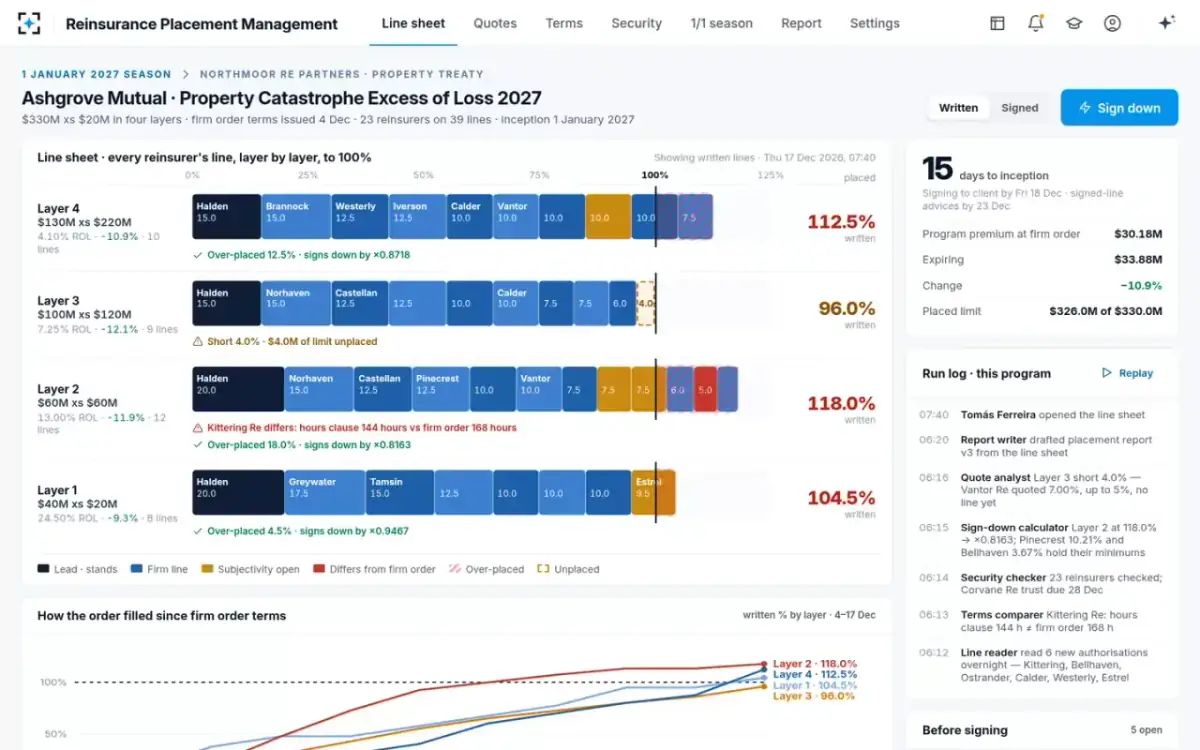
"Risk-adjusted" is the important word. As the term implies, the series measures the change in cost for the risk bought rather than the change in total spend (the reports do not publish the adjustment method), so it reads more like a price change than a budget change. A broker's revenue moves with spend, so it can fall less or more than the measured price. The fictional sample program in the solution shows the effect from the broker's side: its four layers renewed at rates on line between 9.3% and 12.1% below expiring, and its premium at firm order was 10.9% below expiring.
Reinsurance Placement Management: one sample program's price at firm order against expiring
What did regulators say about the 2026 renewals?
The PRA's January 2026 letter on its insurance supervision priorities said it was observing a continuing softening of the underwriting cycle in many general insurance lines, which could put pressure on pricing, terms and conditions and reserving, and that the trend appeared particularly pronounced in some London Market wholesale lines, as recent reinsurance renewal seasons illustrated. It asked boards to keep underwriting discipline and to price and reserve adequately (PRA, insurance supervision priorities 2026).
EIOPA's June 2026 Financial Stability Report drew the same picture from European data. On reinsurance it judged that "the hard market may have peaked before 2025", reported that "the overall growth in non-life reinsurance premiums in the EEA slowed down significantly, especially in non-proportional segment", and noted that cedants' ceded share "decreased slightly in 2025 after increasing steadily for several years", which "may be an early signal of moderation in the hard market conditions" (EIOPA, Financial Stability Report, June 2026). EIOPA also reported market commentary that January 2026 renewals were more accommodating for cedants; that is EIOPA citing others, so it is a direction, not a measurement.
The 2026 reinsurance market, signal by signal, from public bodies only
| Source | What it measured or said | Direction for buyers |
|---|---|---|
| Florida OIR (July 2026) | Preliminary 2026 data: nearly half of insurers down 15–25% risk-adjusted; at least 10% lower across most layers on average | Cheaper, with improved terms |
| PRA (January 2026) | Continuing softening cycle, pronounced in some London Market wholesale lines and recent reinsurance renewals | Softer; supervisors watching discipline |
| EIOPA (June 2026) | Hard market may have peaked before 2025; ceded share fell slightly; EEA reinsurers' median solvency 242% | Softer, with well-capitalised sellers |
| IAIS (December 2025) | Reported gross reinsurance premiums of about $1.75 trillion in 2024; non-life combined ratio stable at 95%; retention ratios up marginally | Large, profitable market; buyers keeping slightly more |
| NAIC (2025 results) | Professional reinsurers' combined ratio improved 3.0 points to 97.7%; casualty lines still above 100% | Property easier than casualty |
| U.S. Treasury FIO (September 2026) | U.S. P&C combined ratio 93.03% in 2025, the lowest in ten years; net reinsurance cessions up 4.7% | Cedants buying more, from a stronger position |
Is the reinsurance market soft? The profit and solvency evidence
The sellers are in good health, which is what makes a market soft. EIOPA's supervisory data shows the median combined ratio for non-proportional reinsurance written by EEA reinsurers falling "by 14 percentage points (pp) to a value of 55%" in 2025, driven by "substantially favourable loss experience", and the median solvency ratio of EEA reinsurers rising "by 11 pp to 242% at end of 2025" (EIOPA, June 2026). When reinsurers are that well capitalised and that profitable on catastrophe business, they compete for lines.
European reinsurers at the end of 2025, from supervisors' data
242%
median Solvency II ratio of EEA reinsurers, up 11 points
55%
median combined ratio on non-proportional reinsurance, down 14 points
€23.5bn
growth in EEA reinsurers' excess of assets over liabilities (2024: €398.4bn)
95%
global non-life reinsurance combined ratio in 2024 (IAIS)
The global supervisors' view is similar. The IAIS reported gross reinsurance premiums of almost $1.75 trillion for 2024, about 23% of global gross premiums written, with net premiums of over $1.2 trillion, and a non-life reinsurance combined ratio "stable at 95% in 2024, recovering from a sharp increase in 2022, which had marked its highest value since 2005"; reinsurers "maintained strong solvency positions at the end of 2024" (IAIS, Global Insurance Market Report 2025). It also found that "reinsurance usage decreased slightly, evidenced by a marginal rise in retention ratios", which is what cedants do when their own balance sheets are strong.
Where reinsurers still lost money
Not every line softened. The NAIC's 2025 results for 21 U.S. professional reinsurers show the group's combined ratio improving 3.0 points to 97.7%, but casualty lines still running above 100%: the regulators' report lists other liability occurrence at 122.3% and other liability claims-made at 107.0%, with non-proportional assumed property at 102.4% and non-proportional assumed liability at 53.3% (NAIC, 2025 full-year results). A broker placing a casualty program in 2026 is in a different market from one placing property catastrophe.
The NAIC data also shows how much of U.S. "reinsurance" is not a market at all. Of $897.8 billion of P&C premium assumed in 2025, 88.9% was affiliated, mostly intra-group pooling. The 21 professional reinsurers' own unaffiliated premium was $51.5 billion, which the NAIC puts at roughly half of all unaffiliated assumed premium in the U.S. property and casualty industry (the casualty reinsurance market in 2025 quotes the report line by line); the industry-wide unaffiliated total implied by those two figures is about $100 billion, by our arithmetic.
How much U.S. reinsurance is a market: assumed premium in 2025, layer by layer
All U.S. P&C assumed premium · $897.8B
- Affiliated, mostly intra-group · 88.9%
- Unaffiliated · 11.1%
Unaffiliated assumed premium · about $100B
- 21 professional reinsurers · 51.5%
- Other insurers · 48.5%
Professional reinsurers' unaffiliated premium · $51.5B
- Non-prop. property · 18.8%
- Other liability, occurrence · 16.1%
- Non-prop. liability · 15.6%
- Other liability, claims-made · 7.7%
- Homeowners · 6.8%
- All other lines · 35%
How much capital do reinsurers have?
Supervisors publish it for the reinsurers they supervise, not for the world. For European reinsurers, EIOPA's Solvency II data shows total assets up about €39.3 billion in 2025 from €881.6 billion, and the excess of assets over liabilities up nearly €23.5 billion from €398.4 billion (EIOPA, June 2026). Global capital totals quoted in the trade are commercial estimates, including the one EIOPA itself cites, and are left out here.
For U.S. cedants the more useful capital question is about counterparties: which reinsurers can take a line without posting full collateral. The NAIC's Reinsurance Task Force materials for March 2026 record, in minutes still marked as a draft, that its working group "has now approved 107 reciprocal jurisdiction reinsurers and 42 certified reinsurers for passporting" (NAIC Reinsurance (E) Task Force, draft minutes of 9 December 2025). A broker widening a panel in a soft market is choosing among those and among authorized reinsurers; an unrated reinsurer still needs collateral funded before inception if the client's buying instructions say so. Monitoring those counterparties after the placement is a separate job.
What a softer market changes for brokers and cedants
Three things, all visible in placement work. First, more capacity per layer means more over-placement: when reinsurers compete for lines, written lines exceed 100% more often and signing down becomes routine rather than occasional. The public example is FEMA's flood program, whose traditional panel went from 18 reinsurers in 2024 to 27 in 2025; its placement is read layer by layer in a companion guide.
Second, brokerage falls with premium. A broker paid a percentage of premium earns less on the same program when its price falls 10% to 25%, while the work of reading, checking and signing the lines stays the same or grows. How reinsurance brokers make money works the arithmetic. Third, softer markets bring conditions as well as capacity: Florida's regulator reported "improved terms and conditions" overall, but individual lines still arrive with their own variations, and in a crowded panel a line on a shorter hours clause or with an open subjectivity is easier to miss.
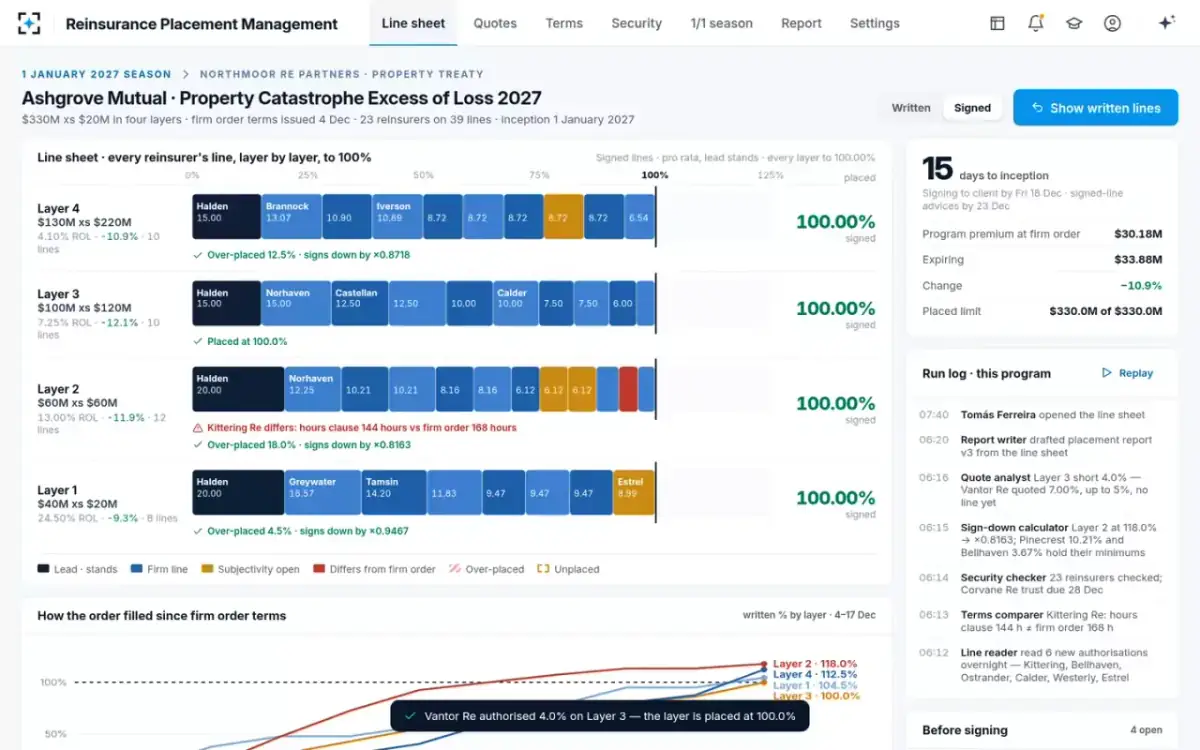
A short layer filled by a late line, in Reinsurance Placement Management
Will reinsurance prices rise in 2027?
No regulator forecasts reinsurance prices, and this guide does not either. What regulators do publish are the facts that drive the next renewal. Florida's 2026 catastrophe stress test results are due in its 1 January 2027 report; as of 15 June 2026, 69% of insurers had filed the 2026 data call and 66% the stress test (Florida OIR, July 2026). The fourth stage of Florida's data call collects the impact of storms on insurers' reinsurance contracts, so a damaging season would show there first. And EIOPA flagged risks that could reverse the trend: natural catastrophe losses, geopolitical risks, and disruption in marine and aviation reinsurance linked to developments in Iran and the Middle East.
For a placement team, the practical answer is to run the 2027 renewals so that the numbers are available the moment the market turns: every quote against expiring and against the firm order, every line against the client's buying instructions, every signing worked out on each change. That is what Reinsurance Placement Management's agents do, with the broker proposing and the client approving; see the solution page.
Questions people ask
Is the reinsurance market soft in 2026?
The regulators' evidence says it is softening. Florida measured risk-adjusted cuts of 15% to 25% for nearly half its insurers in preliminary 2026 data, the PRA described a continuing softening cycle visible in recent reinsurance renewals, and EIOPA judged that the hard market may have peaked before 2025.
How much did reinsurance prices fall at the 2026 renewals?
In Florida, the only government price series this guide could find, preliminary 2026 data showed nearly half of insurers with risk-adjusted reductions of 15% to 25%, and at least a 10% decrease across most layers on average. That followed −0.46% in 2025, −1.70% in 2024 and +27.03% in 2023.
Are casualty reinsurance rates also falling?
The regulators' data points the other way for some casualty lines. NAIC figures for U.S. professional reinsurers show 2025 combined ratios of 122.3% on other liability occurrence and 107.0% on other liability claims-made, so casualty buyers face a different market from property catastrophe buyers.
How big is the global reinsurance market?
The IAIS reported gross reinsurance premiums of almost $1.75 trillion for 2024, about 23% of global gross premiums written, with net premiums of over $1.2 trillion. The figure covers its reporting jurisdictions and includes reinsurance written by composite insurers, so it is larger than estimates limited to specialist reinsurers.
Why do regulators collect reinsurance pricing data?
To judge whether insurers can pay catastrophe claims. Florida's regulator runs its annual data call to assess insurers' financial viability in covering catastrophic losses, collecting planned purchases, actual purchases, the participating reinsurers and contracts, and the impact of storms on those contracts.