Reinsurance broking software is any system a reinsurance broker uses to place and administer its clients' programs: from the market approach and the quotes, through firm orders, written lines and signing down, to signed-line advices and the accounts. The software a placing team actually uses is the kind that meets its work where it already happens. Quotes and authorisations arrive by email, by market portal message and as scanned slips; a tool that needs them typed in again adds work in the fortnight when brokers have none to spare. A tool that reads them, lays each line against the firm order, and shows the reinsurer's own words behind every figure removes work, and the broker keeps the decisions. Botminds' Reinsurance Placement Management is built for that second kind of adoption: six agents read, compare, check and calculate, the broker proposes, and the client approves. The supervisors' 2026 evidence fits that path: in the Bank of England and FCA's survey of UK financial firms, 80% of firms with AI agents in production used them for decision support, where agents recommend and people decide and execute.
This page also answers the related search for reinsurance broker software. Product examples come from a fictional sample program in the solution; every company and person in it is invented.
What is reinsurance broking software?
It is a family of tools rather than one product, and buyers save time by naming which job they are buying for. A reinsurance broker's work splits into the submission the cedant's data feeds, the placement from market approach to signed lines, the wording and contract, the technical accounts and settlement, and claims and recoveries. Each has different inputs, different users and different failure modes. This guide is about the placement: the part of the year where quotes, firm orders, written lines and signing happen, and where a mistake reaches every reinsurer on the layer.
Within placement, the useful test is where the software gets its facts. A line-sheet tool that a broker fills in by hand is a better spreadsheet. A market platform where reinsurers enter their own lines removes keying for the business written on it, but not for the authorisations that still arrive by email and slip. Software that reads every channel into one line sheet, with the source attached, is the only kind that removes the keying everywhere. The levels below put those differences in order.
An adoption plan built around one renewal date
A placing team is best placed to adopt a tool in its quiet months and to test it on real business before the peak, not during it. A plan built backwards from a renewal date, with a replay of last season first, lets the team trust the tool on documents it already knows before it relies on it in December.
Adopting reinsurance broking software around a 1 January renewal
WhenSeptember–October
PhaseReplay last season
What happensFeed two or three finished 1 January programs, in the order their messages arrived. Compare every recorded line, flagged difference and signing with what the team actually did.
WhoAnalytics lead and one broker
Move on whenEvery disagreement traced to a source and explained
WhenNovember
PhaseRun beside the team
What happensLive inbox and portal for one or two programs; the team still builds its own line sheet. The tool's output is checked each morning against the broker's.
WhoThe brokers on those programs
Move on whenBrokers start from the tool's line sheet by choice
When1–20 December
PhaseLive on chosen programs
What happensLines read and checked by the agents; signings proposed by the calculator; every proposal, request and advice still released by a broker.
WhoPlacing team; head of placement for exceptions
Move on whenSignings approved by clients without rework
WhenJanuary
PhaseReview, then widen
What happensCount corrections, missed differences and hours. Settle buying-instruction templates and report formats before 1 April, 1 June and 1 July programs start.
WhoHead of placement
Move on whenA written decision on which programs move next
The replay is the step most teams skip and most need. It turns "does it work?" into a set of countable questions about documents the team already understands: did the tool read each written line's share, layer and rate correctly; did it catch every condition the brokers caught; does its signing match the advices that went out, to 0.01%? Every disagreement is either a tool error to fix or, as often, a hand error the team never noticed. Which placement tasks move to agents, and how to test them on a finished season, are set out in a companion guide.
The November phase is where adoption is won or lost. Its aim is that brokers who have checked the tool's line sheet against their own every morning for three weeks choose to stop keeping their own. Mandating the tool on 1 December, without that run, asks brokers to trust a new picture in the fortnight they can least afford a wrong one.
Reinsurance broker software: five levels of placement automation
Placing teams sit at different points on the same path, and each level needs something different to reach the next. The ladder below runs from a spreadsheet line sheet to agents that propose the signing, and its last row is the one that never moves.
Five levels of placement automation, and what each needs to reach the next
| Level | What it looks like | What it takes to move up |
|---|---|---|
| 1 · Spreadsheet line sheet | Each broker keys authorisations into a workbook; signing down is a formula someone wrote years ago. | One shared line sheet per program, with every line traceable to a message. |
| 2 · Shared placement system, keyed by hand | Lines, layers and reinsurers in one system; still typed in from emails, portal messages and slips. | Reading the channels lines actually arrive on, so keying stops. |
| 3 · Messages read into the line sheet | Authorisations read from email, portal and scans, each line with its source passage. | Laying every line against the firm order and the client's buying instructions automatically. |
| 4 · Lines checked as they arrive | Each line compared clause by clause with the firm order; security, collateral and shares tested on every change. | Proposals: signings, capacity requests, reports and advices drafted for the broker. |
| 5 · Agents propose, people decide | The signing is worked out to exactly 100.00% with every minimum checked; requests and advices drafted; each sent only when a person releases it. | Nothing: this is where the tool stops. |
| Never automated | Choosing the panel, advising the client, accepting a difference, binding, sending. | Brokers, clients and reinsurers. |
Most of the value arrives at level 3, because keying is where hours go and where small errors enter. Botminds estimates that on one property catastrophe program in the final fortnight, re-keying authorisations and line slips takes about 4 of roughly 17 hours spent on the signing by hand, with checking conditions, signing down and drafting the report taking most of the rest. Those are Botminds' design estimates, not a measured result at any broker. Level 4 is where the risk falls: a line written on different terms is caught when it arrives, not when the wording comes back.
Start where the lines already arrive
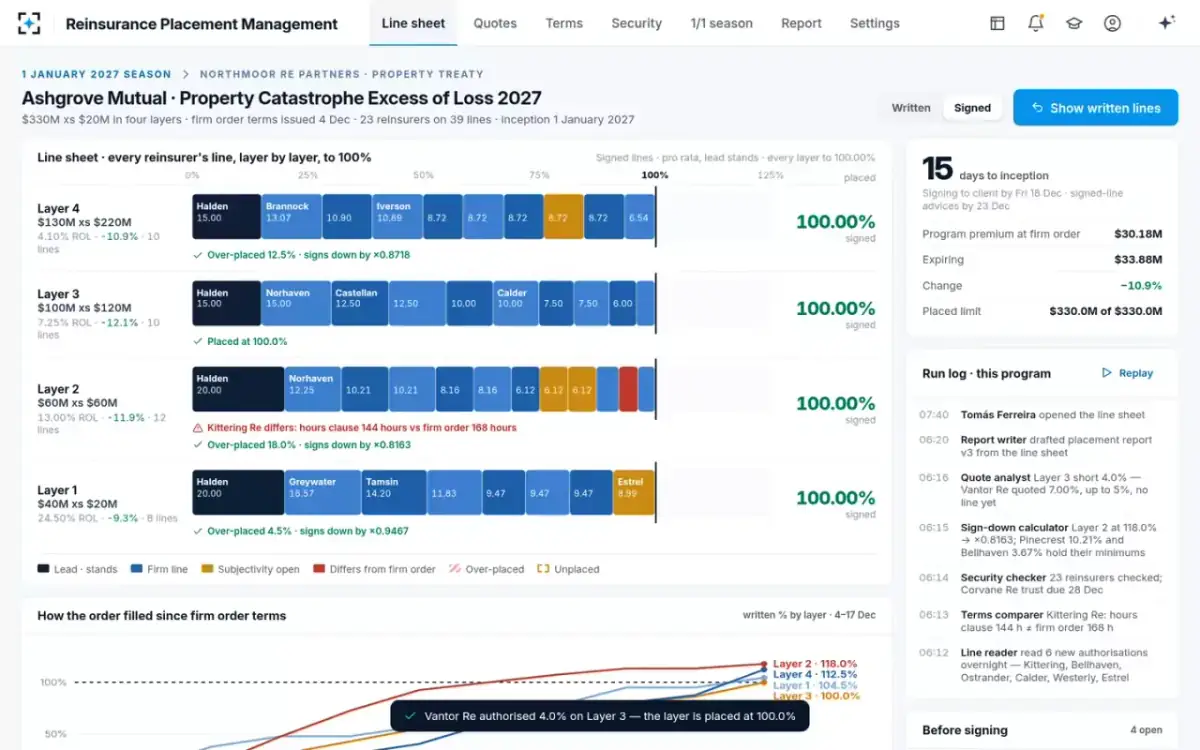
A placing team will not change how reinsurers send it lines, so the software has to read what comes. In practice that is four channels: the placement mailbox, where most quotes and authorisations land; market portal messages; scanned line slips, often with conditions written in; and the firm orders and buying instructions the broker agreed with the client. Reinsurance Placement Management reads all four, records each written line with its layer, conditions and the passage it came from, and treats a newer authorisation as a new version, never an edit.
The order filling, line by line, in Reinsurance Placement Management
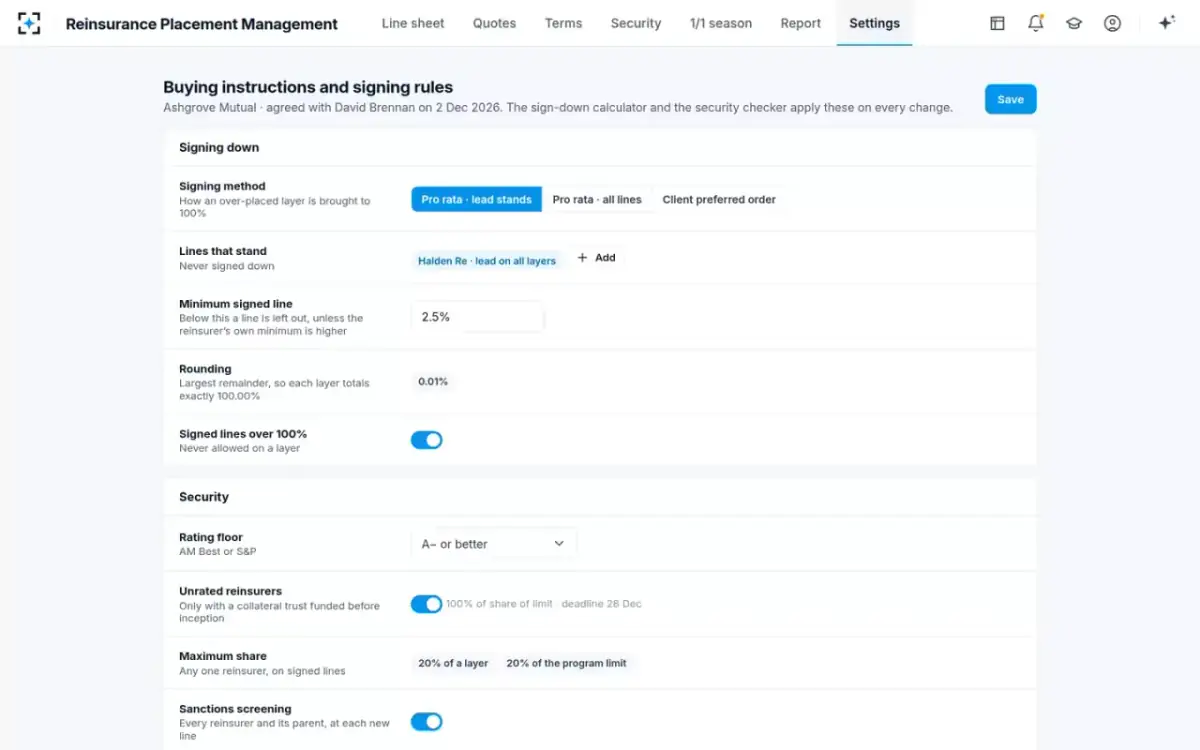
The other half of adoption is the client's rules. Every cedant buys on its own terms: a rating floor, a collateral rule for unrated reinsurers, a maximum share per reinsurer, a signing method, minimum lines. If those live in a broker's head, the tool cannot apply them; if they are settings agreed once with the client, every line is tested against them on every change, and the broker's attention goes to the exceptions. The NAIC's model act already requires a broker to follow the insurer's written standards for ceding risk (NAIC Model Act #790; the act's text), so writing them down is not extra work.
The client's buying instructions, written down once and applied to every line
What supervisors expect when a vendor's AI enters the placement
Supervisors expect the firm, not the vendor, to own the system. EIOPA's opinion on AI governance, written for insurers and reinsurers (a broker's clients and counterparties), says "undertakings are ultimately responsible for the AI systems that they use, regardless of whether the AI systems are developed in-house or in collaboration with third party service providers", and that they "should obtain adequate information and assurances from third-party service providers about the characteristics, capabilities, data used to train and test the AI systems, and the limitations of the AI systems used" (EIOPA Opinion on AI governance and risk management, August 2025).
How UK financial firms govern AI they buy from vendors, 2026
39%
of reported AI systems were third-party implementations, up from 33% in 2024
53%
of high-materiality AI systems were third-party, up from 35%
81%
relied on vendor assurance and contracts to understand third-party systems; 24% had deep knowledge of them
54%
found applying model risk management to vendor-supplied models a challenge
The third figure is the uncomfortable one for any buyer. For systems built in-house, 77% of firms relied on deep knowledge of how they work; for third-party systems, 24% did, and 81% relied instead "on vendor assurance and contractual arrangements" (Bank of England and FCA, 2026). A placing team can close most of that gap without seeing the vendor's code, by insisting on outputs it can check itself: a source passage behind every recorded line, the arithmetic behind every signed share, and a trail of every agent step and human decision.
What to ask a vendor of reinsurance broking software before you buy
Ask questions whose answers you can test on your own documents, not ones a slide can answer. The checklist below is built from the places placements go wrong and from what supervisors told firms to obtain from their vendors.
Questions to put to any reinsurance broking software vendor
- Can it read our last season's mailbox, portal messages and scanned slips as they are?
Ask for a replay on two of your finished programs, scored line by line.
- Does every recorded line open on the reinsurer's own words?
A figure you cannot trace is not evidence of placement.
- How does it treat a revised authorisation?
It should keep both versions with their dates, not overwrite the first.
- Will it show a line on different terms, or fold it into the signing?
Differences from the firm order must reach the broker and the client as a decision.
- Can our clients' buying instructions be settings, applied on every change?
Rating floor, collateral rule, maximum share, signing method, minimum lines, rounding.
- Does the signing total exactly 100.00% with every minimum and standing line kept?
Test it on a layer you signed by hand last year.
- What can it send without a person?
The right answer for requests, proposals, reports and advices is nothing.
- What do you tell us about its limits, its data and its updates?
EIOPA expects firms to obtain this; the Bank of England found regression testing of vendor updates was not universal.
What to measure after the first renewal season
Measure what the tool changed in the placement, not how often it was opened. Five numbers, each countable from the programs the team placed, tell a head of placement whether to widen its use. Corrections: how many recorded lines a broker had to correct, and why. Differences: how many lines on terms other than the firm order the tool flagged before the client or the wording did, and how many it missed. Signings: how many signed-line advices had to be reissued after they went out. Time: hours per program from order close to an approved signing, against the team's own count for the previous season. Exceptions: how many security or buying-instruction exceptions went to the head of placement, and how many were waived.
The first three are quality measures and should fall to near zero; the fourth is the economic case; the fifth is a governance measure that should be stable, not falling, because a falling exception count can mean the rules were quietly loosened. Reinsurance Placement Management's design target for the fourth is a checked signing proposal on the same day the order closes, and every agent step and human decision sits on the program's activity trail, so each of the five can be counted from what actually happened rather than from memory.
Where Reinsurance Placement Management fits, and where it does not
It fits the placement from firm order to signed lines on treaty programs placed by subscription: reading every quote and authorisation, laying each against the firm order terms, building the quote comparison by layer, checking security and shares against the client's buying instructions, working out the signing to exactly 100.00% with every minimum checked, and drafting the placement report and signed-line advices for the broker to release after the client approves. Its six agents are the line reader, terms comparer, quote analyst, security checker, sign-down calculator and report writer, and none of them sends anything on its own. The design target is a checked signing proposal on the same day the order closes.
It does not replace the broker's accounting and settlement system, its client relationship records or its contract drafting, and it does not prepare the cedant's submission. Submission work sits in Reinsurance Submission Preparation, and treaty wording checks in Treaty Wording Comparison. It does not choose the panel or advise the client. And it is only as good as the buying instructions it is given: a rule that lives in a broker's head cannot be applied on every change.
Every program a team is placing for one renewal date, layer by layer
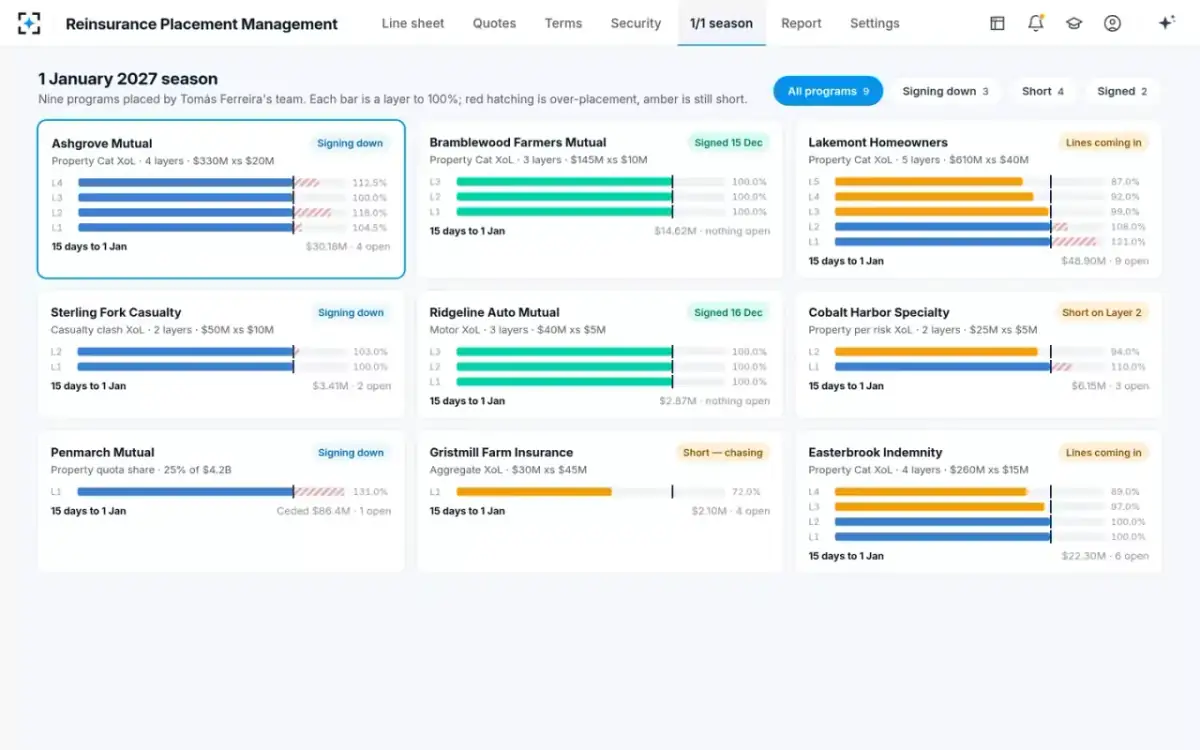
How the signing arithmetic works in detail, and how to test any tool's version of it, is the subject of the signed lines calculator guide. To see the whole placement on a sample of your own authorisations and firm orders, start from the solution page.
Questions people ask
What do reinsurance brokers use to place treaties?
A mix: email and market portals for quotes and authorisations, scanned slips, and a line sheet that is often a spreadsheet. The work that ties them together, laying lines against firm order terms and signing down, is frequently done by hand, which is where reading and checking software saves the most time.
Does reinsurance broking software work with email and portals?
It has to, or the team keeps keying. Reinsurance Placement Management reads the placement mailbox, market portal messages and scanned line slips, and records each written line with the passage it came from.
How long does adoption take?
Plan around a season rather than a date: a replay on last season's programs in the autumn, a few weeks running beside the team, live use on chosen programs at the renewal, and a review before the next date. The timing depends on how many programs and clients' buying instructions have to be set up.
Will brokers use AI tools in the renewal season?
They will use tools that save them time without hiding anything. Firms in the 2026 Bank of England and FCA survey mostly deployed AI agents for decision support, and fewer than one in ten expected agents to place orders or approve outcomes within a year; a placement tool built the same way matches how brokers already work.
Who is responsible if the software gets a line wrong?
The firm using it. EIOPA's opinion says undertakings are ultimately responsible for AI systems they use, whoever built them, and a broker's duties to its client under the model act do not change with its tools. That is why every output should be checkable and every commitment should wait for a person.