Firm order terms in reinsurance are the final terms on which a ceding insurer instructs its broker to place a program: the structure of each layer, the price, the reinstatements, the hours clause, the exclusions, the wording, the premium terms and the security the client will accept. Once the broker issues them, every reinsurer is asked to write a line on those terms, and each authorisation that comes back is measured against them clause by clause. A line written on the firm order terms can go straight into the signing. A line written "subject to" something different (a shorter hours clause, an extra exclusion, a collateral condition, final model output) is a different offer, and it cannot be signed as if it were the firm order until the reinsurer confirms the firm order terms or the client accepts the difference. Botminds' Reinsurance Placement Management is an agentic solution for treaty brokers whose terms comparer lays every authorisation against the firm order this way and marks each condition a difference, an open subjectivity or cleared, without accepting any difference itself.
The annotated firm order below is Layer 2 of a fictional sample program in the solution, Ashgrove Mutual's 2027 property catastrophe excess of loss placed by Northmoor Re Partners; the companies are invented. The legal points come from published English judgments and U.S. statutory accounting, linked where they are used.
What are firm order terms in reinsurance?
They are the client's order, written down. Before the order, reinsurers quote, and the terms move as the broker tests the market. At the order, the cedant chooses the terms it will buy on, and the broker puts them to the market as firm: "write a line on these terms". The English courts use the same vocabulary. In one Commercial Court case the placing broker took the quotation sheet round the market and, once the client gave instructions to proceed, wrote "FON w.e.f. 1/5/05 £10m x/s £10m @ £58,800 net" (a firm order note, with effect from 1 May 2005) at the foot of it and asked the underwriters "to note the assured's firm order with effect from 1st May 2005" (Dunlop Haywards v Barbon [2009] EWHC 2900 (Comm)).
In the London market the terms now live in a standard document. The Court of Appeal described the Market Reform Contract as "the standard form of insurance and reinsurance contract in the London market" and, quoting an earlier Commercial Court judgment, explained that it replaced a practice in which the broker prepared "a “slip” which contained brief details of the risk and its terms", with the formal wording later (Tyson International v Partner Reinsurance Europe [2024] EWCA Civ 363). Whatever the form, the firm order terms are what each written line is compared with, and what the signed contract has to match.
One slip, annotated: the firm order line by line
A firm order reads like a list, but each line does a different job, and some are where reinsurers most often write their own variation. The annotation below takes the sample's Layer 2 firm order line by line, says what each line settles, and marks the lines where a written line can drift from the order.
The firm order for one layer, annotated: what each line settles and where lines drift
Layer 2 · $60,000,000 excess of $60,000,000
The layer the line attaches to. An authorisation that names the wrong layer, or none, is not a written line on this one.
Rate on line 13.00% · 100% premium $7,800,000
The firm order price. A line written at a higher rate is a different offer; the quote analyst never sets this price, the client does.
Reinstatements: one at 100%
How much limit comes back after a loss, and at what premium. A line asking for fewer reinstatements, or a higher reinstatement premium, gives the client less for the same price.
Hours clause: 168 consecutive hours
How long a window of losses counts as one loss occurrence. A shorter clause can split one storm into more occurrences, each with its own retention.Lines drift here
Exclusions: cyber and disease, market standard
The exclusions every line accepts. A reinsurer adding its own exclusion has written on different terms.Lines drift here
Wording: Northmoor property cat 2027
The contract wording the lines attach to. "Subject to wording agreed" is a subjectivity until the wording is agreed.Lines drift here
Premium: deposit 100%, payable quarterly
How and when premium is paid; a line asking for different payment terms has to be put to the client.
Security: A− or better, or 100% collateral
The client's rating floor. An unrated reinsurer can write only with collateral funded before inception.Lines drift here
Signing: pro rata, lead stands; minimum signed line 2.5%
How over-placement is resolved. Lines written "to stand" or with their own minimum signed line change the arithmetic.
Two lines on the annotated order are not about cover at all but about the placement itself: the security line and the signing line. They are the client's buying instructions carried into the order, and they matter as much as the hours clause. A reinsurer that meets every coverage term but is unrated and has not funded its collateral is not yet a line the client can rely on; a reinsurer that writes "minimum signed line 10%" has changed how the whole layer signs down. How written lines become signed lines is explained in a companion guide.
Quote, firm order, written line: three different promises
A quote is a reinsurer's price for terms that may still change; a firm order is the client's instruction on fixed terms; a written line is a reinsurer's agreement to take a share on those terms, or on stated variations. The three happen in sequence, and the most expensive mistakes come from treating one as another: a quote recorded as a line, or a line with a condition recorded as a line on the firm order.
From quotes to signed contract on one 1 January program
- Quotes: terms still movingto 3 Dec
- Firm order terms issued4 Dec
- Lines written on, or against, the firm order4–17 Dec
- Signing approved; advices17–23 Dec
- Subjectivities cleared; collateral fundedto 1 Jan
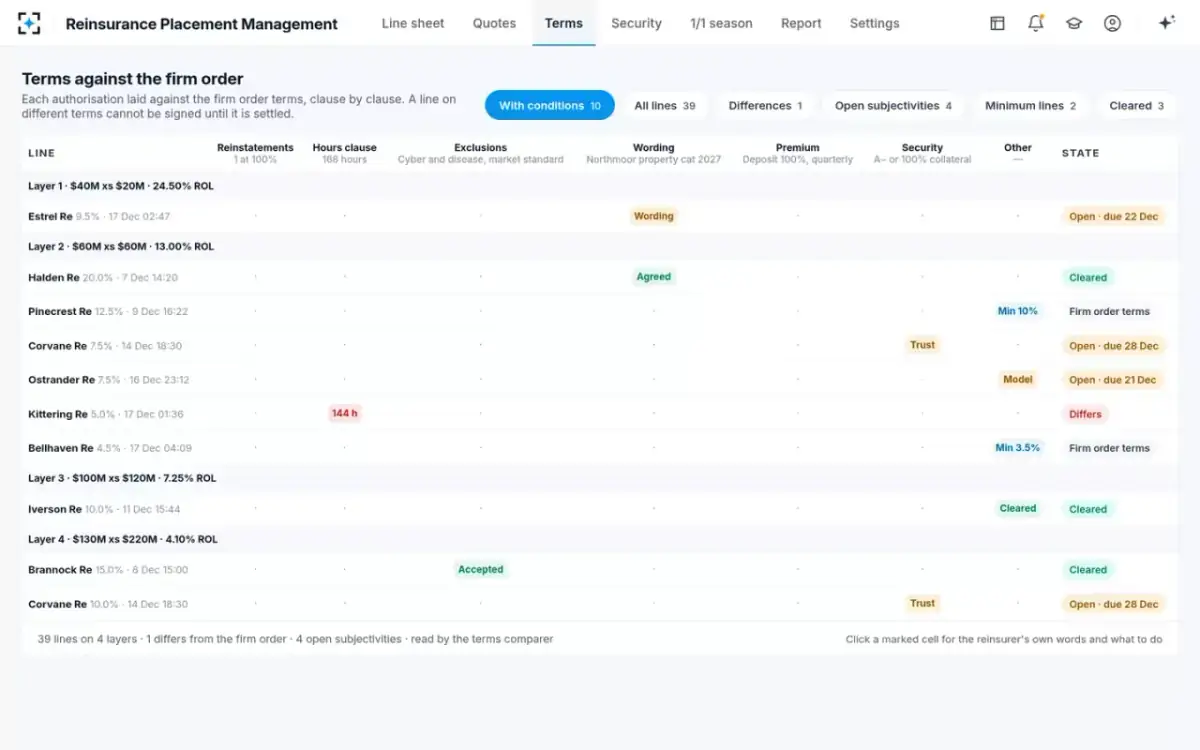
The sample shows how far apart the steps can sit. Firm order terms went out on 4 December; by 17 December, 39 lines had been written by 23 reinsurers on four layers. One line differed from the firm order and four subjectivities were open, each with its own due date, while three layers were over-placed and one was short. Every one of those states is a fact about a line measured against the firm order terms, which is why the terms have to be precise enough to measure against.
Hours clause, reinstatements, exclusions: where lines drift
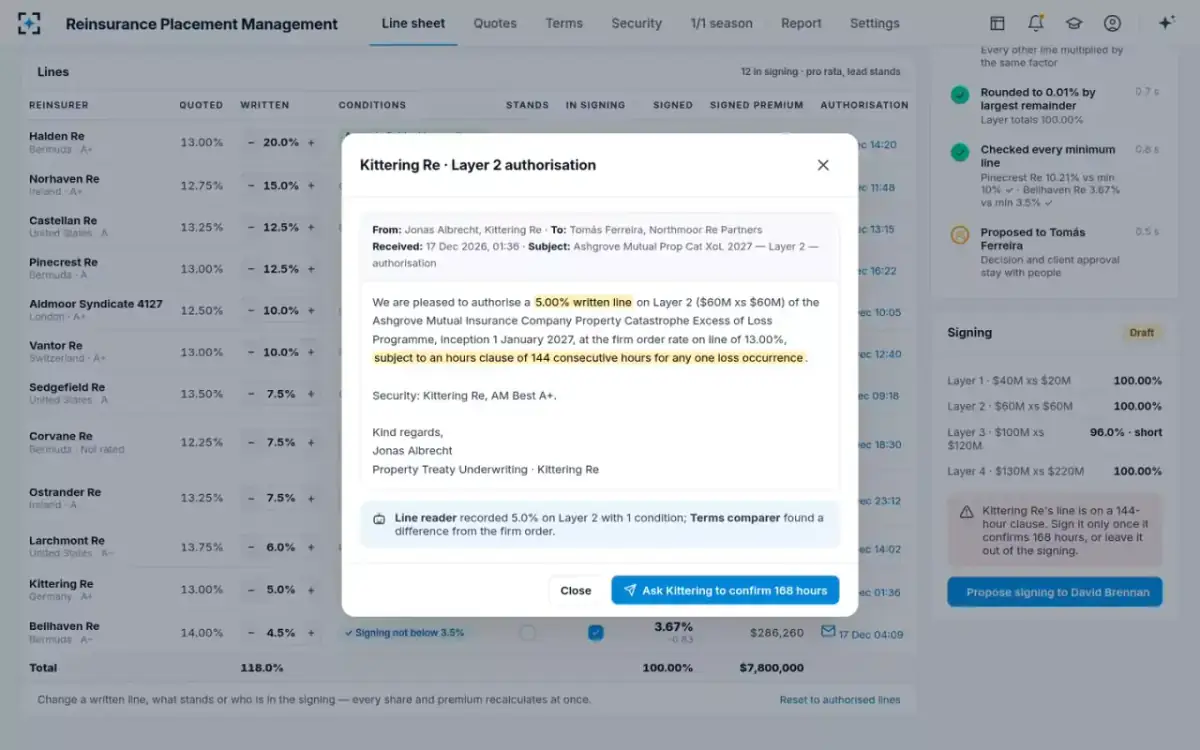
Coverage terms are where a single written line can quietly give the client less cover than it ordered. The hours clause is the clearest case. It sets the window within which losses from one event are aggregated into one loss occurrence; under a property catastrophe excess of loss, a shorter window can turn one storm into two occurrences, each with its own retention. In the sample, one reinsurer authorised 5.00% of Layer 2 "subject to an hours clause of 144 consecutive hours for any one loss occurrence", against the firm order's 168.
How much turns on those words is a matter for the courts. In 2024 the Court of Appeal for England and Wales, construing a 168-hour clause in a property catastrophe excess of loss reinsurance, held that what can be aggregated within the window are losses that first occur during it, even if the financial loss goes on developing afterwards (Unipolsai Assicurazioni v Covéa Insurance [2024] EWCA Civ 1110). A line written on a different number of hours is therefore not a technicality; it changes which losses fall in which occurrence, and so what the reinsurer pays.
Every authorisation against the firm order, clause by clause, in Reinsurance Placement Management
What is a subjectivity in reinsurance?
A subjectivity is a condition a reinsurer attaches to its line that has to be satisfied for the line to stand on the agreed terms: "subject to final catastrophe model output", "subject to wording agreed", "subject to a collateral trust funded before inception". It is not a difference from the firm order but a promise still to be completed, and it has a date. In the sample, four were open on 17 December: final model output due 21 December, an agreed wording due 22 December, and one unrated reinsurer's collateral trust due 28 December on two layers.
The court record shows how easily subjectivities outlive the placement. In Dunlop Haywards v Barbon, a quotation sheet "set out 4 subjectivities"; when the firm orders were noted, "all of the subjectivities set out on the quotation sheets remained outstanding", and "the policies incepted with effect from 1st May 2005, albeit with the subjectivities still in place at that stage" (Dunlop Haywards v Barbon [2009] EWHC 2900 (Comm)). One underwriter had noted the firm order "sub slips within 10 days"; in the event it took longer, and the broker obtained a further 7 days. An open subjectivity with no owner and no date is a line whose terms nobody is tracking.
Security details and the terms of signing down
The firm order is not only about cover; it also fixes who may write and how the layer will be signed. The textbook description of a Market Reform Contract, as recorded in a 2024 Commercial Court judgment, lists six sections: risk details; information given to insurers at placement; security details, consisting of "the subscriptions of subscribing insurers in percentage terms of the financial limits" and the terms of signing down; a subscription agreement naming the slip leader; fiscal and regulatory items; and "broker remuneration and deductions: information relating to brokerage, fees and deductions from premium" (Tyson International v GIC Re [2024] EWHC 236 (Comm), recording Colinvaux's Law of Insurance).
The same description adds a rule worth printing on every firm order: "It is not permitted to include a line condition “wording to be agreed”: all wording must be agreed before the insurer commits to the contract." Treaty programs placed outside that form often do carry wording subjectivities, as the sample does; where they do, the subjectivity needs an owner and a date, and the broker needs to know which lines are still waiting on it. In U.S. statutory accounting the wording has a further deadline: a multi-reinsurer contract the lead has not signed within nine months of the period's start is presumed retroactive (NAIC Issue Paper No. 75, the rule carried into SSAP No. 62R).
What happens if a reinsurer writes on different terms?
The line cannot be signed as a firm order line until the difference is resolved, and only three resolutions exist. The reinsurer confirms the firm order terms, so the line becomes a firm order line; the client accepts the difference, so the line is signed on its own terms with the client's knowledge; or the line is left out of the signing, and the layer is re-signed without it. A broker has no authority to accept the difference for the client.
The order matters because a signing proposal is often due before the reinsurer replies. In the sample, the broker asked the reinsurer to confirm 168 hours, and meanwhile proposed the signing to the client with that line shown as "subject to" the confirmation: its signed share of 4.08% was stated, and the condition with it. The sample's what-if shows the alternative: re-signed without that line, the layer was 113.0% written and every other line moved up (the factor went from ×0.8163 to ×0.8602). Which of these steps agents can take, and which they must leave to people, is set out in a companion guide.
When a later document rewrites the slip
The firm order and the slip or MRC that records it are not always the last word. Two English appeals about the same reinsurance program, decided in 2024 and 2026, show a later document either replacing the slip or yielding to it, depending on one sentence. A captive insurer reinsured U.S. property on a facultative basis; two reinsurers each wrote 10% of excess layers, each first signed an MRC with English law and exclusive English jurisdiction, and each then agreed, eight or nine days later, a facultative certificate on another form with New York law and arbitration.
Same program, same 10% lines, two reinsurers, two results
| Partner Re | GIC Re | |
|---|---|---|
| First document | MRC: English law, exclusive English jurisdiction | MRCs signed 30 June 2021: English law, exclusive English jurisdiction |
| Later document | Certificate agreed 8 July 2021: New York law and arbitration; nothing making it subject to the MRC | Certificates agreed 9 July 2021: New York law and arbitration, plus "RI slip to take precedence over reinsurance certificate in case of confusion" |
| Court of Appeal | 2024: the later contract superseded the MRC; the English action was stayed for New York arbitration | 2026: the MRC prevailed; the two dispute clauses were irreconcilable and the slip took precedence |
There was nothing in the MRC to prevent the parties from agreeing, either expressly or by necessary implication, that the MRC should be superseded by a later contract on different terms. That is what they did.
Lord Justice Males, Tyson International v Partner Reinsurance Europe [2024] EWCA Civ 363
For a placement team, the lesson is about documents the broker itself circulates. In the Partner Re case the court noted that the later form was sent by the reinsured's broker to the reinsurer "for agreement", which it called "the language of contract formation". In the GIC case, the clause that kept the slip on top was one line on the certificate. A firm order, a slip and every later certificate are one chain, and the broker is usually the one holding it. What the broker's ten-year file must contain is set out in a companion guide; the solution itself is on the solution page.
A line on different terms, opened on the reinsurer's own words
Questions people ask
What is a firm order in insurance?
A firm order is the client's instruction to place cover on fixed terms, after quotes have been gathered. Underwriters then "note" the firm order and write lines on it; in one English case the broker wrote a firm order note on the quotation sheet and took it round the market for each underwriter to note.
What is the difference between a quote and a firm order?
A quote is a reinsurer's price and terms while the program is still being shaped; the terms can move. A firm order fixes the terms the client will buy on, and reinsurers are then asked to write lines on those terms, so every line can be compared with one standard.
Who agrees the firm order terms?
The client, on the broker's advice, usually after the lead reinsurer has set the terms others will follow. Under U.S. statutory accounting the lead is the reinsurer that sets the terms for the others, and its signature within nine months is what keeps a multi-reinsurer contract from being presumed retroactive.
Can a subjectivity still be open at inception?
It can, and the court record shows it happening: in Dunlop Haywards v Barbon the policies incepted with all four subjectivities still outstanding. A placement team should treat each open subjectivity as a line with a due date and an owner; the sample client's instructions send reminders 10, 5 and 2 days before inception.
Does the slip or the later wording govern a reinsurance contract?
Whichever the parties agreed should govern. In two 2024 and 2026 English appeals on the same program, a later certificate replaced the slip where nothing subordinated it, and the slip prevailed where the certificate said "RI slip to take precedence over reinsurance certificate in case of confusion".