Reinsurance brokers make money mainly from brokerage: a commission set as a percentage of the reinsurance premium, which the reinsurer bears because it is deducted from the premium before the reinsurer receives it. Some clients pay a fee instead of, or as well as, commission, and some brokers earn extra income from reinsurers and insurers for data, analytics and placement facilities. The FCA's market study of London wholesale broking put it plainly: brokers "are typically compensated for their placement activities in the form of commission, paid by the insurer as a deduction from the GWP", and because "brokers' commission is set as a percentage of premiums, falls in premium rates can adversely impact brokers." For a cedant buying a property catastrophe program in 2026, when Florida's regulator measured risk-adjusted price cuts of 15% to 25% for nearly half of the insurers it surveys, that means the broker is paid less for the same work, and the cedant's test of value shifts from price to the quality of the placement. Botminds' Reinsurance Placement Management is an agentic solution for treaty brokers that cuts the hours a placement takes, which is where a broker's margin is decided.
Two caveats run through this guide. The FCA's study covered London wholesale broking, including facultative reinsurance but not treaty reinsurance, so its figures describe the market around treaty broking rather than treaty broking itself. And no regulator publishes a typical treaty brokerage rate; any percentage used below is a placeholder, labelled as such. Product examples come from a fictional sample program in the solution.
How are reinsurance brokers paid?
In three ways, in order of size. First, brokerage: a percentage of the premium on each line the broker places, deducted from the premium the cedant pays so the reinsurer receives the net amount. Second, fees: the FCA found brokers "may instead (or in addition) be remunerated by charging a fee directly to the client", usually "a fixed fee, expressed as an absolute amount, as opposed to the more typical commission rate (expressed as a percentage of GWP)" (FCA MS17/2.2, February 2019). Third, income from the other side of the market: services sold to insurers and the higher pay earned on business placed through facilities.
The third stream is small but growing, and it is where conflicts sit. Among the brokers the FCA sampled, 15 offered consultancy-style services to insurers in 2016, such as data provision, analytics, sector reports and pipeline discussions, and these "accounted for approximately 8% of their revenues overall." The FCA also found that "8% of GWP was placed using facilities", where underwriters commit capacity in advance, and that "remuneration rates for like-for-like policies were between 4-6% higher via facilities than in the open market in 2016."
Brokerage is a percentage of premium: the arithmetic
Because brokerage is a percentage of premium, a broker's revenue on a program moves with the premium, not with the work. The sample program in the solution shows the effect. Ashgrove Mutual's four-layer property catastrophe excess of loss, $330 million excess of $20 million, renewed for 2027 at $30.18 million of premium at firm order terms against $33.88 million expiring, a fall of 10.9%. At any brokerage rate, the broker's revenue on that program fell by the same 10.9%. The placement work did not: four layers, 23 reinsurers, 39 written lines and three layers over-placed still had to be read, checked, signed down and advised.
A 10.9% cheaper program is 10.9% less brokerage: premium by layer, expiring and at firm order
Put a placeholder rate on it to see the scale. At an illustrative brokerage of 10% of premium (a round number for arithmetic, not a market figure), the program pays $3.39 million of brokerage on the expiring terms and $3.02 million at firm order: $370,000 less for the same placement. A broker cannot recover that by working faster on one program, but across a season of programs the hours per placement decide whether the book still pays for the team.
What a falling reinsurance market does to brokerage
The market has been falling where it is measured. Florida's Office of Insurance Regulation, which collects domestic property insurers' planned and actual reinsurance purchases each season, reported that risk-adjusted reinsurance costs rose 27.03% from 2022 to 2023, then fell 1.70% in 2024 and 0.46% in 2025 (Florida OIR, January 2026). For 2026, its preliminary data showed nearly half of the insurers surveyed seeing risk-adjusted reductions of between 15% and 25%, and at least a 10% decrease in risk-adjusted costs across most layers on average (Florida OIR, July 2026).
The FCA described what that does to a commission-paid broker in a soft market: falling premium rates "can adversely impact brokers", who "can attempt to mitigate this impact by using the competition amongst insurers for business to obtain enhanced commissions and revenues for existing business, or by seeking alternative revenue streams." Both responses matter to a cedant. An enhanced commission from a reinsurer is a cost the cedant may never see on its own invoice, and an alternative revenue stream from the reinsurers on its panel is a relationship it is entitled to know about. The 2026 reinsurance market, read from regulators' numbers, has its own guide.
What the law makes a reinsurance broker disclose about pay
In states that adopted the NAIC's Reinsurance Intermediary Model Act, the broker's pay sits inside its accounts and its file. The written authorization must require the broker to keep accurate accounts of every material transaction, including the information behind every commission, charge and fee it receives or is owed (Florida's enacted wording is quoted in the statement-of-account guide), and to "disclose to the insurer any relationship with any reinsurer to which business will be ceded or retroceded" (NAIC Model Act #790, Section 4). The ten-year record must show the "rates of all reinsurance commissions, including the commissions on any retrocessions handled by the RB."
Brokerage and a fee: who pays, what it moves with, what the cedant sees
Brokerage (commission): Deducted from the premium the cedant pays, before the reinsurer receives it.
Fee: Paid by the client directly.
Brokerage (commission): The premium: falls when prices fall, rises when they rise.
Fee: Whatever was agreed; the FCA found it usually a fixed amount.
Brokerage (commission): In the FCA's words, brokers "may prefer to award business to an insurer willing to pay a higher rate of commission."
Fee: Neutral between reinsurers; the broker earns the same whoever writes.
Brokerage (commission): The rate on each line, in the accounts and the file the model act requires.
Fee: The invoice, and whether any commission is also taken.
The FCA framed the commission problem as a principal-agent one: "All things being equal, clients would prefer that the broker charge a lower commission rate as this should be reflected in a lower premium. Brokers, on the other hand, may prefer to award business to an insurer willing to pay a higher rate of commission." It did not find that this was harming clients across the market, and it closed the study without intrusive remedies, but it left conflicts, client information and certain broker-insurer contracts to normal supervision. A cedant's defence is the one the model act already gives it: ask for the commission on every line and every relationship with every reinsurer, in writing, before the signing.
Do reinsurance brokers work for the cedant?
Yes. The model act defines the reinsurance intermediary-broker as one who places cessions "on behalf of a ceding insurer", owes it accounts and a fiduciary's care of its money, and must follow the insurer's written standards for ceding risk (the model act, section by section). The Bureau of Labor Statistics describes brokers generally the same way: they "represent their clients, rather than insurers" (BLS Occupational Outlook Handbook).
Being paid by deduction from the reinsurer's premium does not change whom the broker works for, but it explains why disclosure matters. The FCA tested one form of conflict in reinsurance directly: whether brokers that place a risk can force the insurer to use them for its facultative reinsurance. Of 6,200 reinsurance placements from 2016 it reviewed, 65% of net ceded premium went to the original broker and 35% to a different one, and it "did not find any evidence that the likelihood of a broker being named as facultative reinsurance broker is associated with a broker's share" of the market, while noting it could not rule the practice out.
How London wholesale brokers were paid, in the FCA's market study
8%
of revenue came from consultancy-style services sold to insurers, among the 15 brokers offering them in 2016
8%
of gross written premium was placed through facilities
4–6%
higher remuneration rates on like-for-like policies placed via facilities than in the open market, 2016
65%
of net ceded premium in the facultative reinsurance placements reviewed went to the original broker
What brokerage should buy: six things a cedant can check
A cedant cannot judge a broker by the premium alone, because a cheaper program may simply be a softer market. It can judge the placement. Each of the checks below has evidence in the broker's file, and each one fails in ways that cost the cedant more than the brokerage.
Six things brokerage should buy, and the evidence for each
- A panel that meets the buying instructions on signed lines
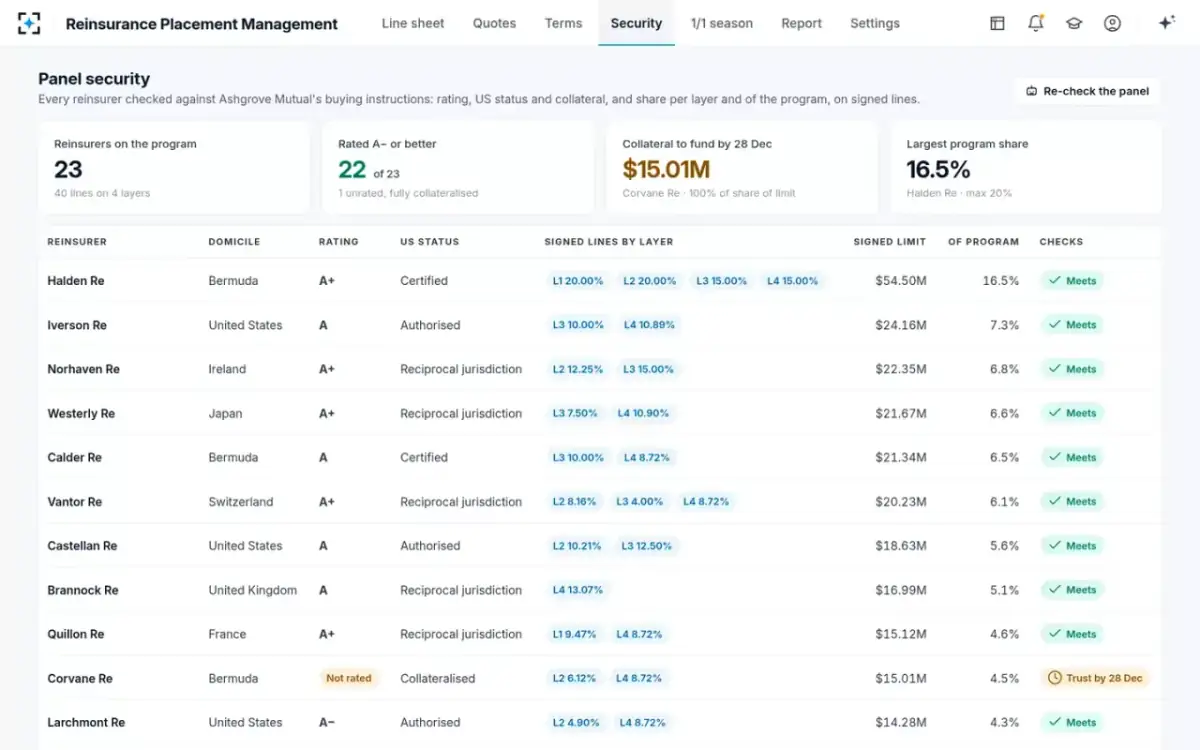
Rating floor, U.S. status, collateral for unrated reinsurers and maximum share, checked after the signing, not only at quote.
- Every line on the firm order terms, or a difference put to you in writing
A shorter hours clause or a narrower exclusion is less cover; it should reach you as a decision, not as a surprise in the wording.
- A signing that holds
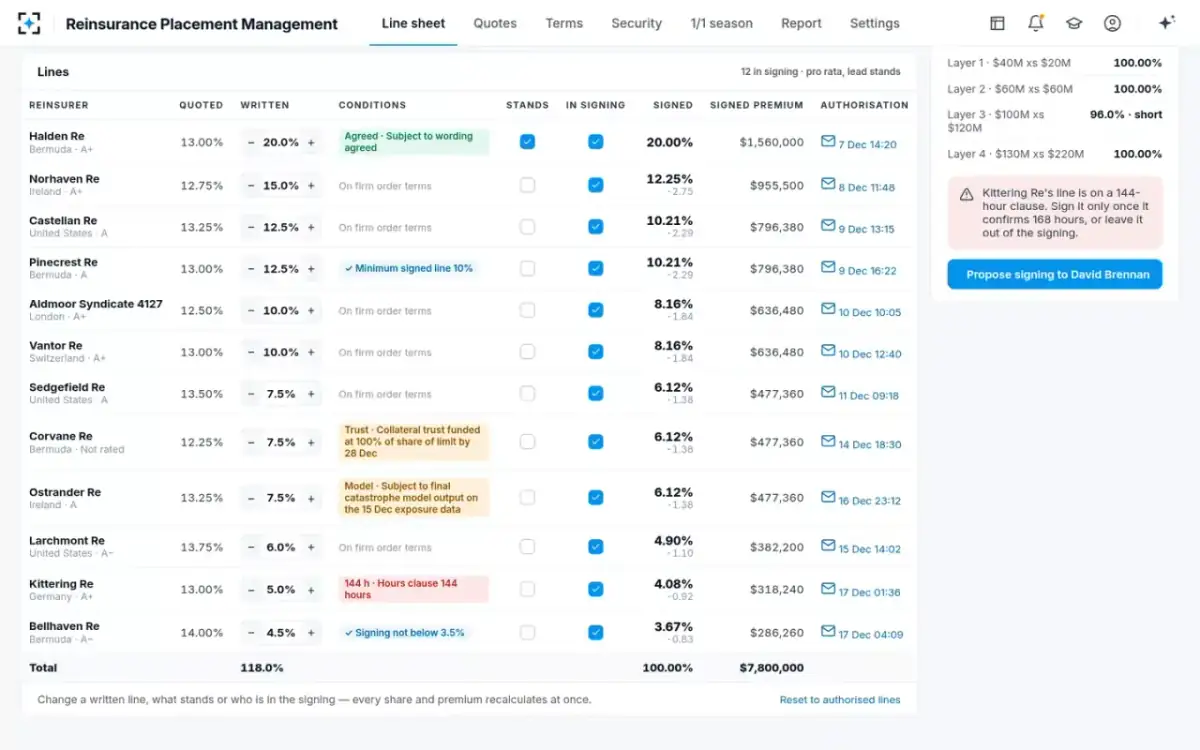
Over-placed layers at exactly 100%, the lead and any line written to stand at full width, every reinsurer's minimum line respected.
- Advices and contract signatures on time
Signed-line advices before inception; under statutory accounting, a multi-reinsurer contract the lead has not signed within nine months is presumed retroactive.
- Your money handled as the law requires
Held as a fiduciary and remitted within 30 days, with accounts that support every commission and fee.
- Servicing after placement
Collateral, reserve funding and contract completion: in 2026 an appeal court let an insurer pursue its broker over alleged post-placement lapses.
The fourth and sixth items are the ones cedants underweight. A signing that has to be corrected after advices go out costs every reinsurer's time and the cedant's credibility, and how written lines become signed lines is where most of those errors start. Post-placement servicing is now a litigated question: in Porch.com v. Gallagher Re the Fifth Circuit held that what servicing a broker "customarily" performs after placement is a question of fact for trial. A reinsurance broker's responsibilities set the baseline a cedant can hold its broker to.
Reinsurance Placement Management: what a cedant sees on signed lines, from rating to share
How much do reinsurance brokers earn?
No government series separates reinsurance brokers. The Bureau of Labor Statistics counts them among insurance sales agents, whose median annual wage was $62,280 in May 2025, with the highest-paid tenth above $138,140 and a median of $61,550 in insurance agencies and brokerages (BLS Occupational Outlook Handbook). The BLS adds that "commissions are the most common form of compensation, especially for experienced agents", and that wages in its data include sales commissions and bonuses.
Those figures describe the whole occupation, which is dominated by retail agents, and say little about a treaty placement broker in London, Bermuda or New York. What they do show is the shape of the pay: like the firm's brokerage, an individual's earnings move with what is sold. For the firm, the FCA found no evidence of excessive profitability and that average margins improve as brokers grow, "driven primarily by economies of scale."
Where Reinsurance Placement Management changes the economics of a placement
If revenue per program falls with the market, the lever a broker controls is the cost per program, and most of that cost is hours. Botminds estimates that one property catastrophe program's signing work in the final fortnight takes about 17 hours by hand (re-keying authorisations, checking conditions, checking security, signing down, writing the report and advices, and client review) and about 4.5 hours of people's time with the solution's agents doing the reading, comparing, checking and calculating. Those are Botminds' design estimates, not a measured result at any broker.
The saving is not the main point for the cedant. The hours that remain are review, the decisions on differences, and the client. In Reinsurance Placement Management the sign-down calculator proposes and the broker decides, the security checker never waives a buying instruction, and signed-line advices go out only after the client approves. The cedant pays the same brokerage and gets a placement where every line can be traced to the reinsurer's own words. See how that works on the solution page.
Twelve lines, each with its written line, signed line and signed premium
Questions people ask
What is brokerage in reinsurance?
Brokerage is the broker's commission on a reinsurance placement, set as a percentage of the premium and deducted from it before the reinsurer is paid. Under the NAIC model act the broker's accounts must carry the information that supports it, and its file must record the rates of all reinsurance commissions.
Who pays the reinsurance broker, the cedant or the reinsurer?
Economically, the brokerage comes out of the premium, so the reinsurer receives less than the cedant pays; the FCA described commission as "paid by the insurer as a deduction from the GWP." The broker still works for the cedant, and some cedants pay a fee directly instead of, or as well as, commission.
How much is reinsurance brokerage?
No regulator publishes a standard treaty brokerage rate, and it varies by line, layer and client. What a cedant can do is ask for the rate on every line in writing, as the model act's accounts and records provisions already require the broker to support.
Can reinsurance brokers earn money from reinsurers?
Yes, beyond brokerage. The FCA found London brokers selling data, analytics and other consultancy-style services to insurers, about 8% of revenue for those offering them in 2016, and earning higher remuneration on business placed through facilities. The model act requires a broker to disclose any relationship with a reinsurer on the cedant's program.
Does a cheaper reinsurance program mean the broker did a better job?
Not by itself. In 2026 Florida's regulator measured risk-adjusted reductions of 15% to 25% for nearly half the insurers it surveyed, so much of a price fall is the market. The placement's quality shows in the panel's security, lines on the firm order terms, a signing that holds and advices on time.