The use of AI in reinsurance underwriting today is mostly decision support: reading broker submissions, rebuilding a cedant's loss triangles and exposure tables, comparing this year's schedules with last year's and drafting questions and referral notes, with an underwriter deciding the line and terms. No US, EU or UK supervisor prohibits it. What they expect is set out in the NAIC's model bulletin on insurers' use of AI, adopted by 29 jurisdictions as of 8 October 2026; EIOPA's August 2025 Opinion on AI governance; and the Prudential Regulation Authority's 2026 priorities, read beside the Bank of England and FCA's October 2026 survey of AI in UK financial services. Across all three the expectation is the same: a written program, documented systems, oversight by people in proportion to the impact, and diligence on systems bought from third parties. Botminds' Treaty Underwriting Workbench is built on that line: its agents rank and draft, and never quote, bind or send.
This guide covers three questions buyers ask, in order: where AI is used in reinsurance underwriting, how much it is allowed to decide, and what a supervisor will expect to see. Examples from the solution use its fictional sample season.
Most insurers already use AI; far fewer have written a policy for it
Is AI used in reinsurance underwriting? What the surveys measure
AI is widely used by insurers, mostly behind the scenes, and no supervisor publishes a figure for reinsurance underwriting alone. The Bank of England and FCA's 2026 survey found that "86% of respondents reported using artificial intelligence (AI), up from 75% in 2024", and that among sectors, "All responding UK banks and international banks reported currently using AI, followed by 93% of responding insurers" (Bank of England and FCA, 2026). Its insurance group covers general, life and health insurers and insurance service providers; it does not split out reinsurers.
EIOPA's survey of 347 insurance undertakings across 25 countries, covering life and non-life (re)insurance lines, found that "65% of insurance undertakings are already actively using Gen AI systems, but the majority of use cases are at a proof-of-concept stage" (EIOPA, Generative AI Market Survey). Use is concentrated away from customers: "64% of the reported use cases are for internal back-office applications". And governance trails use: "49% of undertakings have developed a dedicated AI policy (a twofold increase from 2023)". The picture for a chief underwriting officer is common use, early maturity and incomplete governance.
AI use cases in reinsurance: where the hours are
The strongest AI use cases in reinsurance underwriting are the ones that take hours, not judgment: reading, rebuilding, comparing and drafting. A casualty treaty submission can carry dozens of documents in a broker's own layout; the fictional sample one in the Treaty Underwriting Workbench had 42, including a nine-tab loss workbook with 16,412 claim rows. Botminds estimates that rebuilding one casualty program by hand takes an analyst two to four days. That is the work agents are suited to.
EIOPA's survey describes the same direction in primary insurance. Insurers reported internal generative AI chatbots that "assist underwriters in finding relevant information in their internal underwriting guidelines", and listed "Underwriting Assistants" among typical use cases, "Augmenting data received from customer's applications with insights into underwriting guidelines and rules to enhance the work of actuaries / underwriters when conducting risk assessments." In treaty underwriting the equivalent is the six agents in the solution: a submission reader, a triangle rebuilder, a large-loss and premium checker, an exposure comparer, a pricing and fit scorer, and a note writer. Each has a written limit, and none of the limits allows a decision.
Six use cases on a treaty desk, and the limit each one works under
| Use case | What the agent does | What it never does |
|---|---|---|
| Reading submissions | Sorts and reads every document; maps each workbook tab; extracts the slip's terms. | Fills a missing figure; it lists it as a question. |
| Rebuilding triangles | Rebuilds paid and incurred triangles from claim records and ties them to the cedant's. | Overwrites a cedant figure; outside data is used only for the tail, labelled. |
| Checking large losses and premium | Reads large losses against the slip; on-levels premium with the achieved rate. | Removes a loss the treaty covers. |
| Comparing exposure | Compares this year's schedules with last year's and writes change notes. | Infers exposure that is not in a schedule. |
| Pricing and ranking | Works out commission, expected result and rate adequacy; scores fit; ranks the season. | Quotes, binds or sends. |
| Drafting | Drafts broker questions and the referral note, each line cited. | Sends anything; the underwriter sends. |
Agentic AI in reinsurance: decision support, not autonomy
Agentic AI in financial services is widespread but tightly bounded, and the evidence says firms are keeping it that way. The Bank of England and FCA asked about agents by level of autonomy, and found that "80% reported having AI agents in production that provided decision support (ie, AI agents recommend actions, humans decide and execute). Only 2% reported deploying agents with broad autonomy." Looking ahead a year, no more than 9% expected agents to decide customer outcomes, place orders, move payments or change limits and controls; the reinsurance settlement process shows what that line means where cash moves.
How far firms let AI agents act: four levels of autonomy
| Level | What it means, in the survey's words | Firms with agents at this level | General insurance |
|---|---|---|---|
| Decision support | Agents recommend actions, humans decide and execute | 80% | 3% |
| Constrained execution | Agents execute actions within predefined limits and rules | 46% | 3% |
| Conditional autonomy | Agents act independently but require human approval for certain actions | 22% | 1% |
| Broad autonomy | Agents can initiate and execute actions with limited real-time human involvement | 2% | 0% |
The general insurance column is the striking one: 3% of respondents report decision-support agents there at all. Agentic underwriting is early, which is an advantage for a reinsurer that sets its boundaries now rather than retrofitting them. The boundary in the solution sits at decision support: agents rank the season and draft the counter, the underwriter decides and sends, and the chief underwriting officer approves referrals. Agents that recommend and people who decide is also the model the survey reports most firms use.
What are the rules for AI in insurance underwriting in the US?
In the US the main text is the NAIC's Model Bulletin on the Use of Artificial Intelligence Systems by Insurers, adopted on 4 December 2023 and, as of 8 October 2026, adopted by 29 jurisdictions, with insurance-specific rules or guidance in California, Colorado, New York and Texas (NAIC adoption map). The bulletin is addressed to "All Insurers Licensed to Do Business" in the adopting state, and expects each to keep a written AI systems program covering any AI that makes or supports a regulated insurance decision (NAIC Model Bulletin). What that program must contain, section by section, is set out in the guide to the NAIC AI bulletin's requirements.
The bulletin is written around consumers: its controls are meant to mitigate "Adverse Consumer Outcomes", scaled to the "Degree of Potential Harm to Consumers". A treaty pricing decision is made between two insurers, so the consumer-harm weighting is lower than for a homeowner's premium. Three of its five factors for sizing controls still apply directly to a treaty desk: what kind of decision the AI system makes, informs or supports; how far people take part in the final decision; and how much the insurer relies on data, predictive models and AI systems bought from third parties. Whether a particular reinsurer is in scope depends on its licensing in each adopting state; its compliance team will know. Insurance respondents told Treasury in 2024 that state regulators oversee AI use and that existing state laws are sufficient to govern it (U.S. Treasury, AI in Financial Services).
Does the EU AI Act apply to reinsurers?
The EU AI Act's high-risk rules reach insurance in one place, and treaty underwriting is not it. EIOPA's Opinion explains that the AI Act treats as high-risk only AI used to assess risk and set prices for individual people in life and health insurance (EIOPA Opinion on AI governance and risk management; which insurance uses the AI Act calls high-risk). Pricing a casualty treaty with another insurance company is not risk assessment of a natural person. For the systems outside that category, EIOPA's Opinion sets "high-level supervisory expectations relating to governance and risk-management systems that undertakings should develop, following a risk-based and proportionate approach", under the Solvency II Directive's system-of-governance rules, which apply to insurance and reinsurance undertakings alike.
The Opinion lists six areas: fairness and ethics; data governance; documentation and record keeping; transparency and explainability; human oversight; and accuracy, robustness and cybersecurity. Its impact assessment includes "the extent to which the AI system can act autonomously" and prudential factors such as an AI system's possible impact on gross written premiums or solvency. Timing for the high-risk rules is moving: EIOPA's June 2026 Financial Stability Report notes the Commission's Digital Omnibus proposal to postpone them, with "a final deadline of 2 December 2027", a proposal that "still requires approval by the EU co-legislators before entering into force" (EIOPA Financial Stability Report, June 2026).
What three supervisors expect when AI supports underwriting decisions
| United States | European Union | United Kingdom | |
|---|---|---|---|
| Main text | NAIC Model Bulletin on the Use of AI Systems by Insurers (December 2023) | EIOPA Opinion on AI governance and risk management (August 2025), under Solvency II; the AI Act for high-risk uses | PRA insurance supervision priorities (January 2026); Bank of England and FCA AI survey (October 2026) |
| Status | Adopted by 29 jurisdictions as of 8 October 2026; own rules in CA, CO, NY, TX | Opinion in force as guidance; high-risk AI Act rules for life and health pricing of natural persons, timing under review | Supervisory expectations within existing rules |
| Treaty underwriting in scope? | Licensed insurers' AI that makes or supports regulated decisions; controls scaled to consumer harm | Not high-risk under the AI Act; governance expectations apply proportionately | Yes, as part of safety and soundness |
| Core expectation | A written AIS Program: governance, risk controls, internal audit, third-party diligence | Proportionate governance across six areas, including human oversight and documentation | Adopt AI "without compromising on safety and soundness"; watch data, third parties and cyber |
What the UK supervisor expects from AI in underwriting
The PRA's 2026 priorities for insurers treat AI as an opportunity that amplifies old risks, not a new category of rule. The letter puts it in one paragraph.
However, these advanced technologies present novel risks, amplifying existing issues such as inaccurate data, reliance on third party providers and cyber risks. Firms need to adopt new technologies without compromising on safety and soundness.
Prudential Regulation Authority, insurance supervision priorities, January 2026
The Bank of England and FCA survey shows where firms' controls stand against those risks. Governance on paper is near universal: "94% of respondents reported firmwide AI policies, principles or standards". Controls before deployment are common: "Human approval, pre-deployment review, and vendor due diligence were each reported by more than 90% of respondents." Controls after deployment are not: "ongoing monitoring, leakage testing and periodic review or recertification were each reported by around half of respondents." And for systems bought in, "81% instead relied on vendor assurance and contractual arrangements", against 24% claiming deep knowledge of third-party systems. A reinsurer buying an underwriting AI should plan for the half the survey says most firms miss: watching the system after it is live.
Can AI make underwriting decisions?
Nothing in these texts forbids an AI from supporting an underwriting decision; all of them expect a person to own it. The NAIC bulletin sizes controls partly by how far people take part in the final decision. EIOPA lists human oversight among its six areas and expects roles and responsibilities, "including escalation procedures", to be defined in policy documents. The Bank of England survey shows the market's own choice: 80% of firms use agents that recommend while humans decide, and almost none expect agents to approve or decline outcomes within a year.
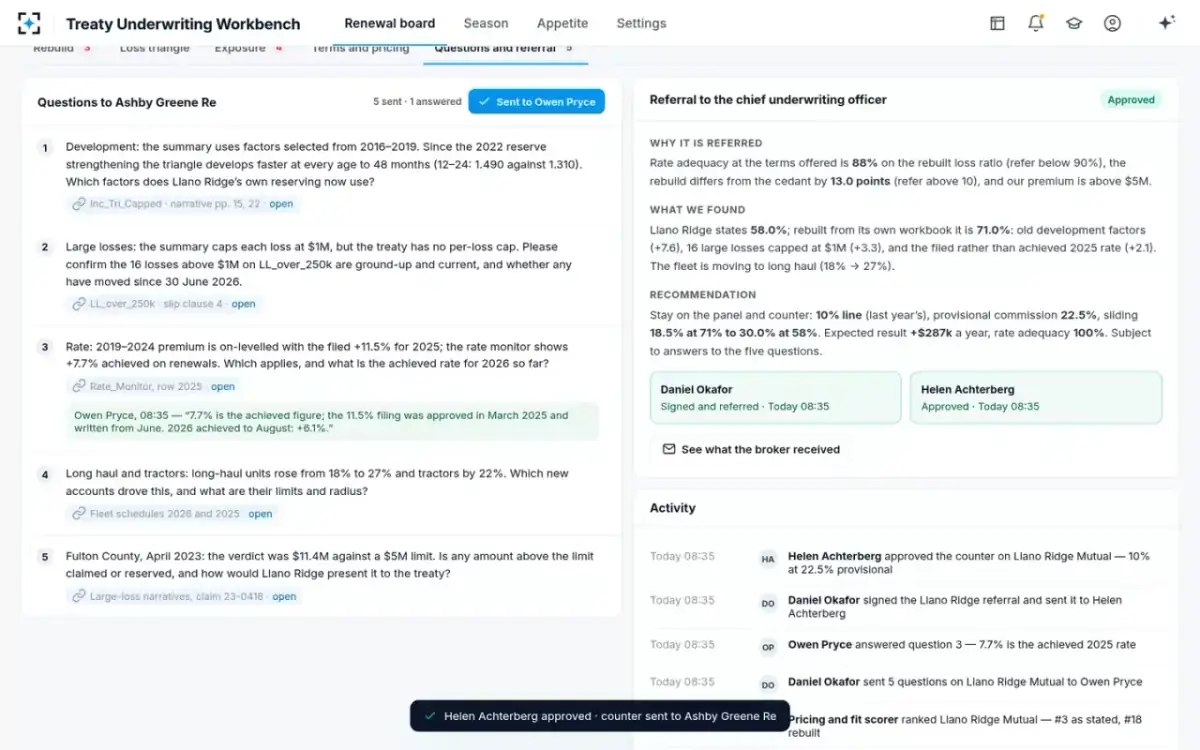
For treaty underwriting the case for keeping the decision human is also practical. The judgments that matter, whether a cedant's management can be trusted, whether a capped loss is a one-off, whether a relationship is worth a smaller line, are not in the submission. In the solution the agents never quote, bind or send; each question and counter goes out only from the underwriter, and a program goes to the chief underwriting officer when rate adequacy at the offered terms is below 90% on the rebuilt loss ratio, when the rebuild is more than ten points from the cedant's figure, when the reinsurer's premium is above $5 million, for a new cedant, or when declining a program written five years or more. How the work divides task by task is set out in the reinsurance underwriting process, split between agents and people.
Decisions stay with people: the referral signed by the underwriter and approved by the CUO
A governance file a supervisor would accept for underwriting AI
A supervisor reviewing AI in treaty underwriting will ask what the system does, who decided to use it, how it is controlled and how anyone knows it still works. The checklist below turns the NAIC bulletin, EIOPA's six areas and the Bank of England survey's gaps into the documents a reinsurer should hold.
Eight documents to hold for an underwriting AI system
- An inventory entry and a materiality rating
What the system does, which decisions it supports, and its impact on premium, results or solvency.
- A named owner accountable to senior management
The NAIC bulletin vests responsibility in senior management accountable to the board.
- The decision boundary, in writing
What agents may do, what they may never do, and which decisions are human; in the solution, agents never quote, bind or send.
- The method settings and their approvals
Benchmarks, factor rules, thresholds, appetite and authority, versioned with who approved each and when.
- Traceability of outputs
Each figure linked to the document, tab, cell or page it came from, so any decision can be reconstructed.
- Validation before use
A replay on closed submissions, scored against the team's own files, with results kept.
- Monitoring after go-live
Periodic re-scoring and review of disagreements: the control the Bank of England found at only about half of firms.
- Third-party diligence
For a bought system: data handling, change notification, audit rights and cooperation with regulators, in the contract.
The validation item is where most programs are thinnest, and where a reinsurer has an unusual advantage: last year's renewal is a ready-made test set. A pilot on last 1/1's submissions sets out how to run it and what to score.
Where the Treaty Underwriting Workbench fits the expectations, and what you still own
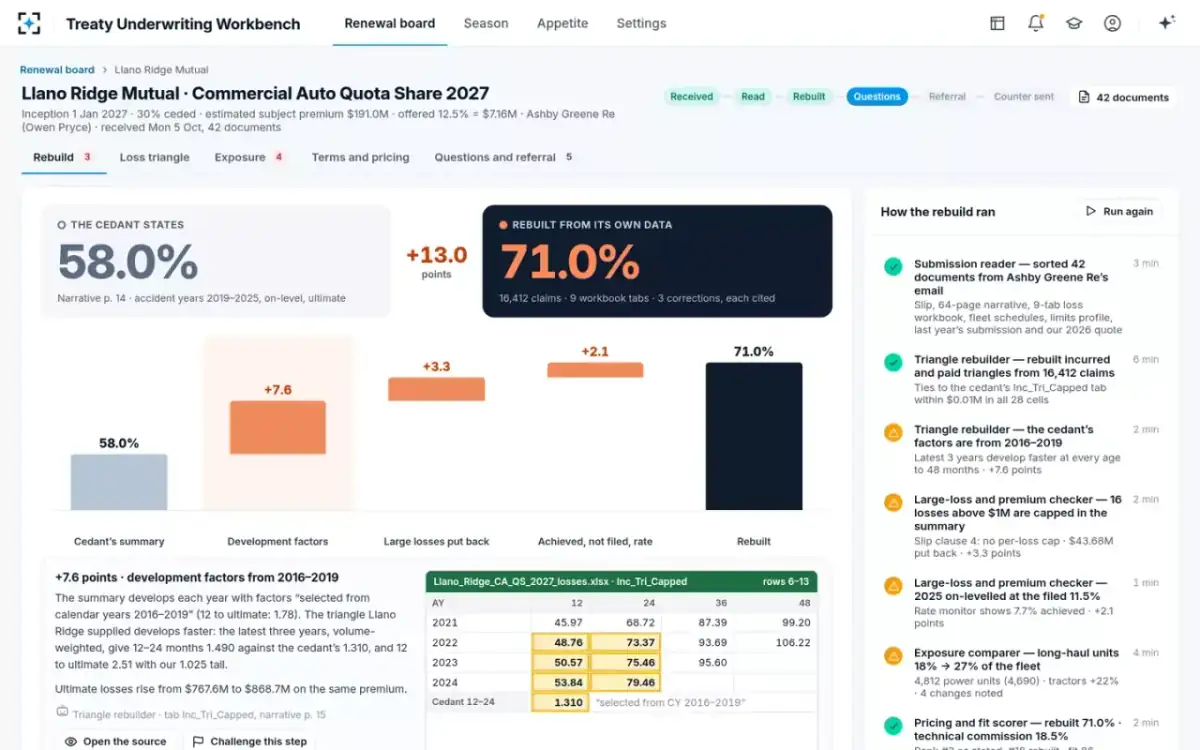
The solution is built to make the governance file easy to fill, not to fill it for you. Its agents work at the decision-support level the survey describes: they rank and draft, and never quote, bind or send. Each rebuilt figure opens the document, tab and cell, or page, it came from; the cedant's figure is never changed and sits beside every rebuilt one; outside data enters a rebuild only as a labelled benchmark tail. Thresholds, benchmarks, appetite and authority are versioned settings on the audit trail, with the approver and the date, and every question, counter and referral is recorded with who and when. Submission data is kept per cedant and per broker.
What stays with the reinsurer is what no vendor can supply: the decision to use the system, the boundary and settings it runs under, the validation on your own book, the monitoring after go-live and the human decisions themselves. Those are also what the supervisors' texts ask about first.
The run log: every agent step shown, timed and tied to its evidence
To see the controls on a season of your own, start from the Treaty Underwriting Workbench.
Questions people ask
What is the NAIC AI model bulletin?
It is a model bulletin the NAIC adopted on 4 December 2023 setting out how state insurance regulators expect insurers to govern AI systems that make or support regulated decisions, centred on a written AI Systems program with governance, risk controls, internal audit and third-party diligence. As of 8 October 2026 it had been adopted by 29 jurisdictions.
Does the NAIC AI bulletin apply to reinsurers?
It is addressed to all insurers licensed to do business in the adopting state, so a reinsurer licensed there is addressed by it; its controls are scaled to potential harm to consumers, which is lower for a treaty decision between two insurers. Scope depends on each reinsurer's licences, so its compliance team should confirm it state by state.
How many insurers use AI?
In the Bank of England and FCA's 2026 survey, 93% of responding UK insurers reported using AI. EIOPA's 2025 survey found 65% of EU insurance undertakings actively using generative AI, most use cases still at proof-of-concept stage and 64% of them in back-office work.
What is the biggest risk of generative AI in insurance?
Insurers in EIOPA's survey named inaccurate outputs, often called hallucinations, as the main risk, ahead of cybersecurity, data protection and lack of explainability. In underwriting the defence is traceability: every figure an agent produces should open the source it came from, so a person can check it before relying on it.
Will AI replace reinsurance underwriters?
The evidence points to AI supporting decisions rather than making them: 80% of firms in the Bank of England survey use agents for decision support and only 2% give agents broad autonomy. The BLS projects a 4% decline in underwriting jobs to 2035, driven mainly by automated primary underwriting rather than tailored treaty work.
Do we need to tell brokers or cedants that AI is used?
The NAIC bulletin's notice expectation concerns consumers, not ceding companies, and no text reviewed here requires a reinsurer to disclose AI use to a broker. Some reinsurers choose to, and in the solution brokers see only their own submissions, questions and answers, which the underwriter sends.