Casualty reinsurance pricing estimates what a cedant's liability, auto or workers' compensation business will cost the reinsurer: from its own history, trended, developed and restated to the treaty's terms (experience rating), and from its current limits and premium run through industry severity curves (exposure rating). The pricer weighs the two, then loads the ceding commission, brokerage, expenses and a target return. The weak point is the first step. Rebuilding a cedant's casualty history by hand takes an analyst two to four days on Botminds' estimate, so in a busy renewal some programs are priced on the cedant's own summary instead. Botminds' Treaty Underwriting Workbench rebuilds every program with agents, each step cited. This guide works out what a hand rebuild costs, and what skipping it costs.
The program figures come from the solution's fictional sample season, a commercial auto quota share submitted by Llano Ridge Mutual to Kestrel Point Re for 1 January 2027; the wage rates come from the Bureau of Labor Statistics and the market figures from the NAIC, linked where they appear.
Where one casualty program's first-view days go: most of the time is rebuilding, before any judgment
By hand · 3.25 analyst days
- Reading · 15%
- Triangles · 39%
- Large losses, premium · 15%
- Exposure · 15%
- Questions, referral · 16%
How is casualty reinsurance priced? Experience, exposure and judgment between them
Casualty treaties are priced twice and reconciled. Clark's study note for the Casualty Actuarial Society sets out both methods (Clark, Basics of Reinsurance Pricing). Experience rating starts from the cedant's own large losses: "it is very important that allocated loss adjustment expenses (ALAE) be captured separately from losses", and for general and auto liability "the underlying policy limit should also be listed". Each loss is trended, capped at the limits that would apply in the treaty period, put into the layer, and developed, a step that "is critical due to the very large factors needed to reflect future development." Exposure rating instead takes the limits and premium the cedant expects to write and uses a severity distribution "based on industry statistics" to calculate increased limits factors and the share of loss in the layer.
Neither method is the answer on its own. Clark's note opens with what it calls the pricing paradox: "If you can precisely price a given contract, the ceding company will not want to buy it." A book stable enough to price precisely is a book the cedant would keep. So "the "basic" pricing tools are usually only a starting point", and the actuary's value is in knowing when their assumptions fail. That judgment is only as good as the experience it reads, which is why the rebuild matters.
Why casualty reinsurance is costly to get wrong: the 2025 numbers
Casualty is where reinsurers lost money in 2025, even in a profitable year. The NAIC's analysis of the 21 professional reinsurers it tracks shows a 97.7% combined ratio overall, but 122.3% on other liability written on an occurrence basis and 107.0% on claims-made (NAIC, 2025 full-year results). Every dollar of premium on occurrence-based other liability cost them about $1.22 in losses and expenses.
One market, very different lines: professional reinsurers' combined ratios in 2025
97.7%
all lines, 21 professional reinsurers
122.3%
other liability, occurrence
107.0%
other liability, claims-made
53.3%
nonproportional assumed liability
The primary market shows the same pressure from the other side. Treasury's Federal Insurance Office reports direct premium growth of 9.3 percent in commercial auto liability and 8.0 percent in other liability in 2025, driven by "rate increases to counter underwriting losses" (FIO, Annual Report on the Insurance Industry, September 2026). The NAIC reports the commercial auto liability pure net loss ratio improving 3.0 points to 71%, and credits the rate increases insurers kept taking as social inflation drove claim costs up. For a quota share reinsurer, those rate increases are exactly where a cedant's summary can flatter: a rate filed is not a rate achieved. How the 2025 results break down by line is set out in the casualty reinsurance market in 2025, by NAIC data.
What is social inflation in reinsurance, and why it lands harder on a layer
Social inflation is the NAIC's term for "rising insurance claim costs above economic inflation resulting from increased litigation, broader definitions of liability, more plaintiff-friendly legal decisions, and larger compensatory jury awards." Its listed drivers include nuclear verdicts, defined as "jury awards of $10 million or more that exceed a plaintiff's documented economic losses", and third-party litigation financing. It has led, the NAIC says, to "billions in underwriting losses" and reduced coverage availability, "particularly in commercial auto, commercial liability, and medical professional liability lines."
For a reinsurer the effect is magnified twice. On an excess layer, any inflation pushes more claims through the attachment point, so the layer's losses grow faster than the ground-up losses beneath it; Patrik's CAS chapter calls this the leveraged effect of inflation on excess claims. On a quota share with original policy limits up to $5 million and no per-loss cap, as on the sample program, every verdict up to the limit is shared in full. Llano Ridge's large-loss narratives included a Fulton County verdict of $11.4 million against a $5 million policy limit, fictional, but the shape social inflation describes. The cedant's summary had capped every loss at $1 million.
How long does it take to price a casualty treaty?
The first view of a casualty treaty takes days by hand, before any negotiation. On Botminds' estimate an analyst spends about 3.25 days rebuilding one casualty quota share: half a day sorting and reading the submission, a day and a quarter rebuilding the triangles, half a day each on large losses and premium, exposure, and the questions and referral note. The split above shows where those days go; with the solution the same first view is a design target of under an hour, and was 23 minutes on the sample program from the broker's email to the board.
The days are the analyst's, but the cost lands on the underwriter's calendar. A team that receives two hundred casualty submissions in six weeks cannot spend three days on each before quote dates, so it triages: the large programs and the known problems get rebuilt, the rest are priced on the cedant's figures with a judgmental load. Patrik describes where that leads. Pricing from aggregate data, "with no specific information about large claims, is very risky, but it is sometimes done", and although the target return should then be higher for the added uncertainty, "often, the opposite occurs because of marketing pressures" (Patrik, CAS textbook, ch. 7).
What a hand rebuild costs: the wage arithmetic
At public wage rates, one hand rebuild costs about a thousand dollars of analyst time. No BLS series isolates reinsurance analysts, so the arithmetic below uses the median wage for all insurance underwriters, $81,370 in May 2025 (BLS), which over a standard 2,080-hour year is about $39 an hour. The pricing actuary's median is $130,000, about $62.50 an hour (BLS). Both figures are wages only, before benefits and overhead.
What one rebuild costs, and what it was worth on one sample program
Loss avoided
$251k a year not lost
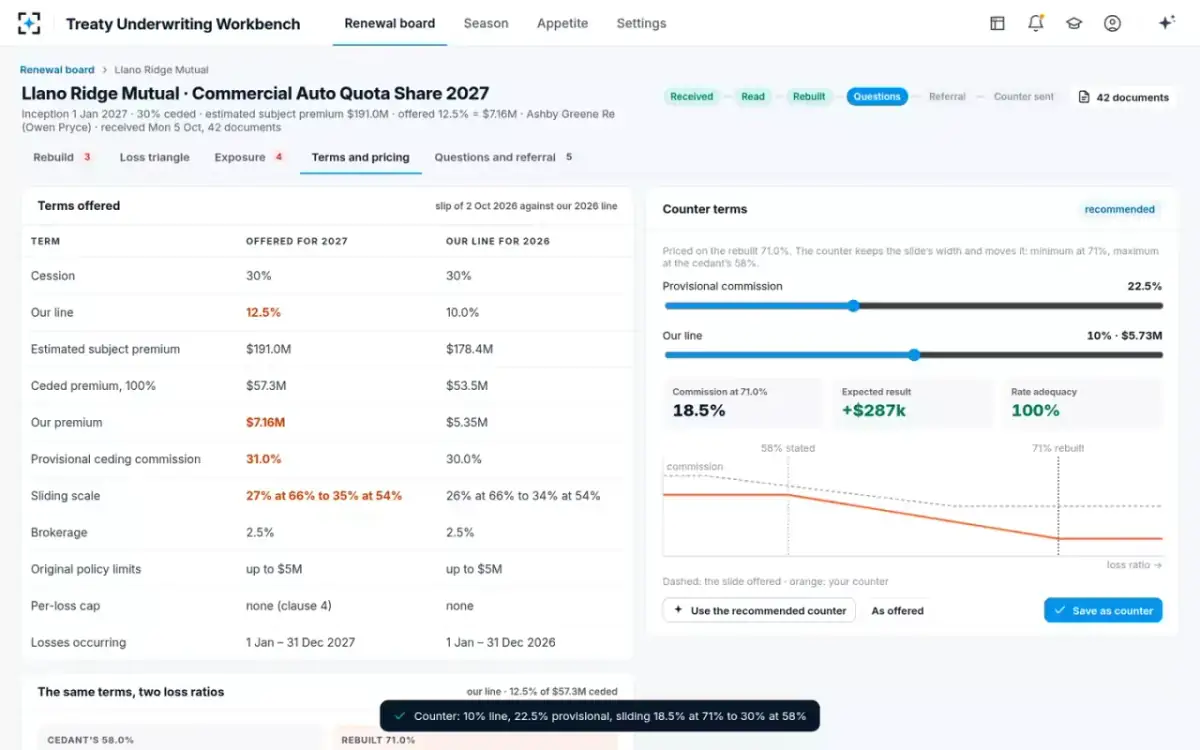
The 12.5% line offered loses $251,000 a year at the rebuilt 71.0% loss ratio; on the cedant's 58.0% it looked like +$299,000.
Underwriter's decision
Counter earned
+$287k a year
A 10% line at 22.5% provisional commission, sliding 18.5% at 71% to 30% at 58%: 100% rate adequacy on the rebuild.
Underwriter; CUO approved
Rebuild by hand
26 h × $39.12 ≈ $1,017
3.25 analyst days (Botminds' estimate) at the BLS median underwriter wage, wages only.
Analyst
Rebuild with agents
4 h × $39.12 ≈ $156
0.5 days checking the rebuild and editing questions and the referral (Botminds' estimate), wages only.
Analyst and underwriter
Set against the reinsurer's own expense load the rebuild is small. Clark's worked quota share in the CAS study note carries 1.0% for administrative expenses and 1.0% for unallocated expenses on top of the commission and a 5.0% brokerage; the sample reinsurer loads 3.0% of premium for its expenses. On the Llano Ridge line that 3.0% is about $215,000 a year. A $1,017 rebuild is half a percent of it. The question is not whether rebuilds are affordable, but whether there are enough analyst days in a season to do them all.
What not rebuilding costs: $550,000 on one quota share
Skipping the rebuild costs the difference between the cedant's loss ratio and the real one, multiplied by the line. On the sample program the cedant's summary stated 58.0%. Rebuilt from its own data, it was 71.0%: 7.6 points from development factors selected from 2016–2019, 3.3 from sixteen large losses capped at $1 million on a treaty with no per-loss cap, and 2.1 from on-levelling 2025 with the filed 11.5% rate rather than the 7.7% achieved. Every correction came from data in the same submission.
The same terms on two loss ratios: priced on the summary, and priced on the rebuild
Priced on the cedant's 58.0%: 32.3%: the slide runs from 27% at 66% to 35% at 54%.
Priced on the rebuilt 71.0%: 27%: the slide's floor, reached at any loss ratio above 66%.
Priced on the cedant's 58.0%: +$299,000 a year.
Priced on the rebuilt 71.0%: −$251,000 a year.
Priced on the cedant's 58.0%: 99%: close enough to write.
Priced on the rebuilt 71.0%: 88%: below the 90% that refers.
Priced on the cedant's 58.0%: Above the 31.0% provisional offered.
Priced on the rebuilt 71.0%: 18.5% = 100 − 71.0 − 2.5 brokerage − 3.0 expenses − 5.0 margin.
Priced on the cedant's 58.0%: Accept the 12.5% line as offered.
Priced on the rebuilt 71.0%: Counter at a 10% line, 22.5% provisional, and refer to the CUO.
The difference between the two columns is $550,000 a year on one line. That is about five hundred hand rebuilds at the wage rate above. It is also not the end of the cost: a quota share that loses money in its first year is often renewed, because relationships are sticky, and a reinsurer that learns of the gap after the treaty incepts has a year of premium on the books at the wrong price.
Terms and pricing: the slide offered, last year's terms, and a counter priced on the rebuild
Across a book: five programs that lose money on the rebuild
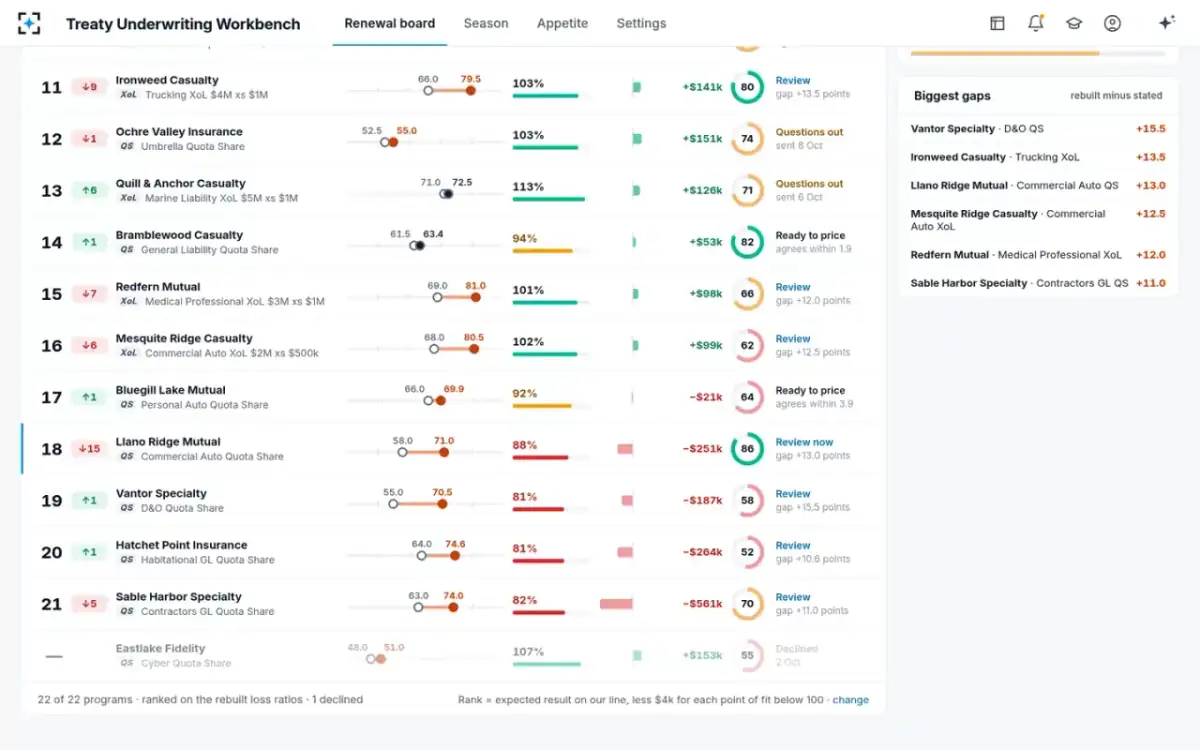
The cost of skipping rebuilds compounds across a season. In the sample, the senior underwriter's 22 programs expect $4.70 million on the reinsurer's lines as the cedants state them, and none loses money. Ranked on the rebuild, seven move five points or more, all upwards, and five lose money at the terms offered.
Five of 22 programs lose money on the offered terms once rebuilt
Four of the five are casualty quota shares where the rebuild moved the loss ratio by more than ten points. Spending 3.25 analyst days on each of the 22 programs would have cost about 72 analyst days, roughly $22,000 in wages at the rate above; the five programs together lose about $1.28 million a year on the offered terms. The arithmetic is not close, which is why the binding constraint is the calendar, not the cost.
Ranked on the rebuild: the programs that moved, and the biggest gaps
The costs a rebuild does not remove
Agents remove the rebuilding hours, not the pricing judgment or the negotiation. On Botminds' estimate the questions and referral still take a quarter of a day per program with the solution, half of what remains. The pricing actuary still selects benchmarks and reviews the large loss picks; in the sample, every loss pick above $5 million goes to the actuary. The underwriter still sets the counter and talks to the broker, and the chief underwriting officer still signs referrals.
What changes is when those people see the evidence. In the sample the five questions to the broker went out with the counter still being set, each tied to a tab or page, and the broker answered the rate question before the referral was approved: 7.7% was the achieved 2025 rate. The value of the agent's hours is partly that they come first. How the same quota share runs through a spreadsheet, a pricing tool and an agent workbench is compared in reinsurance pricing tool, spreadsheet or agents, and the method behind the rebuild's starting point is worked line by line in the burning cost method in reinsurance.
How much does a reinsurance underwriter earn?
No official series separates reinsurance underwriters, but the occupation's figures bound the answer. The BLS reports a median of $81,370 for insurance underwriters in May 2025, with the lowest tenth below $55,530 and the highest tenth above $145,160; actuaries' median was $130,000, with the highest tenth above $215,100. For pricing purposes the relevant number is the hour, not the year: a treaty underwriter's hour spent copying a triangle is an hour not spent on the five programs that lose money. To see the rebuild and ranking on a season of your own, start from the Treaty Underwriting Workbench.
Questions people ask
What did reinsurers lose on other liability in 2025?
NAIC data for the 21 professional reinsurers it tracks shows a 122.3% combined ratio on occurrence-based other liability and 107.0% on claims-made other liability in 2025, against 97.7% for all their lines. Other liability occurrence was 16.1% of their unaffiliated assumed premium, the second-largest line.
How is casualty quota share pricing different from excess of loss pricing?
A quota share is priced mainly by evaluating the ceding commission against the expected loss ratio of the whole book, often with a sliding scale; an excess treaty is priced as a loss cost for the layer, from trended large losses and exposure curves. Clark's CAS study note treats the two separately, and the casualty excess method needs individual large losses with their policy limits and ALAE.
What is rate adequacy in reinsurance pricing?
Rate adequacy compares what the terms leave for losses with the loss ratio expected. On the sample program, at a 27% commission, 2.5% brokerage, 3.0% expenses and a 5% target margin, 62.5 points remain for losses against a rebuilt 71.0%: 88% adequacy. At the counter's 18.5% commission, 71 points remain: 100%.
Why are casualty reinsurance terms tightening on some programs?
Because the losses are concentrated there: occurrence-based other liability ran at 122.3% for professional reinsurers in 2025, and the NAIC names social inflation as a driver in commercial auto, commercial liability and medical professional liability. Primary insurers raised liability rates to match, with direct premium up 9.3% in commercial auto liability and 8.0% in other liability according to Treasury's FIO.
Is it worth rebuilding a small casualty program?
On the arithmetic here, almost always: a hand rebuild costs about a thousand dollars in wages, and a two-point error on a $2 million line is $40,000 a year. The constraint is analyst days in a six-week season, which is what agents change.