The reinsurance underwriting process for a treaty runs in four movements: judge the cedant, rebuild its data, price the terms, then decide and negotiate. In between sit about a dozen tasks, from sorting the broker's email to drafting the referral note for the chief underwriting officer. Most of the hours are spent in the second movement, rebuilding the loss triangles, large losses, premium and exposure a cedant supplies in its own layout; most of the judgment sits in the first and the last. Botminds' Treaty Underwriting Workbench gives the reading and rebuilding to six agents, each step cited to the tab, cell or page it came from, and leaves the underwriter the decisions: whether to write, the line, the terms, and when to refer.
This guide sets out the process the profession teaches, maps each task to agent or person, and explains why each boundary sits where it does. The worked example is fictional sample data from the solution: a commercial auto quota share submitted by Llano Ridge Mutual to Kestrel Point Re for 1 January 2027.
Twelve tasks between the broker's email and the referral, re-divided
1Log the broker's email and sort its attachments
AgentSorts every document by kind and marks it read
Person—
Why the line is hereMechanical, and the first place a submission waits
2Extract the slip's terms
AgentCession, line, limits, caps, commission and slide, each cited to its clause
PersonReads any clause that is disputed
Why the line is hereThe terms decide what every later number means
3Map the loss workbook
AgentSays what each tab holds and links last year's submission and quote
Person—
Why the line is hereEvery broker's layout is different
4Rebuild the triangles
AgentPaid and incurred, from the claim rows, tied to the cedant's own triangle
PersonChecks the tie-out
Why the line is hereArithmetic, but the longest single task by hand
5Select development factors
AgentApplies the house method and shows the cedant's factors beside it
PersonActuary owns the benchmark and the tail
Why the line is hereA choice, so the rule is set by a person and versioned
6Read large losses against the slip
AgentPuts back losses the treaty covers that the summary capped
PersonDecides whether a loss is a one-off
Why the line is hereNever removes a loss the treaty covers
7Bring premium to today's rates
AgentOn-levels with the achieved rate from the cedant's rate monitor
PersonDecides when filed and achieved disagree
Why the line is hereThe denominator moves the loss ratio as much as the losses
8Compare exposure with last year
AgentWrites year-on-year change notes, each with its source
PersonDecides which changes matter
Why the line is hereNever infers exposure that is not in a schedule
9Price the terms offered
AgentCommission on the slide, expected result and rate adequacy on both loss ratios
PersonSets the counter
Why the line is hereAdvice, not a quote
10Score fit and rank the season
AgentScores each program against appetite and ranks the book
PersonCUO sets the appetite
Why the line is hereThe ranking is a setting the reinsurer owns
11Draft the broker's questions
AgentDrafts each question with the tab, cell or page it rests on
PersonEdits and sends
Why the line is hereAgents never send
12Decide, and refer
AgentDrafts the referral note
PersonLine, terms, write or decline; CUO approves referrals
Why the line is hereJudgment and authority
What are the steps in reinsurance underwriting? The profession's thirteen
The Casualty Actuarial Society's textbook chapter on reinsurance, by Gary Patrik, gives the clearest public list of the steps. It recommends doing both an exposure rating, "akin to a primary manual rate", and an experience rating, "completely dependent upon the cedant's particular claims experience", and weighing them together into a final technical rate (Patrik, Foundations of Casualty Actuarial Science, ch. 7). Its thirteen steps are below, with who does each in an agent-assisted desk.
Patrik's thirteen rating steps, and where each one sits once agents do the rebuilding
| Step, in the textbook's words | Kind of work | Who does it |
|---|---|---|
| 1. Gather and reconcile primary exposure, expense and rate information | Reading and reconciling | Agents, cited to source |
| 2. Calculate an exposure expected loss cost | Model with chosen curves | Actuary's method, run by the pricing team |
| 3. Gather and reconcile primary claims data | Reading and reconciling | Agents, tied to the cedant's triangles |
| 4. Filter the major catastrophe claims out of the claims data | Rules applied to a listing | Agents propose; person confirms |
| 5. Trend the claims data to rating period | Arithmetic on a chosen trend | Agents apply; the trend is a set choice |
| 6. Develop the claims data to settlement values | Factors on a triangle | Agents apply the house method; actuary owns benchmark and tail |
| 7. Estimate the catastrophe loss potential | Model output | Catastrophe modelling team |
| 8. Adjust the historical exposures to the rating period | On-level arithmetic | Agents, with the achieved rate first |
| 9. Estimate an experience expected loss cost | Arithmetic on steps 3–8 | Agents |
| 10. Estimate a "credibility" loss cost | Weighing two estimates | Actuary and underwriter |
| 11. Estimate the probability distribution of the aggregate reinsurance loss | Stochastic model | Actuary, for complex contracts |
| 12. Specify values for ceding commission, expense loading and target return | Terms and appetite | Underwriter, within set targets |
| 13. Negotiate, reconcile opinions and estimates, alter terms, and finalize | Negotiation | Underwriter, with the CUO on referrals |
Patrik groups the steps himself: "Steps 1, 2, and 12 may be considered to be exposure rating, steps 3–9 and 12 to be experience rating, and steps 10–13 to be rate finalization." The mapping follows the same grain. The experience-rating block, steps 3 to 9, is where the rebuilding lives, and it is almost all reading, reconciling and arithmetic on choices someone has already made. Rate finalization, steps 10 to 13, is judgment. The agents belong in the first block; people own the second.
How do reinsurers underwrite a treaty? The cedant first, then the book, then the price
A reinsurer underwrites a treaty by judging the cedant before the numbers. Patrik is explicit about the order: the reinsurer "evaluates first the management of the potential cedant", then the cedant's underwriting, pricing and claims handling, then the structure of its whole reinsurance program, and only "Lastly" the particular treaty and its rates. "Many reinsurers will send a team of marketing and underwriting people to perform a pre-quote audit," he adds, and claims people to review claims handling and reserving.
That order matters for where agents help. The first judgment, whether these are people a reinsurer wants to deal with for years, comes from relationship, audit visits and market knowledge, none of which is in a submission. The agents help with what comes after, and they also help the first judgment indirectly: a cedant whose summary keeps flattering its own data is telling the underwriter something about its management, and a rebuild that sits next to the summary on every screen makes that visible season after season.
Reading the submission: half a day by hand, twenty-three minutes with agents
Reading is the task that most often decides whether a program gets a real look. A casualty submission is not a form: the sample one carried 42 documents, from the broker's email and a six-page slip to a 64-page narrative, a nine-tab loss workbook with 16,412 claim rows, sixteen large-loss narratives, two years of fleet schedules, a limits profile and the reinsurer's own quote and signed line from the year before. Botminds estimates that sorting and reading it takes an analyst about half a day by hand.
In the solution the submission reader sorts every document by kind, maps each workbook tab to what it holds, extracts the slip's terms and links last year's submission. On the sample program the first view was on the board 23 minutes after the broker's email arrived. Two rules make that safe: the reader cites the file, tab and cell for every value, and it never fills a missing figure. A missing figure becomes a question to the broker, not a guess.
Rebuilding the cedant's numbers, one cited step at a time
Rebuilding is where the cedant's figure and the reinsurer's part company, so it is where citations matter most. On the sample program the cedant's narrative stated a 58.0% loss ratio. Rebuilt from its own workbook it was 71.0%, and each of the three steps between them is a separate agent's work with its own evidence.
From the broker's email to an approved counter: agents prepare, people decide
Agent
Submission readerSorts and reads all 42 documents, maps the workbook's nine tabs, extracts the slip terms.
Never: Fills a missing figure
Agent
Triangle rebuilderRebuilds paid and incurred triangles from 16,412 claims, ties them to the cedant's within $0.01 million in all 28 cells, applies the house factors: +7.6 points.
Never: Overwrites a cedant figure
Agent
Large-loss and premium checkerPuts back sixteen losses capped at $1 million on a treaty with no cap (+3.3) and on-levels 2025 with the achieved 7.7%, not the filed 11.5% (+2.1).
Never: Removes a loss the treaty covers
Agent
Exposure comparerNotes long-haul units up from 18% to 27% of the fleet and $5 million limit policies up from 141 to 212.
Never: Infers exposure not in a schedule
Agent
Pricing and fit scorerAt 71.0% the slide pays its 27% floor and the line loses $251,000; works out an 18.5% technical commission and a counter.
Never: Quotes, binds or sends
Agent
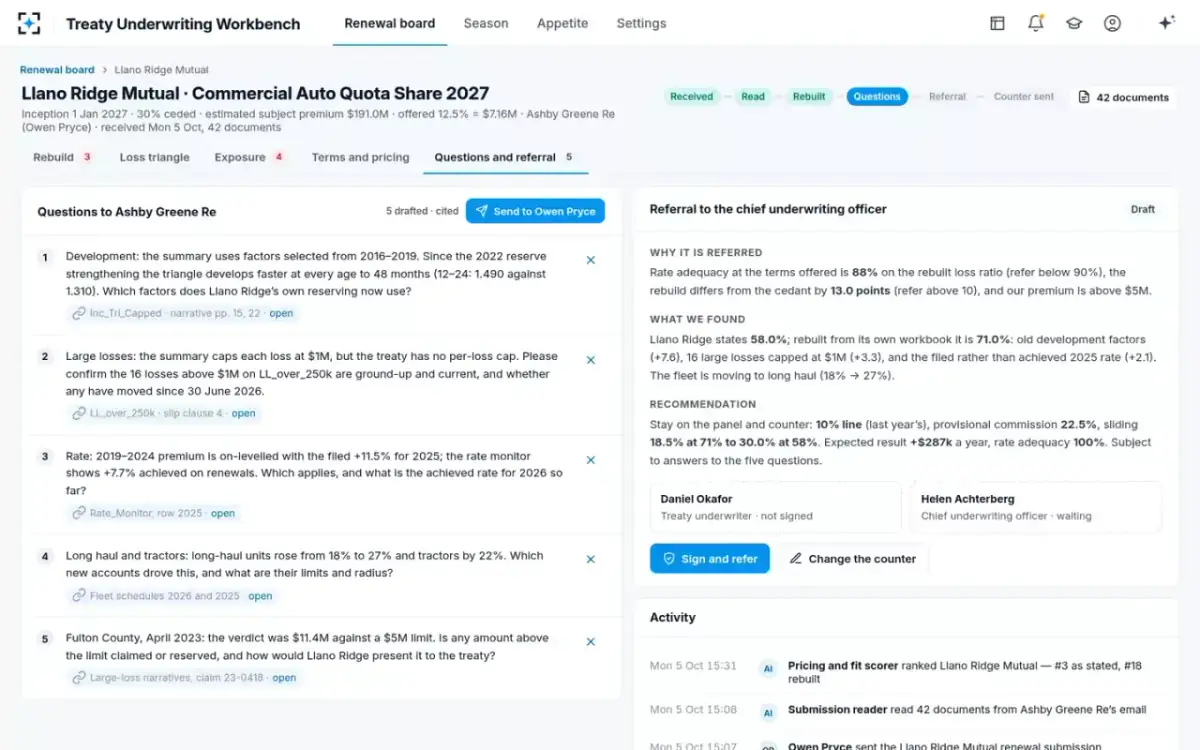
Note writerDrafts five cited questions to the broker and the referral note.
Never: Sends anything
A person decides
Treaty underwriterEdits and sends the questions, sets the counter at a 10% line and 22.5% provisional commission, signs the referral.
A person decides
Chief underwriting officerApproves the counter; it goes to the broker.
The guardrails in the flow are what make the split hold. The triangle rebuilder never overwrites a cedant figure; it shows the cedant's next to every rebuilt one, and uses outside data only for the tail of the development pattern, labelled as the reinsurer's own benchmark. The large-loss checker never removes a loss the treaty covers, and uses the cedant's own rate monitor before any outside rate. Those rules mean the underwriter is never asked to trust a number without seeing where it came from. The tie-out test that proves the triangle step, and how to replay it on last year's programs, is in replaying a loss development triangle before you trust the agent.
What can be automated in reinsurance underwriting, and what cannot?
Reading, reconciling and arithmetic on agreed choices can be automated; choosing, weighing and committing cannot. In the table above, that splits cleanly: steps 1, 3, 4, 5, 8 and 9 are agents' work once the choices are set; step 6 is agents' work on a method the actuary owns; steps 2, 7, 10 and 11 stay with actuarial and catastrophe models and the people who run them; steps 12 and 13 are the underwriter's.
The profession's own state of knowledge argues for keeping the choices with people. The CAS Reinsurance Working Group's 2026 call for papers asks, among its open questions, "How should we select and implement rate changes in the absence of credible data", and how to handle "signal reserves" in claims data and their interaction with trend and development (CAS, 2026 Reinsurance Call Paper Program). Where the profession has no settled answer, an agent should apply the reinsurer's chosen rule and show its work, not invent a rule of its own. In the solution those choices are settings: the development benchmark, how factors are selected, which rate change to on-level with, the gap that flags a program, the target margin and the adequacy that refers, all versioned on the audit trail.
Agents can do the arithmetic on a choice. They should not make the choice.
Reinsurance underwriting guidelines: appetite as rules an agent can score
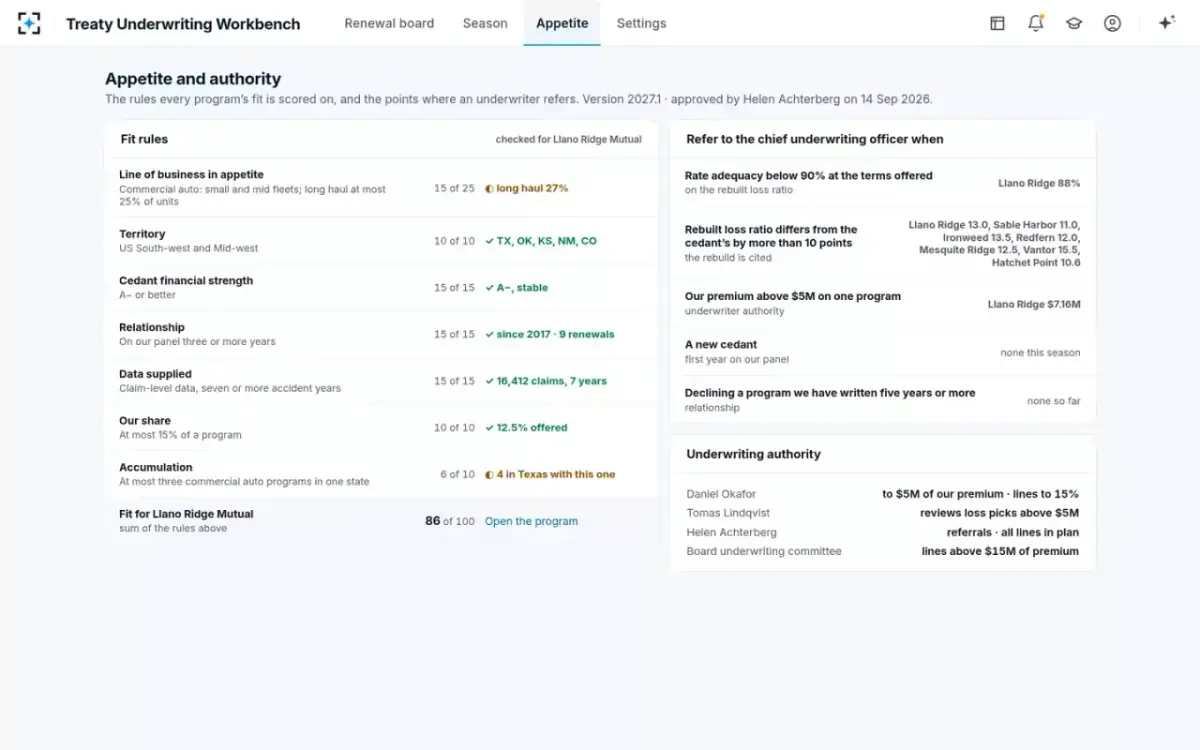
Reinsurance underwriting guidelines say which programs a reinsurer wants and who may write them, and once written as rules they can be scored on every submission. The sample reinsurer's appetite, version 2027.1, has seven fit rules worth 100 points: line of business, territory, the cedant's financial strength, the relationship, the data supplied, the share offered and accumulation.
Llano Ridge scored 86. It lost ten points on line of business because long-haul trucking had reached 27% of its fleet against an appetite of at most 25%, and four on accumulation because it would be the fourth commercial auto program in Texas against a rule of at most three in one state. Neither is a reason to decline on its own. Both are things an underwriter should know before setting the line, and a guideline that sits in a PDF is not checked on all 214 submissions in a season; a guideline written as a scored rule is.
Appetite and authority: the fit rules each program is scored on, and who may write what
Who decides the line size on a treaty?
The underwriter decides the line, within written authority, and larger lines go up the chain. In the sample, the senior underwriter may write up to $5 million of premium on one program and lines up to 15%; the pricing actuary reviews loss picks above $5 million; the chief underwriting officer approves referrals and all lines in plan; the board's underwriting committee takes lines above $15 million of premium.
The agents' part is to show what each line earns on each loss ratio. On Llano Ridge the broker offered a 12.5% line, $7.16 million of premium, up from 10% the year before. At the cedant's 58.0% that line expected +$299,000; at the rebuilt 71.0% it expected −$251,000, a swing of $550,000 on one program. The underwriter's counter went back to last year's 10% line at a 22.5% provisional commission, sliding to 18.5% at a 71% loss ratio: +$287,000 a year at 100% rate adequacy. The arithmetic of that counter, and how a pricing spreadsheet, a pricing tool and an agent workbench each reach it, is set out in reinsurance pricing tool, spreadsheet or agents.
What is a referral to the chief underwriting officer?
A referral is a program the underwriter may not write alone, sent up with the reasons and a recommendation. In the sample, five triggers refer a program: rate adequacy below 90% at the terms offered on the rebuilt loss ratio; a rebuild more than ten points from the cedant's figure; the reinsurer's premium above $5 million on one program; a new cedant; or declining a program written five years or more.
Llano Ridge tripped three of them: rate adequacy of 88%, a 13.0-point gap and premium above $5 million. The note writer drafted the referral in three parts, why it is referred, what was found and the recommendation, each line cited. The underwriter signed it; the chief underwriting officer approved it. The value of a drafted referral is not speed alone. It is that the CUO reads the same evidence the underwriter saw, in the same order, instead of a paragraph that says a program looks thin.
Questions to the broker and the referral note, drafted and cited, waiting for the underwriter
What the split changes for each role, and what it does not
The split changes what each person spends time on, not who is accountable. The analyst stops copying tabs and starts checking a rebuild that is already tied to the cedant's triangle, spending the time on the differences. The pricing actuary sees the cedant's factors, the rebuild and the house benchmark side by side, each with its source, before a quote rather than after. The underwriter sees every program rebuilt and ranked and opens the ones that moved. The chief underwriting officer gets the gap, the reasons and the counter in one note.
What does not change is the signature. Every question, counter and referral in the sample is drafted by an agent and sent by a person, and every step is on the activity trail with who and when. The reasons the boundary sits there, including what supervisors in the US, EU and UK expect when AI supports underwriting, are set out in the use of AI in reinsurance underwriting. To see the split on a season of your own, start from the Treaty Underwriting Workbench.
Questions people ask
What does an underwriting analyst do in reinsurance?
The analyst prepares each submission for the underwriter's decision: rebuilding triangles from the claim data, checking the large-loss listing against the slip, bringing premium to today's rates and comparing exposure with last year. Botminds estimates that this takes two to four days per casualty program by hand, which is the part agents can take.
What is a pre-quote audit in reinsurance?
It is a visit by the reinsurer's underwriting and marketing people, and often its claims people, to the cedant before quoting. Patrik's CAS chapter describes it as part of judging whether the cedant's underwriting, pricing and claims handling can be trusted, since a treaty reinsurer does not underwrite the individual policies itself.
Can a reinsurer underwrite a casualty treaty without large-loss detail?
It can, but the textbook calls it very risky. Patrik notes that pricing from an aggregate excess triangle alone, without information on individual large claims, should carry a higher target return for the added uncertainty, and that market pressure often pushes the other way. In the solution a missing listing becomes a question to the broker, not an assumption.
How long does the reinsurance underwriting process take for one treaty?
By hand, the first view of a casualty program takes an analyst two to four days on Botminds' estimate, before questions, negotiation and referral. The solution's design target is a first view in under an hour; on the sample program it was 23 minutes from the broker's email.
Who is accountable when an agent gets a number wrong?
The people who sign. Agents in the solution rank and draft but never quote, bind or send; each figure opens the document, tab and cell it came from, so the underwriter can check it before relying on it. The settings that drive the rebuild are versioned and approved, so a wrong rule can be traced to who set it and when.