A treaty underwriter is the person at a reinsurer who decides whether to write a cedant's reinsurance program, what share (the line) to take, and on what terms: the ceding commission, the slide, the limits and the exclusions. Unlike a primary underwriter, the treaty underwriter does not look at individual policies; the job is to judge a whole book of business, written by someone else, from the data the broker sends. In the weeks before 1 January that data arrives as hundreds of submissions in hundreds of layouts, and most of the underwriter's week goes to getting the cedant's numbers into a shape that can be judged at all. Botminds' Treaty Underwriting Workbench is an underwriting solution for reinsurers that reads each submission, rebuilds the cedant's loss ratio from its own data and ranks the season, so the underwriter's hours go to the decisions only an underwriter can make.
The week below follows a casualty underwriter through the middle of the 1 January renewal. The people, the reinsurer and the cedants are fictional sample data from the solution: Kestrel Point Re's US casualty team, 214 submissions for 1 January 2027, and a senior underwriter, Daniel Okafor, with 22 programs in his own book. The research on the job comes from the Bureau of Labor Statistics, the NAIC and the Casualty Actuarial Society's own textbooks, linked where they appear.
The 1/1 season on a casualty desk: six weeks of arrivals, then eleven weeks to bind
- Submissions arrive31 Aug–12 Oct
- Questions outto 23 Oct
- First quotesto 13 Nov
- Firm order termsto 4 Dec
- Authorisationto 15 Dec
- Signing to inceptionto 1 Jan
What does a treaty underwriter do? Judge a cedant, not a policy
A treaty underwriter judges a portfolio and the company that writes it. The Casualty Actuarial Society's textbook chapter on reinsurance, by Gary Patrik, puts the difference plainly: "Since a treaty covers a share of a portfolio of insurance policies, insureds are rarely individually underwritten and priced by the reinsurer; many of the policies to be covered may not be written by the cedant until well into the reinsurance coverage period" (Patrik, Foundations of Casualty Actuarial Science, ch. 7). On 1 January the reinsurer is buying into policies, many of which have not been written yet.
So the first questions are about people. Patrik lists them: what is the cedant's management philosophy, is the company financially solid, what are its business plans, and "Why do they want reinsurance? Why do they need reinsurance?" Then, as he writes, "Do they know what they are doing?" Only once the cedant passes does the underwriter turn to its underwriting, pricing and claims handling, and then to the treaty and the rate.
The NAIC describes reinsurance as a contract in which "The extent of that obligation is defined by the terms and conditions of the applicable reinsurance agreement" (NAIC, Reinsurance). That is why the treaty underwriter also owns the wording of the deal: the slip's terms decide what a loss ratio means. On the sample program in this week, a quota share with no per-loss cap, the cedant's own summary capped every loss at $1 million. The underwriter's job is to notice that, and to decide what it is worth.
Treaty underwriter vs facultative underwriter: a portfolio against a single risk
The difference is the unit of decision. "A facultative certificate reinsures just one primary policy," Patrik writes, and "The reinsurer underwrites and accepts each certificate individually; the situation is very similar to primary insurance individual risk underwriting." A treaty, by contrast, "reinsures a specified part of the loss exposure for a set of insurance policies for a specified coverage period."
That changes the evidence each underwriter works from. A facultative underwriter reads one risk: a building, a fleet, a manufacturer, with its own loss history and engineering report. A treaty underwriter reads aggregates: years of premium, claim triangles, a large-loss listing, a limits profile, the cedant's rate changes. The facultative question is whether this risk is acceptable at this rate. The treaty question is whether this cedant's whole book, as it will be written next year, will pay for itself at these terms, and how far the figures the cedant presents can be trusted.
It also changes the calendar. Facultative work arrives all year as single placements. Treaty work bunches around renewal dates, 1 January above all, so a treaty underwriter's year has a season in it, and the season is where the hours run out.
Monday to Friday on the casualty desk, hour by hour
In the middle of the season a casualty treaty underwriter's week is a queue of submissions, a queue of broker questions and a queue of referrals, all due before the same quote date. The table follows Daniel Okafor through the week of 12 October in the sample season, with 81 days to inception, first as the week runs when every program is rebuilt by hand, then as it runs with the agents doing the rebuilding.
One week in October, as it runs by hand and as it runs with the agents
| When | By hand | With the agents |
|---|---|---|
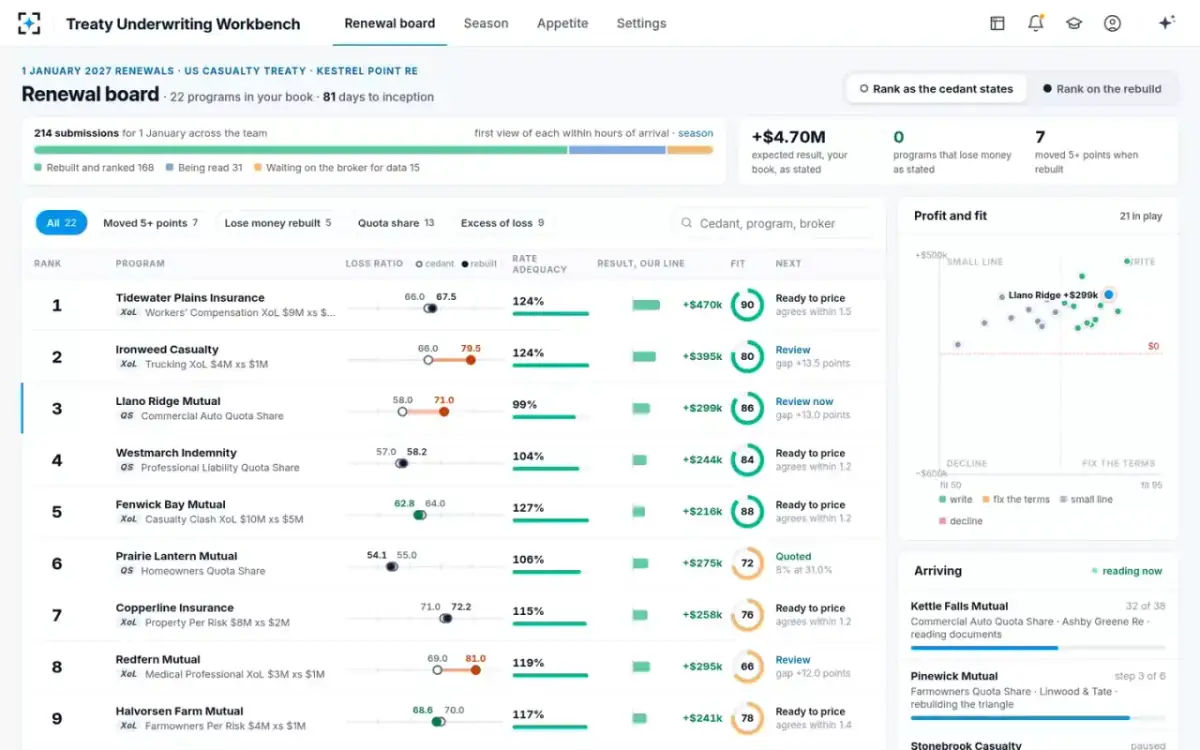
| Monday, 08:00 | Sort the weekend's broker emails. Save attachments, log six new submissions, ask the analyst which can be started this week. | Open the renewal board: 214 submissions for 1 January across the team, 168 already rebuilt and ranked, 31 being read, 15 waiting on brokers for data. |
| Monday, 09:30 | Start Llano Ridge Mutual's commercial auto quota share: find the loss tab in a nine-tab workbook, map it to the in-house template. | Switch the board from "rank as the cedant states" to "rank on the rebuild". Seven programs move five points or more; five now lose money on the offered line. |
| Monday, 11:00 | Broker call on a program quoted last week. Notes go in an email to self. | Open Llano Ridge: 58.0% as stated, 71.0% rebuilt, a three-step bridge between them, each step cited to a tab, cell or page. |
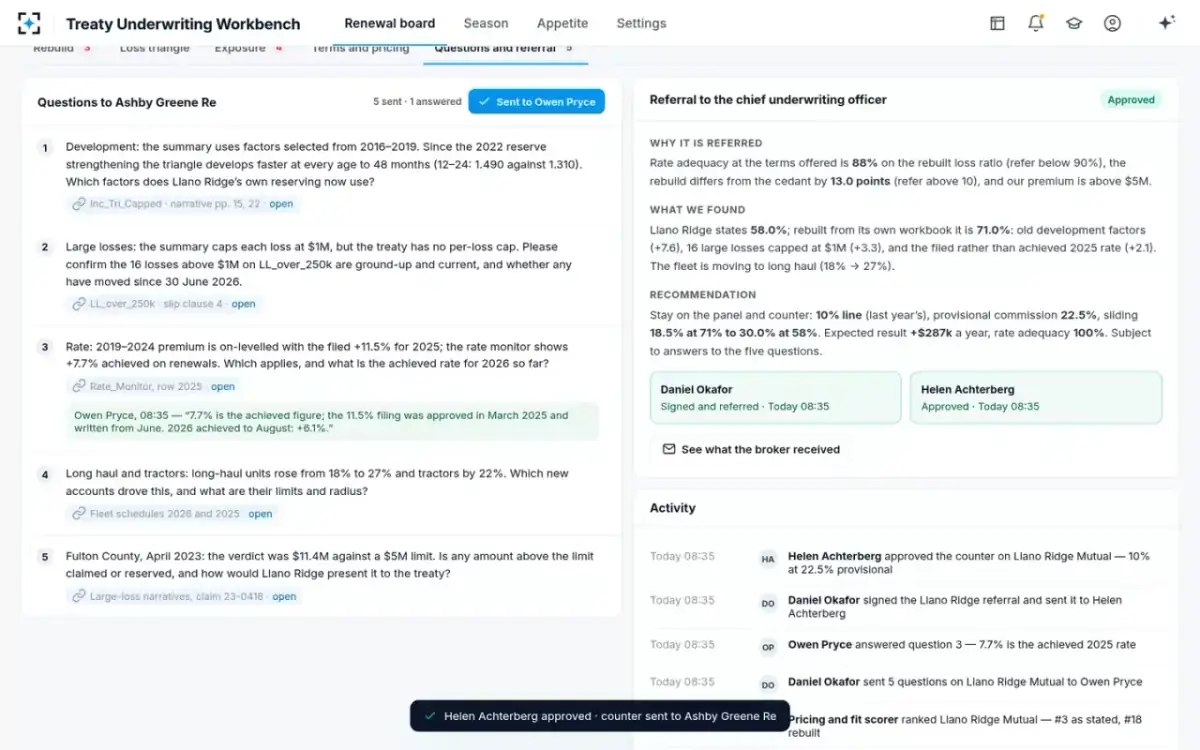
| Tuesday | The analyst rebuilds the Llano Ridge triangle from 16,412 claim rows. The underwriter reads the 64-page narrative for what the triangle cannot say. | Check the three corrections: development factors from 2016–2019, sixteen losses capped at $1 million on a treaty with no cap, and the filed 2025 rate used where the achieved rate was lower. |
| Wednesday | Large-loss listing against the slip. Premium on-levelled. Fleet schedules compared with last year's, by hand, in two windows. | Exposure change notes: long-haul units from 18% to 27% of the fleet, $5 million limit policies from 141 to 212. Decide which go into the broker questions. |
| Thursday | Pricing sheet. Commission on the slide at the cedant's loss ratio, then at the analyst's. Draft broker questions and the referral note. | Set the counter: last year's 10% line, 22.5% provisional commission. Edit the drafted questions and referral, then sign and send. |
| Friday | Two programs done properly this week. Three more priced on the cedant's summary because the quote date will not move. | Ranked season reviewed again. Time spent on the movers, the referrals and two broker meetings. |
The Friday row is the one that matters. Daniel's own line about his season, in the sample, is "I can read five submissions properly a week. I have twenty-two." Everything that does not get read properly is priced on the cedant's summary, and a cedant's summary is honest but chosen: old development factors, capped large losses, rate changes taken as filed. Each choice can be defended. Together, on the sample program, they were worth thirteen points of loss ratio.
Where a treaty underwriter's hours go: rebuilding, not judging
Most of a casualty program's first days go to rebuilding the data, not to the decision. Botminds estimates that an analyst rebuilding one casualty quota share by hand spends about three and a quarter days on it, and that well over half of that is triangles, large losses and premium, the arithmetic that has to be done before anyone can argue about the answer.
Where a casualty program's first-view days go, by hand
By hand · 3.25 days
- Reading · 15%
- Triangles · 39%
- Large losses, premium · 15%
- Exposure · 15%
- Questions, referral · 16%
With the agents · 0.5 days
- Reading · 10%
- Triangles · 20%
- Large losses, premium · 10%
- Exposure · 10%
- Questions, referral · 50%
The second bar is the point. With the agents, half of what remains is questions and the referral: the work of deciding what to ask and what to recommend. The underwriter's day moves from copying tab three into a template to checking a rebuild that is already tied, cell by cell, to the cedant's own triangle. The analyst in the sample, Priya Raman, puts the before in one line: "Half my week is copying tab 3 into our template." How that reallocation works, step by step, is set out in the reinsurance underwriting process, split between agents and people.
The renewal board: the season ranked, with the cedant's figure and the rebuild side by side
The decisions only the treaty underwriter makes
Five decisions stay with the underwriter however the rebuilding is done: whether to write the program, the line, the terms, what to ask the broker, and whether to refer. None of them is arithmetic. Each rests on judgment about a cedant's management, its market and the relationship, the things Patrik's first questions are about.
Four people carry each program; the rebuilding moves, the decisions do not
Today
Reads five submissions properly a week and has twenty-two in the book; the rest are priced on the cedant's summary.
With agents
Sees every program rebuilt and ranked, opens the ones that moved, and decides line and terms on cited figures.
Still theirs: Write or decline, the line, the terms, what to ask, when to refer
Today
Spends two to four days rebuilding each casualty program from the broker's workbook.
With agents
Checks a rebuild already tied to the cedant's triangle and spends the time on the differences.
Still theirs: Whether a correction is right for this cedant
Today
Finds out late that a cedant's development factors are five years old.
With agents
Sees the cedant's factors, the rebuild and the house benchmark side by side, each with its source.
Still theirs: Loss picks, benchmarks and the tail
Today
Gets a referral that says the program looks thin, without the reasons in one place.
With agents
Gets the gap, each cited reason and the recommended counter in one note, and approves or sends it back.
Still theirs: Referrals, appetite and authority
The line is the clearest example. On the sample program the broker offered Kestrel Point a 12.5% line, up from 10% the year before. At the cedant's 58.0% the larger line looked better; at the rebuilt 71.0% the slide hit its 27% floor and the line lost $251,000 a year. The underwriter chose to counter at last year's 10% line with a lower provisional commission. The agents worked out what each option earned. Choosing between them, and deciding the relationship was worth keeping, was the underwriter's call, and the counter still went to the chief underwriting officer because the rebuild sat more than ten points from the cedant's figure.
A treaty underwriter is paid to judge a cedant's book. In renewal season, most of the week goes to rebuilding it.
How many submissions does a treaty underwriter see?
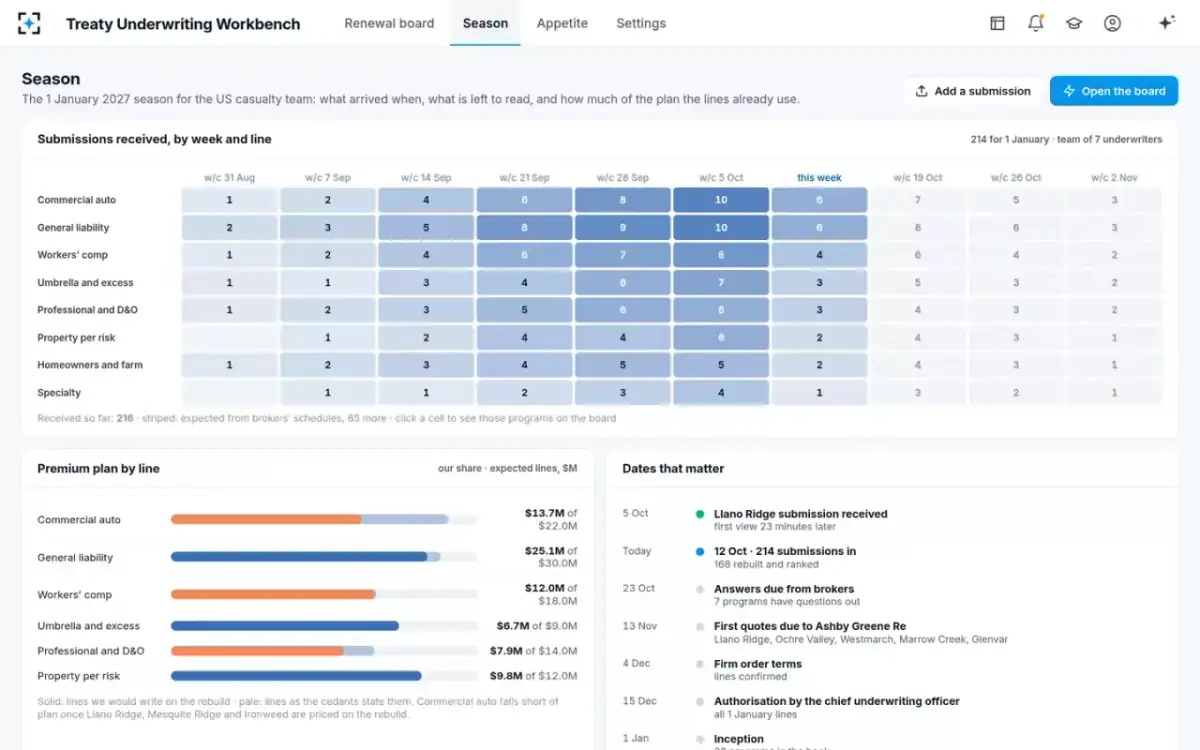
No public statistic counts submissions per treaty underwriter; the number depends on the reinsurer, the lines and the season. In the sample season, a team of seven US casualty underwriters received 214 submissions for 1 January, about thirty each, and the senior underwriter held 22 programs in his own book. Arrivals bunched: the busiest fortnight, the weeks of 28 September and 5 October, brought eight and ten commercial auto submissions and nine and ten general liability ones.
What a count misses is size. A casualty submission is not a form; the sample one ran to 42 documents, including a six-page slip, a 64-page narrative, a twelve-page annual statement extract, a nine-tab loss workbook with 16,412 claim rows, sixteen large-loss narratives and two years of fleet schedules. One "submission" can carry more reading than a week of primary applications, which is why the meaningful number is not how many arrive but how many are read properly.
The season view: what arrived each week, and how much of the plan the lines already use
What skills does a reinsurance underwriter need?
The Bureau of Labor Statistics lists five qualities for insurance underwriters: analytical skills, decision-making skills, attention to detail, interpersonal skills and math skills (BLS Occupational Outlook Handbook). It says most enter with a bachelor's degree, that beginners "typically work under the supervision of senior underwriters for up to 12 months", and that experienced underwriters may move up to senior underwriter or underwriting manager. It does not separate reinsurance underwriters from the rest.
Treaty work leans on three of those harder than primary work does. Math, because the decision turns on a loss ratio that has to be rebuilt: development factors, trend, on-level premium and the commission a slide pays at each outcome. The burning cost method and the as if loss ratio are the two calculations a new treaty underwriter learns first. Detail, because one clause in a slip, such as "no per-loss cap", changes what a large-loss listing means. And interpersonal skill, because every number the underwriter disputes goes back to a broker, and through the broker to a cedant who will be on the panel next year too.
What is new is the share of the work that is checking. When a rebuild arrives already done, the skill is knowing which correction to challenge and why: whether development has really sped up or the cedant changed its claims system, whether a capped loss belongs in the treaty or is a one-off the cedant should keep. That is judgment, and it is the part of the job the textbooks spend their pages on.
Will AI replace treaty underwriters?
The official projection is a slow decline in underwriting jobs, with automation as the stated reason, but treaty decisions are the kind least suited to it. The BLS projects employment of insurance underwriters to fall 4 percent from 2025 to 2035, and gives automated underwriting software, which lets fewer people process more applications, as the reason. It adds that for "specific and complex insurance types", underwriters "need to rely more on analytical insight". It still expects about 6,800 openings a year, almost all to replace people who retire or move on.
Underwriting by the numbers: fewer jobs, steady openings, a wide pay range
125,600
insurance underwriter jobs in the US in 2025
−4%
projected change in underwriter employment, 2025 to 2035
6,800
openings a year projected over the decade, mostly to replace leavers
$81,370
median annual wage, May 2025; the top tenth earned more than $145,160
The automation the BLS describes is primary, high-volume work: an application goes in, the software recommends, the underwriter confirms. A treaty is the opposite case, one program at a time and each tailored, where the hard part is judging a cedant's figures, not processing them. What agents change is the rebuilding that comes before that judgment. Supervisors are watching the same line: what supervisors expect from AI in reinsurance underwriting sets out the rules and the survey evidence.
Why the week matters more in a profitable year
A good year for reinsurers overall is not a good year for every line, and the treaty underwriter's week is where that difference is found. NAIC data for 2025 shows the 21 professional reinsurers it tracks at a 97.7% combined ratio overall, but at 122.3% on other liability written on an occurrence basis and 107.0% on claims-made (NAIC, 2025 full-year results). A team that prices on cedants' summaries writes the market's average. A team that rebuilds every program can pick the programs inside it.
The sample board shows what that looks like on one desk. As the cedants state them, Daniel's 22 programs expect $4.70 million on Kestrel Point's lines and none loses money. On the rebuild, five do. The week is spent finding those five early enough to counter, decline or refer, before 13 November rather than after the treaty has incepted.
The end of the week: questions sent, referral signed, counter approved
To see the board, the rebuild and the referral on a season of your own, start from the Treaty Underwriting Workbench.
Questions people ask
Is treaty underwriting a good career?
It is a specialist path inside a shrinking occupation. The BLS projects insurance underwriter jobs to fall 4% from 2025 to 2035 but still expects about 6,800 openings a year, and the work that is automating fastest is high-volume primary underwriting, not tailored treaty programs.
How much does a treaty underwriter earn?
No official series isolates treaty underwriters. For all insurance underwriters, the BLS reports a median of $81,370 in May 2025, with the lowest tenth under $55,530 and the highest tenth above $145,160. The BLS does not publish a figure for reinsurance underwriters on their own.
What does a treaty underwriting analyst do?
The analyst turns a broker's submission into numbers the underwriter can judge: the loss triangles, the large-loss listing against the slip, premium at today's rates and exposure against last year. Botminds estimates that this takes two to four days per casualty program by hand, which is the work the solution's agents take on.
What is the 1/1 renewal?
It is the date on which a large share of reinsurance treaties renew, 1 January. Submissions arrive from late summer, quotes and firm order terms follow in November and December, and lines are authorised and signed before inception. The sample season ran from the first arrivals on 31 August to authorisation on 15 December.
Do treaty underwriters need to be actuaries?
No. The BLS says underwriters usually hold a bachelor's degree, commonly in business, and the pricing actuary is usually a separate role: it counts about 31,200 actuaries against about 125,600 underwriters (BLS, actuaries). On casualty treaties the two work side by side: the actuary owns development benchmarks and loss picks, the underwriter the line, the terms and the relationship.