A reinsurance underwriting platform is software that takes a reinsurer's treaty submissions from the broker's email to a priced, referred decision: it reads each submission, rebuilds the cedant's loss and exposure figures, ranks the season by expected result and fit, and records who decided what. The way to choose one is not a demonstration but a pilot on submissions you have already underwritten: last 1 January's, run through the platform exactly as the brokers sent them, and scored against the files your team built at the time. Botminds' Treaty Underwriting Workbench is built to be tested that way; every rebuilt figure opens the tab, cell or page it came from, so a pilot can check the work, not just the answer. This guide sets out a six-week design: which programs to pick, what data to bring, what to measure, and when to stop.
Examples of what the platform produces come from the solution's fictional sample season, Kestrel Point Re's 1 January 2027 US casualty renewals. The pilot design, the scorecard and the stop rules are ours, offered as a starting point.
What a fair pilot of a reinsurance underwriting platform needs before it starts
- Last renewal's submissions, exactly as received
Broker emails with every attachment: slips, narratives, workbooks, schedules. Not cleaned copies.
- Your team's own files for the same programs
The rebuilt triangles, the factor selections, the pricing sheet and the loss ratio each program was written or declined on.
- Your quotes, signed lines and declines
So the ranking can be compared with what the team actually did, and with what has happened since.
- Your appetite, authority and referral rules
Written down, so fit scores and referral triggers test your rules, not the vendor's.
- Your development benchmarks and house method
Which factors, over how many years, which tail, which rate to on-level with. Set before the run and not changed during it.
- A scorecard and stop rules agreed in advance
Signed by the chief underwriting officer and the pricing actuary before any result is seen.
What is a reinsurance underwriting platform? Four jobs, one that matters most
A reinsurance underwriting platform does four jobs: it reads submissions, rebuilds the cedant's figures, ranks the season and records decisions. Most buyers judge the first and third, because they show well: a board of programs sorted by a score, a pile of documents marked read. The job that decides whether the rest can be trusted is the second, the rebuild, because that is where the cedant's figure becomes the reinsurer's.
The four jobs of a reinsurance underwriting platform, and what a pilot should test in each
| Job | What good looks like | What the pilot tests |
|---|---|---|
| Read | Every document in a broker's email sorted and read; every workbook tab mapped; the slip's terms extracted with their clauses. | Share of documents correctly classified; slip terms against your file; missing figures turned into questions, not guesses. |
| Rebuild | Triangles rebuilt from claim rows and tied to the cedant's; large losses read against the slip; premium on-levelled; exposure compared with last year. | Tie-out of every cell; factors against your selection; rebuilt loss ratio against your file; every figure traceable to its source. |
| Rank | The season ordered by expected result and fit against your appetite, with the cedant's figure beside the rebuild. | Whether the programs your team declined or countered last year rank low on the rebuild, and why. |
| Record | Questions, counters and referrals drafted, sent by people, and kept on an audit trail with versioned settings. | Whether a reviewer can reconstruct, for any program, what was decided, by whom, on which figures and under which rules. |
Why a vendor demonstration proves so little in treaty underwriting
A demonstration runs on the vendor's data, and treaty data is the one thing no two cedants format alike. Clark's CAS study note on reinsurance pricing says it in its first page: "there is no such thing as the "average" reinsured or the "average" reinsurance price" (Clark, Basics of Reinsurance Pricing). Each program is tailored, and each broker's workbook has its own tabs, caps and conventions. A platform that reads a showcase submission cleanly has shown that it reads that submission.
The profession's own working group says the data problem is unsolved. The Casualty Actuarial Society's Reinsurance Working Group opened its 2026 call for papers by describing a field "where data is often sparse at best", in which "actuaries seem to have an endless catalog of imperfect modeling options to choose from" (CAS, 2026 Reinsurance Call Paper Program), and asked for general guidelines on the data reinsurance pricing needs, especially for the deals with no standard format; what a cedant should bring on day one is the cedant's side of that gap. Where there is no standard format, the test has to be your formats.
A demonstration and a pilot on your own closed renewal answer different questions
Vendor demonstration: The vendor's sample submissions, chosen to run cleanly.
Pilot on last 1/1's submissions: Your brokers' submissions as received, including the messy ones.
Vendor demonstration: Whatever the vendor says it is.
Pilot on last 1/1's submissions: Your team's own file, plus a year of development since.
Vendor demonstration: The vendor's defaults.
Pilot on last 1/1's submissions: Your factor selection, benchmark, on-level rule and appetite, fixed in advance.
Vendor demonstration: That the screens work.
Pilot on last 1/1's submissions: Whether the rebuild matches or improves on your team's, program by program, and whether every figure can be traced.
Vendor demonstration: An afternoon.
Pilot on last 1/1's submissions: About six weeks of part-time effort from an analyst, an underwriter and a pricing actuary.
Can you test a reinsurance platform on last year's submissions?
Yes, and last year's closed renewal is the best sample there is. The submissions are real and in your archive. Your team rebuilt and priced them, so the right answer, or at least your team's answer under deadline, is on file. Decisions were made, so the ranking can be compared with what the team chose. And a year has passed, so for some programs the development since inception shows whose loss ratio was closer.
Use that last point carefully. One year of development on a casualty treaty is mostly noise; a quota share that has run well for twelve months has proved little about its ultimate cost. Treat it as a tiebreaker on large disagreements, not as the scoring standard. The scoring standard is the rebuild's own evidence: does each figure tie to the cedant's data, and does each correction cite the clause, tab or page it rests on. How to run that comparison on the triangles specifically is in replaying last year's loss development triangles.
What data does a pilot need, and how many programs?
A pilot needs the submissions as received, your files on the same programs, and your written rules, all of which already exist. For the sample, take 20 to 30 programs from last 1 January: enough to cover three or more lines, quota share and excess of loss, several brokers, and at least five programs your team remembers as hard. Include two or three you declined and two or three you countered, because the ranking should be tested on decisions, not only on numbers.
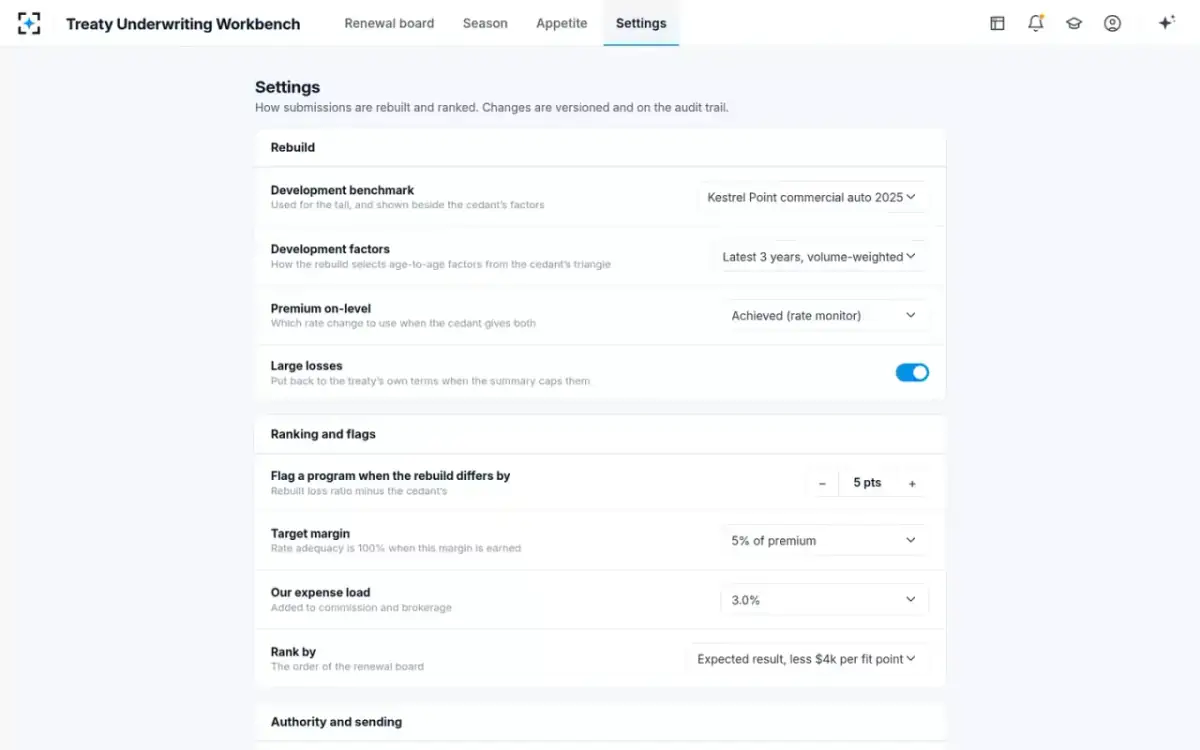
The platform's settings should be yours before the first run. In the solution those are named choices: the development benchmark, how factors are selected (for example, the latest three years, volume-weighted), which rate change to on-level premium with, whether large losses are put back to the treaty's own terms, the gap that flags a program, the target margin, the expense load and how the board is ranked. Each is versioned on the audit trail, so a pilot can show exactly which rules produced which results.
Settings: the rules a pilot fixes before the first run
What should we measure in a pilot? A five-line scorecard
Measure the rebuild first and the ranking last. The scorecard below is the one we suggest; the pass marks are for the chief underwriting officer and the pricing actuary to set before the run, and the suggestions in the third column are ours.
A pilot scorecard: what to measure on each replayed program, and a suggested bar
| Measure | How it is scored | Suggested bar, set in advance |
|---|---|---|
| 1. Tie-out | Every rebuilt triangle cell against the cedant's own triangle, within a stated tolerance. | Every cell ties or is flagged with its reason; no silent differences. |
| 2. Traceability | Open each figure on the bridge and in the pricing; it must open its document, tab and cell, or page. | Every figure traceable; one untraceable figure fails the program. |
| 3. Rebuilt loss ratio | Against your team's file for the same program, using the same house method. | Most programs within a point or two; every larger gap explained by a cited correction or a known judgment. |
| 4. Questions, not guesses | Missing or inconsistent data turned into broker questions, compared with what your analyst chased last year. | No figure filled in that the submission did not contain. |
| 5. Hours | Analyst and underwriter time per program to a first view you would rely on, by hand last year and with the platform now. | A material cut in first-view hours, measured, not estimated. |
The third line is where pilots go wrong in both directions. A rebuild that matches your file on every program may simply be repeating your method; one that differs on many may be finding what your team missed under deadline. Neither is a pass or a fail by itself. The useful output is a list of disagreements, each with the platform's citation and your file's reasoning, reviewed by the actuary. On the sample season the solution moved seven of one underwriter's 22 programs by five points or more; in a pilot, each of those is a conversation worth having before you buy.
How long does a reinsurance software pilot take? Six weeks, part-time
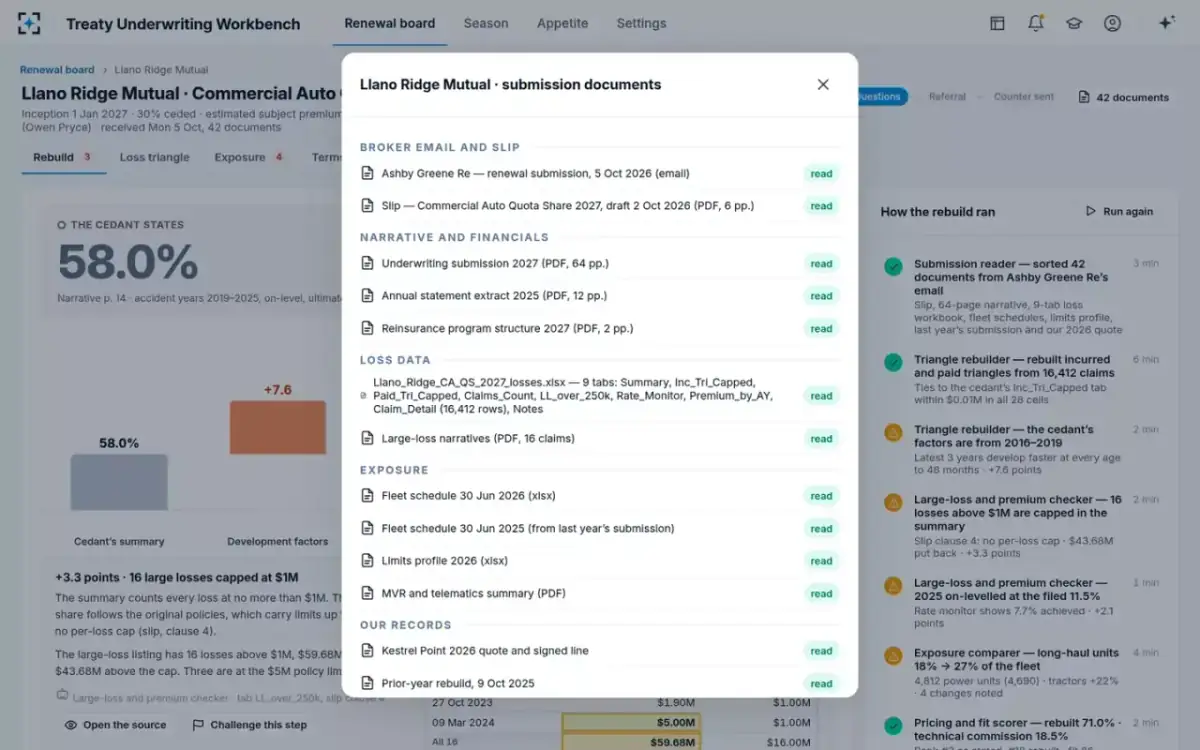
A pilot on closed submissions takes about six weeks of part-time effort, most of it in scoring, not running. The runs themselves are short: in the sample, the first view of a 42-document submission was on the board 23 minutes after the email. The time goes into setting the method, reviewing disagreements and writing up.
A six-week pilot: one week to set up, two to replay, three to score and decide
- Set up: rules, benchmarks, sampleWeek 1
- Replay 20–30 programsWeeks 2–3
- Score tie-out, traceability, loss ratiosWeek 4
- Review disagreements with the actuaryWeek 5
- DecideWeek 6
Run it away from the 1 January peak. A pilot squeezed into October competes with the live season for the same analysts and gets scored in a hurry; one run in the spring has the people and the closed renewal still fresh. If the platform passes, the next renewal date can run in parallel: live submissions through the platform, your team's normal process alongside, and the disagreements reviewed weekly.
Stop rules: when to end a pilot early
Agree in advance what ends a pilot, so a weak result is not argued away. We suggest four stop rules. First, an untraceable figure: if the platform shows a number that cannot be opened to its source, the rebuild cannot be audited, and an underwriter cannot rely on it. Second, a filled-in gap: if the platform supplies a figure the submission did not contain, without saying so, it has guessed. Third, a changed cedant figure: the cedant's own number must sit beside the rebuild, unaltered, on every screen. Fourth, a moved setting: if results only come right after the method is changed mid-pilot, the pilot has tested the tuning, not the platform.
None of those is about accuracy in the narrow sense. They are about whether the platform's output can be checked, because in treaty underwriting a number that cannot be checked is not used, however close it is. Regulators frame the market's current risk in the same terms. The Florida Office of Insurance Regulation, which measures reinsurance prices for Florida residential property programs, reported that "Preliminary 2026 ARDC data suggests nearly half of ARDC insurers are experiencing risk-adjusted pricing reductions between 15% and 25%" (Florida OIR, July 2026), and the Prudential Regulation Authority expects boards to "maintain robust underwriting discipline in this weakening environment" (PRA, 2026 priorities). When prices fall, selection carries the margin, and selection depends on numbers the underwriter can trust.
What to ask a reinsurance underwriting platform vendor
Ask how the platform behaves when it is unsure, not only what it does when it is right. Six questions separate a platform you can audit from one you have to believe.
Six questions for a reinsurance underwriting platform vendor
- Does it ever change the cedant's figures?
The right answer is no: the cedant's figure sits beside every rebuilt one, and every correction is a separate, cited step.
- What outside data does a rebuild use, and is it labelled?
In the Treaty Underwriting Workbench, only a benchmark development tail, labelled as the reinsurer's own.
- What happens when a figure is missing?
It should become a question to the broker, never an estimate.
- Can it quote, bind or send anything?
Agents should rank and draft; questions, counters and referrals should go out only from a person.
- Who can change the rules, and is the change recorded?
Benchmarks, thresholds, appetite and authority should be versioned settings with an approver and a date.
- What does each broker see?
Submission data should be kept per cedant and per broker; in a broker portal, brokers should see only their own submissions, questions and answers.
Where the Treaty Underwriting Workbench fits, and where it does not
The solution fits the work between a broker's email and an underwriter's decision on treaty submissions: reading every document, rebuilding the cedant's loss ratio from its own triangles, large-loss listing and rate monitor, comparing exposure with last year, ranking the season by expected result and fit, and drafting the questions and referral note. It is strongest where submissions are many, varied and long-tailed, as in casualty treaty renewals, and where the gap between the cedant's figure and the real one is the decision.
It is not a catastrophe model, a policy administration system or a reinsurance accounting system, and it does not replace the pricing actuary's stochastic models for loss-sensitive features; it produces the rebuilt loss and exposure tables those models start from. It does not quote, bind or send. A pilot should include the hand-offs: where the rebuild goes next (your pricing model, your underwriting file), and whether that hand-off keeps each figure's source. The guide to reinsurance pricing tools, spreadsheets and agents covers where the solution sits beside a pricing tool you already run.
The submission, read: 42 documents sorted by kind, with last year's quote and rebuild linked
To run the pilot on a sample of your own past submissions, start from the Treaty Underwriting Workbench.
Questions people ask
How many submissions should a reinsurance platform pilot use?
Twenty to thirty programs from one closed renewal is usually enough to cover several lines, both quota share and excess of loss, and several brokers' formats. Include programs your team declined or countered, so the ranking is tested against real decisions as well as numbers.
Do we need to clean the data before a pilot?
No, and you should not. Feed the submissions exactly as the brokers sent them; cleaning them first tests your analysts, not the platform. The point of the pilot is to see how the platform handles your brokers' real layouts, gaps and inconsistencies.
Can the pilot run during the 1 January renewal?
It can, but it will be scored in a hurry by people who are also running the live season. A closed renewal replayed between renewal peaks gives cleaner results; a parallel run on live submissions is a better second phase than a first one.
What does a reinsurance underwriting platform cost?
Prices depend on volume and configuration and are not published consistently enough to compare. The better comparison is against the cost of rebuilding by hand: about three analyst days per casualty program on Botminds' estimate, and the cost of the programs priced on cedants' summaries because those days ran out.
What happens to our submission data in a pilot?
In the Treaty Underwriting Workbench, submission data is kept per cedant and per broker, and settings and decisions are versioned on an audit trail. Ask any vendor the same questions in writing: where the data is held, who can see it, and how it is removed when the pilot ends.