FEMA reinsures the National Flood Insurance Program in two ways: a traditional reinsurance placement renewed each year, and multi-year capital-market placements, catastrophe bonds that FEMA calls FloodSmart placements. Each covers a stated percentage of NFIP flood losses within a band, for example 12.0334% of losses between $7 billion and $9 billion in 2025, and the capital-market placements respond only to flooding from named storms. Because FEMA publishes the layers, the percentages, the premium and the trigger wording, its program is the one real reinsurance program anyone can study, and reading it raises exactly the questions a ceded team answers on private treaties: does this event qualify, which placements are reached, and for how much? Botminds' Reinsurance Contract Search answers those questions on a cedant's own wordings, quoting the clause that decides. This guide practises them on FEMA's.
All figures for the NFIP program come from FEMA's own pages and the Congressional Research Service, linked where used. The comparison screens show a fictional sample cedant, Cardale Mutual, in the solution.
Six parts of any reinsurance trigger, read in FEMA's NFIP program and in a private treaty
What kind of event
FEMA's NFIP placementsCapital-market placements: flooding from named storms only. Traditional 2025: a single qualifying flood event, not defined in the release.
In a private treatyThe loss occurrence or catastrophe event definition
The question it settlesDoes this event qualify at all?
Declared by whom
FEMA's NFIP placementsThe National Hurricane Center: tropical cyclone, depression, storm or hurricane.
In a private treatyOften an industry catastrophe serial number
The question it settlesWho has to call it an event, and have they?
How losses are grouped
FEMA's NFIP placementsOne event; the grouping rules sit in the contracts.
In a private treatyThe hours clause, such as 72 consecutive hours for hail
The question it settlesOne event or two?
Band and share
FEMA's NFIP placements2025 traditional: 12.0334% of $7–9bn and 25.8584% of $9–11bn.
In a private treatyRetention, limit and the reinsurers’ share of the layer
The question it settlesHow much, and where does it stop?
Term
FEMA's NFIP placementsTraditional: the calendar year. Capital-market: three years from issue.
In a private treatyThe treaty period and the wording in force on the loss date
The question it settlesWhich covers were in force that day?
Territory
FEMA's NFIP placements50 states, DC, Puerto Rico and the U.S. Virgin Islands; not American Samoa, Guam or the Northern Mariana Islands.
In a private treatyThe territorial scope article
The question it settlesIs the location inside the cover?
Does FEMA buy reinsurance?
Yes. FEMA has bought reinsurance for the NFIP every year since January 2017, under authority Congress gave it in the Biggert-Waters Flood Insurance Reform Act of 2012 and the Homeowner Flood Insurance Affordability Act of 2014. FEMA describes what it buys as per occurrence property catastrophe excess of loss reinsurance, the same family of cover a private cedant buys for hurricanes (FEMA, NFIP Reinsurance Program).
The program uses two routes to the market. Traditional reinsurance is placed for one year with a panel of reinsurers. Capital-market reinsurance runs for three years and is funded by catastrophe bonds, with a transformer reinsurer standing between FEMA and the investors, which FEMA names on its program page. If a placement is triggered, FEMA says, the proceeds are deposited into the National Flood Insurance Fund.
Which FEMA placements were in force on a given day, March 2022 to March 2027
- 2022
- 2023
- 2024
- 2025
- Nothing later on FEMA’s pages
- In force
- Ended without a covered event
- In force
- Ended
- Not yet
- In force
- Ended
- Not yet
- In force
How does the NFIP reinsurance program work?
It works like any cedant's catastrophe excess of loss cover, with one difference in form: each placement takes a percentage of the NFIP's losses within a band rather than a full layer. The reinsurers pay their percentage of whatever part of a qualifying event's NFIP losses falls inside the band, and nothing below it.
The 2025 traditional placement is a clean example. FEMA's release says it covers part of NFIP losses above $7 billion from a single qualifying flood event, structured as 12.0334% of losses between $7 billion and $9 billion and 25.8584% of losses between $9 billion and $11 billion, for a premium of $139.9 million (FEMA, 15 January 2025). Multiply the percentages by the $2 billion width of each band and the maximum recovery is about $757.8 million, matching the $757.835 million of risk FEMA says it transferred. A loss of $12 billion recovers no more than a loss of $11 billion: everything above the top band stays with the program.
What does FEMA's reinsurance cover? The words to read in each placement
Each placement covers a share of NFIP flood losses from a qualifying event, within a band, during its term and in its territory. Every one of those five terms is a coverage question, and FEMA's pages answer some of them in plain words and leave others to the contracts.
The territory is stated: the capital-market placements cover the 50 states, the District of Columbia, Puerto Rico and the U.S. Virgin Islands, and FEMA says American Samoa, Guam and the Northern Mariana Islands are not included. The terms are stated: the 2024 capital-market placement runs from 7 March 2024 to 7 March 2027 and covers 10% of losses between $8 billion and $9 billion and 23.75% between $9 billion and $11 billion. What makes a flood event qualify for the traditional placement is not defined in the release. On a private treaty, that is the moment to open the event definition article; on FEMA's program, it is the moment to ask for the contract.
FEMA's capital-market placements: term, first-year premium and bands
| Placement | Term | First-year premium | Share of NFIP losses covered | Outcome |
|---|---|---|---|---|
| 2018 | Aug 2018 – Jul 2021 | $62M | 3.5% of $5–10bn; 13% of $7.5–10bn | Ended without a covered event |
| 2019 | Apr 2019 – Apr 2022 | $32M | 2.5% of $6–8bn; 12.5% of $8–10bn | Ended without a covered event |
| 2020 | Feb 2020 – Feb 2023 | $50.28M | 3.33% of $6–9bn; 30% of $9–10bn | Ended without a covered event |
| 2021 | Feb 2021 – Feb 2024 | $79.44M | 12.5% of $6–7bn; 22.5% of $7–9bn | Ended without a covered event |
| 2022 | Feb 2022 – Feb 2025 | $61.23M | 2.5% of $6–7bn; 5% of $7–9bn | Term ended February 2025 |
| 2023 | Mar 2023 – Mar 2026 | $50.37M | 5% of $7–8bn; 11.25% of $8–10bn | In force through the 2025 season |
| 2024 | Mar 2024 – Mar 2027 | $88.43M | 10% of $8–9bn; 23.75% of $9–11bn | In force through the 2025 season |
What is a named storm trigger?
A named storm trigger means a placement responds only to losses caused by a storm that a named authority has declared a tropical cyclone, depression, storm or hurricane. For FEMA's capital-market placements the authority is the National Hurricane Center, and the definition is written out in full.
These capital market reinsurance placements only cover risk from “named storms.” A named storm is a storm or storm system that the National Weather Service’s National Hurricane Center has declared to be a tropical cyclone, tropical depression, tropical storm, or hurricane.
FEMA, NFIP Reinsurance Program
FEMA spells out the consequence too: a major flood that is not a named storm would not trigger the 2021–2023 FloodSmart placements. FEMA gives the reason for accepting that gap: catastrophe modelling and history indicate that most of the NFIP's risk of single flood events above $6 billion comes from named storms. A ceded analyst should read two details. The definition includes a tropical depression, so the storm need not reach hurricane strength. And FEMA says the placements apply to flooding that results directly or indirectly from a named storm, which brings rainfall flooding far inland within the trigger, while a slow-moving inland rain event with no declared storm stays outside it.
The 2025 release adds a sentence worth reading slowly: "If a named storm flood event is large enough to trigger all reinsurance agreements, FEMA will receive qualifying payments." It describes the scenario that triggers everything. It does not say whether a flood without a named storm could still trigger the traditional placement, whose trigger the release describes only as a qualifying flood event. Answering that needs the contract wording, which is precisely the discipline of a coverage answer: quote the words, and where the published words stop, say so.
Did FEMA collect reinsurance after Harvey?
Yes, in full. FEMA reports that by 31 July 2021 it had paid NFIP policyholders more than $9.03 billion for Hurricane Harvey claims, and that it recovered the whole $1.042 billion of its 2017 traditional reinsurance (FEMA). The first placement the program ever bought paid its limit in its first season.
One storm filled the first placement; the program's debt is a different scale
$9.03bn
NFIP claims paid for Hurricane Harvey, as of 31 July 2021
FEMA
$1.042bn
reinsurance recovered under the 2017 traditional placement: all of it
FEMA
$22.525bn
NFIP debt to the Treasury after a $2bn borrowing in February 2025
CRS, April 2025
$30.425bn
statutory borrowing limit
CRS, April 2025
FEMA also explains the years since: no qualifying event has occurred under any of its reinsurance agreements since the 2017 hurricane season. That is not a failure of the program, FEMA argues, because buying reinsurance transfers risk whether or not an event occurs; but it does mean every placement since 2017 has expired or is running without a recovery. FEMA is also explicit about what reinsurance cannot do: it leaves the NFIP's existing debt to the Treasury untouched, and is meant only to slow the build-up of new debt.
What is FloodSmart Re?
FloodSmart Re is the name attached to FEMA's capital-market placements: catastrophe bonds whose investors back NFIP reinsurance for three years, through a transformer reinsurer. FEMA's own page refers to them as "the three FloodSmart placements" when explaining the named-storm trigger.
The structure has one feature that matters for coverage questions: FEMA notes the capital-market reinsurance "expires at the end of the three years when the catastrophe bonds mature unless a reinsurance claim exhausts the coverage". So a bond placed in March 2023 still covered the 2025 season, while one placed in February 2022 had matured by then. When a ceded team answers "which covers were in force on the loss date?", a multi-year bond is the cover most likely to be forgotten, because nothing about it is renewed in the year of the loss.
Six coverage questions to practise on FEMA's program
Because the terms are public, the NFIP program is a good training set for the questions a ceded analyst gets on private treaties. Each answer below cites only what FEMA has published, and says so where the published words run out.
Practice questions on the 2025 NFIP program, with the words that decide each
| Question | The words that decide | Answer from the published terms |
|---|---|---|
| A hurricane causes $10bn of NFIP flood losses in 2025. What does the traditional placement pay? | 12.0334% of $7–9bn; 25.8584% of $9–11bn | $240.7M + $258.6M ≈ $499.3M, if the event qualifies |
| The same hurricane: what do the two capital-market placements pay? | 2023: 5% of $7–8bn, 11.25% of $8–10bn; 2024: 10% of $8–9bn, 23.75% of $9–11bn | $275.0M and $337.5M, since a hurricane is a named storm |
| An inland rain flood with no declared storm causes $8bn of losses. | “only cover risk from named storms”; “single qualifying flood event” | Capital-market placements: no. Traditional: the release does not say; ask for the contract |
| A tropical depression, never a hurricane, causes the flooding. | Named storm includes a “tropical depression” declared by the NHC | Within the capital-market trigger, subject to the loss bands |
| A typhoon floods insured properties in Guam. | Territory: 50 states, DC, Puerto Rico, U.S. Virgin Islands | Capital-market placements: Guam is not included |
| A $13bn event: how much more than an $11bn event? | Every band tops out at $11bn | Nothing more: losses above $11bn stay with the NFIP |
The third row is the one to dwell on. A good answer quotes the capital-market trigger, applies it, and then states plainly that the traditional placement's trigger is not in the published text. That is the same rule a coverage tool should follow on a private program: when no clause answers, refer the question instead of guessing. In the sample cedant's question log, the matching case is a referred question about whether an aggregate cover responds to wildfire smoke damage with no catastrophe serial number.
Reading any trigger: what the NFIP program teaches about private treaties
Every trigger has the same parts as FEMA's: what kind of event, declared by whom, measured how, within which band, during which term, in which territory. Private treaties hide those parts in definitions and articles rather than a press release, but the reading is identical, and so are the traps: an event that is one occurrence or two, a definition that turns on someone else's declaration, a cover from an earlier year still running.
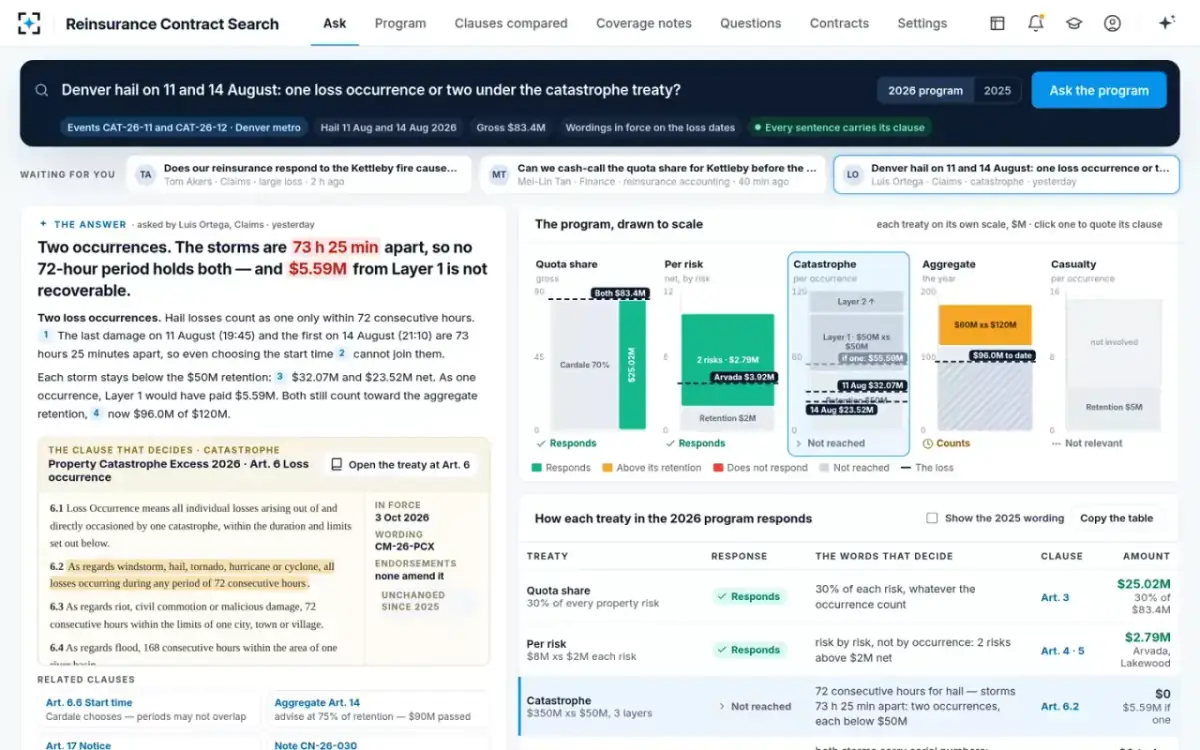
The sample cedant's hail question is the private-treaty twin of the named-storm question. Its catastrophe treaty defines a loss occurrence by a 72-hour window for hail, two storms fell 73 hours 25 minutes apart, and the answer turns on that one number, worked in how reinsurance layers work.
A private treaty's trigger, quoted: the hours clause decides one occurrence or two
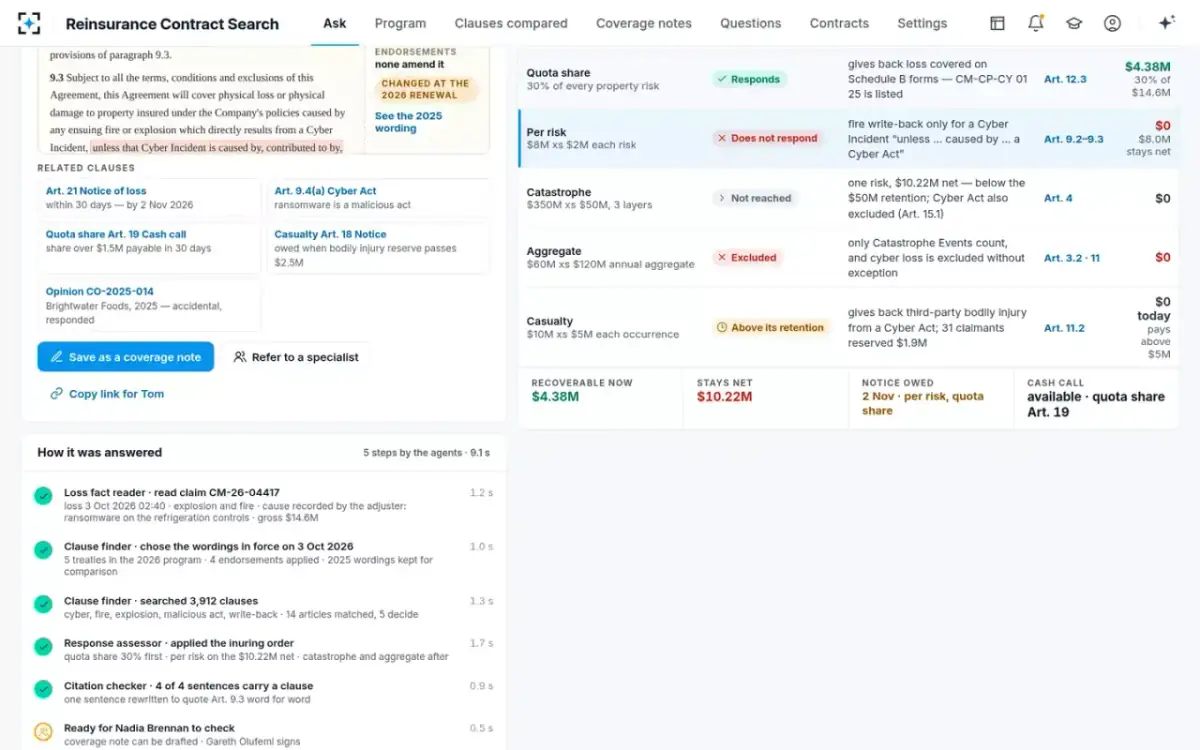
Every treaty tested against one event, with the deciding words beside each
To practise the same questions on your own program's wordings, start from Reinsurance Contract Search; for the order in which covers apply to one loss, see inuring reinsurance.
Questions people ask
Does reinsurance raise NFIP premiums?
FEMA says it has not so far. Its program page states that the seven traditional placements from 2017 to 2023 and five capital-market placements from 2018 to 2022 "did not result in an increased rate for NFIP policyholders". FEMA adds that it will work with the Administration and Congress on how to pay for a larger program.
Does FEMA's reinsurance affect NFIP policyholders' claims?
No. FEMA states that its reinsurance agreements are between FEMA and the reinsurers and do not change its contracts with policyholders, and that the timing of reinsurance payments does not affect claim payments. Reinsurance is a funding source for FEMA, not a condition of any claim.
Why hasn't FEMA recovered any reinsurance since 2017?
Because no event since the 2017 season has produced NFIP losses large enough to reach the placements. FEMA's 2025 traditional placement attaches at $7 billion of losses from a single qualifying flood event, and its capital-market placements at $7 billion or more, from named storms only.
Is there a 2026 NFIP reinsurance placement?
FEMA's published reinsurance page and releases describe placements through January 2025, the traditional placement for calendar year 2025, plus capital-market placements running to March 2027. For anything later, the source to check is FEMA's own reinsurance page and press releases.
How much does FEMA pay for reinsurance?
For the 2025 traditional placement, $139.9 million for $757.835 million of cover. Earlier traditional premiums ranged from $90.2 million in 2023 to $235 million in 2018, and first-year premiums for the capital-market placements from $32 million (2019) to $88.43 million (2024).