An ultimate net loss clause defines the loss a reinsurance contract responds to: usually the sum the cedant actually paid in settling losses, sometimes with loss adjustment expense added, and after deducting salvage, other recoveries and inuring reinsurance. The retention and the limit then apply to that figure, so the clause answers the questions claims and finance actually ask: does our reinsurance respond, under which clause, and for how much? Misread it and the error is rarely small. Whether defense costs sit inside a limit or on top of it turned, in New York's highest court, on the words of one facultative certificate, and a worked example in the Casualty Actuarial Society's study materials shows one claim producing reinsurance payments $180,000 apart under the two readings. Botminds' Reinsurance Contract Search answers limit questions by quoting the ultimate net loss and limit wording of each treaty in force on the loss date, because this is a clause no one should answer from memory.
Worked figures use a fictional sample cedant, Cardale Mutual, and its program as it runs through the solution. The court records, the Florida statute and the Casualty Actuarial Society's examples are real and linked where they appear.
What an ultimate net loss definition adds, deducts and leaves out: a sample wording and a public statute
| Element | Sample per risk treaty, Art. 12 | Florida Hurricane Catastrophe Fund, s. 215.555 | Why it matters |
|---|---|---|---|
| Starting point | “the sum actually paid by the Company in settlement of losses” | All incurred losses under covered policies | Paid or incurred decides when a recovery can be billed |
| Loss adjustment expense | Not mentioned in the definition: read the limit and expenses articles | Excluded from losses, then reimbursed at a fixed 10% of reimbursed losses | The expense line can be inside the limit, on top of it, or a flat add-on |
| Salvage and recoveries | Deducted | Not stated in the definition | A subrogation recovery after billing has to be returned in proportion |
| Inuring reinsurance | Deducted “whether collected or not” | Not stated in the definition | An unpaid inuring recovery stays with the cedant |
| Extra-contractual and over-limit amounts | Not mentioned in the definition | Excluded: bad faith and punitive awards, amounts above policy limits | Often negotiated separately, in an extra-contractual obligations clause |
| Ex gratia payments | Not mentioned | Excluded: voluntary expansions of coverage, including waived deductibles | A settlement beyond the policy terms is the cedant’s own |
What is ultimate net loss in reinsurance?
Ultimate net loss is the cedant's final loss on a claim or event, net of everything the wording says to deduct, measured the way the reinsurance contract says to measure it. It is the number the retention is subtracted from and the limit is applied to. A treaty that says "$8M excess of $2M ultimate net loss each risk" means nothing until ultimate net loss is defined.
The sample per risk treaty's definition is typical of a property wording: "Ultimate Net Loss means the sum actually paid by the Company in settlement of losses, after deduction of all salvages, recoveries and inuring reinsurance, whether collected or not." Three choices are packed into that sentence. "Actually paid" makes the measure paid rather than reserved. "After deduction" lists what comes off. And the definition is silent on expenses, which sends the reader to the limit and expense articles; silence there is where disputes start. A property catastrophe program is no different: the English Court of Appeal's 2024 Unipol judgment describes a cover whose lowest layer was "£20 million in excess of £10 million Ultimate Net Loss each and every Loss Occurrence" (Unipolsai v Covéa, [2024] EWCA Civ 1110).
What does the ultimate net loss clause include, and what does it deduct?
It includes what the cedant paid on covered losses and, depending on the wording, some or all of the expense of settling them; it deducts salvage, subrogation and other recoveries, and usually inuring reinsurance. What it leaves out matters as much: extra-contractual obligations, losses in excess of the original policy limit, and payments the cedant made beyond the policy's terms.
The clearest public example of a full definition is a statute. Florida's law for its state hurricane reinsurer defines "Losses" as all incurred losses under covered policies and then lists eight exclusions, from business interruption and liability coverages to bad faith and punitive awards, amounts above the policy's limits and allocated or unallocated loss adjustment expenses (Fla. Stat. s. 215.555). It then puts expense back in by formula: for contracts effective from June 2019, the fund reimburses loss adjustment expense at 10 percent of the losses it reimburses. That is the expense question answered in advance, in public, which is exactly what most private wordings leave to the limit article.
The three most common expense designs in private treaties are expense included in the limit, expense in addition to the limit in proportion to the loss, and expense added to the loss before the retention and limit apply. The arithmetic of each is below, and the difference between them is the subject of almost every limit dispute.
Are defense costs inside the reinsurance limit? Only if the words put them there
Defense costs are inside a reinsurance limit only if the contract, read as a whole, says so. There is no default in New York law either way: the state's Court of Appeals answered that question in 2017, and its answer was to read the certificate.
The case, Global Reinsurance Corp. of America v. Century Indemnity, came to the Court of Appeals as a certified question from the Second Circuit. The certificate at issue reinsured a $1,000,000 per occurrence general liability policy: the cedant kept the first $500,000, and the reinsurer accepted $250,000 as part of the $500,000 above it. The cedant had billed $327,149 under it, $82,627 of loss and $244,522 of expense (2017 NY Slip Op 08711). The reinsurer said $250,000 capped loss and expense together; the cedant said it capped loss alone, with expense on top.
Note the proportions. Expense was three times the loss on this certificate, which is common in long-tail liability where defense runs for years. The expense-inclusive reading cut the bill by $77,149, almost a quarter; on a certificate with a larger expense ratio, the same reading could take most of the recovery.
What Global Re and Excess decided about limits and expenses
Global Re decided that New York has no rule of construction and no presumption that a per occurrence limit in a reinsurance certificate caps defense costs, so each certificate is read under ordinary contract principles. It did not decide whether that certificate's limit included expense; that went back to the federal courts to decide on the words.
The court was correcting a reading of its own earlier decision, Excess Insurance Co. v. Factory Mutual (2004). There, a property certificate carried a limit of US$7,000,000 any one occurrence; after an arson-suspected warehouse fire the cedant settled with its insured and sought $12 million from the reinsurers, $7 million for the settlement and $5 million as their share of the loss adjustment expense it had spent fighting the claim. The 2004 court held the reinsurers to $7 million in total.
Once the reinsurers have paid the maximum amount stated in the policy, they have no further obligation to pay Factory Mutual any costs related to loss adjustment expenses.
New York Court of Appeals in Excess Ins. Co. v Factory Mut. Ins. Co. (2004), as quoted in Global Re (2017)
Other courts had since read that sentence as a general presumption that limits include expenses. The 2017 court said it was not: Excess turned on that certificate's own words, read with the rest of the agreement, and its expenses came from the cedant's litigation with its own policyholder, not from third-party defense the original policy required. For a ceded team the lesson is procedural. The court also cautioned that a certificate may not be the whole agreement, so the answer to "is defense inside the limit?" can depend on the follow-form wording, the underlying policy and the placing documents, not only on the line that states the limit.
Expense inclusive vs expense in addition: the arithmetic
Expense inclusive means the limit caps loss and expense together. Expense in addition means the limit caps loss, and expense is paid on top, usually in proportion to the share of loss in the layer. A third design adds expense to the loss before the layer applies, so expense can both erode the retention and fill the limit.
Three ways a treaty can treat loss adjustment expense, and what each does to the reinsurer's payment
Expense inclusive, or added to loss: Loss plus expense together
Expense in addition, pro rata: Loss only; expense follows the share of loss in the layer
Expense inclusive, or added to loss: Where expense is added to loss, it counts toward the retention
Expense in addition, pro rata: Measured on loss alone
Expense inclusive, or added to loss: Expense can push a claim into the layer that loss alone would not reach
Expense in addition, pro rata: No recovery until loss alone exceeds the retention
Expense inclusive, or added to loss: Recovery stops at the limit, expense and all
Expense in addition, pro rata: Recovery can exceed the limit by the expense share
Expense inclusive, or added to loss: “inclusive of expenses”, “including loss adjustment expense” in the net loss definition
Expense in addition, pro rata: “in addition to the limit”, “in the same proportion as”, “pro rata”
Clark's study note works one claim both ways. With trended loss of $920,000, expense of $460,000, and a treaty of $600,000 excess of $400,000, the pro rata treatment puts $520,000 of loss and $260,000 of expense in the treaty, a total of $780,000. Treating expense as part of the loss puts $600,000 in the treaty, its full limit, with $380,000 left above it (Clark, Example 2). Same claim, same layer, $180,000 apart.
One misread, priced at three claim sizes
The direction of the error depends on the size of the claim, so a cedant cannot assume one reading always favours it. The CAS textbook's table for a $500,000 excess of $500,000 layer, with expense of $50,000 to $150,000 a claim, shows the crossover.
The same layer pays more under one reading for small claims and under the other for large ones
On a single claim the swing is $50,000; on a casualty program with dozens of large claims a year, a misread in the cedant's own recovery model compounds across every one of them, and in both directions. The fix is not to guess which reading is generous. It is to quote the treaty's words in every limit answer and to bill on them.
Where expenses meet the hours clause: the Unipol appeal
Expense allocation also matters when a loss has to be split between periods. In the Unipol appeal over COVID business interruption losses under a property catastrophe program, the trial judge had noted that the wordings' clauses on quantifying losses included "the Ultimate Net Loss clause, with the allocation of loss adjustment expenses, litigation costs and the application of salvage and recoveries" ([2024] EWCA Civ 1110). On the reinsurers' reading, those expenses and credits would have had to be unpicked into the hours window. The Court of Appeal rejected that reading. Either way, the ultimate net loss clause was part of the machinery for answering whether the program responded at all, which is why how a loss climbs the layers depends on it.
How do you check a reinsurance limit? Six reads before a number
Read the limit with every article that changes what it caps. A limit stated in one line is defined by four or five others, and the court in Global Re did exactly this: it read the limit in light of the whole agreement.
Six reads that settle whether a reinsurance limit includes expense
- The limit article itself, word for word
Look for "inclusive of", "including expenses" or "in addition". A bare figure settles nothing.
- The ultimate net loss or net loss definition
Does it add loss adjustment expense to loss? If so, expense counts toward the retention as well as the limit.
- Any separate expense or loss adjustment expense article
Pro rata wording ("in the same proportion as") usually means expense on top of the limit.
- The follow-form or "as original" wording
The New York court noted that Excess never decided whether a follow-form clause brings in the original policy’s defense terms; read the original policy if the treaty follows it.
- The wording in force on the loss date, endorsements applied
An expense clause changed at renewal applies only to losses after its effective date.
- Prior coverage opinions and billing history on this treaty
How both sides have billed and paid before is the surrounding circumstance a court may look at if the words are doubtful.
How Reinsurance Contract Search answers "is defence cost inside the limit?"
Reinsurance Contract Search answers a limit question by quoting the limit, net loss and expense articles of each treaty in force on the loss date, and by comparing the same clause family across the program. In the sample cedant's question log, "Is defence cost inside the casualty limit?" was answered in 4.8 seconds with the clauses quoted; a question whose wording does not settle it is referred to the casualty specialist instead.
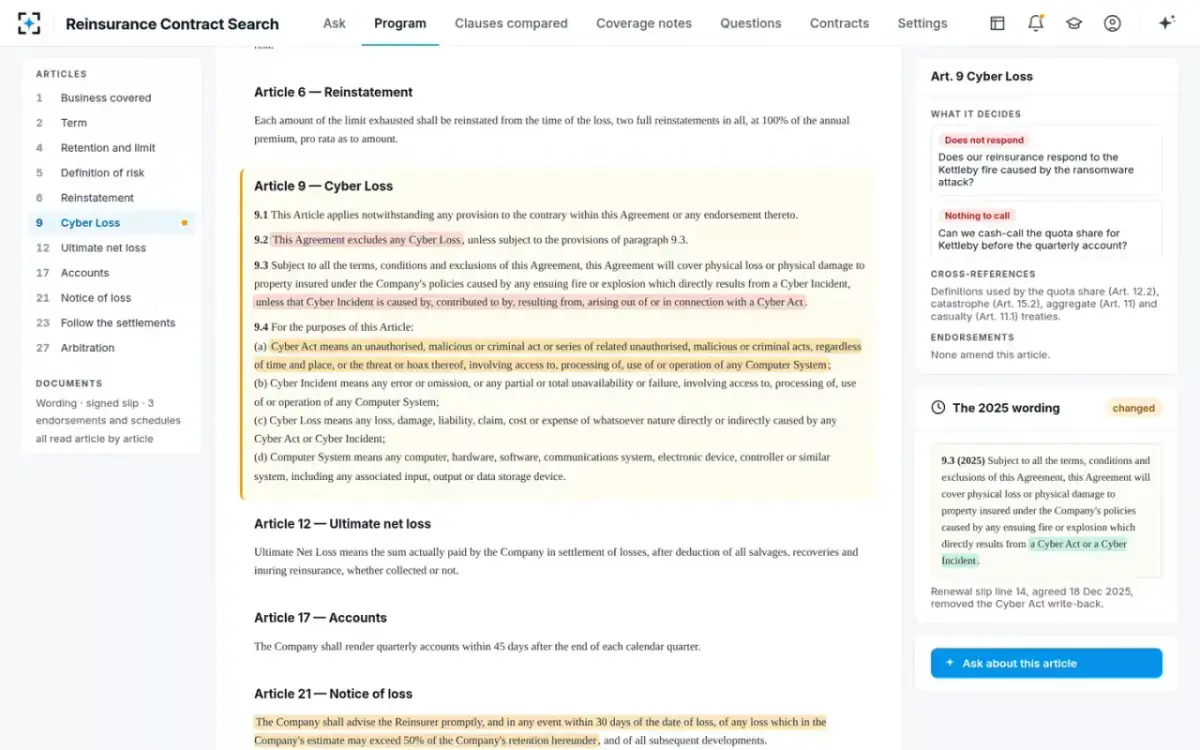
The ultimate net loss article in the sample per risk wording, with the deciding words in view
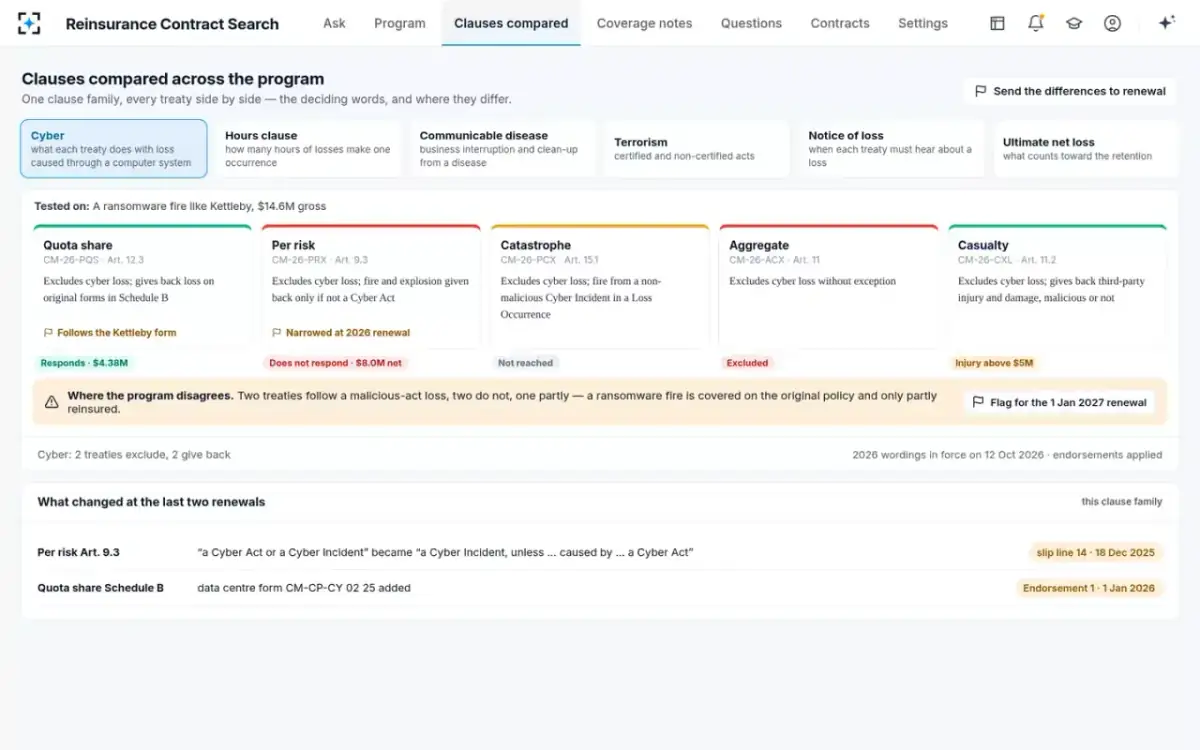
One clause family across every treaty: ultimate net loss is one of six
The limits are the same as for every answer: a ceded analyst checks it, the agents never state a coverage position to a reinsurer, and a disputed meaning goes to a specialist. The net side of the definition, what is deducted before the treaty measures a loss, is taken further in the net retained lines guide. To see a limit question answered on a sample program, start from Reinsurance Contract Search.
Questions people ask
What is ultimate net loss meaning in insurance, as opposed to reinsurance?
In umbrella and excess liability policies the term is commonly used for the total the insured becomes legally obliged to pay, which decides when the excess policy attaches. In reinsurance it is the cedant's paid loss net of the deductions the treaty lists. The idea is the same, a defined net figure that the limit applies to, but the deductions differ.
Is loss adjustment expense part of ultimate net loss?
Only if the definition says so. Some wordings add allocated loss adjustment expense to loss, some pay it in proportion on top of the limit, and some, like Florida's state hurricane fund, exclude it from losses and reimburse a fixed percentage. Unallocated expense, the cedant's own overhead, is often excluded; Florida's statute excludes both kinds from losses.
Does ultimate net loss include bad faith or punitive awards?
Usually not unless the treaty says so, and many wordings deal with them in a separate extra-contractual obligations clause. The CAS textbook notes that clash layers can be exposed by "extra-contractual-obligations (i.e., bad faith claims)", which is why their treatment is negotiated. Florida's statute excludes bad faith and punitive awards from the losses its fund reimburses.
What does "whether collected or not" mean in an ultimate net loss clause?
It means the treaty deducts inuring reinsurance as if it had been paid, even if an inuring reinsurer defaults. The shortfall stays with the cedant and does not move up to the next layer. The inuring reinsurance guide works through what that does to a program.
Who decides when a limit clause is ambiguous?
In the end a court or arbitration panel, reading the whole agreement and, if the words are doubtful, the surrounding circumstances. Inside a cedant, the head of ceded reinsurance decides the position the company takes, usually with counsel, and a ceded analyst should not bill on an ambiguous reading without that decision.