Contract abstraction tools read a contract and pull its key terms into structured fields, such as parties, dates, limits, renewal terms and named clauses, so a team can search and report on a portfolio without opening each document. That is valuable work, and for a reinsurance program it produces a useful treaty summary. It does not answer a coverage question. Whether a treaty responds to a loss depends on the exact words of the deciding clause, in the version in force on the loss date, with every endorsement applied and the program read in inuring order, and an abstract keeps a summary of the words, not the words. Botminds' Reinsurance Contract Search reads every wording, slip and endorsement article by article and answers from the clause itself. This guide sets the two side by side so a buyer can tell which problem each solves.
The treaty examples come from a fictional sample cedant, Cardale Mutual, whose 248 documents span three program years in the solution. The research on contract review comes from the CUAD benchmark and EIOPA, linked where used.
Two years of one treaty, abstracted: the fields match, and the answer differs by $8.0M
Treaty
2025Property Per Risk Excess 2025
2026Property Per Risk Excess 2026
Wording
2025CM-25-PRX
2026CM-26-PRX
Limit and retention
2025$8M xs $2M each risk
2026$8M xs $2M each risk
Cyber
2025Cyber loss excluded; ensuing fire and explosion written back
2026Cyber loss excluded; ensuing fire and explosion written back
What the cyber field leaves out: Art. 9.3
2025: fire or explosion "which directly results from a Cyber Act or a Cyber Incident".
2026: fire or explosion which directly results from a Cyber Incident, "unless that Cyber Incident is caused by, contributed to by, resulting from, arising out of or in connection with a Cyber Act".
On a $14.6M ransomware fire, the 2025 words recover $12.38M across the program; the 2026 words recover $4.38M.
What is contract abstraction?
Contract abstraction is the process of reading a contract and recording its important terms in a standard, structured form, the abstract, so that people can find and compare terms without reading the whole document. The term is used most in real estate, procurement and commercial contracts, and the same idea appears in reinsurance as a treaty summary or a contract register.
Research on automating it gives the clearest description of what abstraction is and is not. The Contract Understanding Atticus Dataset, CUAD, was built by legal experts to train and test exactly this task, and its authors put the idea simply: "models learn to highlight the portions of text that lawyers should attend to" (Hendrycks et al., CUAD, NeurIPS 2021). Abstraction picks out the passages a person should read; it is not a substitute for the reading.
What it took experts to abstract 510 contracts, in the CUAD benchmark
41
clause categories lawyers chose as most important
general information, restrictive covenants, revenue risks
13,101
labelled clauses across 510 contracts
≈10%
of each contract labelled, on average
about 0.25% per category
70–100h
of training for each law student annotator before labelling
What are contract abstraction tools, and what do they produce?
Contract abstraction tools are software that extracts named terms from contracts into fields, usually with a person reviewing the result, and load them into a register or another system. Their output is a table: one row per contract, one column per term, each cell a value or a short passage.
Insurers already use them this way. EIOPA's survey of generative AI in European insurance records an insurer using agentic AI "to generate structured data from insurance contracts and automatically upload it into the Customer Relationship Management (CRM) system of the organisation" (EIOPA Generative AI market survey). That is abstraction at scale, and for portfolio questions such as which treaties expire on 1 January, which reinsurers sit on which layer, or what the total limit is, a field per term is exactly right.
Is a treaty abstract enough to answer coverage questions?
No, for a structural reason rather than a quality one: a coverage question turns on the exact words, and an abstract keeps a summary of them. CUAD's expert annotators labelled about 10% of each contract as important; a coverage answer can depend on a sentence in the other 90%, or on how two labelled clauses interact.
The frame above is the sample cedant's per risk treaty, abstracted as most tools would. Every field matches across the two years, including the cyber field, because both wordings exclude cyber loss and write back ensuing fire and explosion. The difference sits in a subordinate clause the 2026 renewal added to Art. 9.3, and it is the whole answer for a ransomware fire. An analyst who answered from the abstract would have said the per risk treaty responds, and $8.0M of recovery would have been booked that the treaty does not owe.
Courts read reinsurance contracts in the same whole-document way. New York's Court of Appeals, construing a facultative certificate's limit in 2017, read the limit against the whole agreement rather than as a line on its own (Global Re v. Century, 2017). An abstract is, by design, the line on its own.
What a reinsurance treaty summary holds, and what it leaves out
A treaty summary holds the terms that are values: dates, limits, retentions, shares, reinstatements, premium, the reinsurers and the named clauses. It leaves out what connects them: definitions, cross-references, conditions and exceptions, and the relationships between treaties.
What a treaty abstract records, and what a coverage answer also needs
| A coverage answer needs | In a typical abstract? | Why it matters |
|---|---|---|
| Limit, retention and reinstatements | Yes | The arithmetic of every recovery |
| The exact words of the deciding clause, with its exceptions | A short summary at most | Exceptions such as "unless … caused by a Cyber Act" decide the answer |
| The definitions the clause uses | Rarely | Cyber Act, Loss Occurrence and Ultimate Net Loss are defined terms with their own conditions |
| Which endorsement amends which article, from what date | Usually as a list of endorsements | The answer for a loss depends on the wording in force that day |
| The inuring order across the program | No: one row per treaty | Each treaty measures the loss left by the ones before it |
| Prior coverage opinions on the same clause | No | A precedent, or the reason this loss differs from it |
Can abstraction tools read endorsements?
They can extract an endorsement's terms; the harder part is applying it to the right article from the right date. An endorsement is an instruction to change another document, and its effect only exists once it is applied.
The sample cedant's 2026 file shows the patterns a program accumulates in a year. Endorsement 1 to the quota share adds a data-centre form to Schedule B and amends Art. 12.3, effective 1 January 2026. Endorsement 2 to the catastrophe treaty changes the Layer 3 panel. And the per risk change that decides the ransomware fire is not an endorsement at all but line 14 of the renewal slip, agreed on 18 December 2025, which removed the Cyber Act write-back from Art. 9.3. An abstract that lists "Endorsement 1: Schedule B forms" is accurate and still cannot say what Art. 12.3 now reads. Reinsurance Contract Search links each endorsement to the article it amends with its effective date, and answers from the amended text.
What the abstract gets right, and the notice it would still miss
An abstract is good at the values in a notice clause and poor at applying them to a loss. Notices of loss are where that gap costs most, because a missed notice can hand a reinsurer an argument against paying a recovery the wording would otherwise allow.
The sample per risk treaty's Art. 21 requires notice within 30 days of the date of loss of any loss which, in the cedant's estimate, may exceed 50% of the retention. An abstract records that as "30 days; losses over 50% of retention", which is accurate. Now apply it to the ransomware fire. The per risk treaty does not respond to the loss, yet notice is still owed, because the notice article turns on the size of the estimate, not on whether the treaty pays: $10.22M net is far over half of the $2M retention, so notice is due by 2 November 2026. The quota share has its own trigger, losses over $5M, and is owed notice by the same date. The casualty treaty needs notice only when the injury reserve passes $2.5M, and it stands at $1.9M.
Three treaties, three different triggers, one of them owed notice on a loss it excludes. An analyst working from abstracts has every value needed and still has to read all three articles against the loss to know what is due. Reinsurance Contract Search applies each treaty's notice article to the loss and lists the notices owed with their dates; the agents never send one, and in the sample settings a reminder is set ten days before each is due.
How do you keep treaty versions straight?
Answer every question from the wording in force on the loss date, endorsements applied by their effective dates, and show last year's wording only as last year, or as a labelled what-if. That rule is simple to state and hard to follow by hand once a program has three years of wordings, slips and endorsements in one folder.
Abstraction tends to blur versions in two ways. A register often holds one row per treaty that is overwritten at renewal, so last year's terms disappear just when a late-reported loss needs them. Or it holds a row per year, which preserves the terms but not the dates within the year when an endorsement took effect. Neither tells you which words applied at 02:40 on 3 October. In the sample program, the clause finder picks the wordings in force on the loss date, five treaties with four endorsements applied, and keeps the 2025 wordings for comparison only.
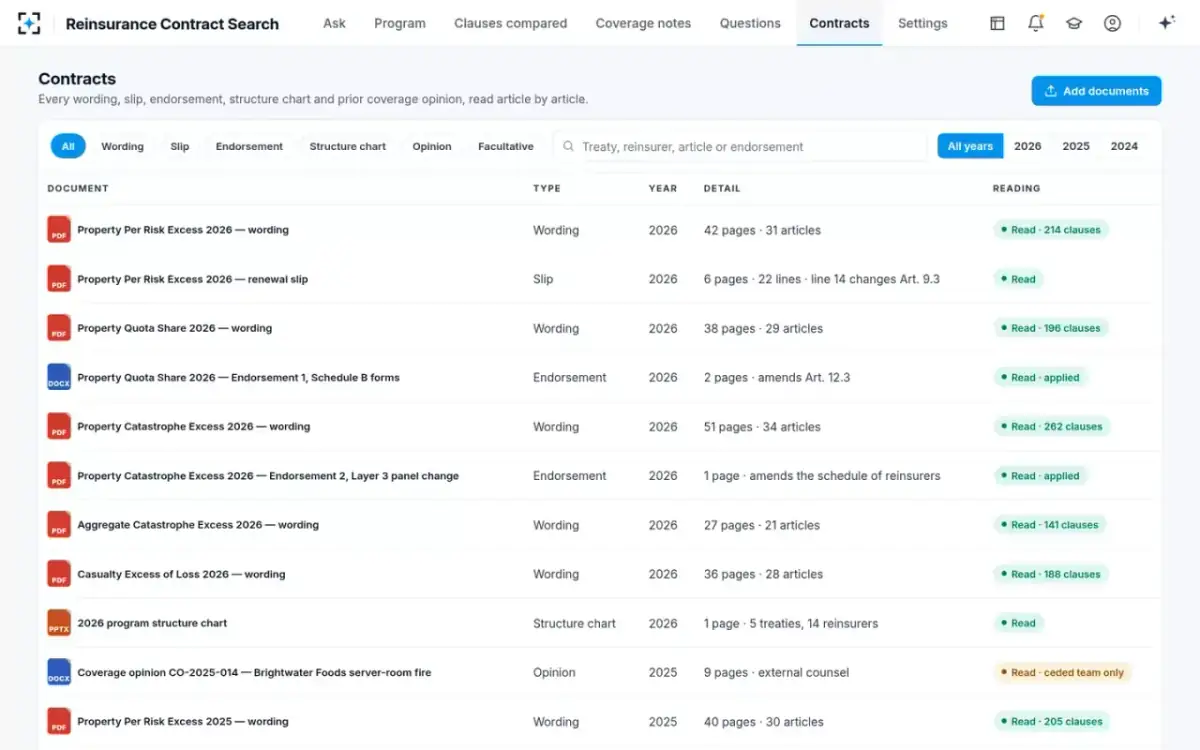
Every document read article by article, by type and program year
When a contract abstraction tool is the right buy
Buy an abstraction tool when the questions are about the portfolio rather than a loss: which treaties renew when, which reinsurers carry how much, which contracts lack a given clause, what to put in a regulator's data call. Those questions are answered by values in fields, and a field-per-term register answers them faster than any reading of wordings.
Typical good uses in a ceded team are renewal calendars, counterparty concentration by reinsurer, the program summary in board papers, and the contract details a state regulator asks for. Abstraction is also a sensible first step for a team whose wordings are scattered across email: the act of abstracting forces every treaty to be found. Where abstraction stops being enough is the moment someone asks whether a particular loss is covered, because that question is about the words.
Contract abstraction tools and reinsurance contract search, side by side
Contract abstraction tool: What are the terms of our contracts, across the portfolio?
Reinsurance Contract Search: Does our reinsurance respond to this loss, under which clause, for how much?
Contract abstraction tool: A field per term, per contract
Reinsurance Contract Search: An answer per question, every sentence citing its clause
Contract abstraction tool: Usually the current terms, or one row per year
Reinsurance Contract Search: The wording in force on the loss date, endorsements by effective date
Contract abstraction tool: Filters and reports over rows
Reinsurance Contract Search: Every treaty applied in inuring order, with the arithmetic
Contract abstraction tool: Selected passages and values
Reinsurance Contract Search: Every article, with definitions and cross-references
Contract abstraction tool: Renewal calendars, panel and concentration reports, data calls
Reinsurance Contract Search: Large-loss coverage questions from claims, finance and underwriting
What to ask a vendor of either kind before you buy
Ask for a demonstration on your own documents and your own past questions, and score what comes back. Any tool looks right on a clean sample contract; the test is a messy program with late endorsements and a renewal that changed one subordinate clause.
Eight questions for a contract abstraction or contract search vendor
- Show the exact words behind every value or answer
A field or sentence without its source passage cannot be checked in seconds.
- Which version of the wording was used, and why?
Ask for the in-force date logic, and test it on a loss after a mid-year endorsement.
- How are endorsements applied to the articles they amend?
A list of endorsements is not the amended text.
- What happens to last year’s terms at renewal?
Late-reported losses need them for years.
- Can it answer one question across every treaty in the program, in order?
Coverage is a program question; inuring order changes every number.
- What does it do when no clause answers?
The right behaviour is to say so and refer; a confident guess is the worst outcome.
- Who can see what?
Facultative certificates and counsel opinions usually stay with the ceded team; underwriting may need wording without amounts.
- What does it never do?
Notify a reinsurer, book a recovery, or change the booked program are decisions for people.
Where Reinsurance Contract Search fits, and where an abstract still helps
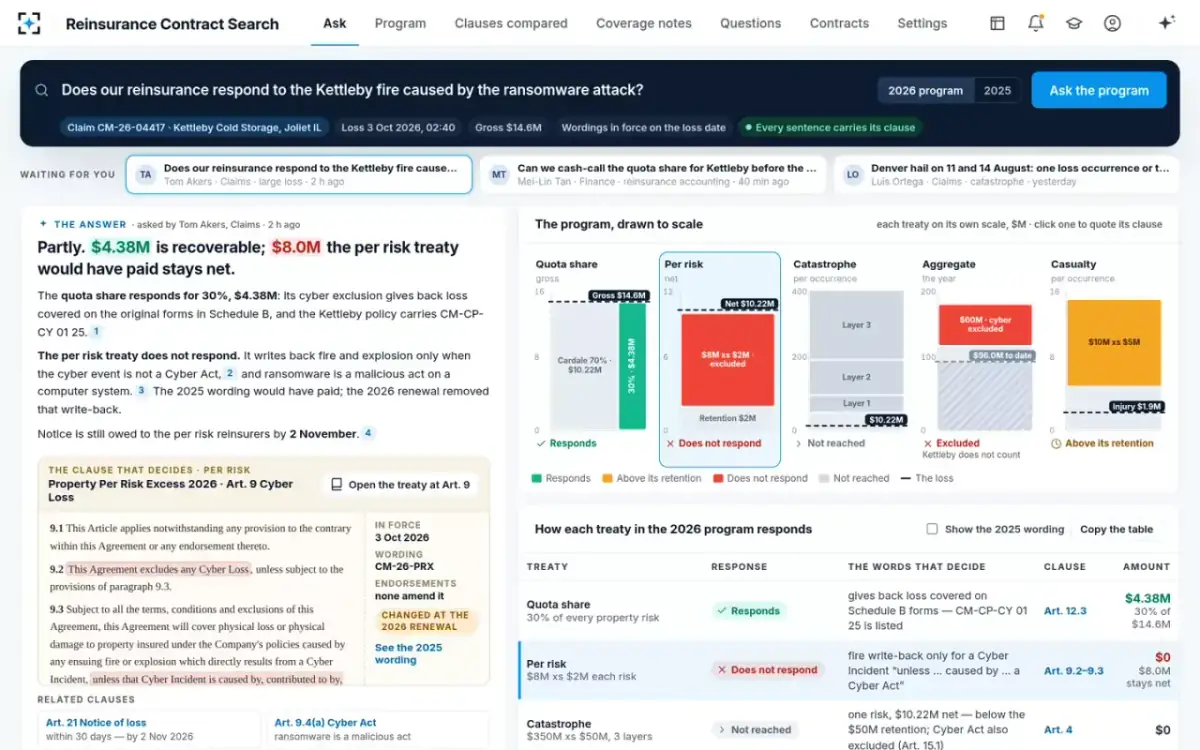
Reinsurance Contract Search is a coverage-question tool that happens to build a program summary on the way. One of its agents, the program mapper, builds the layers, retentions, limits, reinstatements, inuring order and each reinsurer's share from the signed slips and the structure chart, which is the useful part of an abstract. The rest of its agents read the wordings themselves.
A question answered from the wording, with the program drawn to scale beside it
If your team needs portfolio reporting and nothing else, an abstraction tool is the simpler buy. If claims and finance are waiting days for coverage answers, abstraction will not shorten the wait, because the specialist still has to read the words. For how to test either kind on your own questions, see the treaty accuracy test; for the rollout once you have chosen, reinsurance contract management. To see the comparison on a sample program, start from Reinsurance Contract Search.
Questions people ask
What does contract abstraction mean?
It means turning a contract into a structured summary of its key terms, the abstract, so the terms can be searched and reported without reading the document. The research benchmark CUAD frames the task as highlighting the passages a person should review, which is the right way to think about any abstract.
How long does it take to abstract a contract by hand?
It depends on length and the number of terms. In building CUAD, each of 9,283 pages was reviewed at least four times, at five to ten minutes a page, by annotators trained for 70 to 100 hours. Reinsurance wordings of 30 to 50 pages, with slips and endorsements, take correspondingly longer to abstract well.
Can AI abstract contracts accurately?
It can do much of the extraction, with a person checking. CUAD's authors found transformer models had "nascent performance" on expert contract review in 2021, and models have improved since, but no published benchmark covers reinsurance treaties. The safest approach is to keep the source passage beside every extracted value so a reviewer can check it.
Is contract abstraction the same as contract analysis?
No. Abstraction records what the terms are; analysis asks what they mean for a situation, such as a loss, a dispute or a renewal. A coverage question is analysis, and it needs the words an abstract summarises.
What fields should a reinsurance treaty abstract contain?
At least the treaty name and period, business covered, limit, retention, reinstatements and their premium basis, the panel and each share, the inuring order, the notice of loss terms, and the list of endorsements with effective dates. Keep a link from each field to the article it came from, so the abstract can lead back to the words.