Reinsurance contract management is the work of keeping every treaty wording, slip, endorsement and facultative certificate complete, current and answerable, from placement until the last claim under it is settled. Most systems for it are built for the ceded team: a register of contracts, a schedule of shares, a folder of documents. The test of contract management, though, comes from outside the team, when claims, finance or underwriting needs to know what a treaty says about a loss, today. People outside the ceded team will rely on a self-serve answer only when it quotes the clause it rests on and says plainly when no clause answers; supervisors' own surveys show firms keeping humans in the decision while they learn which answers to trust. Botminds' Reinsurance Contract Search is built for that outside test, and this guide shows how a ceded team can roll it out so that trust is earned by rule rather than by claims of accuracy.
The examples are from a fictional sample cedant, Cardale Mutual, as it runs through the solution, including one quarter of questions from the business. Regulator and research sources are linked where they are used.
One quarter of questions: most answered from the clause, the rest referred to a named person
186 questions from claims, finance and underwriting
- Answered with the clause, checked by the analyst · 152 · 82%
- Referred · 34 · 18%
34 referred questions
- Taken by a specialist · 32 · 94%
- Still open · 2 · 6%
What is reinsurance contract management?
Reinsurance contract management is the discipline of holding each reinsurance contract in a state where anyone entitled to rely on it can find out what it says, and in which version, without asking the person who negotiated it. It covers the documents, the program structure they create and the answers that come out of them.
The documents arrive from several hands and at different times. The NAIC notes that reinsurance contracts "may be negotiated with a reinsurer or arranged through a third party; i.e., a reinsurance broker or intermediary" (NAIC, Reinsurance), so the slip, the wording and the endorsements of one treaty can come from the broker over months, while facultative certificates arrive one risk at a time. Statutory accounting puts a clock on the paperwork too: a contract not finalised, written and signed within nine months of inception is presumed retroactive, a rule explained in the 9 month rule in reinsurance.
When the documents are not managed, the cost arrives years later. In a First Circuit case decided in 2000, a cedant billed its facultative reinsurer for $225,000 in 1993 but could not produce the certificate; the court recorded that until it was found in August 1995 the reinsurer had grounds to doubt the reinsurance existed at all (Commercial Union v. Seven Provinces). Two years of a recovery went on a missing document before any clause was argued. Facultative vs treaty reinsurance takes that case further.
How do claims teams check reinsurance coverage today?
Mostly by emailing the ceded team and waiting. The adjuster on a large loss writes to the one or two people who know the program, the question joins a queue behind accounts and renewals, and the answer comes back days later as an email that may or may not cite a clause. Botminds' estimate from ceded team practice is two to five days for a written answer on a large loss, and about 32 working hours of effort, most of it spent finding documents.
Two ways the business gets a coverage answer, and why only one scales
Email the ceded specialist: Two to five days (Botminds’ estimate) on a large loss
Self-serve answer with the clause quoted: Seconds to a cited answer; the analyst’s check follows
Email the ceded specialist: The specialist’s memory of the program, sometimes a quoted clause
Self-serve answer with the clause quoted: The clause in force on the loss date, quoted in every sentence
Email the ceded specialist: Usually the one treaty the asker named
Self-serve answer with the clause quoted: Every treaty, in inuring order, in one table
Email the ceded specialist: The specialist says so, eventually
Self-serve answer with the clause quoted: Referred at once to a named specialist, with what was searched
Email the ceded specialist: An email thread
Self-serve answer with the clause quoted: The question, the clauses returned, who checked and who signed
Email the ceded specialist: Every question
Self-serve answer with the clause quoted: Only the referred questions and the checks
Why claims will not trust an answer that does not quote the clause
Because checking an uncited answer costs as much as producing it. A claims manager who receives "yes, the per risk treaty responds" has to go and find the clause to rely on it, which is the work the answer was meant to save. A quoted clause turns trust into a thirty-second check.
The research on legal AI says the same thing from the other side. The preregistered Stanford study of legal research tools found that the subtle errors, real sources cited for propositions they do not support, are harder to catch than invented ones: "Checking for these kinds of hallucinations requires users to click through to cited references, read and understand the relevant sources, assess their authority, and compare them to the propositions the model seeks to support" (Magesh et al.). An answer that quotes the deciding words removes the clicking through. NIST names the opposite risk too: automation bias, people over-relying on generative AI and rating its output above other sources as the systems become more reliable (NIST AI 600-1). The quotation is the guard against both.
Will staff trust AI answers? What the supervisors' surveys show
Staff trust AI answers where a person stays in the decision, and that is how financial firms are deploying it. Both the Bank of England's and EIOPA's surveys show adoption running ahead in assisted modes, where the system recommends and a human decides.
Supervisors find firms using AI to recommend and people to decide
80%
of UK survey respondents reporting AI agents for decision support
agents recommend, humans decide and execute
2%
reporting agents deployed with broad autonomy
83%
of EU insurers’ generative AI use cases assisted or semi-autonomous
human input and control remain fundamental
9%
of EU insurers’ use cases agentic today
The same Bank of England survey points at the weak spot in most rollouts: what happens after go-live. Human approval, pre-deployment review and vendor due diligence were each reported by more than 90% of respondents; ongoing monitoring, leakage testing and periodic recertification by only about half (Bank of England and FCA). For a contract search tool, ongoing monitoring means knowing, every quarter, how many answers were corrected by the analyst and which kinds of question are being referred.
What should be referred to a specialist?
Anything a clause does not answer with confidence, anything that commits the company to a position with a reinsurer, and anything where the documents disagree. Writing those rules down before launch is what lets claims rely on the rest.
Referral rules a ceded team can adopt on day one
- No clause answers with at least medium confidence
The question goes to the named specialist for that line with what was searched, and stays open until someone takes it.
- The wordings conflict on a meaning
Two treaties define the same term differently, or a slip and a wording disagree. The agents never decide a disputed meaning.
- The structure chart and the signed slips disagree on the program
Shares, layers or inuring order. The analyst decides which document reflects the agreement.
- A facultative certificate may apply
Certificates and counsel opinions stay with the ceded team, so any answer that depends on one is checked there.
- The answer would be sent to a reinsurer
A coverage position to a reinsurer is the company’s position, signed by the head of ceded reinsurance.
- The question is about a loss in litigation or arbitration
Counsel decides what is said and to whom.
One referred question in the sample log shows the first rule at work: "Does the aggregate cover wildfire smoke damage with no serial number?" The aggregate cover's event definition does not settle smoke without an industry catastrophe serial number, so the question waits for the property specialist instead of receiving a plausible guess.
Who signs a coverage note?
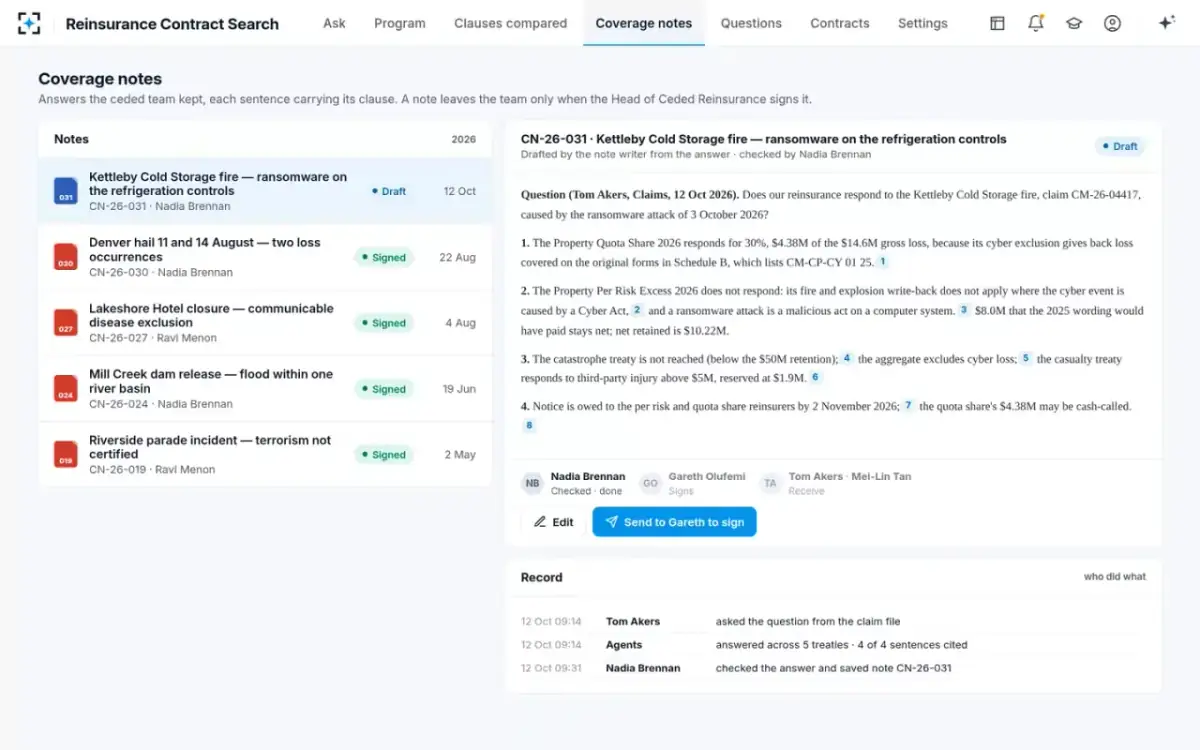
A coverage note is signed under the ceded team's own sign-off rule, and the agents never send one. In the sample cedant the analyst checks the answer, the note writer drafts it with one numbered sentence per finding, each citing its article, and the head of ceded reinsurance signs with the position stated.
A coverage note signed with the position stated, and the clauses it cites
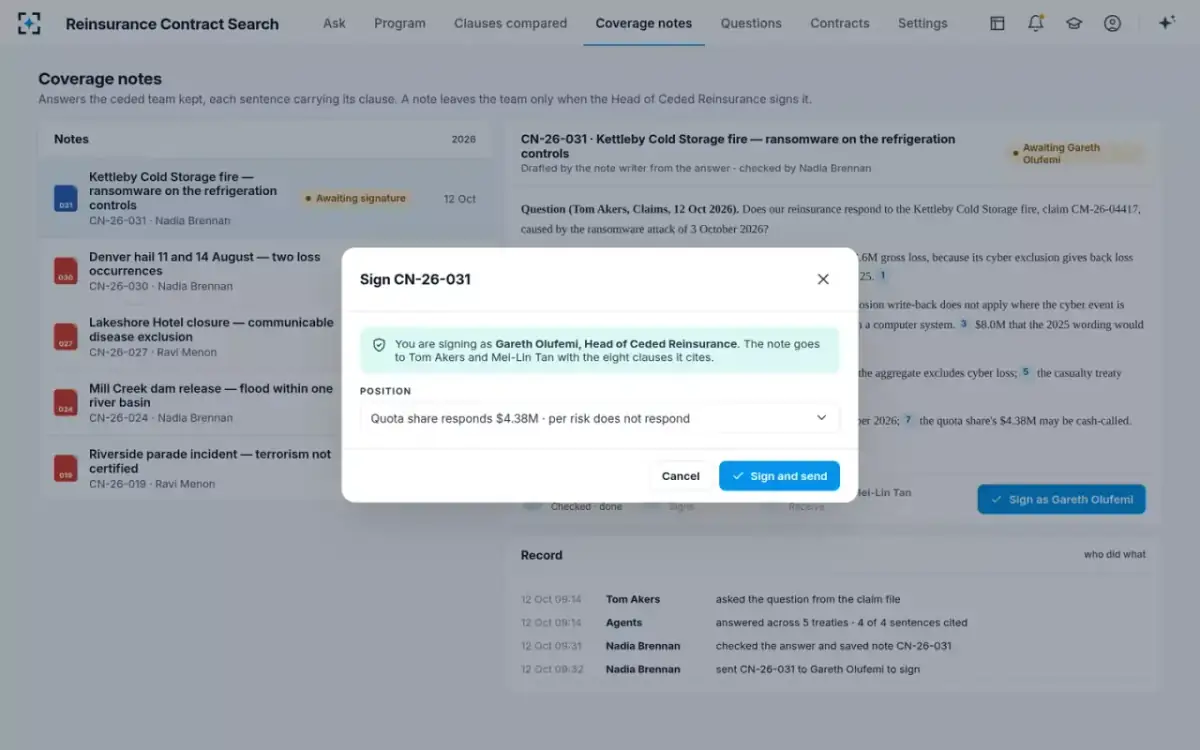
The settings decide which notes need the head's signature. Whatever the threshold, the principle holds: the agents never notify a reinsurer, never commit a recovery and never decide a disputed meaning, and the reinsurance program itself is read, never changed. That is what makes it safe to let claims ask.
How do you roll out a contract search tool? A 90-day plan
Roll it out on the past before the present: load last year's program, replay last year's signed answers, and open it to the business only when the replay is good enough to publish. The plan below is the sequence we suggest; the weeks will move with the size of the program.
A 90-day rollout for reinsurance contract search, with the evidence each stage produces
| Weeks | What happens | What it proves |
|---|---|---|
| 1–2 | Load two program years: wordings, slips, endorsements, structure charts, certificates and prior coverage opinions | Every document is read article by article; gaps, such as a missing certificate, surface now |
| 3–4 | Replay 40–60 signed coverage notes and score each answer sentence by sentence | A measured rate of correct, cited answers, and the question types that are referred |
| 5 | Set the rules: referral confidence, named specialists, sign-off, who sees what by team | Written rules the head of ceded owns, before anyone outside the team asks |
| 6–8 | Open to claims for large-loss questions only; the analyst checks every answer | Real questions, with the analyst’s corrections counted |
| 9–10 | Add finance (amounts, accounts, cash calls) and underwriting (wording and response, no amounts) | Each team sees its own slice of the same answer |
| 11–13 | Publish the quarter: questions, answered share, referrals, corrections, time to answer | The number that earns the next quarter’s trust |
The replay is the step most rollouts skip and the one that matters most. It produces the only accuracy figure claims should believe, one measured on their own past questions, and the method is the one in the treaty accuracy test.
What to measure after go-live
Measure what claims and finance experience, and what the analyst corrects. Five numbers a quarter are enough: questions asked, the share answered without the specialist, referrals and how long they waited, sentences the analyst changed before saving a note, and the median time to a cited answer.
The sample quarter shows the shape: 186 questions, 152 answered without the specialist, 34 referred with two still open, and a median of 9 seconds to a cited answer. Those are sample figures, not a customer's results. The number that most deserves watching is the one the sample does not headline: corrections. A falling correction rate is the evidence that the referral threshold can loosen; a rising one says a renewal changed something the agents are misreading, and is the trigger for a fresh replay.
A coverage note checked by the analyst before it goes for signature
How do you keep answers right after a renewal?
Treat every renewal as a change to the answers, not just to the documents. The rule that the wording in force on the loss date decides means that from inception every new loss is answered from the new wordings, while losses before it keep the old ones; the risk is a change nobody outside the ceded team noticed.
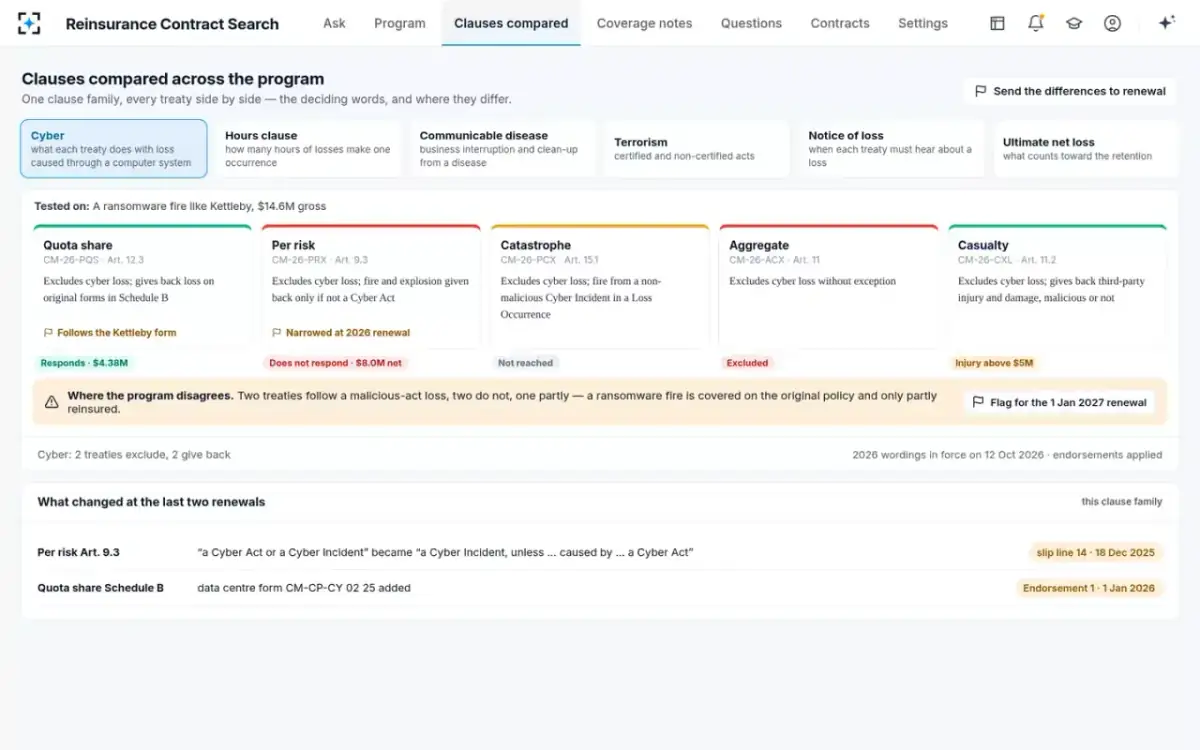
The sample program shows how small such a change can be. At the 2026 renewal, line 14 of the per risk slip, agreed on 18 December 2025, removed the words "a Cyber Act or" from the treaty's fire write-back. Nothing else about the treaty moved: same limit, same retention, same reinsurers. For a ransomware fire, those four words were the whole difference between recovering $12.38M across the program and recovering $4.38M. A claims handler who remembered last year's answer would have been confidently wrong.
A ceded team can make renewals safe in four steps. Load the new wordings, slips and endorsements before inception and let the clause comparison list every clause family that changed against last year. Tell claims, finance and underwriting which families changed, in plain words, before the first loss under the new program. Re-run a handful of last year's signed notes on the new wording as labelled what-ifs, to see which answers would now differ. And for the first quarter, refer questions on the changed families to the specialist even where the clause finder is confident. Drafting and comparing the wordings during the renewal itself is a separate job, done by Treaty Wording Comparison.
Every treaty's clause side by side, with what changed at the last two renewals
Where Reinsurance Contract Search fits, and where it does not
Reinsurance Contract Search answers coverage questions from the contracts; it does not replace the systems that book, bill and place them. It reads the claim system and the booked reinsurance program read-only, and changes neither.
It is not a reinsurance administration or accounting system: premiums, accounts and reinstatement premiums are booked elsewhere, and Ceded Reinsurance Accounting covers that work. It does not draft or compare wordings at renewal, the job of Treaty Wording Comparison, and it does not bill reinsurers for recoveries, which belongs to Reinsurance Recoverables Management. Where it fits is between the documents and the people who need them: the questions that today wait in a specialist's inbox. For the role that inbox belongs to, see the ceded reinsurance analyst, or start from Reinsurance Contract Search.
Questions people ask
What is reinsurance treaty management?
It is the same discipline seen from the treaty side: keeping each treaty's documents, structure and panel current from placement to run-off. Most teams use the two terms interchangeably. Facultative certificates need the same management and are the documents most often missing when a large loss arrives.
Does contract search replace a reinsurance administration system?
No. An administration system books premiums, shares and accounts; contract search answers what the documents say. Reinsurance Contract Search reads the booked program to apply shares and layers but never changes it, so the two run side by side.
How long does it take to roll out reinsurance contract search?
A rollout that replays past questions before opening to the business takes about a quarter for a mid-size program, on our suggested plan. The documents load in the first fortnight; most of the time goes on the replay, the rules and a period in which the analyst checks every answer.
What happens to answers when a renewal changes a clause?
Answers for losses after the change use the new wording, and answers for earlier losses keep the old one, because the wording in force on the loss date decides. Reinsurance Contract Search shows last year's wording beside the new one, clearly labelled, so the change is visible rather than silent.
Can brokers or reinsurers see the answers?
Not through the tool. Answers stay inside the cedant, each team sees its own slice, and the agents never notify a reinsurer. A position goes to a reinsurer only in a coverage note the head of ceded reinsurance has signed.