ChatGPT contract review works for reading and summarising a contract you paste in, and it can be wrong with confidence on the question a ceded reinsurance team actually asks: does this treaty respond to this loss? Research by Stanford and Yale scholars found legal hallucination rates in general chatbots of 58% to 88% on specific questions about federal court cases, and a preregistered Stanford study found that even legal research tools built to cite their sources were wrong or misleadingly cited 17% to 33% of the time. For a treaty, the test that matters has three parts: the answer must cite the clause that decides, from the wording in force on the loss date, with every sentence traceable to quoted words. Botminds' Reinsurance Contract Search is built around those three tests, and this guide shows how to run them on any tool, including ours, with your own past coverage questions.
Worked examples come from a fictional sample cedant, Cardale Mutual, and its 2026 reinsurance program as it runs through the solution. The research comes from Stanford and Yale scholars, NIST, the Bank of England and EIOPA, each linked where it is used.
Three tests every treaty coverage answer must pass, and the failure each one catches
1
The right clause
Does each sentence cite the article that actually decides the question, read with the articles it depends on?
Fails whenA real clause that does not support the sentence, or one from the wrong treaty. The Stanford study calls this misgrounded.
In the study's termsGrounded
2
The right version
Is the quoted wording the one in force on the loss date, with every endorsement applied by its effective date?
Fails whenLast year’s wording, an unsigned draft, or the slip instead of the final wording: an inapplicable source, quoted perfectly.
In the study's termsCorrect
3
Every sentence carries its words
Can every sentence of the answer be traced to quoted words, so a reviewer checks it in seconds?
Fails whenA fluent paraphrase with no quotation, or a summary sentence that adds a condition no clause states.
In the study's termsGrounded, sentence by sentence
Can ChatGPT review a contract? Yes for reading, not for a coverage position
ChatGPT can read a contract and summarise it, find a clause you describe, and draft questions for a lawyer. What it cannot do on its own is take a coverage position on a reinsurance program, because the answer depends on documents it has not been given and dates it has no way to check.
A coverage question is rarely about one document. The sample cedant's question, whether its reinsurance responds to a fire caused by a ransomware attack, needs five treaty wordings, their slips, four endorsements and the program's inuring order, all as they stood on 3 October 2026. Paste one wording into a chat window and the model will answer from that wording, fluently and without telling you that the per risk treaty's cyber article was narrowed at the last renewal, or that the quota share's answer depends on a schedule of forms in a separate endorsement. The gap is not intelligence; it is that the question is about a program, and the chat sees a page.
Is ChatGPT accurate for contract review? What the studies measured
Not reliably enough to stand alone. Two studies from the same Stanford group measured legal hallucinations directly, and both are relevant to treaty questions even though neither tested a reinsurance contract.
The first, by Dahl, Magesh, Suzgun and Ho, asked general-purpose models specific, verifiable questions about random federal court cases. It found legal hallucinations in 58% of answers from ChatGPT 4 and in 88% from Llama 2, rates the authors call alarmingly prevalent (Dahl et al., Large Legal Fictions). The second, a preregistered evaluation by Magesh and colleagues, tested commercial legal research tools that retrieve real documents before answering, the design most contract tools now use. Retrieval helped, but did not solve the problem: the tools hallucinated between 17% and 33% of the time, and the most accurate answered 65% of queries both correctly and with valid citations (Magesh et al., arXiv 2405.20362).
Legal hallucination rates in two Stanford-led studies: chatbots and retrieval tools
Insurers see the same risk from inside. EIOPA's survey of European insurers' generative AI use found that "so-called hallucinations" are considered the main risk of those systems, ahead of cybersecurity and data protection, and that insurers use retrieval because it gives "greater control of the internal 'source of truth'" (EIOPA Generative AI market survey). Control of the source is necessary. The studies show it is not sufficient.
What is a hallucination in legal AI? Incorrect, or misgrounded
A hallucination in legal AI is an answer that is either wrong or cites a source that does not support it. The Stanford study's definition is the one to adopt for treaty work because it catches the subtle failure, not just the invented one: "if a model makes a false statement or falsely asserts that a source supports a statement, that constitutes a hallucination" (Magesh et al.).
The study splits the second half further. A response is grounded if its key propositions "make valid references to relevant legal documents", ungrounded if they are not cited at all, and misgrounded if they are cited but the citation misreads its source or points to one that does not apply, an "inapplicable source" in the study's words. Translate that to a reinsurance program and the inapplicable source has an obvious form: last year's wording. A tool that quotes the 2025 per risk cyber article perfectly, for a 2026 loss, has produced a misgrounded answer that looks better cited than a correct one.
NIST's generative AI profile explains why these errors persuade. It calls the phenomenon confabulation, content stated with confidence that is wrong or false, and warns that a system can also produce invented reasoning and citations to justify an answer, which leads people to trust the output more than they should (NIST AI 600-1). A citation is evidence only if someone checks it.
How do you check AI answers about a contract? Build the test from your own signed notes
Check AI answers against questions you have already answered and signed. Your past coverage notes are a ready-made answer key: each one states a question, a position and the clauses relied on, and each was checked by someone who knew the program. That turns "is it accurate?" from an opinion into a rate.
How to run a treaty accuracy test in two weeks, on any tool
- Pull 40 to 60 signed coverage notes from the last two program years
Use notes, not emails: a signed note has a stated position and named clauses to score against.
- Include at least ten questions where a renewal changed the deciding wording
This is where misgrounded answers hide. An answer from the old wording should fail test 2, however well it reads.
- Include five questions no clause answers
The right output is a referral or "not stated", and a tool that answers them anyway is guessing.
- Load the documents exactly as they are filed, endorsements and slips included
Do not tidy the file for the test. The real file is what the tool will meet.
- Score every sentence, not every answer
One unsupported sentence in a four-sentence answer is a 25% error in the note that would have gone out.
- Have a second analyst score blind
The person who wrote the original note is the worst judge of a paraphrase of it.
- Publish the three rates to claims and finance
Correct and grounded, hallucinated, and incomplete. Trust follows a number people can see.
- Repeat after every renewal
A renewal changes the documents the answers depend on, so the rate from last year does not carry over.
Scoring the answers: what to count, and what a pass looks like
Count each sentence once, against the three tests, and keep refusals separate from errors. A refusal on a question no clause answers is the right outcome, while a confident answer to that question is the worst one.
A scoring sheet for one treaty coverage answer, sentence by sentence
| Outcome | What the sentence did | How it counts |
|---|---|---|
| Correct and grounded | States the position the signed note took, quoting the deciding words from the wording in force | Pass |
| Correct but ungrounded | Right position, no quotation or a citation to nothing specific | Incomplete: the reviewer has to find the clause |
| Misgrounded | Quotes a real clause that does not say it, or the right clause from last year’s wording | Hallucination |
| Incorrect | States a position or amount the note did not take | Hallucination |
| Referred | Says no clause answers and names what it searched | Pass on a question with no clause; incomplete otherwise |
What rate is good enough depends on what happens next. If every answer is checked by a ceded analyst before it leaves the team, a tool that is grounded on most sentences and refers the rest saves hours even with occasional errors, because the errors are caught. If answers go straight to claims, the bar is much higher. The test tells you which of those two places a tool belongs in.
A ChatGPT contract review prompt, and why the prompt is not the fix
A good prompt reduces paraphrase; it cannot supply the wording in force. If you do test a general chatbot, instruct it to quote the exact words it relies on, to name the article and the document it quotes, to say "not stated" when the documents do not answer, and to list which documents it was given. Those instructions make its errors easier to score.
They do not make the errors go away. Dahl and colleagues found that models often go along with a false premise in the question instead of correcting it, and that they do not reliably know when they are hallucinating (Dahl et al.), so asking a model to flag its own uncertainty is not a control. A claims handler who asks "does the fire write-back in the per risk treaty cover the warehouse fire?" has already assumed a write-back that the 2026 wording narrowed; a model that accepts the premise will answer the wrong question well. And no prompt tells a chatbot that the PDF it was handed was superseded by an endorsement it was not given.
The same coverage question in a general chatbot and in a cited contract search
General chatbot with a pasted wording: Whatever was pasted in this session, usually one wording
Reinsurance Contract Search: Every wording, slip, endorsement and structure chart in the program, three program years
General chatbot with a pasted wording: Cannot tell which wording was in force on the loss date
Reinsurance Contract Search: Wording in force on the loss date, endorsements by effective date; last year’s only as a labelled what-if
General chatbot with a pasted wording: One treaty at a time; the inuring order is the user’s job
Reinsurance Contract Search: Every treaty in inuring order, in one table, with the arithmetic
General chatbot with a pasted wording: As good as the prompt; never checked
Reinsurance Contract Search: Each sentence read back against its clause; drifting sentences rewritten to quote it; unsupported ones removed
General chatbot with a pasted wording: Usually answers anyway
Reinsurance Contract Search: Refers the question to a named specialist with what it searched
General chatbot with a pasted wording: Whatever the user copies
Reinsurance Contract Search: A coverage note the analyst checked and the head of ceded signed
Is it safe to upload a contract to ChatGPT?
It depends on the service's terms, your firm's AI policy and the contract's own confidentiality provisions, so the honest answer is: check all three before you paste. A treaty wording names the reinsurers, their shares, the pricing terms and often loss history, and it is a contract with other parties.
Supervisors treat leakage as a first-rank risk. The Bank of England and FCA's 2026 survey found the highest-rated risks to firms from AI were data protection and security, third-party and supply chain risk, and generative AI risks including "data leakage via prompts/outputs" (Bank of England and FCA, AI in UK financial services, 2026). NIST lists data privacy among the core generative AI risks, defined as "leakage and unauthorized use, disclosure, or de-anonymization" of personal or sensitive data (NIST AI 600-1). The practical rule: use a deployment your firm has approved for confidential documents, and never paste claim files with personal data into a consumer chat.
What Reinsurance Contract Search does differently, and what it still leaves to people
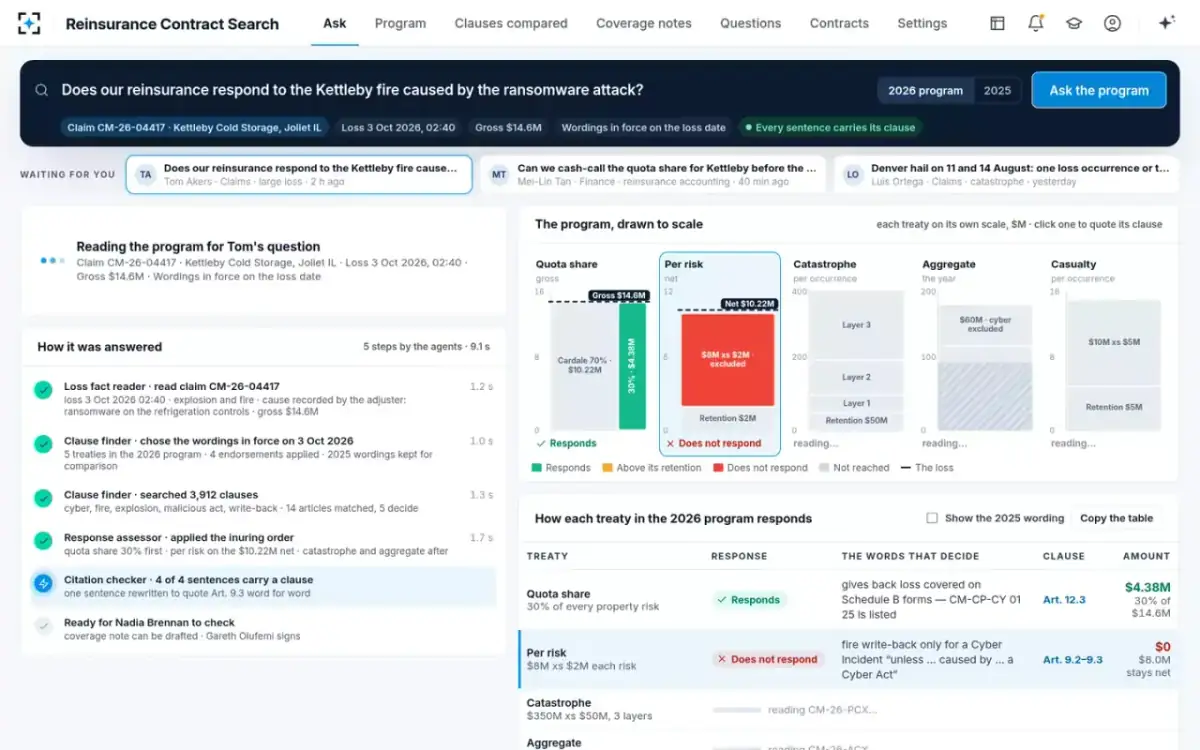
Reinsurance Contract Search is built to pass the three tests by design and to fail safely when it cannot. The clause finder never quotes a wording that was not in force on the loss date. The citation checker reads each sentence back against its quoted clause, rewrites a sentence that drifts so it quotes the clause, and removes anything the clause does not say. A question below the referral setting goes to a named specialist rather than getting an answer.
The citation check in the agents' own steps: four of four sentences carry a clause
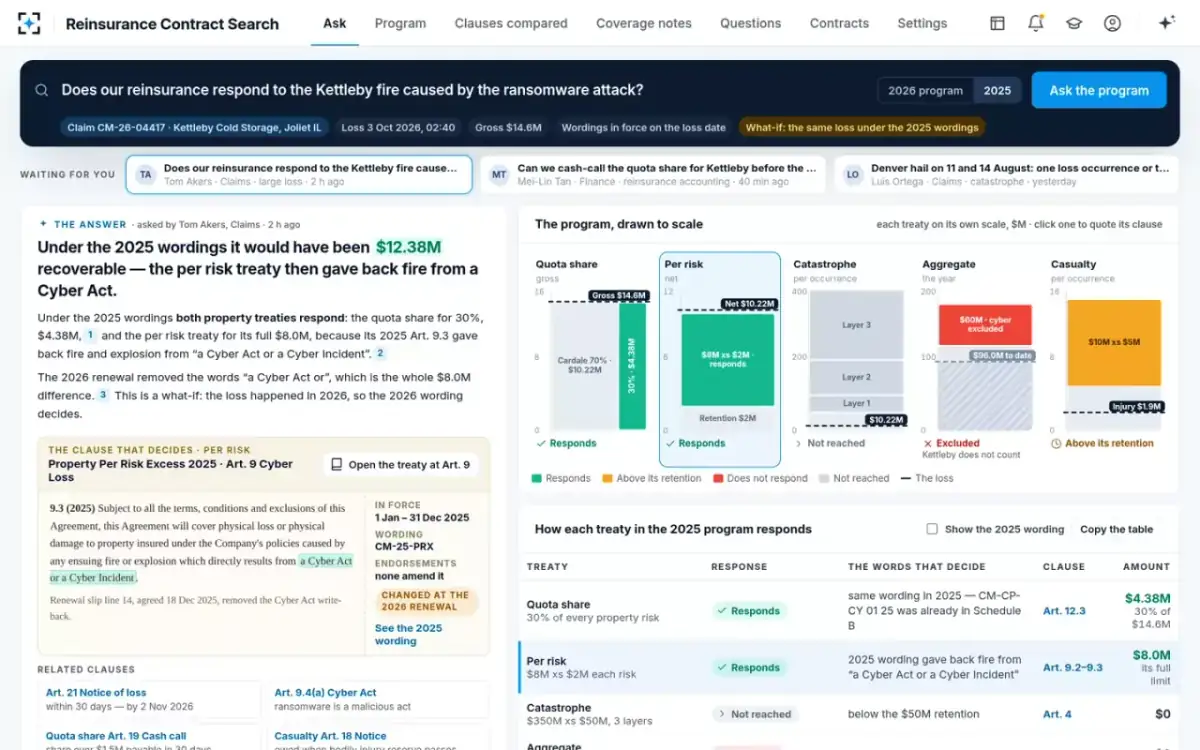
The version test is visible in the answer itself. When a renewal changed the deciding clause, the answer shows last year's wording beside this year's, and a what-if run under the old wording is labelled as such. In the sample, the same fire under the 2025 wordings would have recovered $12.38M instead of $4.38M; the screen says plainly that the loss happened in 2026, so the 2026 wording decides.
Last year's wording, shown as a labelled what-if, never as the answer
What it leaves to people is deliberate. The agents never notify a reinsurer, never commit a recovery and never decide a disputed meaning, and a ceded analyst checks every answer. It is not a general contract reviewer, it does not draft or redline wordings (the job of Treaty Wording Comparison; see redline software for treaties), and its accuracy on your program is something to measure with the test above, not to take from us. The way to trial it is to load a past program and replay signed notes, which is also how a rollout earns claims' trust. For the abstraction tools often evaluated alongside it, see contract abstraction tools compared, or start from Reinsurance Contract Search.
Questions people ask
Can AI cite the clause it relied on?
It can, and a citation is necessary but not sufficient. The Stanford study counted a cited answer as a hallucination when the source was misinterpreted or inapplicable, which in treaty work includes last year's wording. A citation is only useful if each sentence is checked against the quoted words.
How often do legal AI tools hallucinate?
In the preregistered Stanford evaluation, commercial legal research tools that retrieve documents hallucinated on 17% to 33% of queries. General chatbots did worse on case-law questions in a companion study, 58% for ChatGPT 4 and 88% for Llama 2. Neither study tested reinsurance treaties, so a ceded team should measure its own rate.
Is ChatGPT contract review good enough for a coverage note?
Not without a person checking every sentence against the wording in force. A coverage note states the cedant's position to claims, finance or a reinsurer, and an error in it travels. A general chatbot can help draft the prose once the position and the clauses are settled by someone who knows the program.
How many questions do you need to test an AI contract tool?
Enough to cover the failure modes, which is usually forty to sixty signed notes: ordinary questions, questions where a renewal changed the wording, and questions with no answer. Scoring each sentence rather than each answer gives several hundred scored items from that set, enough to see a rate.
Do supervisors allow insurers to use generative AI on contracts?
Yes, with governance. In the Bank of England and FCA's 2026 survey, 80% of respondents reported AI agents deployed for decision support, where agents recommend and humans decide, and only 2% reported agents with broad autonomy. EIOPA's survey found 49% of insurers had a dedicated AI policy, twice the 2023 share.