The difference between facultative and treaty reinsurance is scope and consent. Facultative reinsurance covers a single policy: the cedant offers that risk, the reinsurer underwrites it individually and either accepts or declines, and the agreement is usually recorded in a facultative certificate. Treaty reinsurance covers a defined book of business, such as all the cedant's commercial property, for a period, and every policy that fits the treaty's terms is ceded automatically, with no individual underwriting by the reinsurer. For a ceded team answering "does our reinsurance respond?", the practical consequence is order. A certificate, where one exists, usually applies before the treaties, it is often agreed outside the main renewal, and it is the document most easily missing when a large loss arrives. Botminds' Reinsurance Contract Search reads certificates alongside the treaty wordings, so the answer to a loss starts with the right question: is there a certificate on this risk?
Examples refer to a fictional sample cedant, Cardale Mutual, as it runs through the solution, and to two real court cases in which a facultative certificate was the centre of the dispute, linked where they appear.
The first coverage questions on a large loss, with the certificate checked before any treaty
Agent
Claim readTakes the policy number, the insured risk, the loss date and the amounts from the claim file.
Never: infer a cause the adjuster has not recorded.
Agent
Certificate checkLooks for any facultative certificate attached to that policy and in force on the loss date.
Never: treat an unsigned slip or a draft as the contract.
A person decides
Ceded analyst, if a certificate may exist but is not filedAsks the broker and the underwriter, and holds the answer until the certificate is found or ruled out.
Agent
Program applied in orderApplies the certificate first if the treaties are written net of facultative, then the treaties in their inuring order.
Never: decide a disputed meaning.
A person decides
Ceded team checksCertificates and counsel opinions stay with the ceded team; the analyst checks any answer that depends on one.
What is the difference between facultative and treaty reinsurance?
Facultative reinsurance is negotiated risk by risk; treaty reinsurance is agreed once for a class of business. New York's highest court summarised the distinction in 2017: under a treaty, the cedent transfers its risk under an entire line of business spanning multiple policies, while in facultative reinsurance the reinsurer indemnifies the cedent for all or part of its risk under a single policy. In the words the court quoted from an earlier decision, "[f]acultative reinsurance is policy-specific" (Global Re v. Century, 2017).
The underwriting differs as much as the scope. The CAS textbook compares facultative underwriting to primary underwriting of an individual risk: the reinsurer assesses and accepts each certificate on its own (Patrik, CAS Foundations, ch. 7). Under a treaty the reinsurer underwrites the cedant's book and its underwriting standards, not each policy, and is bound to accept every policy within the treaty's terms.
The facultative transfer of that liability is done on an individual risk basis, which gives both the ceding company and the assuming company the opportunity to thoroughly consider that individual risk and that individual piece of business and to consider the liability which is being transferred one to the other. Treaty business does exactly the same thing, except the transfer is on a book of business, rather than on a single piece of business.
Expert testimony accepted by the North Carolina Court of Appeals, Stonewall Ins. Co. v. Fortress Reinsurers Managers (1986)
Facultative vs treaty reinsurance, row by row
Facultative: One policy, or part of one
Treaty: A defined book of policies for a period
Facultative: The reinsurer underwrites the individual risk and may decline it
Treaty: The reinsurer underwrites the cedant’s book; policies inside the terms are ceded automatically
Facultative: Priced for that risk
Treaty: Priced for the book, often as a share or a rate on subject premium
Facultative: A short certificate, often “as original”
Treaty: A full wording, slip and endorsements
Facultative: Large, hazardous or unusual risks; risks a treaty excludes
Treaty: Capacity, stabilisation and catastrophe protection for the whole book
Facultative: Applies first; per risk treaties are often written net of it
Treaty: Applies to what the certificate leaves, in inuring order
Facultative: Agreed one risk at a time, outside the renewal, and filed separately
Treaty: Rarely missing; more often a late endorsement
What is a facultative certificate?
A facultative certificate is the short document that records a facultative placement: the reinsured policy, the cedant's retention, the reinsurer's share and limit, the basis and the conditions, often by reference to the original policy. The New York court described certificates as usually standard forms, short, and written in terms of art rather than long legal drafting (Global Re), and the one it examined ran to five short items: type of insurance, policy limits, the cedant's retention, the reinsurance accepted and the basis.
Brevity cuts both ways. A certificate can be read in a minute, but its terms of art do a lot of work, and the court cautioned that a certificate may not be the whole agreement: the placing correspondence and the original policy can matter too. It also noted, citing its 1990 Sumitomo decision, that a formal certificate is not needed for the reinsurance to bind. A cedant can therefore be reinsured without a certificate in its files, which is precisely the problem described below.
When is facultative reinsurance used?
Facultative reinsurance is used when a single risk does not fit the treaties: too large, too hazardous, unusual, or excluded. The CAS textbook gives its main function as capacity: "It is used to cover part of specified large, especially hazardous or unusual exposures to limit their potential impact upon the cedant's net results or to protect the cedant's ongoing ceded treaty results in order to keep treaty costs down" (Patrik).
The second reason in that sentence is the one buyers forget. A cedant that cedes its worst risks facultatively keeps them out of the treaty's loss experience, and so out of next year's treaty price. That is legitimate, but it means the facultative program and the treaty program are designed together, and a coverage answer has to know which risks were taken out. Property certificates are sometimes proportional, the textbook adds, while most casualty certificates are written on an excess basis above the cedant's retention.
Does treaty reinsurance cover every policy?
No. A treaty covers the business its wording defines, minus its exclusions, for its period. The CAS textbook notes that "The subject exposure is usually defined by Annual Statement line of business or some variant or subsets thereof", and every treaty then carves out classes, perils and sizes of risk it will not take.
That is why the first answer for a large property loss can be "the treaty does not see this risk". In the sample program, a question from underwriting asked which treaties exclude terrorism on a $70M warehouse; another asked whether the per risk treaty would follow a data-centre endorsement before the next risk was bound. Both are questions about where treaty cover stops, and where facultative cover would have to start.
What is facultative obligatory reinsurance?
Facultative obligatory, or fac/oblig, is market usage for a hybrid in which the cedant may choose which risks of a class to cede and the reinsurer is obliged to accept those within the agreed terms. It sits between a certificate, where both sides choose, and a treaty, where neither does.
The CAS textbook describes the wider family. A facultative automatic agreement "reinsures many primary policies of a specified type", and the textbook likens it to a set of certificates underwritten at the same time. And "There are also non-obligatory agreements where either the cedant may not be required to cede or the reinsurer may not be required to assume every single policy of the specified type" (Patrik). For a coverage question, the label matters less than the cession: under any non-obligatory arrangement, the first thing to check is whether this risk was actually ceded.
Which applies first, fac or treaty?
Usually the facultative certificate applies first, and the treaties respond to what it leaves. Per risk treaties are often written net of facultative cover, and catastrophe covers net of both. But the order is set by each treaty's words, not by convention, and the words can bite the cedant as well as the reinsurer.
Two court cases show the range. In Stonewall (1986), a cedant warranted in a facultative certificate that it would retain $500,000 of a railroad liability risk "for its own account", then reinsured part of that retention elsewhere and argued the cession still counted as its own; the North Carolina Court of Appeals held the words meant net retention only, a condition precedent, and the facultative reinsurer owed nothing (Stonewall v. Fortress). In Seven Provinces (2000), the certificate's retention clause expressly allowed some further reinsurance but was ambiguous about a quota share treaty; the First Circuit upheld a finding, on expert evidence of industry custom, that the treaty cession was allowed. Similar circumstances, a cedant reinsuring the share it had promised to keep, produced opposite outcomes because the words differed. The net retained lines guide works through both.
The first question on a large loss: is there a certificate?
Before any treaty is read, someone has to establish whether a facultative certificate covers the risk, and find it. A certificate placed years ago, one risk at a time, is easy to lose; on a long-tail casualty loss, the policy may be decades old.
The Seven Provinces case is the cautionary tale. The policy was issued in the 1960s; the contamination claims came in 1982; the cedant settled in 1993 and billed its facultative reinsurer $225,000. "Because Commercial Union could not produce a copy of the reinsurance certificate, Seven Provinces initially questioned whether a reinsurance agreement existed between them at all" (Commercial Union v. Seven Provinces, 1st Cir. 2000). The certificate surfaced in August 1995, after the lawsuit had been filed, and the case ran until 2000.
One facultative recovery, seven years: two of them spent finding the certificate
- Bill sent, certificate not found · Aug 1993 to Aug 1995
- Certificate found, still disputed, to trial · to Jan 1998
- Judgment and appeal · to Jul 2000
The cedant won, and the court found the reinsurer's conduct after the certificate was found unfair under Massachusetts law. But the first two years were lost to a filing problem, not a coverage dispute, and a dissenting judge thought the reinsurer had been entitled to question the claim while the certificate was missing. For a ceded team, the lesson is that certificates belong in the same searchable program as the treaties, linked to the policies they cover.
Facultative vs treaty reinsurance examples
Most large losses involve both, and the useful exercise is to say which document answers which part. The examples below are illustrative, built on the sample program's structure.
Which document answers the loss? Five illustrative cases
| The loss | What answers first | What answers next |
|---|---|---|
| Fire at an ordinary commercial property, $6M gross, no certificate | Quota share takes 30% | Per risk treaty on the $4.2M net, above its $2M retention |
| Fire at a large warehouse with a 50% facultative certificate | The certificate, for its share of the policy | The treaties on what the cedant kept, if they are written net of facultative |
| A class the treaty excludes, placed facultatively | The certificate alone | Nothing: the treaty never saw the risk |
| A liability claim on a decades-old policy | Finding the certificate, if one was placed | The certificate’s limit and expense wording, then any treaty in force at the time |
| A hurricane hitting hundreds of homes | Quota share and per risk on each large risk | The catastrophe treaty on the event, net of both |
The fourth row is the one that consumes ceded teams. On an old liability policy the certificate's own limit wording decides how expenses are treated, a question New York's Court of Appeals had to answer in Global Re, set out in the ultimate net loss clause guide.
How Reinsurance Contract Search keeps certificates in the answer
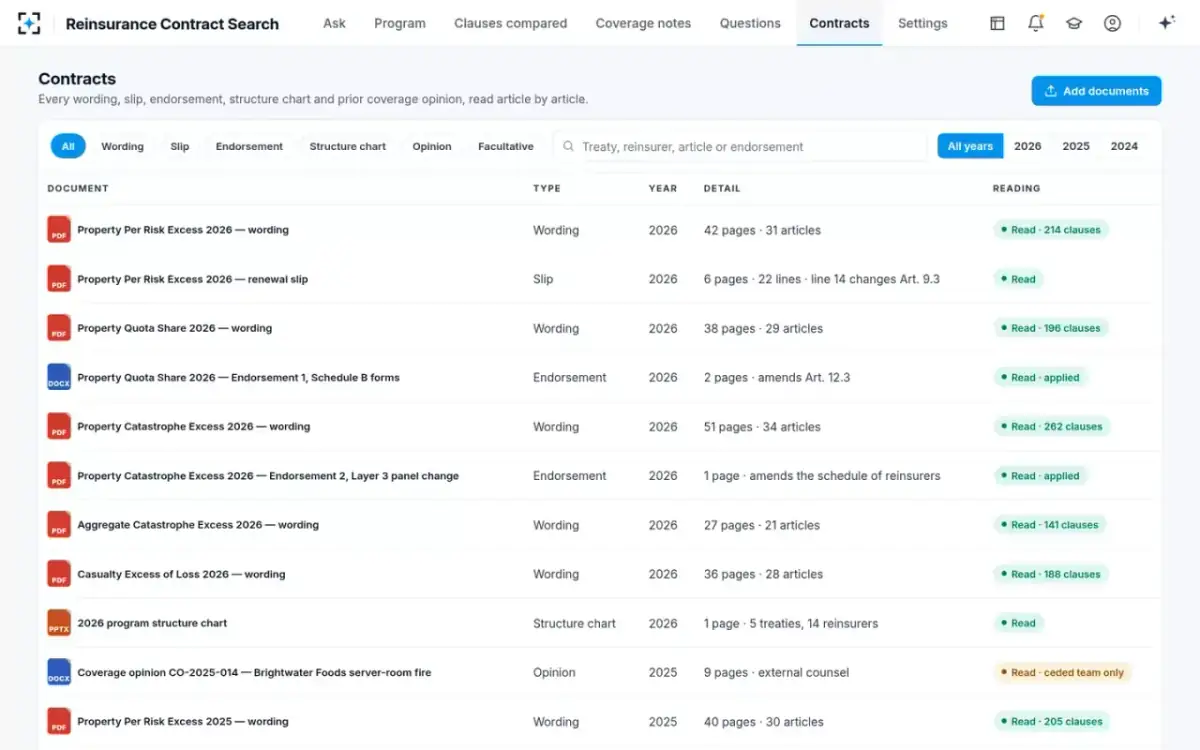
Reinsurance Contract Search reads facultative certificates as part of the program, article by article like the treaty wordings, and filters them by program year beside the wordings, slips, endorsements, structure charts and prior opinions. When a loss arrives, the answer can only start from the right document if that document is in the same place as the rest.
Wordings, slips, endorsements and facultative certificates, filed as one program
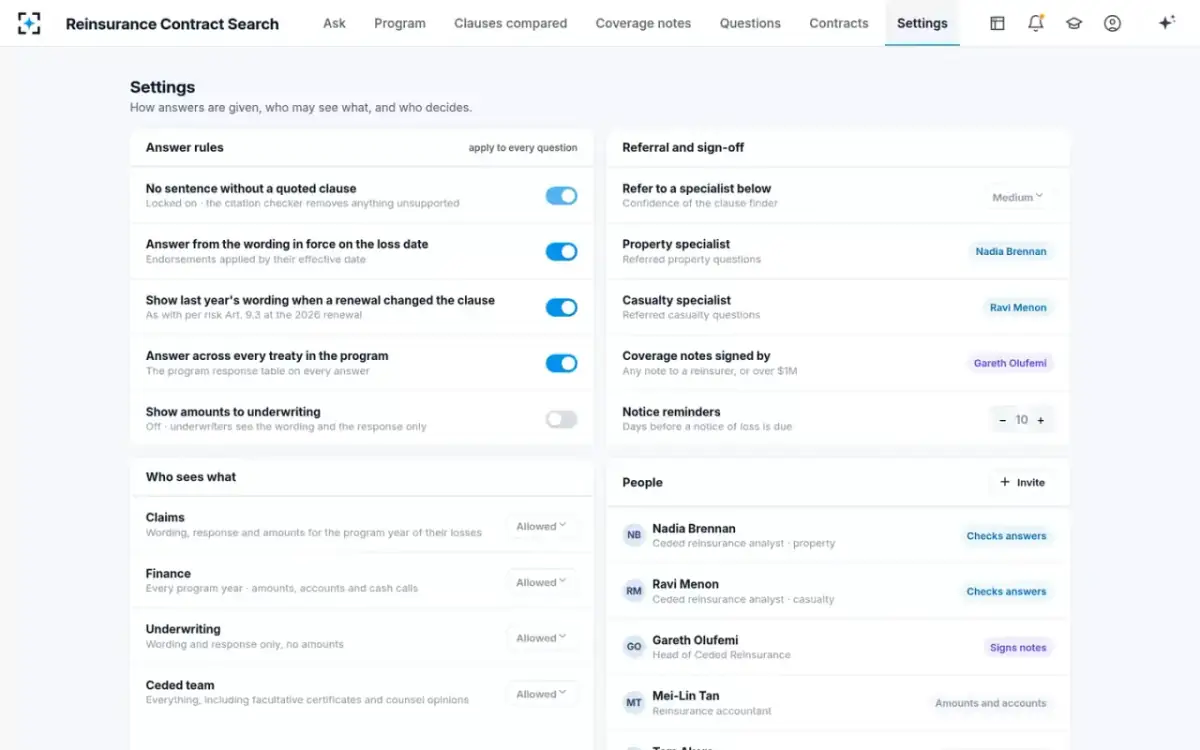
Certificates are also governed differently. In the sample settings, claims sees wording, response and amounts for the program year of its losses, finance sees amounts and accounts, underwriting sees wording and response only, and the ceded team alone sees everything, including facultative certificates and counsel opinions. An answer that depends on a certificate is therefore checked by the ceded team before anyone else relies on it.
Who sees what: certificates and counsel opinions stay with the ceded team
To see a large loss answered with the certificate check first, start from Reinsurance Contract Search.
Questions people ask
Can one risk have both facultative and treaty reinsurance?
Yes, and it is common. A certificate takes part of a large risk and the treaties cover what the cedant keeps, if their wordings allow it. Both Stonewall and Seven Provinces turned on this combination: a facultative reinsurer arguing that the cedant's further reinsurance of its retained share breached the certificate's retention terms.
Who underwrites facultative reinsurance?
A facultative underwriter at the reinsurer, assessing the individual risk much as a primary underwriter would, with its own premium and the right to decline. Treaty underwriters assess the cedant's whole book and underwriting standards instead. Reinsurers often run the two as separate units; the reinsurer in Stonewall had its own Facultative Reinsurance Division.
Does a facultative certificate have to be signed to be binding?
Under New York law the certificate is written confirmation of a contract, and the Court of Appeals has said a formal certificate is not required for a binding agreement. In practice, a cedant needs the signed certificate to prove the terms, and statutory accounting has its own clock for signing reinsurance contracts.
What is a treaty in insurance terms?
A treaty is a reinsurance contract that covers a defined class of the cedant's business for a period, with every qualifying policy ceded automatically. It can be proportional, sharing premium and losses in a fixed percentage, or excess, paying above a retention. A program usually combines several treaties.
Is facultative reinsurance proportional or excess?
Either. The CAS textbook notes that property certificates are sometimes written on a proportional basis, where the reinsurer pays a fixed percentage of each claim, while most casualty certificates are written on an excess basis above the cedant's retention. The certificate's basis line says which.