A net retained lines clause in reinsurance says that the contract applies only to the portion of each risk the cedant retains net for its own account, after deducting the other reinsurance the clause names, such as facultative certificates, quota shares or specific excess covers. It answers the question that sits under many everyday coverage questions: net of what? Whether a per risk retention is measured before or after the quota share, whether a facultative certificate reduces what a treaty sees, whether an unpaid recovery from one reinsurer passes up to the next: each depends on the net retained lines wording read with the program's inuring order. And retention promises cut both ways. Two U.S. courts, reading similar promises to keep part of a risk net, reached opposite results because the words differed. Botminds' Reinsurance Contract Search reads each treaty's net retained lines, inuring and ultimate net loss articles together, so an answer to "what is our net?" quotes the words that make it so.
The examples come from a fictional sample cedant, Cardale Mutual, and its 2026 program in the solution, and from two published court decisions, linked where they are used.
Net of what? Six everyday questions, and the clause each one turns on
Is the per risk retention measured before or after the quota share?
The clauseNet retained lines or inuring clause of the per risk treaty
Common outcomeSets the base for every per risk recovery
Does a facultative certificate on this risk reduce what the treaty sees?
The clauseThe list of inuring covers in the treaty’s net retained lines clause
Common outcomeUsually yes, if the certificate is named or described
If an inuring reinsurer does not pay, does the next treaty pick up the gap?
The clauseUltimate net loss definition: “whether collected or not”
Common outcomeUsually no: the shortfall stays with the cedant
May we reinsure the share we promised a facultative reinsurer we would keep?
The clauseThe certificate’s retention warranty, such as “for its own account”
Common outcomeA breach can void the certificate
What net line can underwriting keep on this risk?
The clauseSurplus share net line retention and the per risk retention
Common outcomeDecides how much is ceded before the loss
What is our net reserve on this claim?
The clauseAll of the above, applied in inuring order
Common outcomeThe number claims needs first
What is a net retained lines clause?
A net retained lines clause restricts a reinsurance contract to the cedant's own retained share of each risk, net of named other reinsurance. Its purpose is to make the reinsurer's exposure follow the cedant's: the reinsurer covers the part of the risk the cedant actually keeps, not a part the cedant has already passed on.
Wordings vary, but the clause usually does three things. It names the business covered as the portion retained net. It lists the reinsurance to be deducted first, which is the program's inuring order in words. And it says the reinsurer's liability will not increase because the cedant fails to collect from those other reinsurers. The sample per risk treaty builds the same effect into its definition of ultimate net loss, which deducts "inuring reinsurance, whether collected or not"; the ultimate net loss clause guide covers the rest of that definition.
What does "net retained" mean in reinsurance?
Net retained means the part of a risk or loss the cedant pays itself, after every other reinsurance on it has responded. It is the cedant's own money at risk, and so the part a reinsurer of the "net" is being asked to share.
A North Carolina appellate court put the definitions in plain terms in 1986: "Net retention is that amount which the reinsured insurance carrier will pay on an insured claim. Treaty reinsurance is that portion of an insured claim which has been ceded to another insurance company, and which will be paid by that insurance carrier" (Stonewall Ins. Co. v. Fortress Reinsurers Managers). The distinction looks obvious. The case existed because a cedant argued that treaty-reinsured amounts were still held "for its own account", since it would ultimately pay for them through treaty premiums.
Who asks 'net of what?', and what each needs the answer for
Today
Sets a gross reserve, then waits to learn the net.
With agents
Gets the net with each deduction quoted, in inuring order.
Still theirs: The gross reserve and the claim file.
Today
Needs to know which recoveries are deducted, and whether an unpaid one counts.
With agents
Sees the deductions and the “whether collected or not” wording behind them.
Still theirs: The booking and the provision for doubtful recoveries.
Today
Asks what net line can be kept on a large risk before binding.
With agents
Sees the net line and per risk retention that apply to the risk.
Still theirs: The decision to write it.
Today
Answers every one of these by reading three wordings in order.
With agents
Checks an answer that quotes them, and holds the questions they do not settle.
Still theirs: Any disputed meaning, and retention warranties on certificates.
What is a net retention, and what is a warranted retention?
A net retention is what the cedant keeps after reinsurance. A warranted retention is a promise, usually in a facultative certificate, that the cedant will keep at least a stated amount net, and breaking it can cost the whole certificate.
In Stonewall, the cedant warranted that it would retain $500,000 of a railroad liability risk "for its own account", and then reinsured part of that retention with another reinsurer. The trial court found the phrase unambiguous, meaning net retention only, and the Court of Appeals affirmed. It also held the warranty was a condition precedent, applying the North Carolina rule that failing a condition precedent relieves the other party "irrespective of the party's good faith or the prejudicial effect" (Stonewall, 1986). The reinsurer's witnesses explained why the promise mattered to them: having the cedant "actually liable on the risk" was significant for managing and handling claims. The reinsurer owed nothing.
[T]he expert witnesses presented by both sides agreed that the reinsurance industry is essentially unregulated, at least with regard to the language and construction of reinsurance contracts, and that such contracts . . . are negotiated and entered into on an individual basis . . . [and] their exact wording varies.
Trial court finding quoted by the North Carolina Court of Appeals, Stonewall (1986)
Does facultative reinsurance inure to the treaty?
Usually, if the treaty's net retained lines or inuring clause names or describes facultative reinsurance, the treaty sees the risk net of the certificate. The CAS textbook notes that per risk treaties often provide protection net of facultative coverage, and sometimes net of proportional treaties too (Patrik, CAS Foundations, ch. 7).
The practical consequence runs in the cedant's direction only if the certificate is loaded. A treaty written net of facultative assumes every certificate is collected; if a certificate is missing from the file, the cedant will compute the treaty recovery on too large a base, and the treaty reinsurer is entitled to the certificate's share. That is why the certificate check comes first in facultative vs treaty reinsurance, and why the inuring order is the first thing the agents apply.
Seven Provinces: when a net retention clause met a quota share treaty
The clearest published fight over net retention wording is Commercial Union v. Seven Provinces, decided by the First Circuit in 2000. The facultative certificate covered half of a $450,000 layer of a liability policy later hit by environmental contamination claims, and it carried a net retention provision. Its text is a good specimen of the genre:
Being a reinsurance of and warranted same NETT rate, terms and conditions as and to follow the settlements of the EMPLOYERS’ SURPLUS LINES INSURANCE COMPANY and that the local office of the said Company retains during the currency of this insurance at least $225,000.00' BEING 50% OF $450,000.00 EXCESS $50,000.00 COMBINED SINGLE LIMIT (subject to reduction by any general excess loss or excess catastrophe reinsurance whether effected by the head office or local office of the Company) on the identical subject matter and risk and in identically the same proportion on each separate part thereof, but in the event of the retained line being less than as above, [ESLIC’s] lines to be proportionally reduced.
Facultative certificate quoted by the U.S. Court of Appeals for the First Circuit, Commercial Union v. Seven Provinces (2000)
The cedant billed the facultative reinsurer its $225,000 half, and billed $180,000 of its own retained half to a pool of quota share treaty reinsurers. The facultative reinsurer argued that the treaty cession breached the net retention provision and that its own liability should fall by the same $180,000, to $45,000. The question was whether "general excess loss or excess catastrophe reinsurance", the further reinsurance the clause allowed, included a quota share. The court found the phrase "apparently was not a common term in the industry" and the certificate ambiguous, so the trial judge heard experts on trade usage and credited the cedant's: that "industry custom long has permitted treaty reinsurance on a risk insured by a facultative certificate absent unequivocal language to the contrary" (Commercial Union v. Seven Provinces).
One net retention clause, four amounts: what was claimed, ceded, offered in argument and spent
The cedant won the coverage point and more: the court upheld double damages and fees under the Massachusetts unfair practices statute for the reinsurer's conduct after the certificate was found, noting that even on its own plausible reading of the clause the reinsurer would have owed $45,000, which it never paid. A judge dissented on that part, arguing the reinsurer was entitled to press plausible defences. The coverage lesson stands either way: a net retention clause that does not say which further reinsurance is allowed invites years of argument about trade custom.
Two retention promises, two outcomes: why the words decide
Stonewall and Seven Provinces look alike: a facultative certificate, a promise about the cedant's retention, and a cedant that reinsured part of the share it was meant to keep. The cedant lost the first and won the second, and the difference was in the words.
Stonewall (1986) and Seven Provinces (2000), set side by side
Stonewall v. Fortress, N.C. Ct. App. 1986: Warranted to retain $500,000 “for its own account”
Commercial Union v. Seven Provinces, 1st Cir. 2000: Warranted to retain $225,000, “subject to reduction by any general excess loss or excess catastrophe reinsurance”
Stonewall v. Fortress, N.C. Ct. App. 1986: Reinsured part of the warranted retention with another reinsurer
Commercial Union v. Seven Provinces, 1st Cir. 2000: Ceded $180,000 of its retained half to quota share treaty reinsurers
Stonewall v. Fortress, N.C. Ct. App. 1986: Yes: “for its own account” meant net retention only
Commercial Union v. Seven Provinces, 1st Cir. 2000: No: the allowed further reinsurance was ambiguous, so trade usage decided
Stonewall v. Fortress, N.C. Ct. App. 1986: Condition precedent: the reinsurer owed nothing, whatever the cedant’s good faith
Commercial Union v. Seven Provinces, 1st Cir. 2000: The clause itself provided for proportional reduction; no breach was found
Stonewall v. Fortress, N.C. Ct. App. 1986: Reinsurer won
Commercial Union v. Seven Provinces, 1st Cir. 2000: Cedant won, with fees and double damages for the reinsurer’s conduct
How do you answer a reinsurance coverage question that turns on "net"?
Answer it in four steps: find the deductions, put them in order, apply them to the loss, and quote each one. Most "net" questions are arithmetic once the deductions are known, and the deductions are written down; the work is finding all of them.
First, read the net retained lines clause, the inuring clause and the ultimate net loss definition of the treaty in question, in the wording in force on the loss date. Second, list the covers they deduct, in the order the program applies them. Third, apply them to the loss: in the sample cedant's cold-storage fire, the quota share takes 30% of $14.6M, so the per risk treaty sees $10.22M, and under the 2026 wording the whole $10.22M stays net because the per risk cyber article does not respond. Fourth, quote each deduction in the answer, so the reader can check the base as well as the result. Where a certificate carries a retention warranty, check the cedant has kept it before billing.
Who decides when the wording is unclear?
Inside the cedant, the head of ceded reinsurance decides the position the company takes, usually with counsel; between the parties, an arbitration panel or court decides. Both cases above show how courts do it: they read the words, and if the words are ambiguous they hear evidence of what the trade meant by them.
The First Circuit quoted the Massachusetts rule directly: "Where, as here, the contract language is ambiguous, evidence of trade usage is admissible to determine the meaning of the agreement" (Seven Provinces). That is expensive evidence, and it arrives years after the loss. A ceded team's better defence is to find the ambiguous retention wordings in its own program before a loss tests them, and to refer, not guess, when a question turns on one.
How Reinsurance Contract Search handles "net" questions
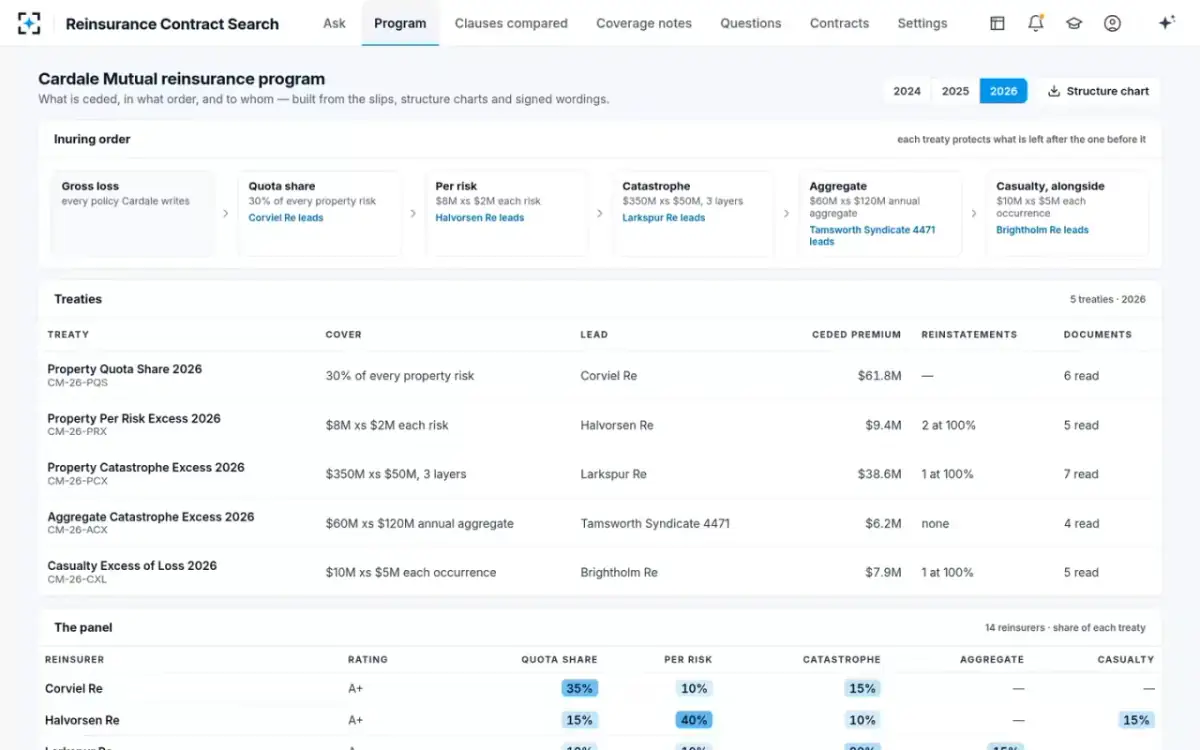
Reinsurance Contract Search answers a net question by applying the program's inuring order, quoting the articles that define the base, and stating what stays net. The treaty view shows each article with its number, so the definition behind a net figure is one click from the answer.
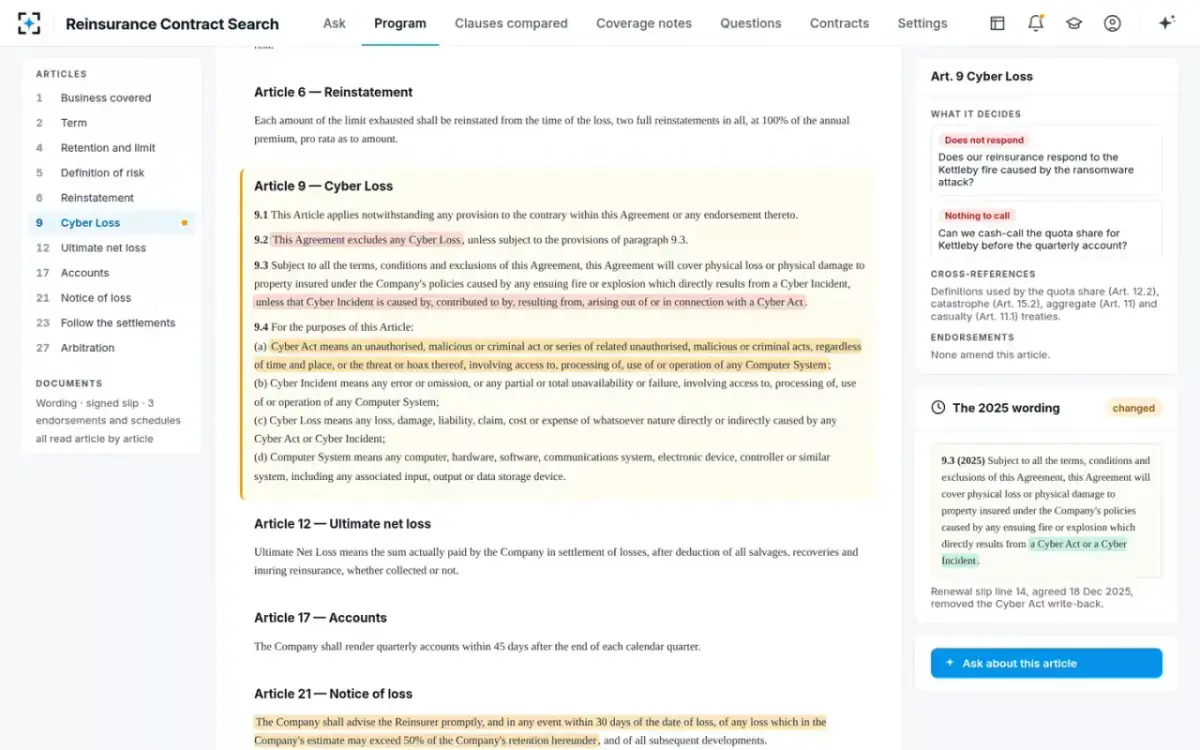
The article behind every net figure: ultimate net loss, deducting inuring reinsurance whether collected or not
The order the deductions are made in, drawn from the slips and structure chart
The limits matter most here, because "net" answers set reserves and bookings: the agents never decide a disputed meaning, never commit a recovery and never notify a reinsurer, and a question no clause settles goes to a named specialist. To see a net question answered across a sample program, start from Reinsurance Contract Search; for the order itself, see inuring reinsurance.
Questions people ask
What is the difference between a net retained lines clause and an ultimate net loss clause?
The net retained lines clause defines which business the treaty covers: the cedant's retained share, net of named reinsurance. The ultimate net loss clause defines how a loss on that business is measured: what was paid, what expenses count and what is deducted. Many treaties need both, and some fold the inuring deduction into the ultimate net loss definition.
Does a net retained lines clause protect the reinsurer if another reinsurer fails?
Usually yes, if it says the reinsurer's liability is not increased by the cedant's inability to collect, or deducts inuring reinsurance "whether collected or not". The shortfall then stays with the cedant. That is why counterparty strength on the lower layers matters to the cedant, not to the reinsurers above.
What is a net line in reinsurance?
A net line is the amount of a risk the cedant keeps for itself. In a surplus share treaty, the CAS textbook explains, the share ceded on each policy depends on the relationship between the policy limit and the treaty's "specified net line retention". Underwriters use the net line to decide how much of a large risk can be written before facultative cover is needed.
Can a cedant reinsure its own retention?
Only if its contracts allow it. A facultative certificate or treaty that warrants a retention, such as Stonewall's "for its own account", can be voided by reinsuring that share. A clause that permits named further reinsurance, as in Seven Provinces, allows it within its terms. Check every warranty before buying cover on a retained share.
Does utmost good faith affect how net retention clauses are read?
It affects conduct more than construction. In Seven Provinces the First Circuit described reinsurance relationships as governed by the traditional principle of utmost good faith, and relied on it in finding the reinsurer's shifting defences unfair. The meaning of the clause itself was decided on its words and trade usage.