A ceded reinsurance analyst is the person in an insurer's ceded reinsurance team who administers the reinsurance the company buys: the treaties and facultative certificates, their wordings and endorsements, the accounts sent to reinsurers, the notices of loss and the recoveries. Because the analyst is also the one who has read the wordings, the job quietly acquires a second half. Every large loss brings the same question from claims, finance and underwriting: does our reinsurance respond, under which clause, and for how much? Botminds' Reinsurance Contract Search exists for that second half. Seven agents read every wording, slip and endorsement article by article and answer the question with the clause that decides, so the analyst checks answers instead of writing each one from scratch.
The examples below come from a fictional sample cedant, Cardale Mutual, as it runs through the solution: a 2026 program of five treaties, 248 documents over three program years and one quarter of questions from the business. The figures about the industry and the occupations come from regulators, the Bureau of Labor Statistics and the Casualty Actuarial Society, each linked where it is used.
Five people carry one large loss, and four of them need the ceded reinsurance analyst
Today
Runs bordereaux, accounts and renewals, and fields every "does the treaty pay?" question by email, one wording at a time.
With agents
Checks a cited answer across the whole program, saves it as a coverage note, and takes only the questions no clause answers.
Still theirs: Every disputed meaning, and the decision to refer one.
Today
Cannot set the net reserve until someone says what the reinsurance pays.
With agents
Asks in plain words and sees the recoverable, what stays net and the notice date, each with its clause.
Still theirs: The gross reserve and the claim file.
Today
Needs to be told which treaty, which layer, which reinsurers and the number before booking a recovery.
With agents
Sees the treaty, the panel shares and the cash call clause beside the amount.
Still theirs: The booking and the quarter-end accounts.
Today
Wants to know whether the per risk treaty follows a new endorsement before binding the next risk.
With agents
Sees the same clause in every treaty side by side, wording and response only.
Still theirs: The decision to write the risk.
Today
Owns every coverage position that leaves the team and wants the clause, not an opinion.
With agents
Signs a note in which every sentence cites its article.
Still theirs: The signature and the program.
What does a ceded reinsurance analyst do?
A ceded reinsurance analyst does four jobs: buys, administers, recovers and explains. The first three appear in any job description. The fourth, explaining what the program covers, rarely does, yet it is the one that sets the analyst's day when a large loss lands.
Buying means preparing the renewal: exposure data, loss history and the submission the broker takes to market. Administering means everything after the slip is signed: loading wordings and endorsements, sending premium accounts, tracking which reinsurer signed which share and watching the program's concentration. That last duty has a regulatory edge. Under the NAIC's Credit for Reinsurance Model Law, a domestic cedant must tell its commissioner within 30 days when recoverables from one reinsurer or group pass half of its surplus, or when it cedes more than a fifth of the prior year's gross written premium to one. Recovering means turning paid losses into bills to reinsurers, with the proof each wording asks for.
Explaining is the work this guide is about. A treaty is a private contract, and the NAIC puts the consequence plainly: the reinsurer's obligation arises only once the cedant's own liability is incurred, and how far it extends is set by the terms and conditions of that particular agreement (NAIC, Reinsurance). Nobody in claims or finance reads those terms. The analyst does, which is why the questions arrive at the analyst's desk.
Reinsurance transactions in the insurance industry can become complicated. Companies may employ numerous reinsurance transactions with a variety of details.
NAIC, Reinsurance topic page
What is ceded reinsurance, in the terms an analyst uses?
Ceded reinsurance is the reinsurance an insurer buys: the insurer, called the cedent or ceding company, transfers part of its risk to a reinsurer for a premium. The same contract is assumed reinsurance from the reinsurer's side. The analyst works on the ceded side, so every number in the job is seen from the cedant's balance sheet: what is ceded, what is recoverable and what stays net.
The volume is larger than most people outside the trade expect, and most of it is not what a ceded analyst handles. The NAIC's 2025 results show U.S. property and casualty insurers ceding $1.0 trillion of premium, but intercompany pooling made up 58.9% of reinsured business and other affiliated cessions another 28.3% (NAIC, 2025 full-year results). Those are transfers inside a group. The third-party program, quota shares, per risk and catastrophe covers placed with outside reinsurers, is the part with wordings to read and reinsurers to persuade. The 21 professional reinsurers the NAIC tracks assumed $51.5 billion of unaffiliated premium in 2025, which the NAIC puts at about half of the U.S. industry's unaffiliated total, and much more goes abroad: the NAIC notes that most reinsurance premiums are reinsured outside the country.
The forms an analyst administers follow the CAS textbook's split. A facultative certificate reinsures a single primary policy, while a treaty covers a defined part of the exposure on a whole set of policies for a stated period (Patrik, CAS Foundations, ch. 7). A mid-size property and casualty cedant typically holds both, which is why facultative vs treaty reinsurance is often the first thing the analyst checks on a large loss.
Who asks the ceded analyst about coverage, and what do they ask?
Claims asks first and most often, finance asks for numbers, and underwriting asks before it binds. Each team needs a different slice of the same answer, and each would otherwise have to read five wordings to get it.
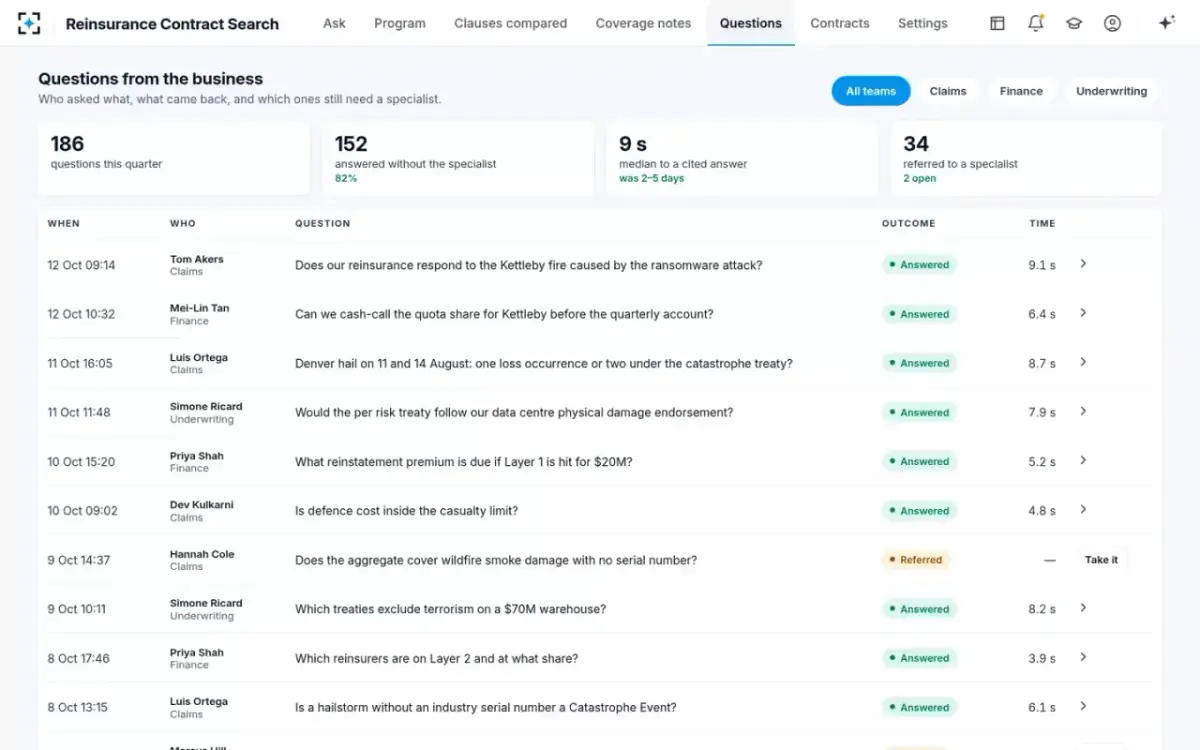
Take the sample cedant's quarter. The question log shows 186 questions from the business in three months, roughly fourteen a week. The adjuster on a ransomware fire at a cold-storage warehouse wants to know whether the program responds before setting the net reserve. The reinsurance accountant wants to know whether the quota share's share can be cash-called before the quarterly account. An underwriter asks whether the per risk treaty follows a data-centre physical damage endorsement. A claims manager asks whether two hailstorms three days apart are one loss occurrence or two. Each question is short. Each answer sits in a different article of a different treaty, and some depend on which wording was in force on the loss date.
One quarter's questions to the ceded team, and what decides each one
| Question from the business | Asked by | What decides it | Answered from the clause? |
|---|---|---|---|
| Does our reinsurance respond to the cold-storage fire caused by ransomware? | Claims | The cyber article of each treaty, in the wording in force on the loss date, applied in inuring order | Yes, cited across five treaties |
| Can we cash-call the quota share before the quarterly account? | Finance | The quota share cash call clause and its threshold | Yes |
| Hail on 11 and 14 August: one loss occurrence or two? | Claims | The catastrophe treaty hours clause and the gap between the storms | Yes |
| Would the per risk treaty follow our data-centre endorsement? | Underwriting | The per risk definition of risk and its follow-form wording | Yes, wording only |
| What reinstatement premium is due if Layer 1 is hit for $20M? | Finance | The reinstatement article: number, rate, pro rata as to amount | Yes |
| Is defence cost inside the casualty limit? | Claims | The ultimate net loss and limit wording of the casualty treaty | Yes |
| Does the aggregate cover wildfire smoke damage with no serial number? | Claims | The aggregate cover’s event definition, which no clause settles for smoke | No: referred to a specialist |
Which coverage questions need the ceded reinsurance analyst at all?
Questions whose answer is written in a clause do not need the analyst to find it, only to check it. Questions whose answer is not written anywhere, or is written ambiguously, need the analyst's judgment and sometimes counsel's. The line between them is the most useful thing a ceded team can draw.
Most of the sample log is the first kind. Whether a hailstorm is one occurrence is settled by an hours clause and two timestamps. Whether defence cost sits inside a casualty limit is settled by the words of the limit and the definition of ultimate net loss, as the ultimate net loss clause guide works through. What a reinstatement costs is arithmetic on a clause. None of these needs the person who knows the program best; they need someone to find the right article in the right version, which is the part that took the hours.
The second kind is smaller and harder. The smoke question has no serial number, an industry catastrophe code, to anchor it, and the aggregate cover's event definition does not say what happens without one. That is a disputed meaning, and in the sample program it goes to a named specialist with what was searched. Courts have seen this kind of question for decades: in a First Circuit dispute over retention wording, the trial judge heard industry experts on what the words meant to the trade, because the contract did not say. Those are the questions worth the analyst's time.
Where the analyst's hours go on one large-loss question
Most of the hours on a coverage question go on waiting and finding, not on judging. Botminds' estimate from ceded team practice, for one large-loss question answered by email, puts the total at about 32 working hours spread over two to five days, and only the last four hours are the analyst writing and signing a position.
Most of a coverage question's hours are spent before anyone reads the deciding clause
By email to the analyst · 32 h
- In the queue · 38%
- Pulling wordings · 19%
- Reading each treaty · 19%
- Inuring and shares · 12%
- Note and sign-off · 12%
With the solution · 1.7 h
- Finding · 12%
- Inuring and shares · 29%
- Checking and signing · 59%
The two bars have different shapes because the work changes, not because people work faster. With the email route, the analyst's judgment is a small slice at the end of a long search. With cited answers, judgment becomes most of the remaining time: checking that the inuring order and shares were applied correctly and signing the note. That is where an experienced analyst adds the most, and why the inuring order is the step the agents are built to stop at when the wording is unclear.
A quarter of questions from the business, answered or referred
What skills does a ceded reinsurance analyst need?
The core skill is reading a wording the way a court would: as a whole, article against article, in the version in force on the date that matters. Around it sit three technical skills and one human one.
The first technical skill is program structure. An analyst has to apply covers in the right order: the CAS textbook notes that a per risk excess treaty is often written net of facultative certificates and sometimes net of proportional treaties too (Patrik), and a catastrophe cover usually sits on what remains. The second is statutory accounting: reinsurance recoverables, the provision for reinsurance and the overdue tests that move surplus. The third is arithmetic under pressure: retentions, shares, reinstatements and limits that apply per risk, per occurrence or per year.
The human skill is saying "I don't know yet" to a claims director who wants a number by noon. A good analyst knows which answers can be given from a clause and which need counsel, and holds that line. Software that answers coverage questions has to hold the same line, which is why the solution refers a question below a confidence setting rather than guessing.
Ceded reinsurance analyst salary and outlook: what public data shows
No government series measures ceded reinsurance analysts. The Bureau of Labor Statistics does not publish a separate occupation or a reinsurance-only employment table, and no regulator counts ceded-team staff. The nearest occupations give a range rather than a figure.
No BLS series covers ceded analysts; the nearest occupations earn $78,000 to $130,000
The outlooks diverge in a way that matters for the role. BLS projects employment of actuaries to grow 9 percent from 2025 to 2035, while insurance underwriters are projected to decline 4 percent and claims adjusters, appraisers, examiners and investigators 6 percent. For underwriters BLS gives the reason as automation: software lets underwriters process applications faster, so fewer are needed (BLS). The ceded analyst sits between the growing analytical work and the shrinking processing work, which suggests where the role is heading: fewer hours locating clauses, more on judgment that software cannot sign.
How big is a ceded reinsurance team?
There is no published count. Regulators collect reinsurance programs, recoverables and collateral, not headcount, so any figure for ceded-team size is an estimate. What can be said is structural: the number of people who know a program well is small, because the knowledge sits in having read the wordings over several renewals.
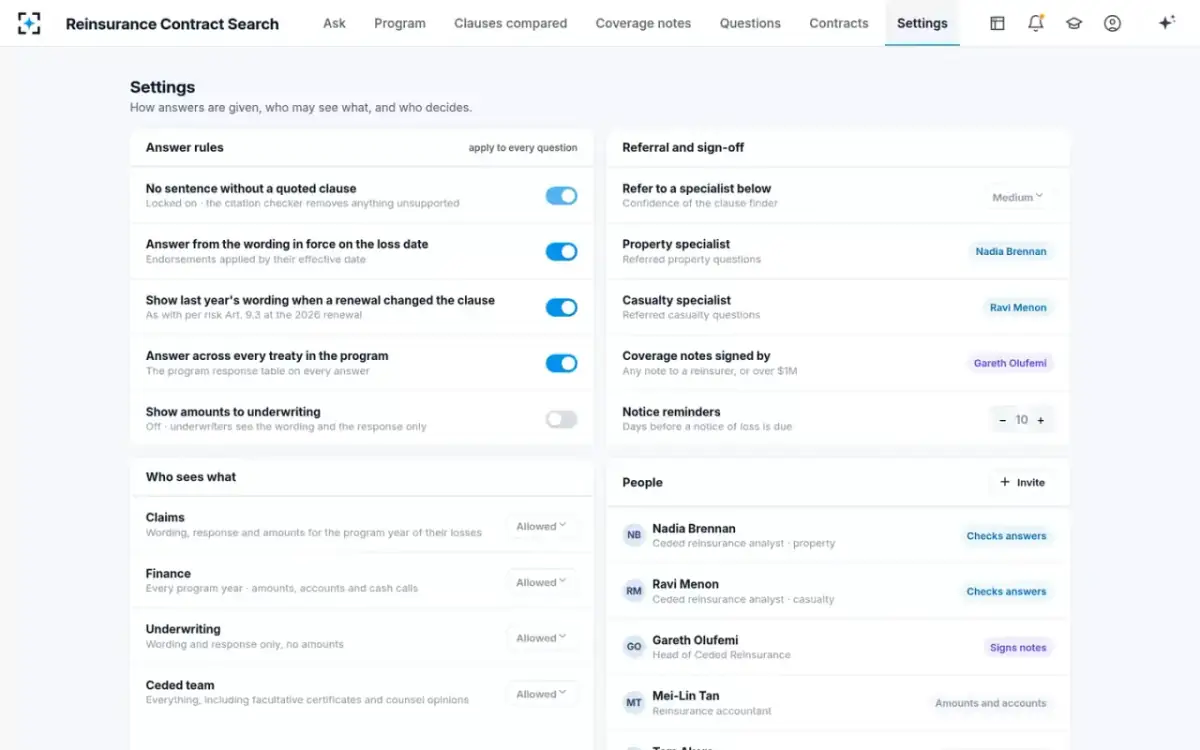
In the sample cedant, two specialists take referred questions, one for property and one for casualty, and one head of ceded reinsurance signs every coverage note. That shape, a handful of people with deep knowledge and a whole company asking them questions, is the bottleneck. The fix is not more analysts but fewer questions that need one.
How Reinsurance Contract Search changes the analyst's quarter
Reinsurance Contract Search moves the finding to agents and keeps the judging with the analyst. A plain question from claims returns a short answer with the deciding clause quoted from the wording in force on the loss date, and the same question answered across every treaty in the program. The analyst checks it, the note writer drafts the coverage note, and the head of ceded reinsurance signs coverage notes under the sign-off rule the team sets.
The limits are where the analyst's role is protected. The agents never notify a reinsurer, never commit a recovery and never decide a disputed meaning. Anything below the referral setting goes to a named specialist, with what was searched, and stays open in the question log until someone takes it. Who sees what is also set by team: claims sees the program year of its losses, finance sees amounts and cash calls, and underwriting sees wording and response without amounts.
The analyst's settings: who checks, who signs, when a question is referred
For the rollout itself, from which questions to open first to how to measure trust, see reinsurance contract management with cited answers. To see the questions, the referrals and the coverage notes on a sample program, start from Reinsurance Contract Search.
Questions people ask
What is a cedent in reinsurance?
The cedent, or ceding company, is the insurer that transfers risk to a reinsurer. The NAIC describes reinsurance as a contract in which "the insurance company—the cedent—transfers risk to the reinsurance company". A ceded reinsurance analyst works for the cedent.
What does a ceded reinsurance analyst do day to day?
A typical day mixes administration and questions: loading endorsements, preparing premium accounts and bordereaux, chasing recoveries on paid losses, and answering coverage questions from claims, finance and underwriting. Around renewal the balance shifts to submission data and placement support. In the sample cedant, the analyst fields ten to twenty coverage questions a week on top of that work.
Is ceded reinsurance a good career?
It is a specialist role with few people who can do it well, which tends to protect it. Public data covers it only indirectly: BLS reports a May 2025 median wage of $81,370 for insurance underwriters and $130,000 for actuaries, with actuarial jobs projected to grow 9 percent to 2035. The analytical part of ceded work resembles the growing occupation more than the shrinking one.
Do ceded reinsurance analysts need to know accounting?
Yes, at least the statutory side. Recoverables, the provision for reinsurance and the treatment of overdue balances all flow from ceded transactions, and the analyst's accounts feed them. The deep accounting usually sits with a reinsurance accountant, but the analyst has to know which treaty, layer and share an amount belongs to.
What is the difference between a ceded and an assumed reinsurance analyst?
A ceded analyst works for the insurer that buys reinsurance; an assumed analyst works for the reinsurer, or the assumed book of an insurer, and looks at the same contracts from the other side. U.S. insurers assumed $897.8 billion of premium in 2025, the NAIC reports, of which 88.9% was affiliated. The skills overlap, but the questions differ: a ceded analyst asks what the program will recover, an assumed analyst what the contract will cost.