Inuring reinsurance is reinsurance whose recoveries are deducted from a loss before another reinsurance contract applies to it: the inuring cover "inures to the benefit of" the later one, which sees only the loss net of it. In a typical property program a facultative certificate or quota share applies first, a per risk excess treaty next, and the catastrophe cover sits on what remains. The order decides what every treaty pays, and it lives in several documents at once: each wording's definition of net loss, the slips and the program's structure chart. Botminds' Reinsurance Contract Search applies that order when it answers a coverage question, and it is built to stop and ask a ceded specialist when the documents do not settle it, because a confident answer in the wrong order is the most expensive kind of wrong.
The worked figures on this page come from a fictional sample cedant, Cardale Mutual, and its 2026 program as it runs through the solution. The definitions come from the Casualty Actuarial Society's study materials, linked where they are used.
An additional problem which may be encountered in both methods is that the excess treaty may apply to the ceding company's retention after a surplus share treaty is applied. The $750k xs $250k layer may apply to a $1,000,000 loss which is actually a 10% share of a $10,000,000 loss.
David R. Clark, Basics of Reinsurance Pricing, CAS study note
What is inuring reinsurance?
Inuring reinsurance is any reinsurance that reduces the loss before a given contract measures it. "Inuring" is relative: the same quota share inures to the per risk treaty, the catastrophe treaty and the aggregate cover at once, while the per risk treaty inures only to the covers above it. The CAS textbook chapter on reinsurance uses the plainest definition: other inuring reinsurance is "reinsurance that applies to the cedant's loss before our coverage" (Patrik, CAS Foundations, ch. 7).
The practical consequence is that no treaty can be read alone. A per risk treaty's retention of $2M is a retention on the loss net of the quota share, not on the gross loss. A catastrophe cover's $50M retention is measured after the per risk recoveries. Read a treaty without its inuring covers and every number in it is applied to the wrong base.
What does "inures to the benefit of" mean in a reinsurance treaty?
"Inures to the benefit of" means the recoveries under one cover are counted for another cover's advantage: the later reinsurer gets the benefit of the earlier reinsurance because its own loss is measured after it. A wording that says the per risk treaty inures to the benefit of the catastrophe treaty is telling the catastrophe reinsurer that its loss is smaller by whatever the per risk treaty pays.
The phrase usually sits in one of three places. It can be in the definition of ultimate net loss, which deducts "inuring reinsurance" from the sum the cedant paid. It can be in a net retained lines clause, which limits the treaty to business the cedant keeps for its own account after named covers, the subject of the net retained lines guide. Or it can be in a separate inuring reinsurance clause that lists the covers by name. Each wording in a program can say something different, which is where questions start.
Which reinsurance applies first? The usual order, and why it is only usual
Usually facultative certificates apply first, then proportional treaties, then per risk excess, then catastrophe excess, then aggregate covers. That order is a convention, not a rule of law, and each cedant's wordings set their own.
The CAS textbook is careful in exactly that way. A per risk excess treaty "often provides protection net of facultative coverage, and sometimes also net of proportional treaties" (Patrik). Often and sometimes are the operative words. A per risk treaty can also be written so that the quota share reinsurers share in its recoveries instead of the quota share inuring to it, and the arithmetic of every loss changes. A casualty treaty can sit in a tower of its own, alongside the property program rather than above it, which is how the sample program's structure chart draws its casualty excess of loss.
The order also changes what the reinsurers price. Clark's CAS study note on pricing describes a catastrophe cover that, typically, applies to the cedant's exposure net of surplus share, per risk excess and facultative reinsurance, and it shows the same problem one layer down (Clark). If the pricing assumed one order and the wording says another, the cedant and the reinsurer are looking at different losses.
An inuring reinsurance example: one fire, two wordings
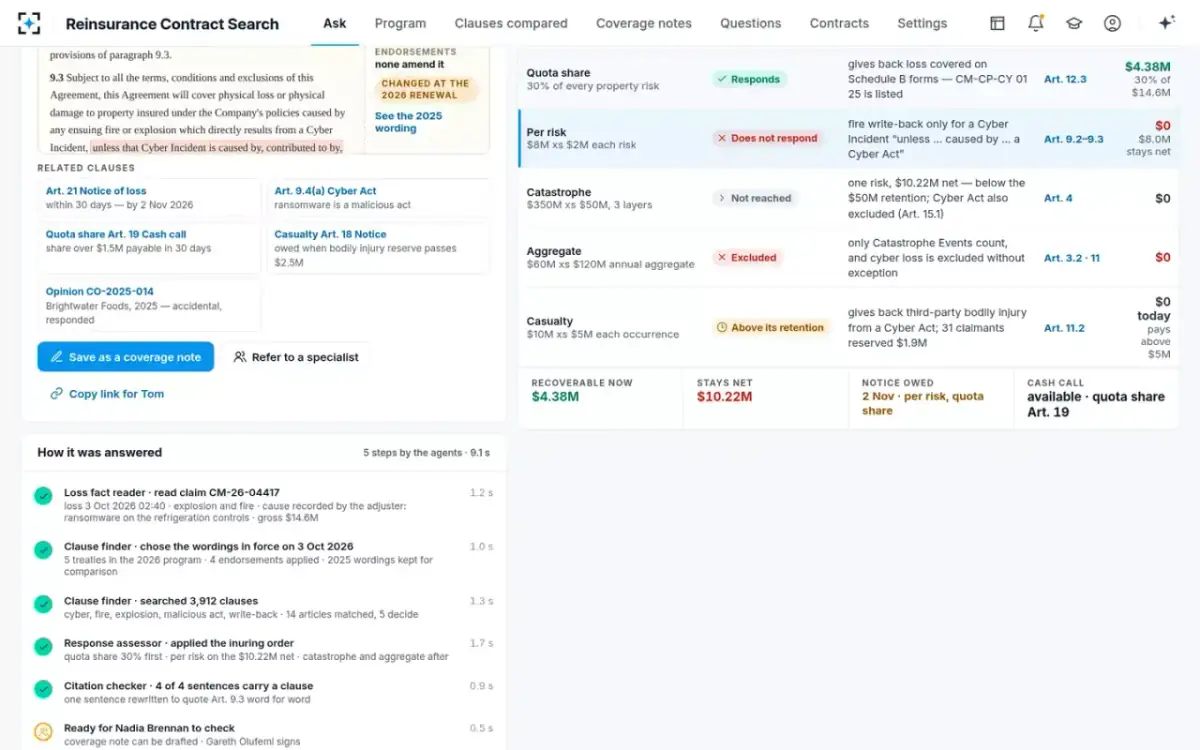
The clearest way to see inuring is to run one loss through a program in order. Take the sample cedant's cold-storage fire: a ransomware attack on the refrigeration controls, then an explosion and fire, gross $14.6M on 3 October 2026. The program applies in this order, and the per risk treaty's wording changed at the 2026 renewal.
One $14.6M fire through the program in inuring order: the 2026 wording and last year's
1
Gross loss
What it sees$14.60M
2026 wordingClaim paid on the original policy
Left, 2026$14.60M
2025 what-ifSame
Left, 2025$14.60M
2
Quota share, 30% of every property risk
What it sees$14.60M (all of it)
2026 wordingResponds: $4.38M
Left, 2026$10.22M
2025 what-ifResponds: $4.38M
Left, 2025$10.22M
3
Per risk excess, $8M xs $2M each risk
What it sees$10.22M, net of the quota share
2026 wordingDoes not respond: fire from a malicious cyber act is not written back
Left, 2026$10.22M
2025 what-ifResponds: $8.0M, its full limit
Left, 2025$2.22M
4
Catastrophe excess, $350M xs $50M
What it seesWhat is left after 2 and 3, one risk
2026 wordingNot reached: below the $50M retention
Left, 2026$10.22M
2025 what-ifNot reached
Left, 2025$2.22M
5
Aggregate excess, $60M xs $120M a year
What it seesQualifying events after the covers above
2026 wordingExcluded: cyber loss without exception
Left, 2026$10.22M net
2025 what-ifNo recovery
Left, 2025$2.22M net
Two things follow from the order. First, the per risk treaty never sees $14.6M; it sees $10.22M, because the quota share has already taken 30%. Under last year's wording it would have paid its full $8.0M limit on that net figure, leaving the cedant $2.22M. Second, the catastrophe cover's retention is measured on what is left after both, so a single-risk fire of this size would not reach it under either wording. The $8.0M difference between the two columns is one changed phrase in one article, and it only shows up when the program is read in order.
What does "net of inuring reinsurance" mean when a reinsurer does not pay?
It usually means the later cover still deducts the inuring recovery, whether or not the cedant collects it. The sample per risk wording defines ultimate net loss as the sum the company actually paid after deducting salvages, recoveries and inuring reinsurance, collected or not (the ultimate net loss clause reads it word by word). Those last words carry the credit risk.
Suppose a quota share reinsurer on 10% of the cedant's quota share fails to pay its part. Under that wording, the per risk reinsurer still measures its loss as if the whole quota share recovery had been collected. The gap does not move up the program; it stays with the cedant. That is why inuring order and reinsurer credit are the same conversation, and why a ceded team watching its panel's security, the work described in reinsurance credit risk, is also protecting the arithmetic of every higher layer.
How does a per risk treaty inure to a cat treaty?
A per risk treaty inures to a catastrophe treaty by cutting each large single-risk loss to its retention before the catastrophe cover adds the event's losses together. In an event with many risks, the per risk recoveries come off first, risk by risk, and the catastrophe cover sees the sum of what is left.
The sample cedant's Denver hail shows the mechanics. Two storms produced $83.4M of gross loss. The quota share took 30%, or $25.02M. Two risks exceeded the per risk treaty's $2M retention net of the quota share, and the per risk treaty paid $2.79M on them. What remained for the catastrophe program was $55.59M, split $32.07M and $23.52M between the two storms. Whether the catastrophe cover responded then turned on a different clause, the hours clause, worked through in how reinsurance layers work. Without the per risk recoveries, the catastrophe cover would have measured a larger loss; with them, every dollar the per risk treaty paid is a dollar the catastrophe reinsurers did not.
Clark flags the modelling side of the same point: details of inuring reinsurance matter because "If a surplus share treaty inures to the benefit of the catastrophe treaty, any features such as occurrence caps or loss corridors will affect the catastrophe exposure", and "The inuring reinsurance terms may not be calculable by the model" (Clark). Caps and corridors in an inuring treaty change what the catastrophe treaty sees.
What if the treaties disagree on inuring? Where the agents stop and ask
When the wordings, the slips and the structure chart do not tell the same story, the agents stop and ask a person; they do not pick the version that gives the larger recovery. Inuring disagreements are common because the documents are written at different times by different people: a structure chart drawn by the broker, slips agreed line by line, and wordings finalised months after inception.
How Reinsurance Contract Search applies the inuring order, and the two places it stops for a person
Agent
Claim readTakes the loss date, the cause the adjuster recorded, the location and the amounts from the claim file.
Never: infer a cause the adjuster has not recorded.
Agent
Program mapperBuilds the inuring order, layers, retentions and shares from the signed slips and the structure chart.
Never: change the booked program.
A person decides
Ceded analyst, if the chart and slips differDecides which document states the order the parties agreed, before any treaty is applied.
Agent
Clause finderPicks the wording in force on the loss date in each treaty, endorsements applied, and the articles that define net loss.
Never: quote a wording that was not in force on the loss date.
Agent
Response assessorApplies the treaties in order and states for each whether it responds, does not, is not reached or responds above its retention, with the arithmetic.
Never: state a coverage position to a reinsurer.
A person decides
Specialist, if a meaning is disputedTakes any question where the wordings conflict on what inures, with what was searched.
The first stop catches the commonest problem. If the structure chart shows the per risk treaty inuring to the catastrophe cover but the per risk slip was agreed on a basis that shares with the quota share, the program mapper flags the difference to the analyst instead of choosing. The second stop is for meaning rather than structure: two wordings that define net loss in ways that cannot both be true. Those go to the named specialist for that line, and the question stays open in the question log until someone takes it.
The inuring questions the agents raise, and who answers them
Most inuring questions fall into a handful of patterns, and each has a natural owner. Writing them down is how a ceded team turns the specialist's knowledge into a rule the whole program can use.
Six inuring questions, the document that should settle each, and who decides when it does not
| The question | Where the answer should be | Who decides if it is not |
|---|---|---|
| Does the quota share inure to the per risk treaty, or share in it? | Per risk slip and its definition of net loss | Ceded analyst, with the broker’s placing slip |
| Does a facultative certificate on this risk inure to the per risk treaty? | Per risk net retained lines or inuring clause | Ceded analyst |
| Is the inuring recovery deducted whether collected or not? | Ultimate net loss definition of the higher treaty | Head of ceded reinsurance, with finance |
| Do caps or corridors in an inuring treaty change what the catastrophe cover sees? | The inuring treaty’s own limits and the catastrophe wording | Ceded analyst, with the pricing actuary |
| A renewal changed the inuring clause mid-program: which applies to this loss? | The wording in force on the loss date, endorsements by effective date | Ceded analyst |
| Does the property program inure to the casualty treaty on a mixed loss? | Each treaty’s business covered and net loss definitions | Casualty specialist, with counsel if the wordings conflict |
One pattern deserves its own warning. A cedant that buys a per risk treaty "net of facultative" and then forgets to load a certificate will compute the per risk recovery on too large a base, and the per risk reinsurer will be entitled to ask where the certificate went. Whether a certificate exists is the first question on any large risk, which is why facultative vs treaty reinsurance starts there.
How Reinsurance Contract Search applies the inuring order on a real question
Reinsurance Contract Search answers a coverage question across every treaty in one table, in inuring order, with the clause and the arithmetic for each. The program view shows the order it applied, drawn from the slips and the structure chart, so the analyst can check the base before checking any clause.
The program in inuring order: each treaty protects what the one before it leaves
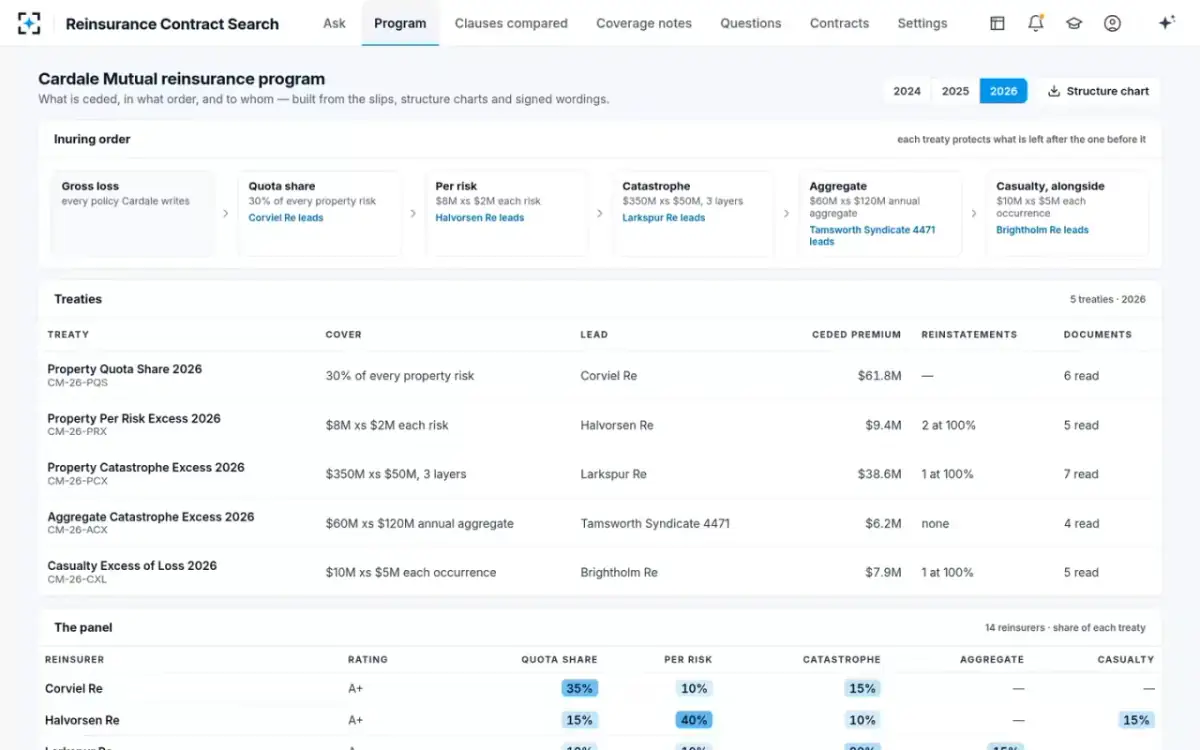
Five treaties, one question, answered in order
To see a program's inuring order applied to your own past losses, start from Reinsurance Contract Search.
Questions people ask
What is an inuring reinsurance clause?
It is a clause that names the reinsurance which applies before the contract it sits in, so that recoveries under those covers are deducted first. Some programs put it in a separate article; others build it into the ultimate net loss definition or a net retained lines clause. The sample per risk wording does it inside its ultimate net loss article.
Is inuring reinsurance the same as underlying reinsurance?
In practice the two are used for the same idea, a cover that sits beneath another and reduces what the higher cover sees. "Inuring" is the word wordings use, because it states the effect: the lower cover works for the benefit of the higher one. "Underlying" describes position in a tower and is looser.
Does a catastrophe bond inure to a traditional catastrophe treaty?
Only if the documents say so. A capital-market cover can sit alongside a traditional layer, share in it, or inure to it, and each choice changes what the traditional reinsurers measure. Public programs show why the wording matters: FEMA describes each of its flood placements as a percentage of losses in a stated band, so how the placements interact has to be read from the contracts, not assumed.
Why does inuring order matter for pricing?
Because the reinsurer prices the loss it will actually see. Clark's CAS study note says the only accurate way to experience-rate a layer that sits behind other reinsurance is to restate the history net of that inuring reinsurance. A cedant that changes its inuring order without telling the market is asking reinsurers to price one program and pay on another.
Who should own the inuring order in a ceded team?
The head of ceded reinsurance owns it as part of the program design, and the ceded analyst maintains it as the wordings, slips and endorsements arrive. When documents disagree, the analyst decides which reflects the agreement and writes the reason into the program file. Software should apply the order, never set it.