Reinsurance layers work by dividing a loss into horizontal bands. The cedant keeps the bottom band, its retention; each layer above it pays only the part of the loss that falls inside its band, written as a limit excess of an attachment point, such as $50M excess of $50M; and anything above the top layer comes back to the cedant. Different kinds of cover define "the loss" differently, per risk, per occurrence or for the whole year, and apply in a set order, so one event can recover from some layers and not reach others. Reading that correctly is a question of words as much as arithmetic: the retention, the hours clause and the reinstatement article each change the answer. Botminds' Reinsurance Contract Search draws a program's layers to scale and tests a loss against each one, quoting the clause that decides. This guide does the same by hand.
The worked event is a fictional one: two hailstorms in the Denver area in August 2026, as they run through the sample cedant Cardale Mutual's 2026 program in the solution. Definitions come from the Casualty Actuarial Society's textbook chapter on reinsurance and its pricing study note.
Which layer pays first? The seven questions a ceded analyst asks of one loss
1
Which wordings were in force on the loss date?
If yesUse them, with every endorsement applied by its effective date.
If noNever answer from last year’s wording except as a labelled what-if.
Denver hail2026 program; both storm dates inside the treaty year.
2
Is there a facultative certificate on any risk?
If yesApply it first, if the treaties are written net of facultative.
If noGo to the proportional treaty.
Denver hailNone on the affected risks.
3
Does a proportional treaty take a share?
If yesTake its share of the whole loss before any excess layer.
If noThe excess layers see the gross loss.
Denver hailQuota share takes 30%: $25.02M.
4
Does any single risk exceed the per risk retention?
If yesThe per risk layer pays that risk’s excess, up to its limit.
If noThe per risk layer is not involved.
Denver hailTwo risks over $2M net: $2.79M.
5
How many loss occurrences does the event make?
If yesOne retention and one limit per occurrence, as the hours clause defines it.
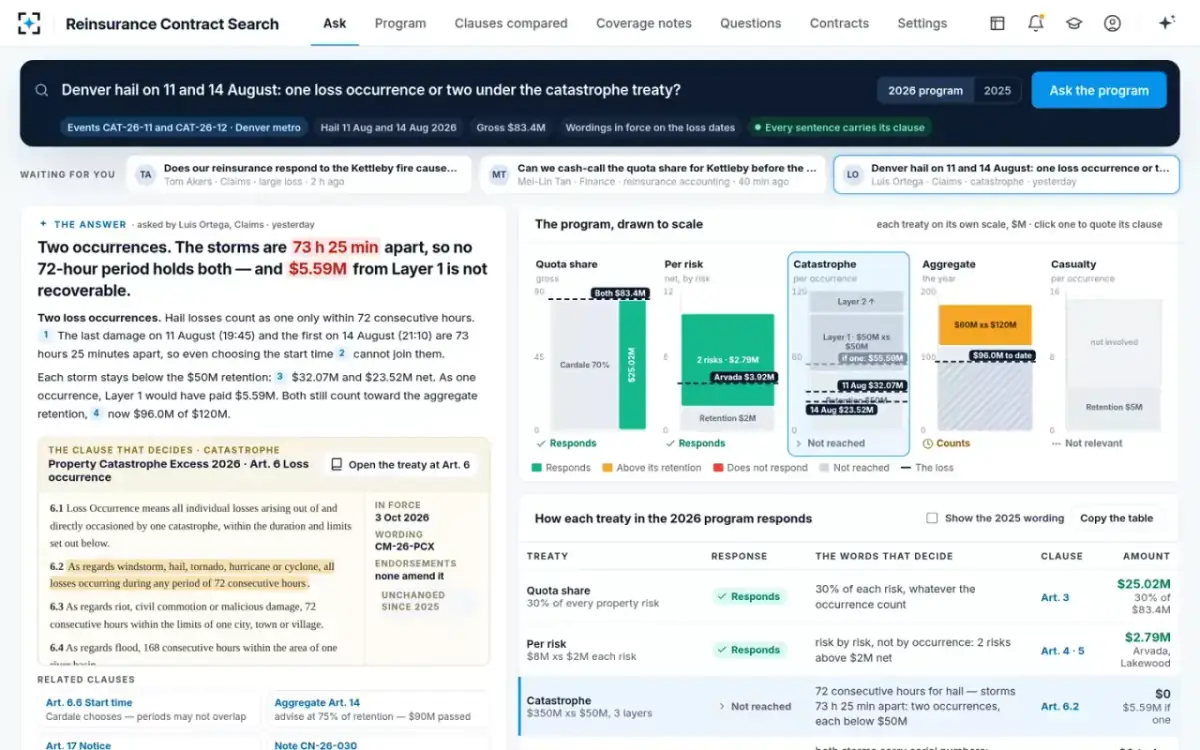
Denver hailTwo: the storms are 73 h 25 min apart under a 72-hour clause.
6
Does an occurrence exceed the catastrophe retention?
If yesLayers respond in order, each up to its limit.
If noThe catastrophe layers are not reached.
Denver hailNo: $32.07M and $23.52M, each below $50M.
7
Does the loss count toward an aggregate cover?
If yesAdd it to the year’s qualifying losses; the cover pays above the annual retention.
If noNot counted.
Denver hailCounts: $96.0M of the $120M annual retention used.
How do reinsurance layers work? Retention, limit and the band in between
Each excess layer has two numbers: the attachment point, where it starts, and the limit, how much it can pay. A layer written "$8M xs $2M" pays the part of a covered loss between $2M and $10M. A loss of $1.5M does not touch it; a loss of $6M costs it $4M; a loss of $14M costs it the full $8M and leaves $4M above it for the cedant or the next layer.
The CAS textbook defines the mechanism precisely: an excess treaty "reinsures, up to a limit, a share of the part of each claim that is in excess of some specified attachment point (cedant's retention)" (Patrik, CAS Foundations, ch. 7). The word "share" matters. Many layers are placed at less than 100%, so the cedant keeps a co-participation inside the layer as well as the retention below it. The same chapter notes that catastrophe covers are "typically of the form of a 90% or 95% share of one or more layers".
What is a retention, and what is an attachment point in reinsurance?
The retention is the amount of each loss the cedant keeps before reinsurance pays; the attachment point is where a layer starts. For the lowest layer they are the same number. For a higher layer, the attachment point is the top of the layer beneath it, while the cedant's retention is still the bottom of the tower.
Both are measured on the loss as the treaty defines it, which is rarely the gross loss. In the sample program, the per risk treaty's $2M retention applies to each risk's loss after the quota share has taken 30%, and the catastrophe treaty's $50M retention applies to each occurrence's loss after the quota share and per risk recoveries. Reading a retention against the wrong base is the commonest arithmetic error in coverage answers, and inuring reinsurance sets out the order that fixes the base.
What is a reinsurance tower? The sample program, layer by layer
A reinsurance tower is the stack of layers that protects one book of business, drawn from the retention to the top limit. A property program usually has two towers in one diagram, a per risk tower for large single losses and a catastrophe tower for events, with proportional and aggregate covers around them.
The sample 2026 program: what each treaty measures, where it attaches, and how often it can pay
| Treaty | Measures the loss | Layer | Reinstatements | Most it can pay in the year |
|---|---|---|---|---|
| Property quota share | Each property risk, from the first dollar | 30% of every property risk | Not applicable | No stated annual cap in the program view |
| Property per risk excess | Each risk, net of the quota share | $8M xs $2M | Two at 100% | $24M: (1 + 2) × $8M |
| Property catastrophe excess | Each loss occurrence, net of the covers above | $350M xs $50M, in three layers | One at 100% | $700M: (1 + 1) × $350M |
| Aggregate catastrophe excess | The year’s qualifying events | $60M xs $120M annual aggregate | None | $60M |
| Casualty excess of loss | Each occurrence, casualty lines | $10M xs $5M | One at 100% | $20M: (1 + 1) × $10M |
Two details in the table are easy to miss. The catastrophe treaty is one line on the program screen but three separate layers, each with its own panel and, often, its own reinstatement terms. And the per risk treaty's annual capacity is three times its limit only because of its two reinstatements; a loss that exhausts the limit a third time in one year is the cedant's.
Which layer pays first? Reading the decision tree
The layer that pays first is the one that applies first in the program's inuring order, and among excess layers, the lowest one the loss reaches. In a typical property program a facultative certificate applies first, then the proportional treaty, then per risk excess, then catastrophe excess, then any aggregate cover. The decision tree at the top of this page follows that order.
The tree is a sequence because each answer changes the next question's base. Once the quota share has taken its 30%, the per risk retention is tested on the 70% that remains. Once the per risk treaty has paid on the two large risks, the catastrophe treaty tests what is left of the event. The order is the cedant's choice, written in the wordings, and the sample program draws its casualty treaty alongside the property covers rather than above them because casualty losses do not pass through the property layers at all.
What each layer sees of one $83.4M hail event, as the covers apply in order
Working layers, higher layers and clash layers
Layers are also named by how often they are expected to pay. A working layer pays most years, a higher layer pays when a single large claim reaches it, and a clash layer sits above every policy limit and pays only when several claims or coverages combine. The names matter because each is priced and reviewed differently.
The CAS textbook's definitions are the cleanest available. A working cover is a layer the textbook expects to see claims every year, which is why working covers are often retrospectively rated. A higher exposed layer "attaches above the working cover(s), but within policy limits". And "A clash treaty is a casualty treaty that attaches above all policy limits", so it can be reached only by extra-contractual obligations, damages above policy limits, catastrophic workers compensation accidents or the clash of several claims from one event (Patrik). For a ceded analyst, a clash layer's first question is always how claims are combined, which brings the occurrence definition back to the centre.
A working cover excess treaty reinsures an excess layer for which claims activity is expected each year. The significant expected claims frequency creates some stability of the aggregate reinsured loss.
Gary S. Patrik, 'Reinsurance', Foundations of Casualty Actuarial Science, CAS
One storm or two: the hours clause decides how many retentions apply
A catastrophe layer applies one retention per loss occurrence, so whether an event is one occurrence or two can decide whether the layer pays at all. The hours clause sets the window: losses inside one period of consecutive hours, chosen by the cedant, can be added together as one occurrence.
The sample catastrophe treaty's Art. 6.2 reads: "As regards windstorm, hail, tornado, hurricane or cyclone, all losses occurring during any period of 72 consecutive hours." The last damage from the first storm was at 19:45 on 11 August and the first damage from the second at 21:10 on 14 August, 73 hours 25 minutes apart. No 72-hour window can hold both, wherever the cedant starts it.
73 hours 25 minutes between storms, against a 72-hour hours clause
- Any 72 consecutive hours
- Gap between the two storms
The arithmetic follows. As two occurrences, the storms produced $32.07M and $23.52M net, each below the $50M retention, so the catastrophe layers pay nothing. As one occurrence, $55.59M would have exceeded the retention and Layer 1 would have paid $5.59M. The difference is 85 minutes of weather and one number in one article. How English courts have read hours clauses, and what a changed number costs, is worked through in the guide to the hours clause.
One loss occurrence or two: the hail question answered with the hours clause quoted
How do reinstatements work?
A reinstatement restores a layer's limit after a loss uses it, usually for an additional premium, so the layer can pay again in the same year. The number of reinstatements sets how many times the limit can be used, and the premium terms set what each restoration costs.
The sample per risk treaty's Art. 6 is typical: it allows two full reinstatements, each charged at 100% of the annual premium and pro rata as to amount, with the limit restored from the moment of the loss. Pro rata as to amount means a loss that uses a quarter of the limit triggers a reinstatement premium of a quarter of the annual premium, at the 100% rate. Clark's CAS study note gives the rule for capacity: the treaty effectively has an aggregate limit of one plus the number of reinstatements times the occurrence limit (Clark). For the sample per risk treaty that is $24M a year. Booking the premium those reinstatements generate is accounting work: how to calculate reinstatement premium works three cases.
The aggregate layer counts what the other layers leave
An aggregate cover adds up a year's qualifying losses, usually net of the other covers, and pays above an annual retention. It is the layer that responds to frequency rather than severity: several events, none large enough for the catastrophe layers, can together reach it.
The Denver hail shows why it matters. Neither storm reached the catastrophe retention, but both count toward the aggregate cover's $120M annual retention, which the sample answer reports at $96.0M used after these storms. The aggregate cover is not paying yet; it is $24M away. For the CAS textbook's definition, an aggregate excess treaty treats as one loss "the accumulation of all subject losses during a specified time period, usually one year" (Patrik). Its event definition is where hard questions sit, and the sample's wildfire smoke question, referred to a specialist because no serial number anchors it, is one of them.
How Reinsurance Contract Search draws the layers for a question
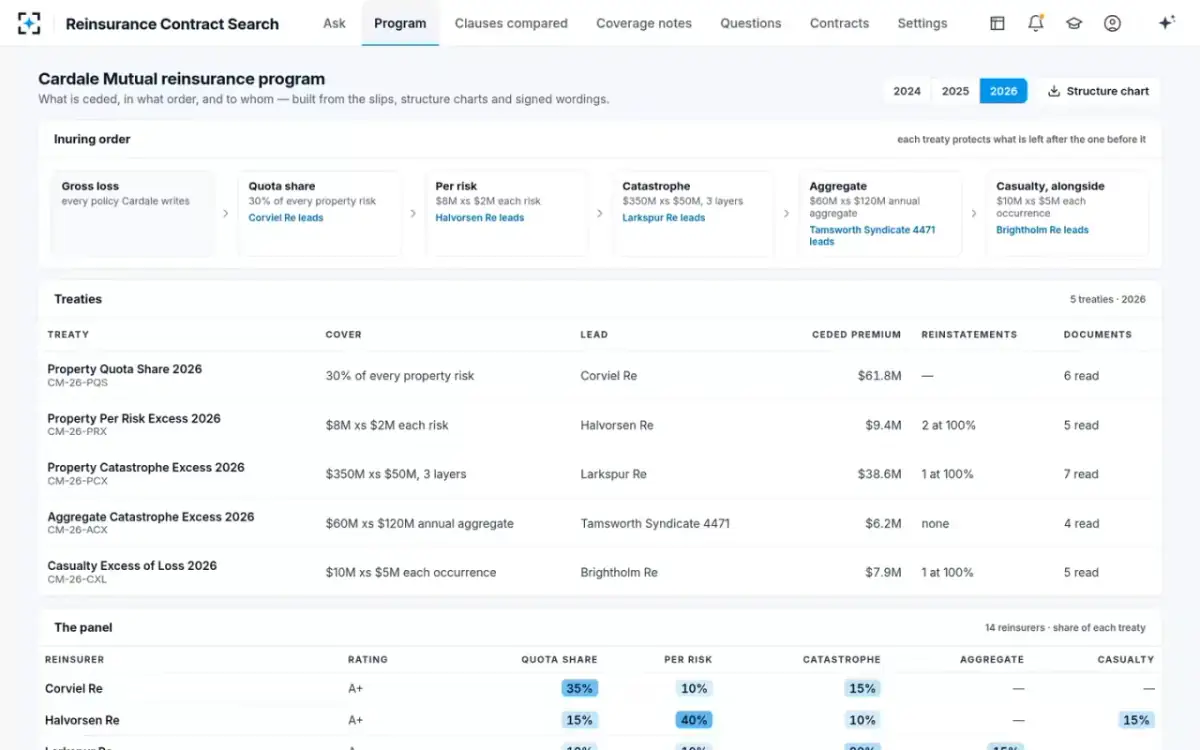
Reinsurance Contract Search draws every treaty in the program to its own scale, marks the loss on each one and states whether each responds, does not, is not reached or responds above its retention. The program view lists the treaties in inuring order, with their layers, reinstatements and panel.
The program behind every answer: layers, reinstatements and the panel
To test your own program's layers against a past event, start from Reinsurance Contract Search; for the clause that defines the loss each layer measures, see the ultimate net loss clause.
Questions people ask
What does "xs" mean in reinsurance?
"xs" means "excess of": $8M xs $2M is a layer that pays up to $8M of the part of a loss above $2M. The first number is the limit and the second the attachment point. A layer written "$350M xs $50M, in three layers" is one tower split into three separately placed bands.
Is the retention the same as a deductible?
It works like one, but it is measured on the loss as the treaty defines it, after inuring covers, and it may apply per risk, per occurrence or per year. In the sample program, the same hail event used two different retentions: $2M per risk for the per risk treaty and $50M per occurrence for the catastrophe treaty.
What happens when a layer is exhausted?
The loss above the layer passes to the next layer up, or back to the cedant if the tower ends. If the layer has a reinstatement left, its limit is restored for later losses in the year, usually for an additional premium. Once the reinstatements are used up, the layer has no more capacity until it renews.
Are reinsurance layers per occurrence or per year?
Either, and the wording says which. Per risk layers apply to each risk's loss, catastrophe layers to each loss occurrence as the hours clause defines it, and aggregate layers to the year's accumulated losses. The same event can be tested on all three bases at once.
Why do catastrophe layers have fewer reinstatements than per risk layers?
Because each use is large and the reinsurer prices the chance of several full losses in one year. In the sample program the per risk treaty has two reinstatements and the catastrophe treaty one. Clark's CAS note adds that, for seasonal perils such as hurricanes, few contracts make reinstatement premium pro rata as to time.