The FHCF reimbursement contract is the agreement between the State Board of Administration of Florida, which runs the Florida Hurricane Catastrophe Fund, and each insurer writing residential property in Florida, under which the fund reimburses a share of the insurer's hurricane losses above a retention. Florida law makes it compulsory: "As a condition of doing business in this state, each such insurer shall enter into such a contract." After a hurricane the contract sets a calendar of loss reports that runs for years, a retention that changes if a third storm arrives, and a limit shared by every insurer. A reinsurer on a Florida program is pricing the same storm on the same cedant, with private notice clauses keeping their own clocks beside the fund's. Botminds' Catastrophe Event Response is an agentic solution for the reinsurer's side of that week, and this guide sets out the state fund's side it has to sit beside.
The contract terms here are from the 2026 reimbursement contract, coverage effective 1 June 2026, and section 215.555 of the Florida Statutes; the figures are from the fund's own reports. Where the guide shows the solution, it uses its sample event, which is fictional sample data.
One covered event in the 2026 contract year: the reports, and the retention, month by month
- Coverage in force before the stormJun to Oct
- Interim loss reports, when the fund asksOct to Dec
- Proof of loss by 31 Dec, then quarterlyJan to May
- Every event paid on the full retentionJun to Dec
- One-third retention for third and later eventsfrom 1 Jan
What is the FHCF reimbursement contract?
The FHCF reimbursement contract is a state-run catastrophe reinsurance contract for Florida residential hurricane losses. In exchange for a reimbursement premium, the fund promises to pay 45%, 75% or 90% of the insurer's losses from each covered event above its retention, at the coverage level the insurer elects, plus an allowance for loss adjustment expenses, which has been 10% of the reimbursed losses for contracts since 1 June 2019. The contract is adopted each year by rule and runs from 1 June to 31 May.
Its trigger is a hurricane, not an hours clause. The 2026 contract defines a covered event as "any one storm declared to be a hurricane by the National Hurricane Center which causes insured losses in Florida." It begins when the hurricane causes damage in Florida while it is a hurricane, continues through later downgrades, and excludes a storm that never becomes one. That is a different test from the consecutive-hours clause in a private catastrophe treaty, and the same storm can be one event to the fund and two to a private layer; the three definitions are compared side by side in what a reinsurer brings to an exposure management platform.
The scale is large. For the 2025–2026 contract year the fund reported $3.6 trillion of exposure, 138 participating insurers and $1.286 billion of reimbursement premium (FHCF 2025 annual report). Its statutory obligation is capped at $17 billion for a single season.
The FHCF reimbursement contract's main terms, 2026–2027
| Term | What the contract or statute says | Why it matters after a storm |
|---|---|---|
| Covered event | Any one storm the National Hurricane Center declares a hurricane that causes insured losses in Florida | A tropical storm is not covered; one hurricane is one event, however long it lasts |
| Coverage level | 45%, 75% or 90% of losses above the retention, as elected | The insurer co-pays the rest of each loss in the fund’s layer |
| Loss adjustment expense | 10% of reimbursed losses, inside the limit | Adjusting costs are not reimbursed as incurred |
| Retention | Retention multiple × the insurer’s reimbursement premium | Full for the two largest events; one-third for others, adjusted from 1 January |
| Ultimate net loss | Losses under covered policies, after deductibles and recoveries other than reinsurance | Private reinsurance recoveries do not reduce what the fund sees |
| Limit | The insurer’s premium × the payout multiple; the fund’s total capped at $17bn | Payouts can be cut uniformly if capacity is short |
When must insurers report losses to the FHCF?
Insurers report losses to the FHCF in three kinds of report: interim loss reports when the fund asks for them, a mandatory proof of loss for each covered event by 31 December of the contract year, and updated proofs of loss every quarter after that until the event is commuted. The statute sets the frame; the contract and its forms set the detail.
The interim loss report comes first. Under the 2026 contract the insurer reports its projected ultimate net loss for each covered event on Form FHCF-L1A, and the reports "will be due at least 14 days from the date of the notice from the SBA that such a report is required." The form asks for paid, outstanding and incurred-but-not-reported losses by type of residential business, excluding loss adjustment expense, and says plainly that "Losses reported under the Interim Loss Report will not be binding." It is an early estimate for the fund's own planning, signed off online by an officer.
The proof of loss is what pays. Reimbursements are based on paid losses reported on Form FHCF-L1B, which needs the electronic signatures of two executive officers, with a detailed claims listing alongside the first one that qualifies for payment. Whatever has been paid already, the contract requires "a mandatory Proof of Loss Report for each Covered Event no later than December 31 of the Contract Year during which the Covered Event occurs using the most current data available", and quarterly updates after that with an as-of date no more than 60 days before each quarter-end. The contract says the fund will pay within 30 days of receiving proofs of loss, or as soon as practicable.
The end is commutation. The fund and the insurer may agree to start it between 36 and 60 months after the end of the contract year; otherwise it begins at the later of 60 months and the resolution of any claims examination. A final proof of loss is due in that window, with an actuary's opinion on outstanding and unreported losses, and later increases are not reimbursed. For a storm in October 2026, that is a reporting relationship that can last into 2032.
What is the FHCF retention?
The FHCF retention is the amount of loss an insurer must bear from a covered event before the fund reimburses anything, calculated by multiplying the insurer's reimbursement premium by a retention multiple the fund sets each year. The multiple is adjusted for the coverage level: 100% of the base multiple for an insurer at 90% coverage, 120% at 75% and 200% at 45%. For 2026–2027, the fund projected an industry-wide retention of $11.93 billion below its layer (FHCF, May 2026).
The retention changes in a busy season, and the timing of the change matters for loss reports. When an insurer has losses from more than two covered events in a contract year, its full retention applies to the two events with the largest losses, and for each other event the statute says "the insurer’s retention shall be reduced to one-third of the full retention." The contract pays every event on the full retention until 31 December and makes the one-third adjustments on or after 1 January, provided the insurer has reported as required, using paid and outstanding losses from its proofs of loss and excluding incurred-but-not-reported losses.
Two practical points follow. An insurer hit by three storms will not see the lower retention on the third until the new year, and only if its December proofs of loss are in. And which storms count as the two largest is decided on reported paid and outstanding losses, so a late-developing storm can change places with an earlier one in a later quarter.
How much can the FHCF pay?
The FHCF can pay up to $17 billion in a contract year across all insurers, including the 10% allowance for loss adjustment expenses, and only as far as its actual claims-paying capacity allows. Each insurer's own maximum is its reimbursement premium times a payout multiple. If the fund's estimated capacity looks insufficient after an event, the contract lets it reduce the projected payout multiples uniformly for every insurer.
The fund's layer for 2026–2027, as projected in May 2026
$11.9bn
industry retention below the fund’s layer ($11.93bn)
$17bn
statutory limit, including 10% for loss adjustment expense
$12.1bn
projected fund balance at year-end 2026 ($12.08bn)
$21.4bn
estimated claims-paying capacity ($21.43bn), $4.43bn above the limit
Capacity comes mainly from cash built from premiums and investment income, bonds issued before an event, any risk transfer the fund buys, and bonds issued after an event, which are repaid by emergency assessments on most property and casualty premiums in Florida. The 2025 annual report puts the assessment base at $92.12 billion of premium and the maximum assessment at 6% for losses in any one year. A reinsurer reading a Florida cedant's program should read the fund's May and October capacity reports as closely as the cedant does, because a shortfall there lands on the cedant, and possibly on its private layers, depending on the wording.
How does the FHCF work with private reinsurance?
The FHCF works beside private reinsurance rather than replacing it: a Florida residential program combines the fund's mandatory layer with whatever private layers the insurer buys below, alongside or above it. Three rules decide how they interact, and a reinsurer should know all three before it prices a Florida program.
The first is that the fund ignores private reinsurance. The 2026 contract says "Reimbursement amounts shall not be reduced by reinsurance paid or payable to the Company from other sources." The insurer's ultimate net loss for the fund is calculated after salvage and other recoveries but excluding reinsurance recoveries. The second is timing: the fund's terms for a contract year are adopted by 1 February and signed by 1 March, before the private renewals, so cedants can buy private cover knowing the fund's layer; the fund notes that many Florida-only insurers buy their private reinsurance effective 1 June. The third is accounting: by statute, premium paid to the fund counts as premium for approved reinsurance.
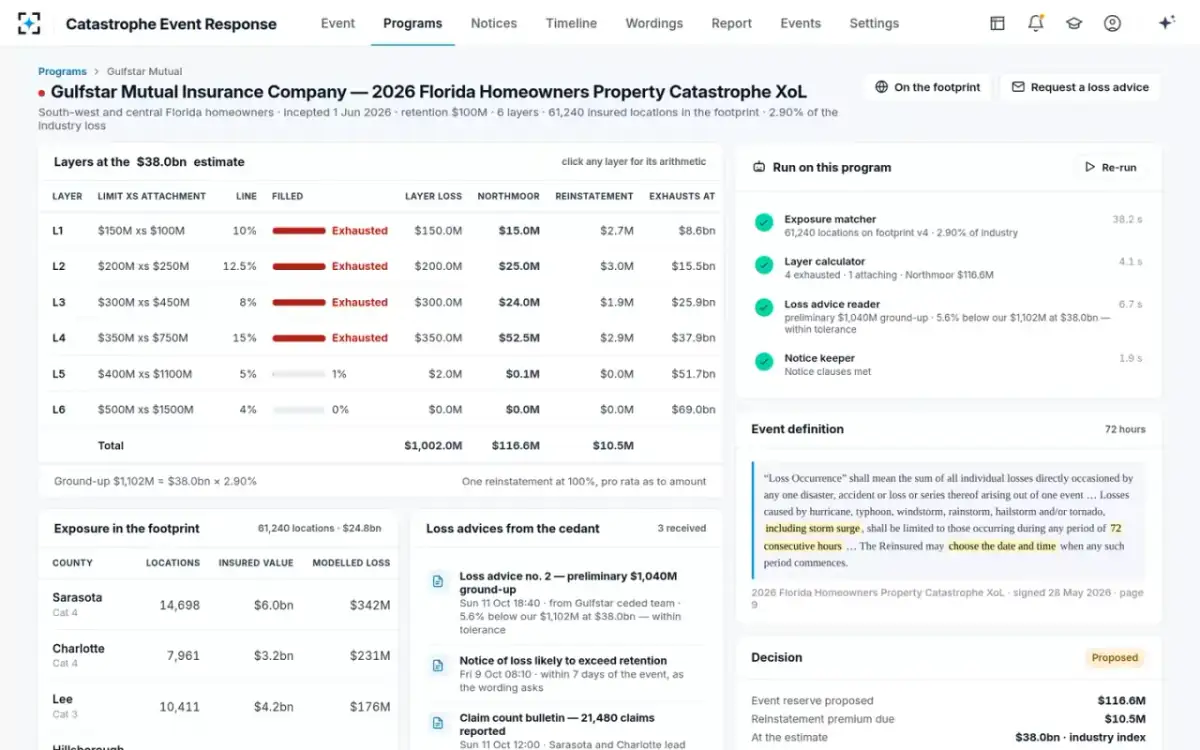
What the statute and contract do not decide is whether the fund's recovery inures to the benefit of a private layer, that is, whether the private reinsurer's layer is measured before or after the fund pays. That is set by each private wording, and it changes what a private layer sees from the same storm. A reinsurer's event arithmetic has to apply it program by program, as it applies each wording's hours clause; a worked example of the private layers alone is in one hurricane through a property catastrophe excess of loss book.
A private Florida program as the reinsurer sees it in Catastrophe Event Response
What happened to the FHCF after Ian and Milton?
After Ian and Milton the fund paid and kept paying. At the end of 2025 its actuaries projected total incurred losses of $8.711 billion for Hurricanes Ian, Idalia, Helene and Milton, of which $7.2 billion was Ian and $1.5 billion Milton, and it performed 16 claims examinations on Ian in 2025 alone. Its historical loss table shows how much of the reported Florida residential losses it paid for each storm.
FHCF paid as a share of reported industry residential losses paid in Florida, by storm
The spread says more about retentions than about storms. Wilma and Irma were large, widespread losses that pushed many insurers deep into the fund's layer. Milton's reported paid losses were $3.4 billion, but by the end of 2025 the fund had paid only $11 million of a projected $1.5 billion, because each insurer's paid losses must exceed its full retention before anything is due. Helene's reported Florida losses of $499 million had produced no fund payment by the end of 2025, against a projected $10 million in all. A reinsurer on a Florida program sees the same pattern from the other side: in a year like 2024, the insurers' own retentions and the private layers beneath the fund carried most of both storms so far.
Who signs what
The fund's reports are the cedant's to sign, and the contract names the level of signature. An officer signs off each interim loss report online; two executive officers sign each proof of loss electronically; a written request for an advance needs two officers. On the reinsurer's side, nothing goes to the fund, but the reinsurer's own notices and loss pick for the same storm need their own signers.
Who signs each report and notice a Florida hurricane sets running
| Report or notice | Who signs | When | Under |
|---|---|---|---|
| FHCF interim loss report (Form FHCF-L1A) | An officer of the insurer, online | At least 14 days after the fund’s notice | Reimbursement contract, Article X |
| FHCF proof of loss (Form FHCF-L1B) | Two executive officers, electronically | By 31 December, then quarterly | Reimbursement contract, Article X |
| Request for an advance | Two officers, in writing | When the insurer needs it | Reimbursement contract, Article X |
| Final proof of loss | The insurer, with its certifying actuary’s opinion | 36 to 60 months after the contract year | Reimbursement contract, Article XI |
| Reinsurer’s notices to retrocessionaires and warranty counterparties | The reinsurance claims manager | On each wording’s clock | The private wordings (sample) |
| Reinsurer’s event loss pick | The chief underwriting officer | Within five business days of landfall (sample) | The reinsurer’s reserving standard (sample) |
The reinsurer's view of the state fund's calendar
A reinsurer on a Florida program does not file anything with the fund, but the fund's calendar shapes what it learns and when. The cedant's interim report to the fund is an early, signed estimate of its ultimate net loss, made on the same claims a reinsurer is waiting to see in a loss advice. The December proof of loss settles which storms are the cedant's two largest for the fund's retention. The quarterly reports that follow are the cedant's best view of development for years after the event.
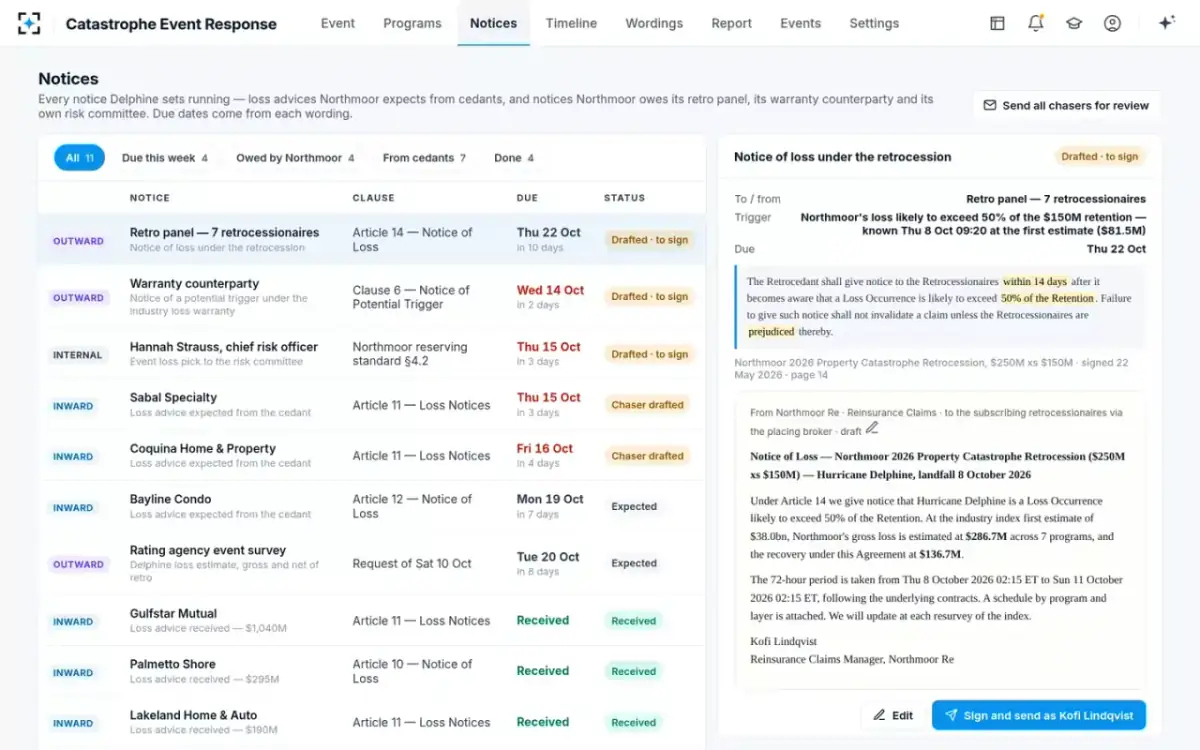
Catastrophe Event Response is built for the reinsurer's side and keeps the reinsurer's own clocks: every inward advice expected under each private wording, every outward notice to retrocessionaires and warranty counterparties, and the internal deadline for the event loss pick, each with its clause and its draft. In the solution's sample event, eleven notices are tracked in the first week, four due within days of each other. A Florida cedant's claims team is meanwhile answering the fund's request for an interim report, the regulator's catastrophe data call and its reinsurers' requests for advices, from the same claim file.
The reinsurer's calendar beside the fund's: every notice and its clause in Catastrophe Event Response
The one figure a reinsurer most needs from that overlap is how each wording treats the fund's recovery, and it is a wording question, not a modelling one. It belongs in the readiness work before the season, alongside each program's hours clause and notice clause; once it is loaded, every re-run of the book applies it. The cost of not having it when the pick is due is set out in the loss pick after a catastrophe.
Questions people ask
How does the Florida Hurricane Catastrophe Fund work?
Every insurer writing residential property in Florida buys a reimbursement contract from the fund each year. The fund collects premium, builds cash and borrows when needed, and after a hurricane reimburses 45%, 75% or 90% of each insurer's losses above its retention, up to a statewide $17 billion a season.
What are the FHCF coverage options?
Insurers elect 45%, 75% or 90% coverage, and the retention multiple rises as the coverage level falls: 200% of the base at 45% and 120% at 75%. The fund reported that the average coverage selected fell to 84.74% for 2025–2026, from 86.87% the year before.
Does private reinsurance reduce what the FHCF pays?
No. The contract says reimbursements are not reduced by reinsurance paid or payable from other sources, and the insurer's ultimate net loss for the fund excludes reinsurance recoveries. How the fund's recovery affects the private layers is set in each private wording.
What is FHCF commutation?
Commutation is the final settlement of all future obligations for an event or a contract year, regardless of later development. It can start between 36 and 60 months after the contract year ends, needs a final proof of loss with an actuary's opinion, and ends the quarterly reporting.
Can the FHCF advance money before losses are paid?
Yes, in three cases the statute names, including to prevent an insurer's insolvency, at market interest rates. A request needs a proof of loss, a detailed claims listing and a written request signed by two officers.