Catastrophe exposure management software, in insurance and reinsurance, holds a company's insured locations and values by peril, zone and contract, adds them up against the limits it has set, and feeds the catastrophe models that estimate what an event could cost. It is a different product from the cybersecurity tools that share the name. After a catastrophe, the same software is asked a harder question: which programs and layers did this event hit, how deep, and which notices are now owed, to the reinsurer by cedants and by it to its retrocessionaires. Catastrophe exposure management tools are built around the first half; the layer arithmetic, each wording's event definition and the notice deadlines often end up in spreadsheets beside them. Botminds' Catastrophe Event Response is an agentic solution for that second half, and this guide is honest about where it stops.
To keep the comparison concrete, it runs one storm through all three approaches: Hurricane Delphine, the solution's fictional Category 4 sample event, against Northmoor Re, a fictional reinsurer with 14 Florida programs and 40 layers. Its names and figures are sample data. The comparison of approaches is ours.
One hurricane, three tools: what each does in the first four days
| The job | Spreadsheets | Exposure platform | Agents, as in Catastrophe Event Response |
|---|---|---|---|
| Read each new estimate and footprint | By hand, when someone sees it | Footprint imported; estimates usually outside it | Checked every 30 minutes; every release versioned |
| Match exposure to the footprint | Per program, on whatever file is to hand | Its core strength: locations overlaid at scale | Overlay on one footprint version; stale files flagged |
| Apply each layer and the retro | Formula by formula, program by program | Varies; often standard terms only, netting done elsewhere | Every layer, line, reinstatement and the retro, arithmetic shown |
| Apply each wording’s event definition | If someone remembers which programs differ | Varies; wordings are usually held as documents | Read from each signed wording; the wording wins |
| Reconcile cedant loss advices | Emails matched by hand | Usually outside the platform | Each advice matched to its program and window; gaps over 10% explained |
| Track notices owed in and out | A calendar, if kept | Usually outside the platform | Every clock read from its clause; the notice drafted, never sent |
| Write the management report | Rebuilt for each new number | Exports to build it from | Rebuilt on each estimate, every figure cited, signed by the CUO |
What is exposure management software in insurance?
In insurance, exposure management software is the system that knows what the company has written, where, against which perils and on which terms, and how much of it one event could take. It keeps the location schedule, the values and the contract terms, groups them into zones, and passes them to catastrophe models. The NAIC's catastrophe modelling primer describes the part of a model that depends on it: the exposure module "also includes information about insurance policy terms and conditions, such as deductibles, limits, and any applicable reinsurance."
For a reinsurer the input is other companies' data. Exposure arrives as cedants' renewal submissions and is refreshed, where the treaty allows, by bordereaux during the year. Exposure management at a reinsurer is therefore as much about knowing which cedant files are current, and how well each is geocoded, as about the platform holding them. A strong platform on stale files gives a confident wrong answer.
The word causes real confusion in search. In cybersecurity, exposure management means finding and reducing a company's attack surface, and much of what appears under "exposure management software" is about that. Catastrophe exposure management is a different discipline with different buyers, and the rest of this page is about it.
What does exposure management software do before and after an event?
Before an event, exposure management software answers what could happen: accumulations by zone, modelled losses at chosen return periods, and how much reinsurance the company needs. After an event it is asked what did happen, and that question needs things the pre-event system rarely holds: the event's footprint versions, the stream of industry estimates, each treaty's wording and the cedants' loss advices.
The before-event work is what regulators test. Florida's Office of Insurance Regulation runs a catastrophe stress test on insurers' reinsurance programs each season, built on the insurers' own modelling information, and the results show what the structure in an exposure system is for. In the 2025 test, a hypothetical season of three historic hurricanes, Charley, Dora and the 1947 Fort Lauderdale storm, "would have caused approximately $39.9 billion in insured losses"; after reinsurance, net losses to insurers were projected at about $12.7 billion.
What reinsurance did to three modelled Florida seasons in the regulator's 2025 stress test
$39.9bn
gross, scenario 1: Charley, Dora, Fort Lauderdale 1947
$12.7bn net of reinsurance
$78.1bn
gross, scenario 2: Lake Okeechobee 1928, Michael, Wilma
$18.4bn net
$74.6bn
gross, scenario 3: Andrew, Frances, Donna
$21.2bn net
Those net figures are exactly what a reinsurer has to produce in reverse after a real storm: the gross loss coming through its cedants' programs and the share that lands on its own layers. The same regulator also collects, in the fourth stage of its annual reinsurance data call, data on the impact of storms on insurers' reinsurance contracts. The post-event view is part of the supervisory picture, not only the reinsurer's.
Is exposure management the same as cat modelling?
No. Exposure management is about knowing and controlling what the company holds; catastrophe modelling is about simulating what events would do to it. A model has a hazard part, a vulnerability part, an exposure part and a financial part, and exposure management owns the exposure part and the quality of what goes into it. The two teams sit together because each is useless without the other.
The distinction matters when buying software. A catastrophe model will produce an event loss table and a probable maximum loss, but it does not track which cedant has sent a loss advice. An exposure platform will show accumulations and overlay a footprint, but it is not built to read a treaty's hours clause. The Property & Auto Claims guide to catastrophe modeling software sets out what models do and what free tools exist; the primary-insurer side of exposure management, stopping new business where a storm threatens, is covered in property catastrophe exposure management software for binding restrictions.
What is accumulation management in insurance?
Accumulation management is the control of how much insured value, and modelled loss, a company holds in any area or event that could be hit at once, measured against limits set by its risk appetite. For a primary insurer the accumulation is its own policies; for a reinsurer it is the sum of its lines across every cedant program exposed to the same peril in the same place.
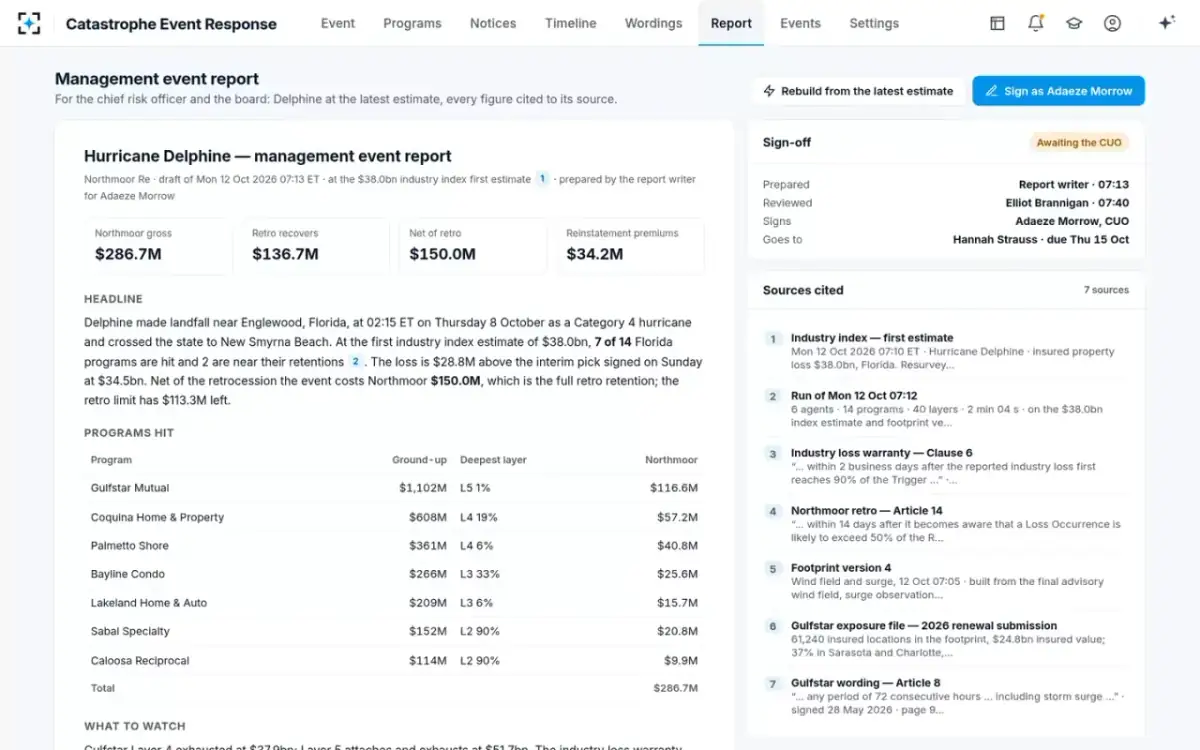
A reinsurer's accumulation is easy to underestimate, because each program looks modest on its own. One storm in the sample event hit seven of Northmoor's 14 Florida programs and brought two more near their retentions; at the industry index's $38.0 billion the reinsurer's gross across them was $286.7 million, almost twice its $150 million retrocession retention. The programs were written separately, by different underwriters, at different times. The accumulation only existed in the footprint.
That is the practical difference between accumulation before and after an event. Before, it is a modelled number against a limit. After, it is a real number that has to be split back into programs and layers, netted against the retrocession, and explained to a risk committee within days.
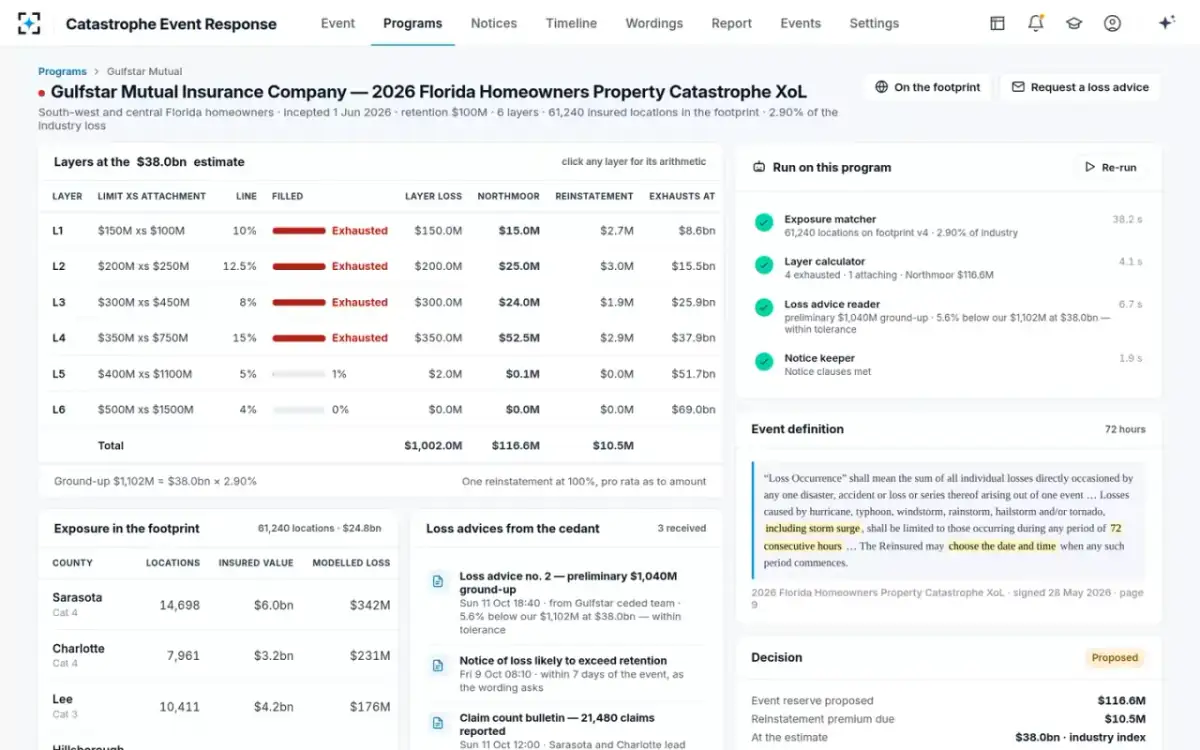
One cedant's tower in Catastrophe Event Response: layers, exposure by county, advices and the event definition
Day two is where the tools part company
The three approaches differ least on day one, when the job is to overlay a footprint, and most on day two, when cedant advices, wordings and notice clocks arrive. A good exposure platform does the overlay well. What it is not built to do is read a cedant's email advice, know that one program's wording allows 96 hours instead of 72, or remember that a warranty notice falls due two business days after the index crosses 90% of its trigger.
Day two of the sample event: an exposure platform beside the agents in Catastrophe Event Response
Exposure platform plus spreadsheets: Arrive by email; matched to programs by hand and compared with the model when time allows.
Agents in Catastrophe Event Response: Read on arrival, matched to program and event window, and compared; Gulfstar’s $1,040M flagged as 5.6% below the model.
Exposure platform plus spreadsheets: One default window applied; exceptions found when a cedant points them out.
Agents in Catastrophe Event Response: Each wording’s window applied; Palmetto Shore’s 96 hours from Wed 22:00 takes in the Brevard tornadoes.
Exposure platform plus spreadsheets: Deadlines worked out from the wordings by the claims team, one by one.
Agents in Catastrophe Event Response: Eleven notices tracked from their clauses, four due that week, each drafted for a signature.
Exposure platform plus spreadsheets: Another night re-pricing the book.
Agents in Catastrophe Event Response: Every program and layer re-priced in about two minutes, on one footprint version.
A new estimate is the moment the difference is easiest to see. With the arithmetic automated, the book is re-priced in the time it takes to read the release; the minute-by-minute version of that run, from a new industry figure to a reviewed report, is traced in event loss estimates: what agents do in the first two hours.
"A late notice can cost us the recovery."
Kofi Lindqvist, reinsurance claims manager at the fictional sample reinsurer
Can software read loss advices?
Yes, with limits. A loss advice is a document or email from a cedant giving its estimated or paid loss for an event, often with a claim count; software can read it, match it to the right program and event window, and compare it with the model. What it should not do is decide whether the cedant is right. That judgement belongs to the claims manager and, where the gap is large, to a conversation with the cedant.
The sample event shows why the comparison is worth automating. Gulfstar's preliminary advice of $1,040 million ran 5.6% below the model, inside the 10% tolerance the reinsurer sets. Palmetto Shore's first advice, $295 million, came 18% below the estimate before surge was added to the footprint. Caloosa Reciprocal's $98 million was 14% below, with surge claims in Lee County still opening. Each gap has a different meaning, and the advice reader's job is to put the reason beside the number, not to change either.
Reading documents is also where software that uses AI meets supervisors' expectations for models, data and human oversight. What the NAIC, Florida's model commission and EIOPA already ask of catastrophe models, and how an AI tool is judged against that bar, is set out in AI catastrophe modeling and what supervisors expect.
The limit is accuracy. In EIOPA's 2026 survey of generative AI among European insurers, hallucinations, meaning inaccurate outputs, were the risk insurers cited most often. The safeguard in the solution is structural: the advice reader never edits a cedant figure, flags an advice that belongs to a different event window, and shows the passage it read, so a person can check it in seconds.
Where Catastrophe Event Response fits, and where it does not
Catastrophe Event Response fits after the event, between the exposure platform and the people who sign. It does not replace a catastrophe model, an exposure platform's accumulation and pricing work, or the reinsurer's claims and accounting systems. It reads what they produce, together with the published estimates, the cedants' files and advices and the signed wordings, and turns them into a loss by program and layer, a notice tracker and a cited report.
It also has edges a buyer should know. It works from published estimates and from the reinsurer's own footprint run; it does not produce an independent hazard model. Its event definitions and notice clocks are only as complete as the wordings loaded before the season. And its figures are proposals: the agents never book a reserve, send a notice or sign a report. The fastest way to test the fit is the one the solution page offers, running it on a past event against the company's own programs and layers, which is also how the inputs a reinsurer needs are found. Those inputs, with an owner for each, are listed in what to have ready for an exposure management platform before June.
The output a buyer should judge: the cited management event report
Build, buy or extend: three ways reinsurers close the day-two gap
Reinsurers close the gap between their exposure platform and the work of the week after a storm in one of three ways, and the right one depends on how many programs they write, how many wordings depart from their standard, and how often a season brings more than one event. None of the three replaces the exposure platform.
The first is to extend: spreadsheets and scripts around the platform, owned by the catastrophe team. It is cheap and flexible, and it is how most teams start. Its weakness is that it lives in a few people's heads; the hours clause exceptions, the notice clocks and the netting logic are rebuilt each event by whoever is on the desk, and the version trail a committee will ask for is reconstructed afterwards.
The second is to build: an in-house event module, usually on the company's data platform. It gives full control and fits the company's own contracts, and it suits a large reinsurer with the engineers to maintain it. Its cost is the maintenance, because the inputs change every season: new wordings, new cedant file layouts, new estimate sources. The third is to adopt agents for the reading and the arithmetic, with people kept on every signature. It is the fastest to a first loss view and the most dependent on preparation, since agents can only apply wordings that have been loaded and read before the storm.
A useful test for which route fits is the last event. Count the hours between each industry release and a re-priced book, the notices whose deadline was worked out by hand, and the advices that sat unread for a day. If those numbers are small, extending the platform is enough. If the sample team's description, a night of re-pricing for every new estimate, sounds familiar, the gap is worth closing properly.
What to ask in a demo of catastrophe exposure management software
Ask to see your own last event, not the vendor's. The questions below separate tools that model well from tools that also carry the work of the week after a storm.
Questions for any catastrophe exposure management or event response tool
- Show one layer’s loss with every input named
The estimate release, the footprint version, the exposure file and date, and the clause applied.
- Re-run the whole book on a new estimate, while we watch
And show what changed: which layers crossed attachment or exhaustion, and what the retro now recovers.
- Apply a non-standard hours clause
A 96-hour window with a reinsured-chosen start should change which losses fall in the event.
- Read a real cedant advice from an email
Match it to the program and window, compare it with the model, and show the passage it relied on.
- List every notice the event triggered, with its clause
Inward advices expected and outward notices owed, each with a due date and who signs it.
- Replay an earlier estimate
A committee will ask why the pick moved; the tool should show the book at any earlier release.
- Show what the software is not allowed to do
Whether it can book a reserve, send a notice or change a cedant figure, and who decides.
Questions people ask
Is exposure management the same as vulnerability management?
Not in insurance. In cybersecurity the two are related terms for finding and fixing weaknesses in a company's systems. In insurance, exposure management means catastrophe exposure, and vulnerability is the part of a catastrophe model that turns hazard into damage for a given type of building.
How do reinsurers manage catastrophe exposure?
They hold each cedant's location and value data by peril and zone, add their lines up across programs against appetite limits, model the result, and buy retrocession for what they do not want to keep. After an event they split the real loss back into programs and layers and net it against that retrocession.
Do I need exposure management software if I already have a catastrophe model?
Usually yes, because the model needs clean, current exposure and the terms of each contract, and someone has to own them. After an event the gap is wider: the model does not track advices, wordings or notices.
Is there free catastrophe exposure management software?
Free tools exist for hazard and loss modelling; FEMA's Hazus is the best known, and the Property & Auto Claims guide to catastrophe modeling software describes it. We know of no free tool for treaty-level event response, which needs a company's own wordings and cedant files.
How long does it take to set up event response software?
It depends on the inputs more than the software: loading and reading the wordings, refreshing cedant exposure and naming signers. Running it on a past event against your own programs is the quickest test of both.