Property catastrophe excess of loss is reinsurance that pays an insurer's losses from one catastrophic event above a retention and up to a limit, usually in a tower of separate layers, each placed with its own reinsurers at its own price. It protects the insurer's net position against an accumulation of claims from one storm, earthquake or fire, and it decides how a footprint becomes a loss for each reinsurer on the program. The hard part is that the event has to be defined before it can be paid: which losses belong to one occurrence under the treaty's hours clause, how far each layer is filled, what it costs to reinstate the limit, and which notices fall due on the way. Botminds' Catastrophe Event Response is an agentic solution that does that work for a reinsurer's whole book after each event, and this page follows one storm through it by hand so the mechanics are visible.
The storm, the companies and every figure in this worked example are invented for illustration: Hurricane Ottilie, a Category 3 storm that makes landfall on Florida's Big Bend coast early on a Monday; Halyard Re, a reinsurer with lines on Florida programs; and three cedants, Coralwood Mutual, Driftline Home and Pinebarren Insurance. The arithmetic is ours. The screens are the solution's own sample event, on its own fictional storm.
Ten days of Hurricane Ottilie, in three lanes: the storm, the estimates, the reinsurer
- Watch and approachSat to Mon
- Landfall, inland track, tornadoesMon to Thu
- Claims emergeto day 10
- No figure yetto Mon noon
- $11.5bnMon
- $15.0bnWed
- Industry index $16.0bnFri
- Own footprintSat
- Book re-priced on each estimateMon to Fri
- Pick signed Sat; advices, hours check, revisionsto day 10
What is property catastrophe excess of loss?
Property catastrophe excess of loss, often shortened to cat XL or cat XoL, is a per-occurrence treaty: the reinsurer pays the part of the cedant's losses from one catastrophe that falls between an attachment point and the top of its layer, after the cedant's retention. Gary Patrik's chapter in the Casualty Actuarial Society's textbook puts it in a sentence: "A catastrophe cover is a per-occurrence treaty used for property exposure. It is used to protect the net position of the cedant against the accumulation of claims arising from one or more large events."
It differs from per-risk excess of loss in what it adds up. In David Clark's study note for the same body, a per-risk layer "applies on a "per risk" basis, which typically refers to a single property location. This is narrower than a "per occurrence" property excess treaty which applies to multiple risks to provide catastrophe protection." A cat XL does not care how large any single claim is; it cares how many claims one event produced, and when each one first occurred.
It also responds to the cedant's net, not its gross. Other reinsurance typically inures to its benefit, so per-risk treaties, quota shares and facultative certificates come off first, and the cat XL sees what is left. In Florida the state hurricane fund's layer sits in the same picture; how it relates to private layers depends on each wording, and is set out in the FHCF reimbursement contract guide. It is left out of the arithmetic below.
How many layers does a cat program have?
A property catastrophe program is split into layers so that each has a different likelihood of being reached and can be priced and placed separately. Lower layers are hit often and cost more per dollar of limit; upper layers are hit rarely and cost less. Patrik's worked example program has four catastrophe layers, each placed as 95% of the layer, with the cedant keeping the other 5%.
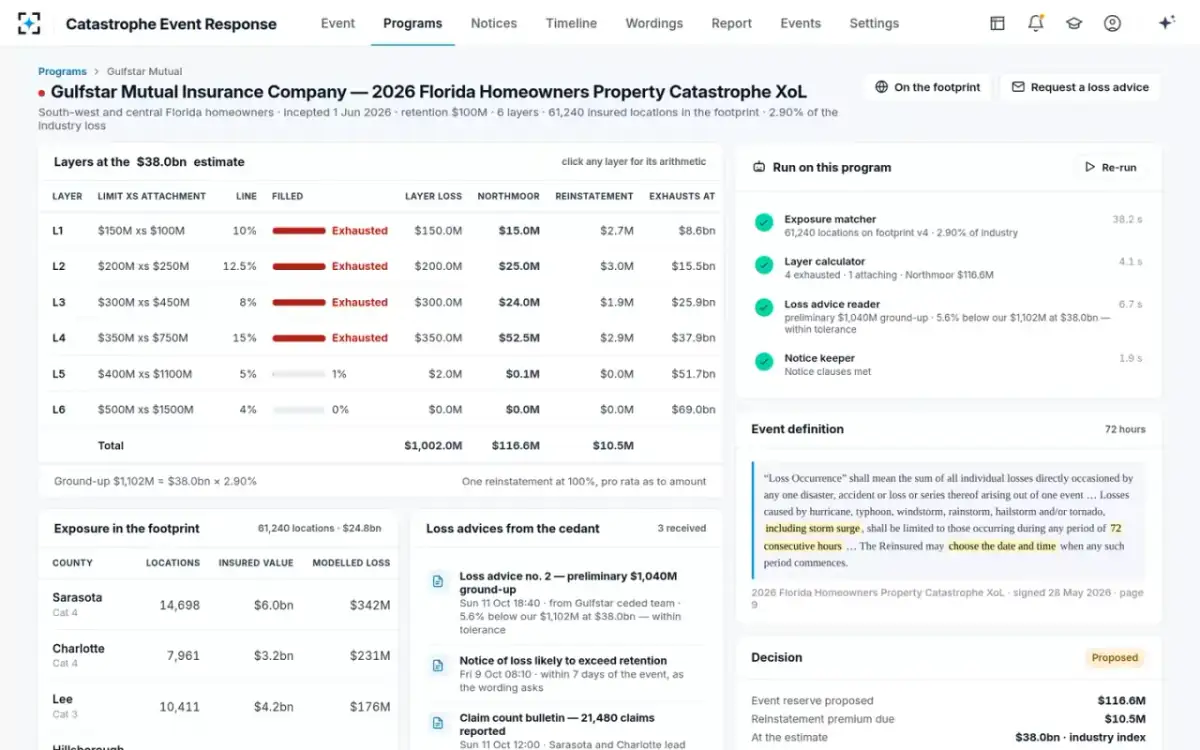
Coralwood Mutual's program in this example has four layers above a $50 million retention, $550 million in all, and Halyard Re takes a different line on each. The solution's own sample program, Gulfstar Mutual, has six above $100 million. The table shows Coralwood's tower and what Ottilie did to it at the industry index estimate, once the hours clause had been applied.
Coralwood Mutual's tower at the $16.0bn index estimate: Ottilie's main occurrence of $405M
| Layer | Limit xs attachment | Halyard line | Rate on line | Loss to the layer | Halyard’s share |
|---|---|---|---|---|---|
| Layer 1 | $50M xs $50M | 20% | 18.0% | $50M, exhausted | $10.0M |
| Layer 2 | $100M xs $100M | 15% | 11.0% | $100M, exhausted | $15.0M |
| Layer 3 | $150M xs $200M | 10% | 6.5% | $150M, exhausted | $15.0M |
| Layer 4 | $200M xs $350M | 5% | 3.5% | $55M, 27.5% filled | $2.75M |
| Total | $500M above a $50M retention | per layer | — | $355M | $42.75M |
Day 0 to day 10: Hurricane Ottilie through one book
Halyard Re opened the event on the Saturday, when the National Hurricane Center put the Big Bend coast under a hurricane watch. Its own footprint, built from the forecast track and wind field, put 5 of its 11 Florida programs in the cone, and the exposure analyst confirmed which cedant files were current. No industry figure existed yet, so for two days the reinsurer's own footprint was the only number in the room.
Ottilie made landfall near Cedar Key at 03:40 on Monday as a Category 3 storm, crossed north-central Florida as a weakening hurricane, and left the state near Jacksonville on Wednesday. Its remnants spun up tornadoes in northeast Florida on Thursday. A Category describes wind alone; the National Hurricane Center says its scale "does not take into account other potentially deadly hazards such as storm surge, rainfall flooding, and tornadoes." For Coralwood, whose book runs from the Big Bend coast to Jacksonville, tornado losses alone came to $45 million.
The estimates came in three steps. A modeller published a range with a midpoint of $11.5 billion on Monday afternoon; a second range on Wednesday, after surge was added to its footprint, had a midpoint of $15.0 billion; and the industry index published $16.0 billion on Friday. Coralwood's exposure in the footprint made it 2.78% of the industry loss, so its ground-up estimate moved from $320 million to $417 million to $445 million. Halyard re-priced its book on each. How that re-pricing runs in minutes rather than nights is traced in event loss estimates: what agents do in the first two hours.
Coralwood gave notice on Tuesday that its loss was likely to exceed half its retention, inside its wording's seven days. Its preliminary loss advice came on day six, at $430 million ground-up, 3% below Halyard's $445 million. On day ten it revised the advice to $445 million as tornado claims were counted, dated each block of claims by when the losses first occurred, and told Halyard which 72-hour window it had chosen.
How does a cat XL respond to a hurricane?
A cat XL responds to a hurricane by taking the cedant's net losses that belong to one occurrence, deducting the retention, and filling each layer in turn from the bottom until the loss runs out. The reinsurer's share of each layer is its line on it. What makes the response hard is not the subtraction but the first step: deciding which losses belong to the occurrence.
Halyard signed its pick on day five on the working assumption that Ottilie was one occurrence for Coralwood: $445 million ground-up, Layer 4 at 47.5%, and $44.75 million for Halyard. Once the hours were settled on day ten, Coralwood's main occurrence was $405 million. After its $50 million retention, $355 million went into the tower: Layers 1, 2 and 3 were exhausted at $50 million, $100 million and $150 million, and Layer 4 took $55 million of its $200 million, 27.5% filled. Halyard's lines of 20%, 15%, 10% and 5% gave it $42.75 million on the program.
Across Halyard's book the picture was smaller but not simple. Driftline Home, with a $40 million retention, had a $120 million loss: its first layer, $40 million excess of $40 million, was exhausted and its second, $60 million excess of $80 million, two-thirds filled, giving Halyard $8.0 million on its 10% lines. Pinebarren Insurance's $28 million loss stayed below its $35 million retention. After the hours check Halyard's gross was $50.75 million, down $2.0 million from the day-five pick; its own $30 million excess of $30 million retrocession recovered $20.75 million, and its net was the full $30 million retro retention on both days.
The hours clause decides how many retentions
The hours clause decides how many retentions a cedant bears, because each separate loss occurrence carries its own. Coralwood's wording follows the common form, the one the English Court of Appeal construed in Unipol v Covéa in 2024: a loss occurrence is every individual loss arising directly from one catastrophe (the clause is quoted and read in the guide to the hours clause). It then limits one occurrence to 72 consecutive hours for windstorm and lets the reinsured choose when they start, as long as they do not start before the first loss. The court held, in a COVID business interruption case under a property catastrophe treaty, that what is aggregated is losses that first occur inside the window, even if they keep developing after it.
Ottilie's losses to Coralwood did not fit in 72 hours. Its claims, dated by when each loss first occurred, fell into four blocks: $40 million in the first eight hours from the outer bands and early surge; $270 million over the next 22 hours from the landfall core; $90 million inland over the following 30 hours; and $45 million from the remnant tornadoes, 74 to 80 hours after the first loss. Two windows were possible.
Two ways Coralwood could place its 72-hour window, and what each does
| Window | Losses inside it | Losses outside it | Into the tower | Coralwood keeps |
|---|---|---|---|---|
| A: hours 0 to 72, from the first loss | $400M: early bands, landfall core, inland | $45M of tornado losses, a second occurrence below the $50M retention | $350M | $95M |
| B: hours 8 to 80, the choice Coralwood made | $405M: landfall core, inland, tornadoes | $40M of early losses, a second occurrence below the retention | $355M | $90M |
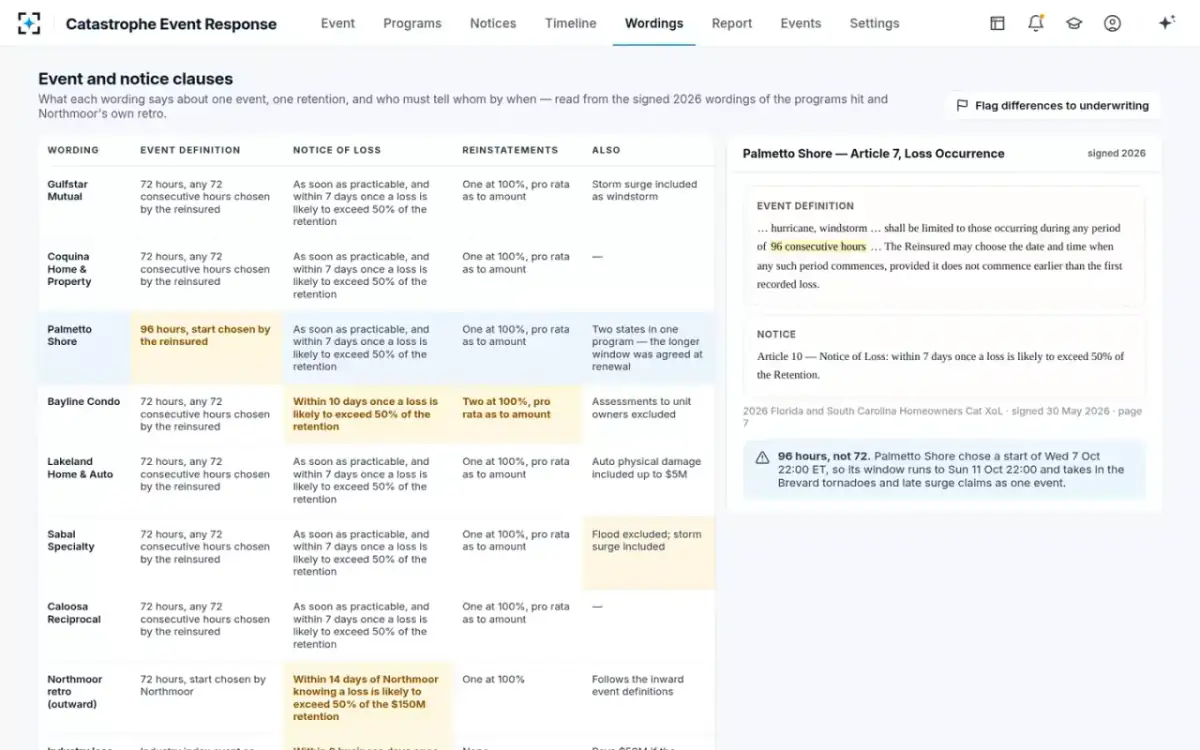
Window B was worth $5 million to Coralwood and a quarter of a million to Halyard. The reinsurer's job was not to argue for A but to check that the losses inside B were dated by first occurrence and arose from Ottilie. That check needs claim dates, not the advice total, which is why it came on day ten and not day six. A reinsurer that applies a house default of 72 hours from the first loss to every program will be wrong wherever a cedant chooses differently, and every wording that allows a different window, such as the 96-hour program in the solution's sample book, multiplies the cases.
In Catastrophe Event Response, each program's event definition comes from its own wording
What is a reinstatement after a catastrophe?
A reinstatement restores a layer's limit after an event has used it, so the cedant has cover again for the next event, in exchange for an additional premium. Catastrophe layers commonly carry one or two, and the premium is often charged pro rata as to amount: in proportion to the share of the limit used. Clark's study note gives the formula with a worked case, a $10 million layer with $2 million of annual premium and a 110% reinstatement, where a $4.5 million loss costs $990,000: the annual premium, times 110%, times the 45% of the limit used (Clark, CAS; how to calculate reinstatement premium works this case and two more).
Reinstatement premium on Coralwood's Layer 4, worked the same way
Layer premium
3.5% × $200M = $7.0M
Rate on line times the limit: what the layer costs for the year, at 100%.
Share of limit used
$55M ÷ $200M = 27.5%
Pro rata as to amount: the premium follows the part of the limit the event took.
Reinstatement at 100%
$7.0M × 100% × 27.5% = $1.925M
Due from Coralwood to all reinsurers on the layer.
Halyard’s share
5% × $1.925M ≈ $0.10M
Across all four layers, Halyard is owed about $4.5M of reinstatement premium.
Two points from the same study note matter after a hurricane. The first is the ceiling: "The treaty effectively has an aggregate limit equal to one plus the number of reinstatements, times the occurrence limit." Coralwood's three exhausted layers, each with one reinstatement, now have one full limit left for the rest of the year; a second storm that reaches them would exhaust them for good. The second is timing: the note observes that because hurricanes are seasonal, few catastrophe contracts charge reinstatements pro rata as to time (pro rata reinstatement premium sets out both methods). A layer reinstated in September costs the same as one reinstated in June.
Reinstatement premium is also an accounting event. It is booked in the period of the loss, so a reinsurer that closes a quarter on an early estimate books the wrong premium as well as the wrong loss. What each day of waiting for a settled pick costs is priced in the loss pick after a catastrophe.
When do loss advices arrive?
Loss advices arrive on the clocks the wordings set, and the first one is usually a notice rather than a number. Most of the solution's sample wordings, like Coralwood's, ask the cedant to give notice as soon as practicable and within seven days once a loss is likely to exceed half the retention; one sample wording allows ten days. The preliminary advice with a figure follows, and revised advices come as claims are adjusted.
In this example the notice came on day one, the first figure on day six and the revision on day ten. Each step narrowed the gap between model and claims: against Halyard's modelled $445 million, the preliminary $430 million was 3% low, and the revised advice, with the tornado claims counted, matched it. Driftline's advice on day eight came in 9% under the model, and Pinebarren's confirmed it stayed below its retention.
Advices also run upward through the reinsurer's own contracts. Halyard's retrocession needed notice once its loss was likely to exceed half its $30 million retention, which happened on the Monday afternoon at the first modeller estimate. Florida cedants, meanwhile, owe the state hurricane fund an interim loss report when the fund asks, due at least 14 days after its notice (FHCF 2026 contract). A cedant's claims team is answering several calendars at once in the same fortnight.
How is a layer exhausted?
A layer is exhausted when the loss to it reaches its limit; for a reinsurer pricing on a share of an industry estimate, that happens at a predictable industry figure. Divide the top of the layer by the cedant's share of the industry loss that falls in the occurrence, and the result is the industry number at which the layer is full. Coralwood's Layer 3 tops out at $350 million; once the hours were settled, its occurrence was 2.53% of the industry loss, so Layer 3 is full once the industry passes about $13.8 billion.
Coralwood's layers by fill at the $16.0bn index estimate, with the industry figure that exhausts each
The exhaustion points tell the underwriter what to say when a cedant calls, and the hours clause moves them. Asked on Wednesday whether Layer 4 was in play, Halyard, still treating Ottilie as one occurrence at Coralwood's full 2.78% share, could answer with a number: Layer 4 attaches at about $12.6 billion and is full at about $19.8 billion. Once $40 million of early losses fell outside the chosen window, those points moved up to about $13.8 billion and $21.7 billion. The solution shows each program's points as lines across the estimate chart, and redraws them when the event definition changes.
The same view in Catastrophe Event Response: a tower's fill, exhaustion points and the event definition
What the ten days teach
Three lessons from Ottilie apply to any property catastrophe excess of loss book. The first is that the event definition, not the estimate, was the most consequential judgement of the fortnight: it moved $5 million between cedant and reinsurers and could not be settled until claims were dated. The second is that layers amplify movement in the industry figure: a 39% rise from the first modeller midpoint to the index took Coralwood's main occurrence from just past the middle of Layer 3 to a quarter of the way into Layer 4. The third is that most of the work was waiting on inputs, not doing arithmetic.
A cat XL is simple arithmetic on a hard definition. The arithmetic can be done in minutes; the definition has to be read before the storm.
That is the division of labour Catastrophe Event Response is built on. Its agents re-price every layer on each estimate, read each program's event definition and notice clause from the signed wording, compare advices with the model and keep the clocks; the reinsurer's people check the hours allocation, sign the pick and send the notices. What a reinsurer needs to load before the season for that to work is listed in what to have ready for an exposure management platform before June.
Questions people ask
What is a reinsurance tower?
A reinsurance tower is the stack of layers in one program, drawn from the retention at the bottom to the top of the last layer. Each layer is a separate contract with its own reinsurers and price, so a tower can have different panels at different heights.
Can the cedant choose when the 72 hours start?
Under many wordings, yes: the clause before the Court of Appeal in Unipol v Covéa let the reinsured choose the date and time a period of consecutive hours starts. Wordings often add limits, such as not starting before the first loss.
What happens when a layer has no reinstatements left?
It is exhausted for the rest of the contract term. Clark's study note puts the total a layer can pay in a year at one plus the number of reinstatements, times the occurrence limit; once that is used, a further event above the attachment is the cedant's.
Does the hurricane's category decide the reinsurance loss?
No. The Saffir-Simpson category rates maximum sustained wind only and leaves out surge, rainfall flooding and tornadoes, while a cat XL pays covered losses from all perils its wording includes in the occurrence.
Is a catastrophe excess of loss the same as a stop loss?
No. A cat XL responds to losses from one occurrence; a stop loss responds to the cedant's total losses, or loss ratio, over a period from all causes. A bad season of several storms can leave a cat XL untouched by any single one while a stop loss pays.