A loss pick is the estimate of ultimate loss a company selects and commits to for a period, a program or a single event. After a catastrophe, a reinsurer's event loss pick is the figure its chief underwriting officer signs for what the event will cost: the loss to each program and layer, the recovery from its own retrocession, the reinstatement premiums it is owed, and the net. Everything downstream waits on that signature, from the event reserve and the quarter's accounts to the notices owed to retrocessionaires and the risk committee's view of appetite. A pick that arrives a week late is a week of decisions taken without it. Botminds' Catastrophe Event Response is an agentic solution that proposes the event loss pick on every new industry estimate, with the arithmetic open, and puts it in front of the people who sign.
The worked example on this page is the solution's sample event: Hurricane Delphine, a fictional Category 4 storm that made landfall in Florida at 02:15 on Thursday 8 October, as it runs through Northmoor Re, a fictional reinsurer. Names, timestamps and figures from it are sample data, not a customer result.
Landfall to a signed loss pick in the sample event, against the reinsurer's own five-day rule
- Five releases from Thu 09:20, book re-priced on eachThu to Sun 19:05
- Interim pick, then the index and a re-runSun to Mon
- Margin before the deadlineto Thu 15
- Thu 8 Oct to Thu 15 Oct7 calendar days
What is a loss pick after a catastrophe?
After a catastrophe, a loss pick means the event loss pick: the reinsurer's committed estimate of what one event will cost it, chosen from several estimates and ranges and signed by an executive. In underwriting the same words mean the expected loss selected to price an account from its loss runs, which is covered in the guide to how a loss pick is built from loss runs. The event loss pick has four parts.
The first is gross: the loss to the reinsurer's line on every layer of every program the event reaches. The second is the recovery from its own retrocession, which depends on the gross crossing the retro's retention. The third is reinstatement premium, which the reinsurer is owed when it restores the limits the event used up. The fourth is the net. In the sample event, at the industry index's $38.0 billion, those were $286.7 million gross, $136.7 million recovered from a $250 million excess of $150 million retrocession, $150.0 million net, and $34.2 million of reinstatement premiums due to Northmoor.
A pick is not a reserve, but it becomes one. The event reserve is booked on the pick, so the signature on the pick is the decision that moves the balance sheet. That is why it belongs to an executive, and why the agents in the solution are limited to proposing it.
How is a loss pick calculated after a catastrophe?
A reinsurer calculates an event loss pick by estimating each cedant's ground-up loss, applying every layer's terms, adding up its own share, and netting off its retrocession. The ground-up loss comes from a share of an industry estimate or from the reinsurer's own footprint run; the terms come from each signed wording, including its event definition. Then the cedants' loss advices replace modelled numbers as they arrive.
The sample event loss pick at $38.0bn, built up in five steps
| Step | What is done | Sample result |
|---|---|---|
| 1. Ground-up by cedant | Each cedant’s share of the industry estimate, from its exposure in the footprint | Gulfstar Mutual 2.90% of $38.0bn = $1,102M |
| 2. Loss to each layer | Retention, limit and event definition applied, layer by layer | Gulfstar Layers 1 to 4 exhausted, Layer 5 at 1% |
| 3. The reinsurer’s share | Its line on each layer, summed across 14 programs and 40 layers | $286.7M gross |
| 4. Retrocession | The outward cover applied to the gross | $136.7M recovered; $150.0M net |
| 5. Reinstatement premium | Premium to restore each limit used, at the wording’s terms | $34.2M due to the reinsurer |
The calculation is quick once automated; the time goes into knowing which inputs to trust. Which industry estimate should lead is a choice the second line should be able to test, as set out in industry loss estimates and the CRO's questions. The minute-by-minute run that produced the sample pick is traced in event loss estimates: the first two hours.
What waits on the pick
Five things wait on a signed event loss pick: the event reserve, reinstatement premium in the accounts, the retrocession recovery, the notices that depend on the size of the loss, and the risk committee's view of appetite. Each has its own clock, and most of them started at landfall, not when the pick was signed.
The clocks that run beside the pick in the sample event, in days
The retrocession notice shows why the pick and the notice are tied. Northmoor's retro wording requires notice within 14 days after it becomes aware that a loss occurrence is likely to exceed 50% of its $150 million retention. That awareness came at 09:20 on landfall day, when the first published figure put Northmoor's loss at $81.5 million, so the notice fell due on Thursday 22 October whatever the state of the pick. A team that waits for a settled number before thinking about notices is already late on this one.
The warranty is shorter. The sample's $50 million industry loss warranty asks for notice within two business days once the reported index reaches 90% of its $40 billion trigger. The index's first estimate of $38.0 billion was 95%, so the notice was due on Wednesday 14 October, two days after the number arrived.
The collateral clock for catastrophe recoverables
For a certified reinsurer, the most specific regulatory clock after a catastrophe is a one-year deferral of collateral on catastrophe recoverables, and it starts with the cedant's first reserve, not the reinsurer's. The NAIC's credit for reinsurance model regulation, which states enact in their own versions, says that "In order to facilitate the prompt payment of claims, a certified reinsurer shall not be required to post security for catastrophe recoverables for a period of one year from the date of the first instance of a liability reserve entry by the ceding company as a result of a loss from a catastrophic occurrence as recognized by the commissioner."
The deferral covers recoverables on fire, allied lines, farmowners, homeowners, commercial multiple peril, inland marine, earthquake and auto physical damage, the lines a hurricane fills. It comes with a condition in the next sentence of the same section: "The one year deferral period is contingent upon the certified reinsurer continuing to pay claims in a timely manner."
The clock is set by the cedant, so a reinsurer that is slow to settle its own view has less of the year than it thinks. Florida cedants, for their part, must give the Office of Insurance Regulation an event estimate gross of reinsurance, their projected net retention and the amount covered by reinsurance, based on their reinsurance chart (Form CRF-26A). Their reserves move on that view, and the reinsurer's year starts with the first of them.
Reinstatement premium is booked when the loss occurs
Reinstatement premium follows the loss into the period in which it occurs, so a late pick misstates the quarter on both sides of the treaty. The NAIC's issue paper behind the statutory rule, carried into SSAP No. 62R, says a liability for additional premium triggered by a loss "shall be recognized by the ceding company during the accounting period in which the loss event(s) giving rise to the obligation to pay such additional premium occur(s)." The cedant books the cost; the reinsurer books the income.
In the sample event that income is $34.2 million owed to Northmoor across the programs hit, and $10.5 million of it comes from one cedant, Gulfstar Mutual. Every layer the industry estimate pushes into or through changes the figure. A reinsurer that closes the fourth quarter on an interim pick books the wrong reinstatement premium as well as the wrong loss, and so does each cedant that relied on its numbers. How a reinstatement is priced, pro rata as to amount, is worked through in one hurricane through a property catastrophe excess of loss book.
The four costs of a late event loss pick, priced on the sample event
Recoveries at risk
retro recovery + warranty payout
$136.7M from the retrocession and a $50M warranty if its trigger is reached, both under wordings whose notice clauses run on their own clocks.
The claims manager’s clocks
A misstated quarter
Δ loss + Δ reinstatement premium
$28.8M between the interim and the signed pick, and $34.2M of reinstatement premium that moves with it.
Booked in the period of the loss
The collateral year
365 days − days to pay
For a certified reinsurer, the deferral runs from the cedant’s first reserve and depends on paying promptly.
NAIC Model Regulation #786
Appetite unknown
retro limit left = $250M − recovery
$113.3M of retro limit left at $38.0bn; until the pick is signed, the CRO cannot say what a second storm would cost net.
The risk committee
What happens if a loss pick is wrong?
If a loss pick is wrong it is revised, and the revision is booked in the period it is made, so the real cost of a wrong pick is a surprise to whoever relied on it. Picks after a catastrophe are expected to be revised; the questions are by how much, in which direction, and whether the company can explain each move.
The sample event moved up. The chief underwriting officer signed an interim pick of $257.9 million gross on Sunday evening at the $34.5 billion modeller midpoint; the index's $38.0 billion on Monday took it to $286.7 million, $28.8 million or 11% higher. Net of retrocession the number did not move at all, because the gross was already through the retro's $150 million retention at both estimates. The CRO's question, whether the event sits inside appetite net, had the same answer both days; the CFO's, how much reinstatement premium to book, did not.
Where Catastrophe Event Response shows the pick moving, estimate by estimate
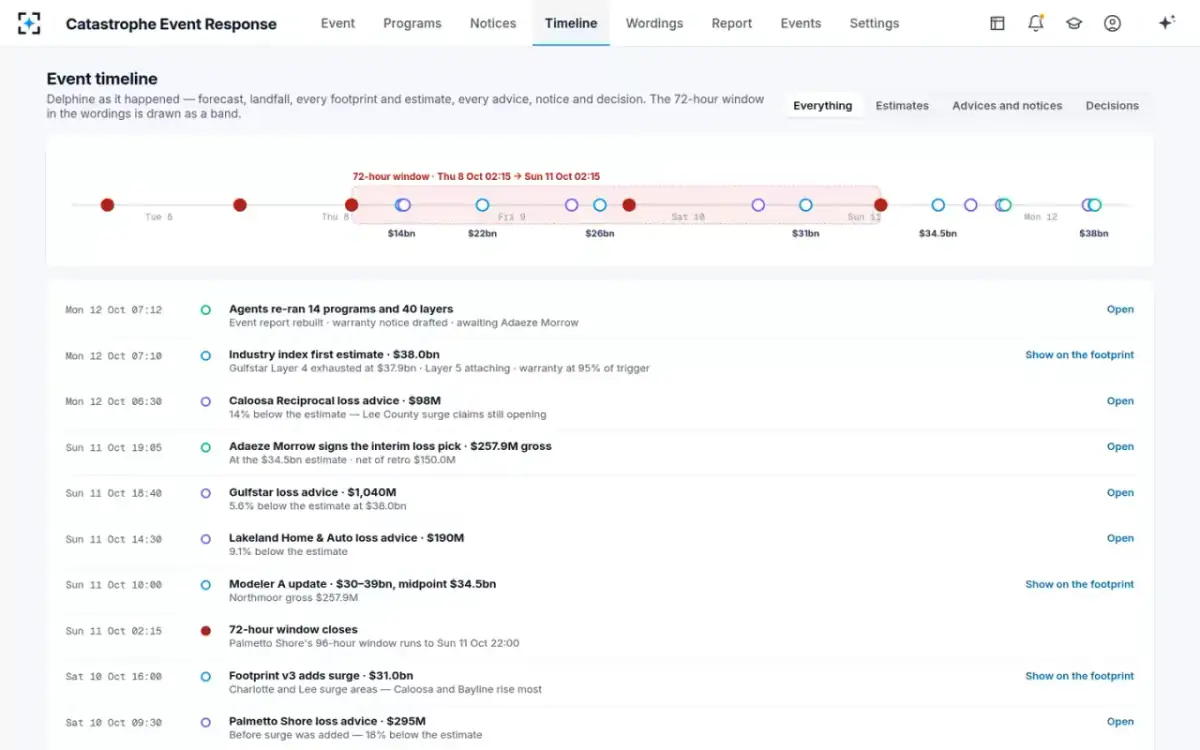
Picks can also fall. In the sample reinsurer's event register, a June flood on the Texas coast drew a first pick of $3.1 million on an early estimate; when the estimate fell, every program was below its retention and the pick went to zero. A late pick would have avoided that revision, and also the work of reserving for it, but only by luck. The defensible course is to pick early, revise on written triggers and explain each move.
The longest revisions come from the top of the program. Florida's hurricane fund, which pays above insurers' retentions, projected $7.2 billion of incurred loss for Hurricane Ian as of 31 December 2025, more than three years after landfall, and allows final loss reports up to 60 months after the end of the contract year (FHCF annual report; 2026 reimbursement contract). A reinsurer's upper layers on a large storm develop the same way.
Shortening the wait: what has to be ready before the storm
Most of the time between landfall and a signed pick is spent on work that could have been done in June. The arithmetic takes minutes once it is automated; what takes days is finding the current exposure file, reading each wording's event definition and notice clause, and agreeing who decides which estimate leads. A reinsurer that does those things before the season starts each event at the arithmetic.
Six things that decide how fast a loss pick can be signed, all settled before the season
- Every inward wording’s event definition and notice clause, read and loaded
In the sample book, five of nine wordings differ from the house standard, including a 96-hour window and a 10-day notice period.
- The retrocession and warranty clocks, written down with their triggers
The retro notice ran from the first published figure on landfall day; the warranty from the index reaching 90% of its trigger.
- The order of estimates, chosen in advance
Index once published, then modeller midpoints, then the company’s own footprint, or whatever order the company prefers, but written.
- Cedant exposure no older than the last renewal
Bordereaux loaded as they arrive, so the share of industry is not computed on a year-old schedule.
- Named signers, with deputies
Who signs the pick, who signs each kind of notice, and who co-signs a large reserve change.
- Written triggers for revising the pick
A new estimate, a layer near exhaustion, an advice far from the model.
Each item is an input the solution needs before it can propose a pick in minutes, and each is equally useful to a team that runs the event by hand. The fuller readiness list, with an owner for each input, is in what a reinsurer brings to an exposure management platform before June.
Who approves the loss pick?
The chief underwriting officer, or a reserving committee the CUO chairs, commonly approves the event loss pick, and the chief risk officer receives it for the appetite view. In the sample setup the CUO signs the pick and the management event report with a password and a stated meaning, and a reserve change over $25 million needs both the CUO and the CRO.
The CUO signs the event loss pick in Catastrophe Event Response
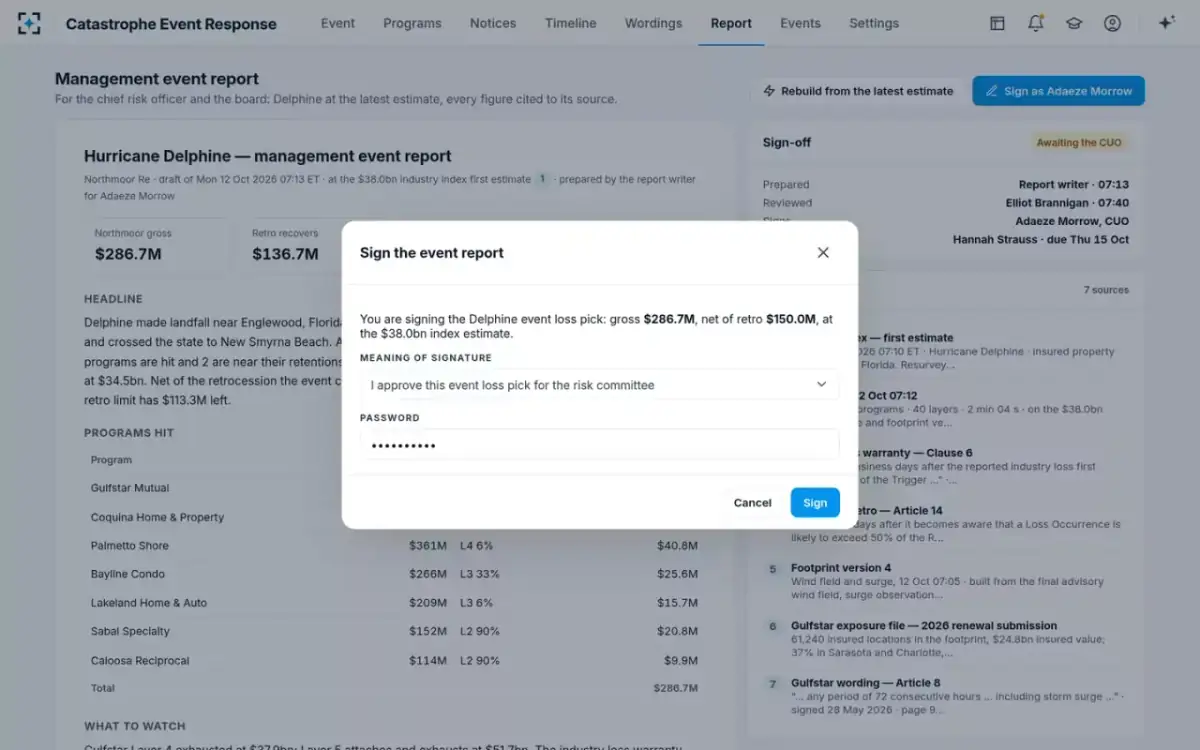
What makes a signature defensible is what sits under it. The sample report cites every figure to the estimate release, footprint version, exposure file or wording clause it came from, and the run it rests on can be replayed. A pick signed on that basis can be revised next week without anyone having to reconstruct why the first one was what it was.
The sample event loss pick put to the CUO on day four
$287M
gross across 7 programs hit ($286.7M)
$150M
net of retrocession, the full retro retention
$29M
above the interim pick signed on Sunday ($28.8M)
3days
to spare before the CRO deadline
Questions people ask
Is a loss pick the same as a reserve?
No. The pick is the selected estimate; the reserve is the liability booked on it. After a catastrophe a reinsurer usually books its event reserve on the signed pick, and changes the reserve when a new pick is signed.
How is an event loss pick different from a pricing loss pick?
A pricing loss pick looks forward: it is the expected loss for next year's policy, built from an account's loss runs. An event loss pick looks back at one catastrophe that has happened and estimates its ultimate cost to the reinsurer's book, from industry estimates, exposure and the wordings, until the cedants' own claims take over.
When should a reinsurer book catastrophe reserves?
When it has a reasonable estimate, not when the estimate is final, because the loss belongs to the period in which the event occurred. The statutory rule for additional premium makes the same point: a reinstatement premium triggered by a loss is recognised in the accounting period in which the loss occurs.
How often should an event loss pick be updated?
On written triggers: each new industry estimate, an estimate within a set distance of a layer's exhaustion point, or a cedant advice that differs from the model by more than a set percentage. The sample reinsurer uses 10% for both thresholds and re-runs the book on every new estimate.
Does an event loss pick include claims not yet reported?
Yes. An event pick estimates the ultimate loss, so it includes losses the cedants have not yet reported. In the first weeks most of a pick is unreported loss, which is why it rests on an industry estimate or a model rather than on advices.