AI catastrophe modeling means using machine learning or AI agents somewhere in the chain that turns a hazard into an insured loss: building a footprint from observations, filling gaps in exposure data, reading cedant advices and treaty wordings, or running the arithmetic that takes an industry estimate down to a reinsurer's layers. It is already in use at the edges of that chain. The core loss models that feed capital requirements and rates are a different matter: in the U.S. they are accepted by regulators by name and version, and anything new is judged against that bar. Botminds' Catastrophe Event Response is an agentic solution that works after an event, on the outputs of accepted models and published estimates, and this guide sets out what supervisors expect of the models and of the AI around them.
Where the guide uses an example it comes from the solution's sample event, Hurricane Delphine, a fictional Florida hurricane, run through Northmoor Re, a fictional reinsurer; those names and figures are sample data. The rules are quoted from the NAIC, the Florida Commission on Hurricane Loss Projection Methodology and EIOPA.
Where AI does catastrophe work in Catastrophe Event Response, and what a supervisor expects of each use
What the AI does in Catastrophe Event Response: Reads advisories, footprints and published estimates; versions each release; never mixes versions in a run.
What a supervisor already expects of that step: Data governance and documentation: which data, which version, when.
What the AI does in Catastrophe Event Response: Overlays cedant locations on the footprint and flags files older than the last renewal.
What a supervisor already expects of that step: Exposure validated and benchmarked; uncertainty rises as geocoding resolution falls.
What the AI does in Catastrophe Event Response: Applies terms and event definitions to every layer and shows the arithmetic for each figure.
What a supervisor already expects of that step: Explainability: a reviewer can follow any number to its inputs.
What the AI does in Catastrophe Event Response: Reads advices and explains gaps over 10% from the model; never edits a cedant figure.
What a supervisor already expects of that step: Accuracy and robustness, with human oversight where outputs can be wrong.
What the AI does in Catastrophe Event Response: Drafts notices and the report, each cited; never sends or signs.
What a supervisor already expects of that step: Human oversight: people decide and execute.
Can AI be used for catastrophe modeling?
Yes, and it is, but mostly around the regulated loss models rather than in place of them. The uses that are easiest to govern are the ones where the AI reads or computes something a person can check: a footprint built from satellite and survey data, an exposure file repaired and geocoded, a cedant's loss advice matched to its program, a layer's loss worked from a share of an industry estimate. The use that is hardest to govern is the one people tend to picture: an AI that replaces the hazard and vulnerability models used for capital and rates.
Supervisors are working on the first kind themselves. EIOPA's June 2026 Financial Stability Report describes a proof of concept with the EU's space programme agency that "tested the usage of Copernicus services and data together with insurance exposure data to help supervisors to effectively assess, monitor and supervise flood risks", illustrated with a flood footprint from the Coimbra region of Portugal. That is footprint-over-exposure work, the same task a reinsurer's event room does after a hurricane, done by a supervisor with earth observation data.
Insurers' own use of generative AI is mostly of the reading kind. In EIOPA's 2026 survey, the majority of reported generative AI use cases, 64%, targeted back-end productivity tools such as data extraction from invoices, audio files or medical reports, content generation and coding or underwriting assistants. Reading cedant advices and treaty wordings after a catastrophe is that kind of use, with higher stakes.
What supervisors already expect of catastrophe models
U.S. supervisors already set expectations for catastrophe models in two places that matter to a property reinsurer: the NAIC's risk-based capital charge for catastrophe risk, and Florida's commission that accepts hurricane models for residential rate filings. Both accept models by name, and Florida accepts them by version. Any AI that produces modelled losses for those purposes will meet the same tests.
The NAIC's capital charge uses modelled losses at set return periods. The instructions in its 2025 proposal say data must be provided for the worst year in 50, 100, 250 and 500, but "only the worst year in 100 will be used in the calculation of the catastrophe risk charge". They also say that no tax effect offsets or reinstatement premiums should be included in the modelled losses, which is one reason a reinsurer's capital view and its event view of the same storm will differ.
Florida goes further on versions. Its Commission on Hurricane Loss Projection Methodology was "created during the 1995 Legislative Session as an independent panel of experts to evaluate computer simulation models and other recently developed or improved actuarial methodologies for projecting hurricane and flood losses." Its list of models accepted under the 2023 hurricane standards names each model with its program version, and a new platform release needs its own acceptance.
Florida's accepted hurricane models: acceptance is by model and program version
21
acceptances in force under the 2023 hurricane standards
6
modelling organisations, one of them a public university
15
of the 21 for one model family, one per platform release, June 2025 to October 2026
1 Nov 2027
when every current hurricane acceptance expires
Fifteen acceptances for one model in sixteen months is the clearest statement of what a regulator means by control. The model did not change its science each time; its software platform did, and the commission still wanted each release named. An AI tool that changes weekly, with no version a regulator could name, would not meet that standard for any use that feeds rates.
Which cat models does the NAIC accept?
For its catastrophe risk charge, the NAIC accepts a short list of named third-party commercial vendor models for earthquake and hurricane, one further vendor model for hurricane only, the Florida Public Model for hurricane only, and an insurer's own model if the domestic or lead state gives written permission. Its proposal to add wildfire to the charge was exposed for comment by the working group and subgroup on 12 November 2025; convective storm stays in the charge for information only.
The own-model route is where an AI-built model would go, and its conditions are specific. The 2025 proposal says "an insurer seeking to use an own model must first obtain written permission to do so by the domestic or lead state insurance regulator." It then asks for written evidence on eight points, including that the model is used for the insurer's own risk management, that it has been validated for each peril, that it "was developed using reasonable data and assumptions", and that its results have been compared with at least one prescribed model, with the drivers of the difference explained. Documentation and a validation report are due at least every five years, or on a material change.
Four supervisory texts a catastrophe AI tool sits under, and what each asks
| Text | Who it binds | What it covers | What it asks of a model or AI |
|---|---|---|---|
| NAIC RBC catastrophe risk charge instructions | U.S. P&C insurers and reinsurers filing RBC | Modelled losses for the capital charge | Named models, or an own model with written state permission, validation and comparison |
| Florida Commission on Hurricane Loss Projection Methodology standards | Models used in Florida residential rate filings | Hurricane and flood loss projection | Acceptance of each model and program version, for a fixed period |
| NAIC Model Bulletin on AI systems | Insurers in the states that adopt it | AI systems used by insurers | A written program for responsible AI use, including third-party systems |
| EIOPA Opinion on AI governance | EU insurers and reinsurers, via their supervisors | AI systems, and models generally | Proportionate governance: data, documentation, explainability, human oversight, accuracy |
What are the rules for AI models in insurance?
The rules for AI models in insurance are mostly the rules for models, applied to AI, plus a small number of AI-specific texts. In Europe, EIOPA's opinion on AI governance says so directly: "existing insurance sectoral legislation requires adequate and proportionate governance and risk management measures when using mathematical models, regardless of whether they are considered AI systems or not." It then sets out areas an insurer's governance should cover: fairness and ethics, data governance, documentation, transparency and explainability, human oversight, and accuracy, robustness and cybersecurity.
"Undertakings should comprehensively secure and test - before release as well as on an ongoing basis - those uses of AI systems that could have a high impact on customers or the solvency of the undertaking."
EIOPA, Opinion on AI governance and risk management, EIOPA-BoS-25-360
A model whose output feeds a capital charge or a loss pick is that kind of use. The same opinion leaves no doubt that buying a model in does not move the responsibility for it: the insurer answers for an AI system whether it built it or a vendor did, a point the guide to reinsurance broking software applies to a bought-in placement tool.
In the U.S., the NAIC's Model Bulletin on the use of AI systems by insurers, adopted in December 2023, had been adopted by 29 jurisdictions as of 8 October 2026, with California, Colorado, New York and Texas following their own insurance-specific rules or guidance (NAIC adoption map). Its detail belongs to compliance teams; for a catastrophe team the practical point is the same as EIOPA's. The company is responsible for the AI it buys, and has to be able to show how it is governed.
Regulators also already treat event estimates as model outputs. Florida's catastrophe reporting form asks insurers, after a hurricane, for the model and version behind their loss estimate and whether long-term, demand surge and storm surge settings were used (Form CRF-26A). An AI tool that contributes to such an estimate inherits that question: which model, which version, which settings.
Is AI replacing cat models?
No, and nothing in the supervisory texts suggests it will soon for capital and rates. Accepted catastrophe models are named, versioned and validated, and the route for a new one, AI or not, runs through own-model permission or Florida's acceptance process. What AI is replacing is the manual work around the models: reading, matching, re-running and drafting.
That is also where firms say they are. In the Bank of England and FCA's 2026 survey of UK financial services, 93% of responding insurers reported using AI, and across all respondents four in five firms with agents in production used them for decision support, where agents recommend and people decide and execute, while only 2% let agents act with broad autonomy (Bank of England and FCA, 2026; what supervisors expect of AI in reinsurance reads the survey in full). A catastrophe event room run with agents looks like the 80%: agents recommend the loss pick and draft the notices, and people decide.
Explainability in practice: one layer's arithmetic, with the four inputs that fix it
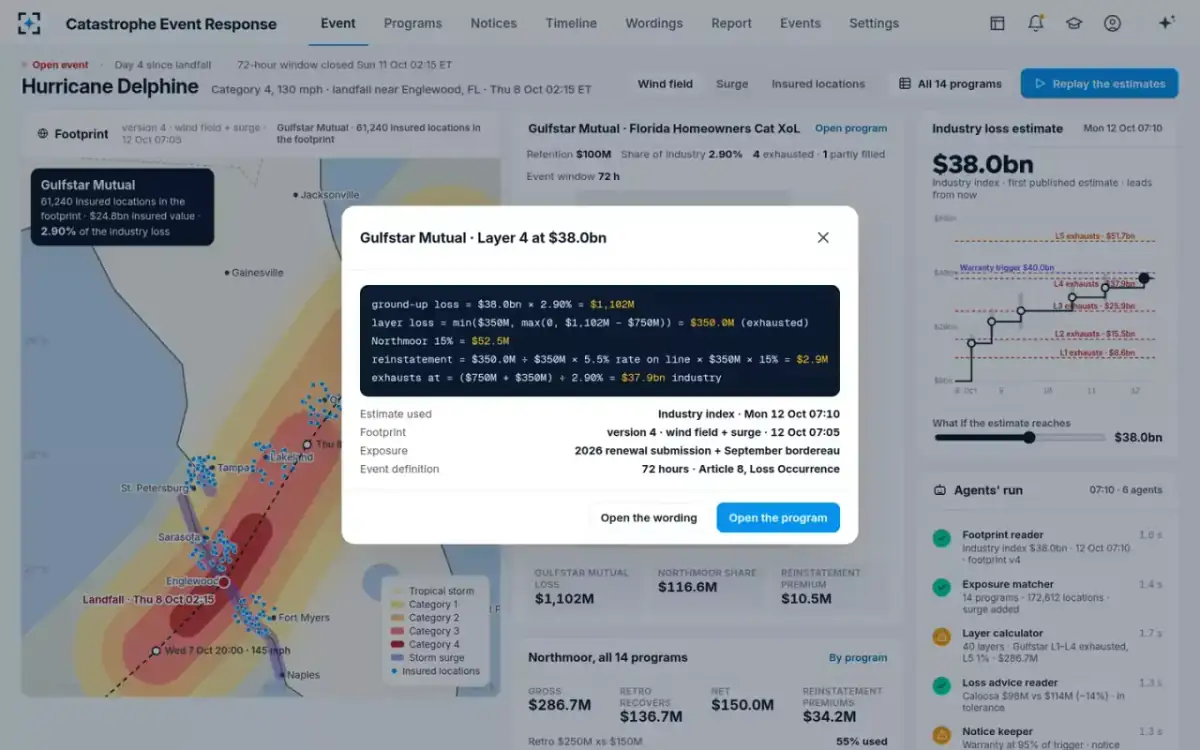
What is model risk management for AI in a catastrophe team?
Model risk management for AI in a catastrophe team is the same discipline the team already applies to catastrophe models, extended to the agents and tools that now sit around them: an owner for each use, documented inputs and versions, validation against something independent, a reproducible trail, and a named person who decides. The supervisory texts above supply the template; the event room supplies the urgency.
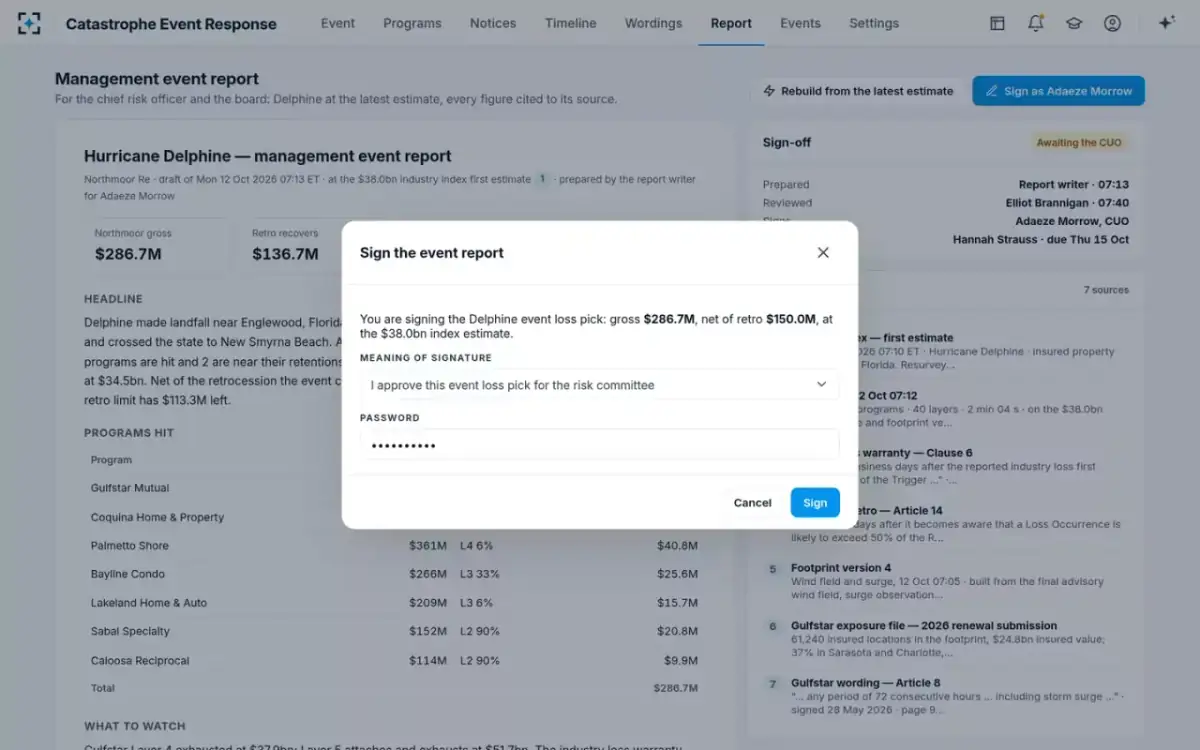
Four practices carry most of the weight. Pin versions, as Florida does: every run tied to one estimate, one footprint version, one exposure file and one set of treaty terms, so it can be replayed. Compare, as the NAIC asks of own models: the agents' layer losses against a simple independent calculation, and their reading of an advice against the advice itself. Keep the arithmetic open, so explainability is a property of the output rather than a document written later. And separate proposal from decision: in the sample setup the agents never book a reserve, send a notice or sign a report, and a reserve change over $25 million needs two executives.
One risk is specific to AI that reads documents. In EIOPA's generative AI survey, "Hallucinations, or inaccurate outputs, was the top-cited risk connected to Gen AI systems". The control is to make every reading checkable: the advice reader shows the passage it relied on, flags advices from a different event window, and never changes a cedant's figure. How the second line should test the estimates the agents are fed is covered in industry loss estimates and the CRO's questions.
Questions to put to any AI catastrophe modeling tool
Put these questions to any tool that uses AI for catastrophe work, whether it claims to model hazard or only to read and compute. The answers should be demonstrations, not assurances.
Before buying AI for catastrophe modeling or event response
- What version of every model and input produced this number?
Including the estimate release, footprint version, exposure file and treaty terms, and whether they can be replayed next month.
- Is any output used for capital or rate filings?
If so, which accepted model it rests on, or which state has given own-model permission.
- What was it validated against, and how often?
The NAIC asks own models for a comparison with a prescribed model and a validation report at least every five years.
- Show the arithmetic for one layer
From the industry figure to the reinsurer’s share, with each input named.
- Show a document it read, and the passage it relied on
And what happens when it reads an advice from a different event window.
- What is it not allowed to do?
Book, send, sign or change a cedant figure, and who decides instead.
- What do you tell us about your own AI systems?
EIOPA expects insurers to obtain adequate information and assurances from third-party providers.
Where Catastrophe Event Response fits against that bar
Catastrophe Event Response is not a catastrophe model and does not seek Florida acceptance or NAIC own-model status. It uses the outputs of the models a reinsurer already licenses and the estimates the market publishes, together with the reinsurer's own footprint run, and applies them to the reinsurer's programs, layers and wordings. Its AI reads, matches, computes and drafts; its outputs are proposals until a named person signs.
That placement is deliberate. It keeps the regulated model where the regulator expects it, and puts the AI where the event room's time actually goes: re-pricing every layer on each new estimate, applying each wording's event definition, and keeping each notice clock. The minute-by-minute run on one new estimate is traced in event loss estimates: the first two hours, and a comparison with spreadsheets and exposure platforms is in exposure management software after a catastrophe.
The decision stays with a person: the CUO signs the event loss pick
Questions people ask
Does Florida's hurricane commission accept AI models?
It accepts hurricane and flood loss models that meet its standards, by model and program version, whatever methods they use. Under the 2023 hurricane standards it had 21 acceptances in force for six organisations as of October 2026, all expiring on 1 November 2027.
Do I need regulator approval to use AI after a catastrophe?
Not specifically for event response, but general AI governance expectations apply where adopted, such as the NAIC bulletin in 29 jurisdictions or EIOPA's opinion in the EU. Anything feeding capital or rate filings follows the model rules for that use.
What is ASOP 38?
Actuarial Standard of Practice No. 38 covers catastrophe modelling for all practice areas. The NAIC's 2025 review of wildfire models for its capital charge was guided by it.
Does EIOPA regulate AI models in insurance?
EIOPA sets supervisory expectations under existing insurance law; its 2025 opinion applies to AI systems that are not prohibited or high-risk under the EU AI Act. It covers models generally, saying sector law requires proportionate governance of mathematical models whether or not they count as AI.
Why did the NAIC propose adding wildfire to its catastrophe charge?
Its catastrophe risk subgroup found that model outputs had become more consistent since its 2022 review and that it had greater confidence in the models. The proposal was exposed for comment in November 2025.