An insurance exposure management system, for a property catastrophe reinsurer, is the platform that holds every cedant's exposure and every program's terms and, after an event, turns a footprint and an industry estimate into a loss by program and layer and a list of notices owed. Whether it does that in minutes or in a week is decided before the storm, by what was loaded: exposure no older than the last renewal, each signed wording's event definition and notice clause, the retrocession and warranty triggers, the order in which estimates lead, and the names of the people who sign. For Florida business the deadline is concrete, because the state hurricane fund's contract year and many private programs start on 1 June. Botminds' Catastrophe Event Response is an agentic solution that runs the event on those inputs, and this guide is the list of what to bring.
The examples come from the solution's sample setup: Northmoor Re, a fictional reinsurer with 14 Florida programs, and Hurricane Delphine, its fictional sample storm. Their names and figures are sample data. The binding-restriction side of the same season, a primary insurer stopping new business while a storm threatens, has its own plan in property catastrophe exposure management software for binding restrictions; this page is the reinsurer's side, after landfall.
The readiness table: what an exposure management platform needs before 1 June, and who owns it
| Input | Owner | Ready by | What goes wrong without it |
|---|---|---|---|
| Cedant exposure, geocoded, no older than the last renewal | Exposure management analyst | Each program’s inception; bordereaux as they arrive | The share of industry is computed on a year-old schedule |
| Program terms: retention, limit, line, reinstatements, inuring order | Treaty underwriting | Each program’s inception | Layer losses use the wrong attachment or line |
| Every wording’s event definition and hours | Contract wording team | When each wording is signed | A 96-hour program is priced on a 72-hour default |
| Every notice clause, inward and outward | Reinsurance claims manager | When each wording is signed | A retro or warranty deadline is worked out after it has passed |
| Retrocession and warranty terms, with triggers | Head of ceded reinsurance | Before the retro incepts | The net is guessed and the warranty notice missed |
| Order of estimates and re-run rules | Head of catastrophe analytics | Before the season | Each event starts with an argument about which number leads |
| Named signers and deputies | Chief underwriting officer and CRO | Before the season | A notice waits for someone on leave |
| A dry run on a past event | Head of catastrophe analytics | Two weeks before 1 June | The first live event is the test |
What is an exposure management platform for a reinsurer?
For a reinsurer, an exposure management platform holds what each cedant has insured, where and on which terms, together with the reinsurer's own position on each program: its layers, its lines and the retrocession that protects them. Before the season it supports accumulation limits and modelled losses. After an event it should answer three questions in order: which programs are in the footprint, how far into each layer the loss reaches, and which notices are now owed, to the reinsurer and by it.
The first question is the exposure platform's home ground. The second and third depend on contract terms that exposure systems often hold only in part, and on wordings they are not built to read. A platform for event response therefore needs a different kind of preparation from a platform for accumulation: not more locations, but every clause that changes what the locations cost. How the three common approaches compare on one storm is set out in exposure management software after a catastrophe.
What data does an exposure management platform need?
An exposure management platform needs four kinds of data before an event: cedant exposure, program terms, wordings and named people. During an event it adds three more: footprints, industry estimates and cedant loss advices. The first group decides how fast it can work; the second decides how often it has to.
Exposure is the hardest to keep current, because it belongs to the cedants. The NAIC's catastrophe modelling primer warns that consistent, accurate insured values are hard to get and must be indexed for inflation from time to time (NAIC primer; the cat modeling analyst's guide covers the values themselves). A reinsurer receives a schedule at renewal and, where the treaty provides for it, bordereaux during the year. The platform should date every file and refuse to use one silently when it is older than the last renewal; in the sample setup, the matching agent flags such files for the analyst instead.
Public reinsurers make the point with fees and examinations. Florida's hurricane fund may charge an insurer the cost of reprocessing inaccurate, incomplete or late exposure data, under s. 215.555, Florida Statutes, and its reimbursement contract says that errors found in an insurer's reported exposure may require a resubmission before a request for reimbursement is fully processed (2026 contract). A private reinsurer has no statute, but it has the same exposure to a cedant's stale file.
One storm, three event definitions
A single Florida hurricane is defined three different ways by three documents a reinsurer's cedants live under, and a platform has to hold all of them. The state hurricane fund counts a storm by its hurricane status; the state regulator's reporting form counts a reporting window around its watches and warnings; a private catastrophe treaty counts losses inside a fixed number of consecutive hours.
Hurricane, reporting event, loss occurrence: one Florida storm under three definitions
| Document | What counts as the event | When it starts and ends | What it decides |
|---|---|---|---|
| Florida Hurricane Catastrophe Fund reimbursement contract | One storm declared a hurricane by the National Hurricane Center that causes insured losses in Florida | From damage in Florida while a hurricane, through later downgrades; a storm that never becomes a hurricane is excluded | Which storms the fund reimburses, and the retention for each |
| Florida OIR catastrophe reporting form (CRF-26A) | The reporting event for an NHC-declared storm system | From the first Florida watch or warning, to 72 hours after the last one ends | Which claims insurers report to the regulator for the storm |
| Private property catastrophe excess of loss | All individual losses from one catastrophe, within the hours clause | A period of consecutive hours, often chosen by the reinsured; 72 hours for windstorm in the sample book | How many retentions apply, and which losses fall in one |
The differences are not academic. A tropical storm that never reaches hurricane strength is outside the fund but can be a loss occurrence under a private treaty. A storm whose watches and warnings cover four days produces one reporting event for the regulator but may need two windows under a 72-hour clause. A platform that holds one default definition will be right for the fund, the regulator or the treaty, and wrong for the others.
Can it apply hours clauses?
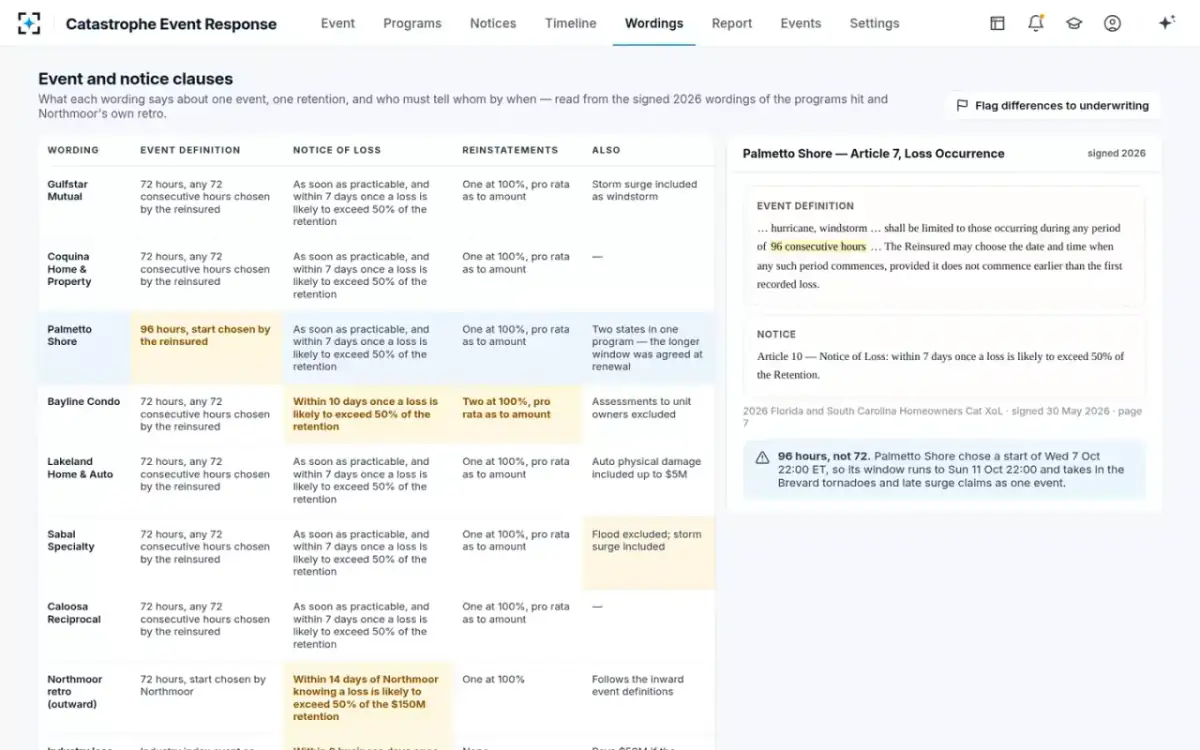
An exposure management platform can apply hours clauses only if the wordings have been read and their clauses loaded, which is why that work belongs before the season. The clause sets the length of the window, the perils it covers, and often who may choose when it starts. The wording before the English Court of Appeal in Unipol v Covéa in 2024 shows the form: "the Reinsured may choose the date and time when any such period of consecutive hours commences". The periods differ by peril; the arbitration tribunal in that case gave, as examples, 72 hours for earthquake and riot, 120 for hurricane, 504 for flood and 168 for other perils.
The court's holding matters for anyone loading those clauses: losses that first occur inside the window are aggregated even if their financial loss keeps developing after it ends. A platform should therefore date each loss by when it first occurred, not when it was reported or paid. How a window choice changes the number of retentions on a real tower is worked through in one hurricane through a property catastrophe excess of loss book.
Event and notice clauses from nine signed wordings, side by side, in Catastrophe Event Response
Does it track loss advice deadlines?
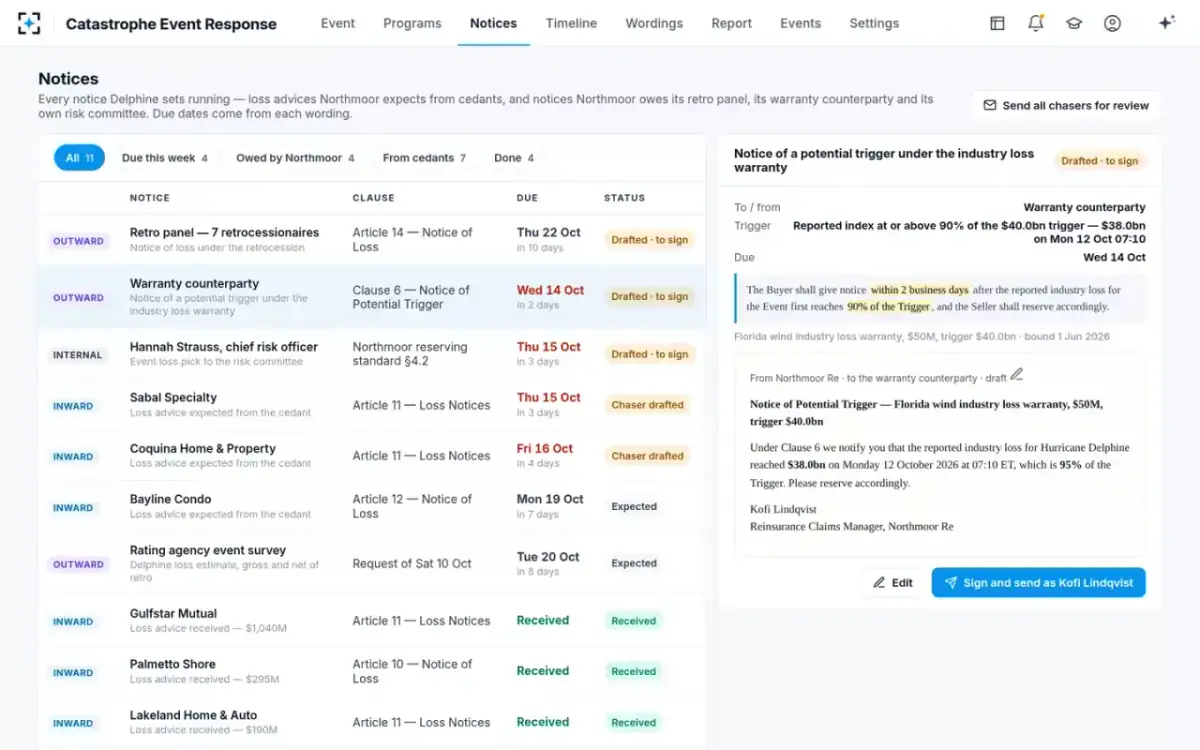
A platform tracks loss advice deadlines if every notice clause, inward and outward, has been read and its trigger defined, so that the clock can start when the trigger is met. The triggers are rarely dates. They are thresholds: a loss likely to exceed half the retention, an index reaching 90% of a warranty trigger, the reinsurer becoming aware of something. A tracker that only holds due dates cannot start its own clocks.
The sample book has four kinds. Most inward wordings ask the cedant for notice within 7 days once a loss is likely to exceed 50% of the retention; one allows 10. Northmoor's retrocession asks for notice within 14 days of Northmoor knowing a loss is likely to exceed 50% of its $150 million retention. Its industry loss warranty asks for notice within two business days of the index reaching 90% of the trigger. And its own reserving standard asks for the event loss pick to reach the chief risk officer within five business days of landfall.
A clock started by a threshold: the industry loss warranty notice, drafted for signature
Who signs, named before the season
Every signature an event needs should have a named owner and a deputy before 1 June, because events arrive at weekends and in holidays. In the sample setup the chief underwriting officer signs the event loss pick and the management report; the reinsurance claims manager signs every notice and every chaser to a cedant; a reserve change over $25 million needs both the CUO and the chief risk officer; and the head of catastrophe analytics runs the event and decides which estimate leads.
The signature has to mean something specific. In the sample, the CUO signs with a password and a stated meaning, "I approve this event loss pick for the risk committee", and the platform keeps the two together. The agents are configured so they cannot hold any of these roles: they read, compute and draft, and never book, send or sign. What the waiting costs when a signer is missing is priced in the loss pick after a catastrophe.
How long to go live before 1 June?
Plan backwards from 1 June, and expect the wordings last. For Florida business the state hurricane fund's calendar is fixed by statute: its board must adopt the reimbursement contract by 1 February, and insurers must execute it by 1 March, so that they know its terms before they finalise private reinsurance. The fund's May 2026 capacity report notes that many Florida-only insurers buy their private reinsurance effective 1 June, while some insurers operating in several states renew on 1 January (FHCF, May 2026).
The Florida reinsurance calendar a platform has to fit inside, January to June
- Fund limits publishedby 1 Jan
- Fund contract adoptedby 1 Feb
- Fund contract executedby 1 Mar
- Private placements and regulator data callMar to mid-May
- Wordings signedlate May
- Signers, estimate order, re-run rulesJan to Feb
- Exposure refreshed from submissionsMar to Apr
- Dry run on a past eventearly May
- Load new wordingslate May
The last item is the easiest to underestimate. In the sample book the signed 2026 wordings carry dates of 22, 28 and 30 May, days before inception, so the event definitions and notice clauses for the season arrive in the final week. A platform that needs weeks to load a wording will start the season on last year's clauses. The sample reinsurer's answer is to read every wording as it is signed and flag each difference from its standard to underwriting.
The regulator's calendar runs alongside. Florida's annual reinsurance data call collects what insurers plan to buy, then what they bought, then the reinsurers and contracts placed, and later the impact of storms on those contracts; by 15 June 2026, 69% of insurers had filed it (OIR, July 2026). Cedants busy with those filings in May are also the ones sending the exposure files a reinsurer needs.
A dry run on last season's event: what it should prove
- Every program in the footprint is found
Against the exposure you held on the event date, with stale files flagged.
- Each layer’s loss matches what you booked, or the difference is explained
Use the estimates published at the time, in the order your rules set.
- Each wording’s event definition is applied
Including any program with a non-standard window or start.
- Every notice the event triggered appears, with its clause and due date
Compare with the notices actually sent, and when.
- The report could have been signed by day four
With every figure cited to its estimate, footprint, exposure file or clause.
The sample setup that made a day-four pick possible
14
programs and 40 layers loaded before the season
9
signed wordings read; 5 differ from the standard
11
notices tracked from their clauses in the first week
3
people who sign: CUO, claims manager, CRO above $25M
Florida's own calendar continues after a storm. The cedants' interim and proof of loss reports to the hurricane fund, and how the fund's layer sits under private programs, are set out in the FHCF reimbursement contract guide.
How Catastrophe Event Response uses each input on the day
Catastrophe Event Response turns the readiness table into a run: each input is read by one agent, and each output stops at a person. On the morning the industry estimate lands, the footprint reader applies the estimate order and versions the release; the exposure matcher overlays the dated cedant files and flags any older than the last renewal; the layer calculator applies the program terms and each wording's event definition and nets the retrocession; the loss advice reader compares cedant advices with the model; the notice keeper starts the clocks whose thresholds have been met and drafts the notices; and the report writer cites every figure to the estimate, footprint, exposure file or clause it came from.
The value of preparation shows in what the agents cannot do without it. With a wording not loaded, the layer calculator falls back to the house default of 72 hours for named windstorm, which is exactly wrong for a program like Palmetto Shore. With a notice clause not read, the notice keeper has no clock to start. With no signer named, the draft waits. None of this is a limit of the software so much as a statement of where the work lives: in the wordings and the files, before the storm.
The solution also has limits a buyer should weigh. It works from published estimates and the reinsurer's own footprint run, not from an independent hazard model; it reads the files and wordings it is given and does not obtain them from cedants; and every figure it produces is a proposal until a named person signs. Running it on a past event against the company's own programs and layers shows quickly which inputs are missing.
Questions people ask
What is a bordereau in reinsurance exposure management?
A bordereau is a periodic schedule a cedant sends its reinsurer, listing risks, premiums or claims under a treaty. For exposure management, a location bordereau updates the renewal schedule during the year, so the reinsurer's view of where the cedant's values sit is not frozen at inception.
When does the Florida hurricane fund's contract year start?
On 1 June. Florida law defines the contract year as the period beginning on 1 June and ending on 31 May, and the 2026 reimbursement contract states coverage effective 1 June 2026.
How often should cedant exposure be refreshed?
At least at every renewal, and whenever a bordereau arrives where the treaty provides for one. In the sample setup, any exposure older than the last renewal is flagged rather than used silently, so the analyst decides whether it is fit for the event.
Should notice clocks start automatically?
The clocks should, the notices should not. A platform can start a clock the moment a threshold in a clause is met, such as an index reaching 90% of a warranty trigger, but the notice itself should be read and signed by the person the wording and the company's rules name.
Can one platform serve both a primary insurer and a reinsurer?
The data model overlaps, but the jobs differ. A primary insurer's event work is about its own policies and its binding and claims decisions; a reinsurer's is about other companies' programs, its layers on them, and the notices between them.