An exposure management analyst keeps the map of a reinsurer's catastrophe risk: every cedant's insured locations and values, by peril, zone and treaty, refreshed as new data arrives. After a hurricane, wildfire or earthquake, that analyst is the first seat in the event room, laying the event's footprint over the exposure to say which programs are hit and how deep. The work is hard because nothing holds still. Cedant files are months old, industry estimates move every day, and each treaty's wording changes the arithmetic. Botminds' Catastrophe Event Response is an agentic solution built for that room: six agents match exposure to the footprint, price every layer and keep the notice clocks, while named people sign the loss pick and every notice.
The examples come from the solution's sample event, Hurricane Delphine, a fictional Category 4 storm, as it runs through Northmoor Re, a fictional reinsurer with 14 Florida programs. Every name and figure from that event is sample data, not a customer's result. The rules and statistics come from regulators and professional bodies, linked where they appear.
The event room at a property catastrophe reinsurer, seat by seat
| Seat | Owns | First 72 hours | Days 4 to 10 |
|---|---|---|---|
| Exposure management analyst | Where the insured values sit, by cedant, peril and zone | Footprint over exposure; stale or badly geocoded files flagged | Re-match on each new footprint; refresh from cedant bordereaux |
| Head of catastrophe analytics | The estimate that leads and the run behind it | Collects advisories and the first modeller ranges | Re-runs the book on each release; reviews the event report |
| Treaty underwriter | The cedant relationship and the program terms | Fields cedant and broker calls on which layers are in play | Explains layer fill and breach points to each cedant |
| Reinsurance claims manager | Every notice in and out, and its deadline | Starts the clocks: retro, warranty, cedant advices | Reconciles loss advices to the model; signs each notice |
| Chief underwriting officer | The event loss pick | Interim pick on the best available number | Signs the pick that goes to the risk committee |
| Chief risk officer | Appetite, net of retrocession | Asks whether the event sits inside appetite | Receives the signed pick, gross and net |
What does an exposure management analyst do after a catastrophe?
Within hours of landfall, the exposure management analyst matches the company's exposure to the footprint, flags the files that cannot be trusted, and hands the cat modeller and the underwriters a list of programs in the zone with each one's share of the event. That list is the first number the rest of the room works from, so its quality sets the quality of everything after it.
For a reinsurer the exposure is second-hand. It arrives in the renewal submission, as a schedule of locations and values the cedant prepared months earlier, and is updated, when the treaty allows it, by bordereaux during the year. The analyst's first job after an event is to know which of those files is current. In the sample event, Gulfstar Mutual's file is its 2026 renewal submission plus a September bordereau, and the solution's matching agent is set to flag any exposure older than the last renewal rather than quietly use it.
The second job is the overlay. A footprint is a version: the first wind field, then one with surge added, then one rebuilt from final advisories. Each new version changes which locations sit in which wind band. Delphine's footprint reached version 4 by day four, and at that point 61,240 of Gulfstar's insured locations, worth $24.8 billion, were inside it. Put together with the vulnerability of each building, that made Gulfstar 2.90% of the industry loss. The analyst's skill is less in drawing the overlay than in saying how far to trust it.
The third job is to stay with it. Every new estimate and every new footprint re-opens the match, and the industry figures for one storm can move many times in the first week. How the room handles that churn, minute by minute, is set out in what happens in the first two hours after an event loss estimate lands.
Who works in a catastrophe event response team at a reinsurer?
A reinsurer's catastrophe event response team, in the setup this guide follows, has six seats: the exposure analyst, a head of catastrophe analytics or senior cat modeller, the treaty underwriters for the region, the reinsurance claims manager, the chief underwriting officer, who signs the event loss pick, and the chief risk officer, who receives it. The table above sets out what each owns. What the table does not show is how the work moves between them.
It moves in one direction for the first day and in circles after that. The analyst's match feeds the modeller's run; the run feeds the underwriter's answers to cedants and the claims manager's notice clocks; the claims manager's loss advices from cedants feed back into the analyst's view of which files were wrong. Each new industry estimate starts the circle again. A team that runs it in spreadsheets spends most of the week on the circle rather than on judgement.
Two of the seats exist because of contracts, not models. The claims manager is there because retrocession, industry loss warranty and cedant wordings each set their own notice deadlines, and a missed one can cost a recovery. The chief underwriting officer is there because someone has to put a name to a number that will be wrong by next week, and say which number it was and why.
Where the first ten days go, seat by seat
On Botminds' estimate, one landfalling hurricane across a Florida property catastrophe book takes about 15 days of effort when the work runs in spreadsheets, and much of it is repeated with each new industry estimate. Matching exposure to the footprint is the largest single block. Applying treaty terms layer by layer, netting the retrocession and reconciling cedant advices are close behind.
Where 15 days of event-room effort go, and the 1.4 days left with agents
By spreadsheet · about 15 days for one hurricane
- Exposure analyst: matching exposure to the footprint · 27%
- Cat analytics: estimates, treaty terms, retro · 33%
- Claims: loss advices and notice deadlines · 27%
- Head of cat and CUO: the event report · 13%
With the agents · about 1.4 days, mostly review
- Matching and pricing, reviewed · 21%
- Loss advices and notices, read and signed · 43%
- Event report, reviewed and signed · 36%
The second row is the argument for agents in this room, and also its limit. What disappears is the mechanical part of the exposure analyst's and the modeller's day: re-matching 172,612 locations across 14 programs, re-pricing 40 layers, re-netting the retro. What remains is the claims manager reading cedant advices and signing notices, and the chief underwriting officer reading and signing a report. Those shares grow, because judgement and signatures do not get faster when arithmetic does.
Published statistics do not measure this. No government source counts the hours a reinsurer spends after a catastrophe, or the people who spend them, and the occupational data below cannot separate reinsurance staff from the rest of insurance. A head of catastrophe who wants a baseline has to take it from the company's own last event: the timestamps on each re-run, each advice and each notice.
What is exposure management in reinsurance?
Exposure management in reinsurance is knowing what the company has written, where, against which perils and on which terms, and how much of it one event could take. It differs from the same job at a primary insurer in two ways: the data comes from cedants rather than from the company's own policy system, and every location sits behind a stack of treaty terms before it reaches the reinsurer.
That stack has an order. As the Casualty Actuarial Society's study note on reinsurance pricing explains, a catastrophe cover typically responds to the cedant's retained exposure after its surplus share, per-risk excess treaties and facultative certificates have done their work. An analyst who matches gross locations without that netting will put programs in the footprint that the reinsurer's layer never sees.
It is also different from catastrophe modelling, though the two seats sit side by side. A model is the engine that turns hazard, vulnerability and exposure into a distribution of losses; the exposure analyst is responsible for what goes in and for reading what comes out against the treaties. The Property & Auto Claims guide on what catastrophe modeling software does covers the engine. This page is about the people around it.
Why the exposure file decides the number
The exposure file decides the number because a catastrophe model can only spread the event over the locations it is given, at the precision it is given them. The NAIC's catastrophe modelling primer is plain that a model's uncertainty grows as geocoding gets coarser (NAIC primer; geocoding accuracy on a property schedule works the point through). A cedant file geocoded to ZIP code centroids puts a beachfront condominium and an inland subdivision on the same point.
Better data does not mean a smaller loss, a point worth making to cedants. The same primer makes the point that cleaner data buys accuracy, not a lower modelled loss (NAIC primer; how that plays out in a PML). After an event, a more accurate file can move the share of the industry loss, and the direction is not known in advance.
Public reinsurers enforce this with money. Florida's statute lets its Hurricane Catastrophe Fund charge an insurer the cost of reprocessing exposure data that arrives wrong, incomplete or late (s. 215.555; the fee is set out in the guide to the FHCF data call), and the fund checks. Its 2025 annual report counts 88 exposure examinations in that year alone. A private reinsurer has no such statute, but it has the same problem: an event is when stale exposure stops being a data-quality note and becomes a wrong loss pick.
"Every new number means another night in the spreadsheet."
Elliot Brannigan, head of catastrophe analytics at the fictional sample reinsurer
Who signs the loss pick, and who signs the notices?
In most reinsurers the chief underwriting officer, or a reserving committee the CUO chairs, signs the event loss pick, and the reinsurance claims manager signs notices to retrocessionaires and warranty counterparties. Analysts and models propose; they do not sign. In the sample reinsurer the rules are explicit: the CUO signs the pick and the management report, the claims manager signs every notice and chaser, and a reserve change over $25 million needs both the CUO and the chief risk officer.
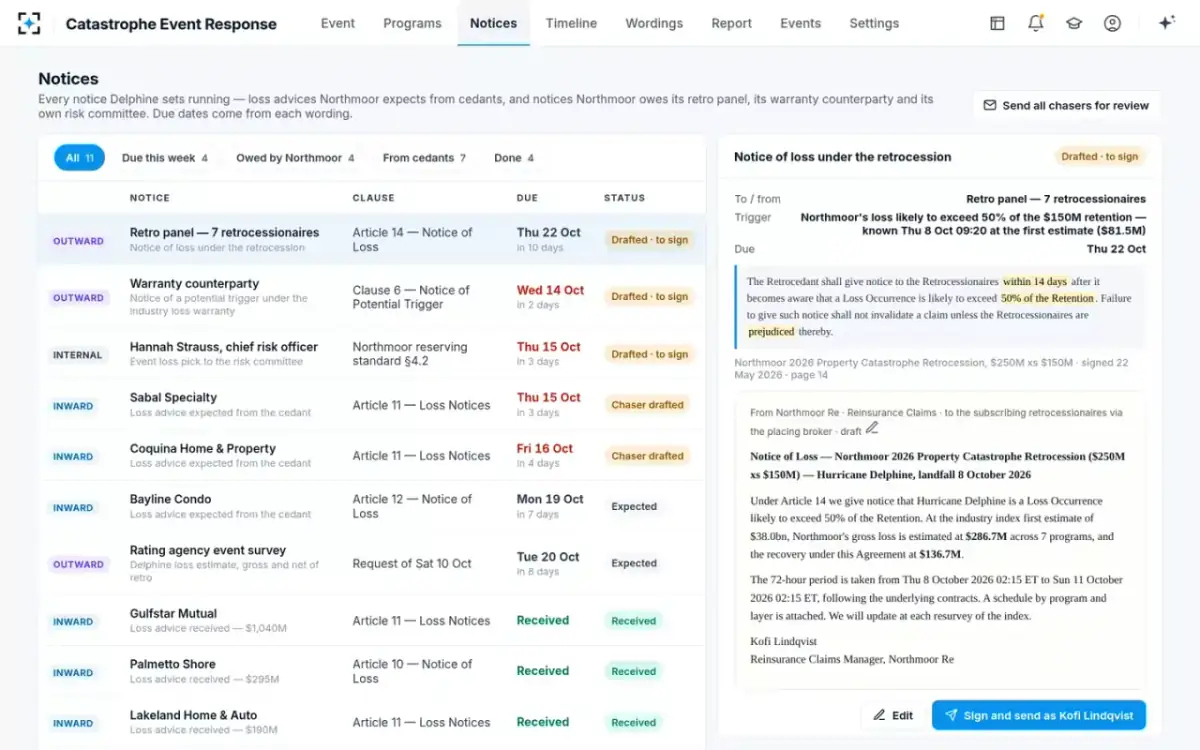
The notices are where seats can fail without anyone noticing. Northmoor's retrocession wording requires notice within 14 days of knowing that a loss occurrence is likely to exceed 50% of the $150 million retention; that clock started at 09:20 on landfall day, when the first estimate put Northmoor's loss at $81.5 million. Its industry loss warranty asks for notice within two business days once the reported index reaches 90% of the $40 billion trigger. Neither deadline lives in the exposure system. Both live in wordings the claims manager has to have read before the storm.
The pick itself moves. Northmoor's chief underwriting officer signed an interim pick of $257.9 million gross on day three and a pick of $286.7 million on day four, when the industry index published. What each day between them costs, and why a regulator's collateral clock starts with the cedant's first reserve, is the subject of the loss pick after a catastrophe.
What the event room owes outside the building
The event room answers to cedants, retrocessionaires, a rating agency or two, and indirectly to state regulators, and each of them asks on its own timetable. The reinsurer's cedants are asked first. After a Florida hurricane, the Office of Insurance Regulation's catastrophe reporting form asks each insurer for its estimated loss gross of reinsurance, its projected net retention and the amount covered by reinsurance, "based on your reinsurance chart", and for the model and version behind the estimate. Those numbers are built on the same layers the reinsurer is pricing, so cedants call their reinsurers in the same week.
Florida cedants also owe the state's hurricane fund its own reports, starting with an interim loss report that is due at least 14 days after the fund asks for it. That calendar, and how the fund's layer sits under private programs, is covered in the FHCF reimbursement contract guide.
A certified reinsurer has one more reason to get the pick done. The NAIC's credit for reinsurance model regulation lets a certified reinsurer defer posting security for catastrophe recoverables for one year from the cedant's first reserve entry for the event, and makes the deferral depend on the reinsurer continuing to pay claims in a timely manner (Model Regulation #786). Paying promptly needs a number someone has signed.
Catastrophe Event Response: what changes for each seat
Catastrophe Event Response changes the event room by taking the repeated arithmetic off the analysts' desks and putting the wording-driven clocks in front of the people who sign. Each seat keeps its decisions. The agents read, match, compute and draft; they never book a reserve, send a notice, sign a report or change a cedant's file.
Five seats in the sample reinsurer's event room, before and after
Today
Re-runs the event against 14 programs by hand each time a modeller or the index publishes.
With agents
Watches every layer in every program redraw in about two minutes when a new estimate lands, and reviews the run.
Still theirs: Which estimate leads, and when the room trusts a footprint
Today
Fields cedant and broker questions without a current view of their layers.
With agents
Opens the program and answers with the layer fill, the breach point and the exposure by county behind it.
Still theirs: What to tell the cedant, and when
Today
Chases cedant loss advices and works out retro and warranty deadlines from the wordings.
With agents
Starts from a tracker with each clock read from its clause and the notice already drafted.
Still theirs: Every signature on every notice
Today
Signs an event loss pick that is out of date by the next estimate.
With agents
Signs a cited report on the latest estimate and sees each layer’s breach point in advance.
Still theirs: The loss pick
Today
Reports event losses against appetite from numbers stitched together after the event.
With agents
Receives the signed pick, gross and net of retro, within five business days of landfall.
Still theirs: The appetite call
Catastrophe Event Response: all 14 programs re-priced at one estimate
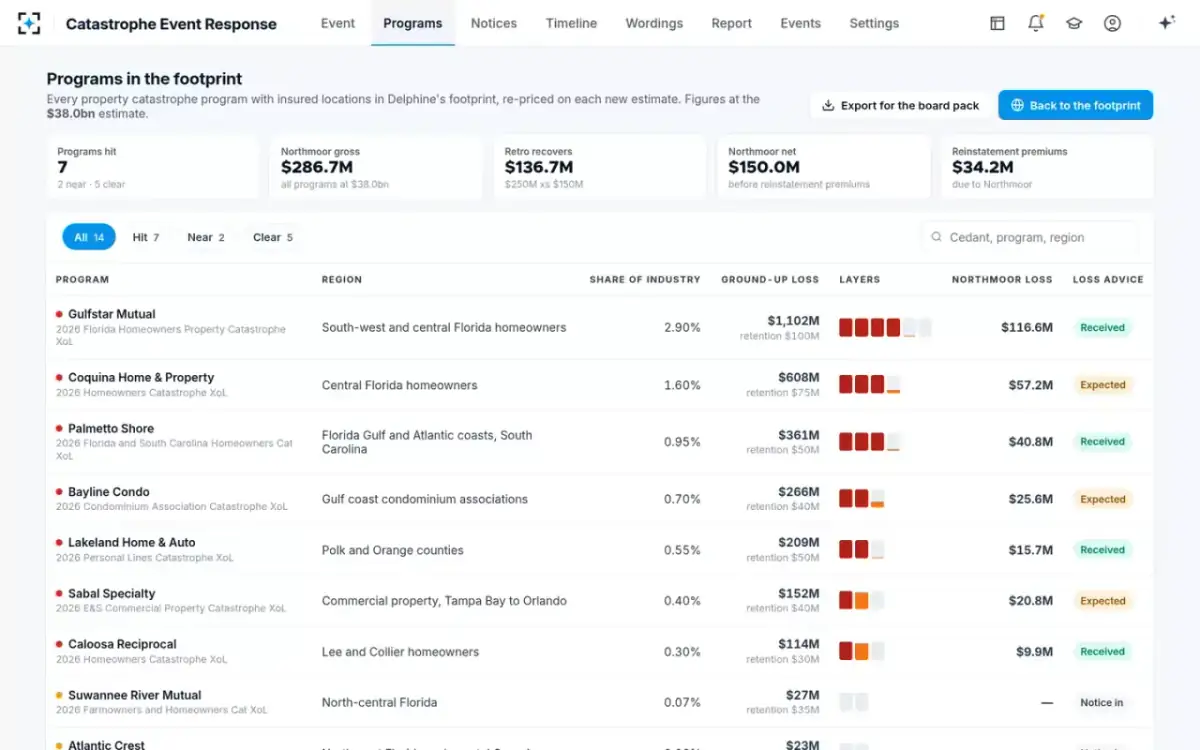
For the claims seat the change is the notice tracker. Eleven notices are open in the sample event, four due in the same week, each with the clause it came from and a drafted letter waiting for a signature. The tracker does not decide whether to send; it makes sure the person who decides sees the deadline in time.
The claims manager's view: every notice, its clause and its draft
What skills does an exposure management analyst need?
An exposure management analyst needs data skills first, treaty knowledge second and model literacy third, with the judgement to say when a number should not be used. The job is less about running a model than about knowing what the inputs are worth.
What the exposure seat needs on the first morning after a catastrophe
- Geocoding and data repair
Know which cedant files are geocoded to the building and which to a ZIP code centroid, because the model’s uncertainty follows that resolution.
- The program terms by heart
Retention, limit, line, reinstatements and what inures first, for every program in a peril zone.
- Model output literacy
Occurrence and aggregate exceedance curves, event loss tables, and what a model’s settings did to the answer.
- Footprint judgement
Which footprint version to trust, and when surge or tornado reports change which locations are in the event.
- Version discipline
Every run tied to one estimate, one footprint and one exposure file, so the number can be explained next week.
- Plain explanation
A cedant asking whether its fifth layer is in play wants a number and a reason, not a model run.
Model literacy is the item most often underrated, because the numbers a reinsurer quotes before the season and the number it books after an event are different kinds of number. The NAIC primer defines the occurrence exceedance probability as the yearly chance that one event's loss passes a given amount (NAIC primer; occurrence and aggregate bases compared), and warns that a 100-year return period is often read as a schedule when it is a probability. After landfall, none of that applies directly: the event has happened, and the question is no longer how likely a loss is but how large this one will be. An analyst who can say which of the season's modelled events the real footprint most resembles, and how far the real loss sits from it, gives the room a sense check that no single estimate provides.
The same literacy is what lets the analyst challenge a cedant. A cedant whose advice runs well below the reinsurer's model may have late surge claims still opening, or a file that put its condominium towers in the wrong wind band; one whose advice runs above may be including losses from outside the event's hours. In the sample event, one cedant's first advice came in 14% below the model, with surge claims in Lee County still opening, and the solution's advice reader explained the gap for the claims manager rather than accepting or rejecting the figure.
Official occupational data cannot tell a reader what the seat pays or how many people hold it, because no federal series isolates exposure analysts or reinsurance staff. The nearest occupations show the direction of the market. The Bureau of Labor Statistics puts the median wage for actuaries at $130,000 in May 2025, with about 31,200 jobs and employment projected to grow 9% from 2025 to 2035. It projects insurance underwriters to fall 4% and claims adjusters, appraisers, examiners and investigators to decline 6% over the same decade. The analytical seats are the ones the projections expect to grow.
Questions people ask
What is a cat event in reinsurance?
A cat event is the set of individual losses a treaty treats as one loss occurrence from one catastrophe, usually limited to a period of consecutive hours set in the wording. Public schemes define their own: Florida's hurricane fund counts any one storm the National Hurricane Center declares a hurricane that causes insured losses in Florida. One storm can therefore be one event under one contract and two under another.
Is an exposure management analyst the same as a catastrophe modeller?
No, though the seats overlap and small teams combine them. The exposure analyst owns the inputs, which locations, values and terms the company holds, while the modeller owns the run and its settings. After an event the analyst says which programs are in the footprint and the modeller says what the event costs them.
What does a cat modeller do after a hurricane?
A cat modeller collects the advisories and published loss ranges, chooses which estimate leads, and re-runs the book whenever a new one lands. The NAIC primer notes that results can differ across models even on the same exposure, so the modeller also documents which model, version and settings produced each number.
How quickly must a reinsurer know which programs a catastrophe hit?
No regulation sets a deadline for the reinsurer's own view, but its contracts do. Typical cedant wordings in the sample book ask for notice within 7 days once a loss is likely to exceed half the retention, and retrocession and warranty notices run on 14-day and two-business-day clocks. The solution's design target is a first loss view by program and layer within a day of landfall.
Do exposure management analysts need to code?
Most do some, because cedant files arrive in different layouts and need cleaning, geocoding and matching before a model can use them. SQL, a scripting language and a mapping tool are common. The more valuable skill is knowing which cleaned file is still wrong.