Written premium is the full premium an insurer charges for a policy's term, recorded when the policy takes effect; earned premium is the share of that premium for the part of the term that has already passed, recognised day by day or month by month. The difference between them is the unearned premium reserve, a liability for coverage still owed. Because the policy administration system records written premium, the billing system records what is due and paid, and the general ledger takes daily summaries of both plus manual journals, the three rarely agree on the same day. Most premium reconciliation breaks are that timing, a cancellation keyed after the cut-off or an endorsement keyed weeks after it took effect, and a few are real errors hidden among them. Botminds' Premium & Claims Reconciliation ties written premium, unearned premium and premiums receivable to the general ledger at each close and separates the timing from the errors before anyone sorts a line by hand.
The policy worked through below is our own illustration. The close examples come from a fictional sample insurer, Larkspur Mutual Insurance Group, at its third-quarter 2026 close in the solution, and the accounting rules from the NAIC and a Casualty Actuarial Society study text, linked where they appear.
One policy, one quarter: written premium against earned premium, month by month
Written premium: $12,000.00 on 1 July, the effective date of a one-year policy.
Earned premium (daily pro rata): $1,019.18: 31 of 365 days.
Written premium: $900.00 for an endorsement effective 16 August, recorded in August even though it was keyed on 15 September.
Earned premium (daily pro rata): $1,064.32: 31 days of the base premium plus 16 of 319 days of the endorsement.
Written premium: Nothing new.
Earned premium (daily pro rata): $1,070.94: 30 days of each.
Written premium: $12,900.00 written.
Earned premium (daily pro rata): $3,154.44 earned, leaving $9,745.56 of unearned premium at 30 September.
What is the difference between written and earned premium?
Written premium is a contract amount recorded at the start; earned premium is revenue recognised as time passes. The NAIC defines written premium as "the contractually determined amount charged by the reporting entity to the policyholder for the effective period of the contract based on the expectation of risk, policy benefits and expenses associated with the coverage provided by the terms of the insurance contract" (NAIC Issue Paper No. 53, 1998), the paper from which the statutory premium standard, SSAP No. 53, was written.
Earned premium follows the coverage. For most property and casualty policies the risk does not change much over the term, so the premium is earned evenly. A year's written premium is a promise to cover a year; after a quarter, roughly a quarter of it has been earned and the rest is held as unearned premium, owed back as coverage or, on cancellation, as a refund.
Statutory accounting is stricter on one side of the match. Acquisition costs such as commissions are expensed when the policy is written, while the premium is earned over the term, so statutory surplus is lower than a matched presentation would show, most visibly in a year of strong growth. The departure from matching is deliberate: statutory accounting is built on conservatism (statutory accounting principles sets out its three concepts), and SSAP No. 71 expenses acquisition costs as incurred (stat to GAAP adjustments traces the effect on surplus).
How do you calculate earned premium? Daily and monthly pro rata
You calculate earned premium by multiplying written premium by the share of the policy term that has expired. Under the daily pro rata method that share is days expired over days in the term; under the monthly pro rata method it assumes policies are written evenly through each month.
Earned and unearned premium, by the two standard methods
Daily pro rata
Written premium × days expired ÷ days in the term
$12,000 × 92 ÷ 365 = $3,024.66 earned by 30 September for a policy written 1 July.
The standard method for auto, homeowners, general liability and property
Monthly pro rata (24ths)
1/24 in the month written, 1/12 in each of the next eleven, 1/24 in the thirteenth
$12,000 × (1 + 2 + 2) ÷ 24 = $2,500 earned by 30 September, whatever the day in July.
A shortcut that needs only monthly totals
Unearned premium reserve
Written premium − earned premium
$12,000 − $3,024.66 = $8,975.34 by the daily method at 30 September.
A liability until the coverage expires
The monthly method is described in the CAS text this way: "Based on that assumption, 1/24 of the premium written in a given month is expected to earn in that month." On a policy written on the first of the month it understates earned premium, by $524.66 on the illustration above by the end of September; on one written on the last day it overstates. Over a book written evenly the errors cancel, but not on a single policy or a lumpy month, which is why a policy-level reconciliation and an earning report run on the monthly method will not agree.
The NAIC allows either for most contracts: premiums are recognised as earned "using either the daily pro-rata or monthly pro-rata methods," with other patterns where "the period of risk differs significantly from the contract period" (NAIC Issue Paper No. 53, paragraph 8).
What is the unearned premium reserve?
The unearned premium reserve is the liability for the part of written premium whose coverage has not yet been provided. It is set up the moment premium is written and released as the premium is earned. The NAIC's premium paper puts the two together: "Upon recording written premium, a liability, the unearned premium reserve, shall be established to reflect the amount of premium for the portion of the insurance coverage that has not yet expired."
On the statutory statement the reserve is a single liability line, broken down in the underwriting and investment exhibit into premium unearned on policies of a year or less, on longer policies, earned but unbilled premium, and reserves for rate credits and retrospective adjustments. At the sample insurer the unearned premium account stood at $248,915,604.40 in the policy system and $248,967,904.40 in the general ledger at 30 September: a difference of −$52,300.00 that turned out to be three homeowners cancellations, explained below.
One policy, month by month, in three systems
The same policy is three different things in three systems. Policy administration knows the contract: effective date, term, premium, endorsements. Billing knows what has been invoiced and paid: installments, due dates, cash. The general ledger knows only what the batches and journals told it, and when.
The illustrative policy's third quarter, as each system saw it
- Policy in force from 1 July, $12,000 written1 Jul
- Endorsement effective 16 Aug, not yet keyed30 days
- $900 keyed15 Sep
- First quarterly installment, $3,000, due 1 July1 Jul
- $900 billed15 Sep
- Daily batches of written premium and billing, without the endorsementJul–mid Sep
- $900 arrives15 Sep batch
Here is where they disagree. In August, statutory accounting says the $900 endorsement was written, because "Additional premiums that are charged to policyholders for endorsements and for changes in coverage under the contract shall be recorded on the effective date of the endorsement" (NAIC Issue Paper No. 53, paragraph 9). But nobody keyed it until 15 September, so the August written premium report, the August billing and the August general ledger all left it out. At the September close it appears in all three, with a month of back-dated earning attached.
Lags like that are not hypothetical. In a limited-scope examination, North Carolina's examiners could not confirm a company's receivable aging because amounts in the aging differed from the policy system, noting that "it can take up to 30 days for an endorsement or policy change to be reflected in the policy system" (North Carolina Department of Insurance, County Hall Insurance Company RRG, 2020).
Why does written premium not match the general ledger?
Written premium does not match the general ledger mainly because the two record at different moments and at different levels of detail. The subledgers post line by line on effective date; the general ledger takes daily summaries plus manual journals. Any transaction keyed after a system's cut-off on the last day lands in the next day's batch, any back-dated endorsement or cancellation lands in a month it does not belong to, and any top-side premium adjustment exists only in the general ledger.
The rule itself was written to stop a related mismatch. Before codification, insurers recorded written premium in different ways, and the NAIC paper changed that: it "modifies current statutory accounting to record the written premium based upon the effective date of the policy or endorsement," whereas the earlier practice allowed "the recording of the premium when the daily report is processed, when the premium is due, or when the premium is paid" (NAIC Issue Paper No. 53, paragraph 13). The statutory answer is the effective date. Systems that process by entry date have to be reconciled to it.
"Written premiums for all other contracts shall be recorded on the effective date of the contract."
NAIC Statutory Issue Paper No. 53, Property Casualty Contracts – Premiums, paragraph 7
How are endorsements and cancellations earned?
Endorsements are written on their own effective dates and earned over the remaining term, and cancellations reverse the unearned part from the cancellation date. An additional-premium endorsement is, in effect, a small policy running from its effective date to the policy's expiry; on the illustration, $900 over the 319 days from 16 August to 1 July. A return-premium endorsement or a cancellation does the opposite, reducing written premium and releasing the matching unearned premium.
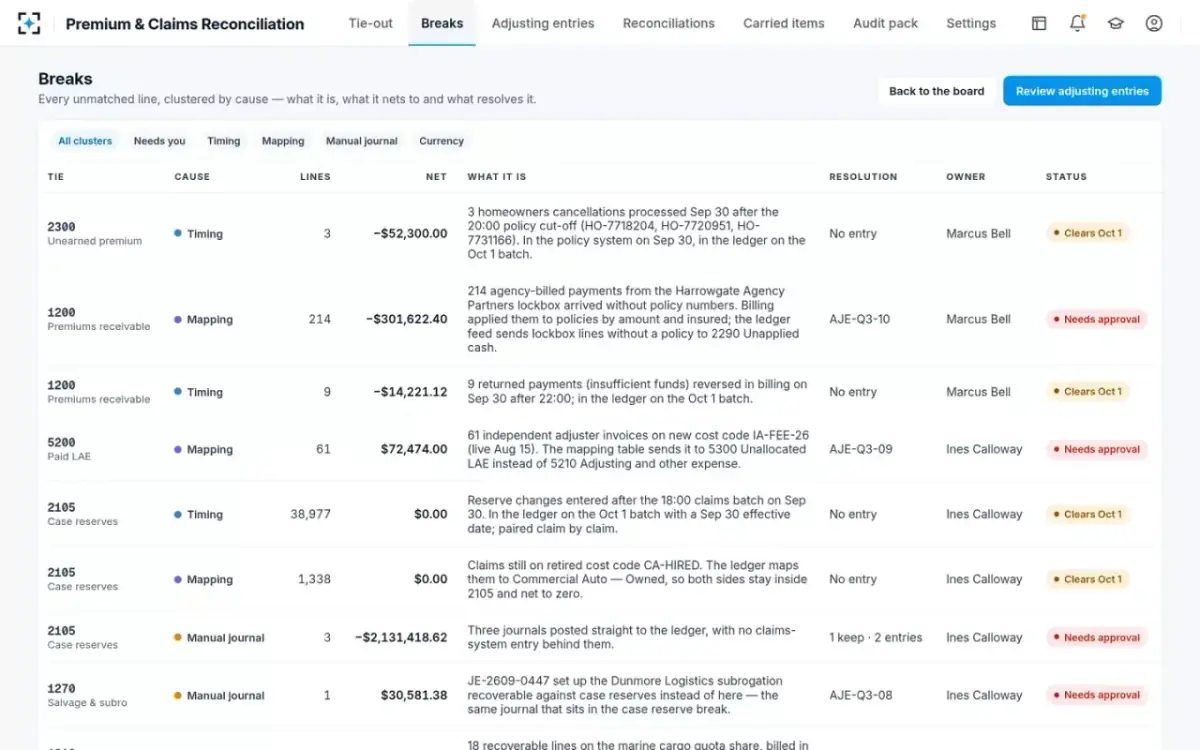
Cancellations are where premium ties break most visibly at quarter-end, because they reverse a large unearned balance in one line. At the sample insurer, three homeowners cancellations were processed on 30 September after the 20:00 policy administration cut-off. They were in the policy system on the 30th and in the general ledger on the October 1 batch, which left unearned premium out by −$52,300.00. The solution showed them as a timing cluster that clears on the next batch, with the three policy numbers, and the tie read explained rather than out of balance.
Every premium and claims break, with what it is and when it clears
How is premium recognised under statutory accounting?
Under statutory accounting, property and casualty premium is recorded as written on the effective date of the policy or endorsement and recognised as earned in proportion to the coverage provided, with an unearned premium reserve for the rest. Three refinements matter for reconciliation.
- Workers' compensation installments. Where premium varies with the insured's activity, written premium may be recorded on an installment basis matching the billing. The NAIC's own example, interpretation INT 99-27, follows a $120,000 policy billed at $10,000 a month: by 30 April, $40,000 earned and in course of collection and $80,000 booked as deferred installments against the same amount of unearned premium (NAIC INT 99-27).
- Audit premium. Premium adjusted after audits of payroll or sales is estimated as earned but unbilled premium and recorded either through written premium or as an adjustment to earned premium; part of it is nonadmitted.
- Premium deficiency. If expected losses and expenses exceed the unearned premium for a group of policies, a premium deficiency reserve is added.
Each refinement adds a balance that the policy administration system may not hold, which is why the premium ties include unearned premium and receivables as well as written premium. How the receivable side becomes nonadmitted is in non-admitted premium receivables and the 90-day rule.
What causes premium reconciliation breaks, and which clear on their own
Premium reconciliation breaks come from six causes, and four of them clear on their own if left alone: timing across a cut-off, back-dated changes, earning-method differences and returned payments. Two do not: mapping errors and cash applied to the wrong place. The work is telling them apart before anyone books a plug.
Six causes of premium breaks, and what each needs
| Cause | Example | What it needs |
|---|---|---|
| Cut-off timing | Three homeowners cancellations after the 20:00 cut-off, −$52,300.00 (sample) | Nothing: clears on the next batch; document it |
| Back-dated endorsement or cancellation | An endorsement effective in August keyed in September | Record in the right period for statutory reporting; explain in the month it lands |
| Earning method | Daily pro rata in the policy system, 24ths in a report | Agree which method the general ledger uses; reconcile the difference once |
| Returned payments | Nine payments reversed in billing after 22:00 on 30 September, −$14,221.12 (sample) | Nothing: clears on the next batch |
| Mapping | A new coverage or cost code sent to the wrong account | A correcting entry now and a mapping change for next month |
| Cash in the wrong place | 214 lockbox payments without policy numbers sent to unapplied cash, −$301,622.40 (sample) | An entry to apply the cash before the receivable ages |
The premium bars beside the claims bars on the tie-out board
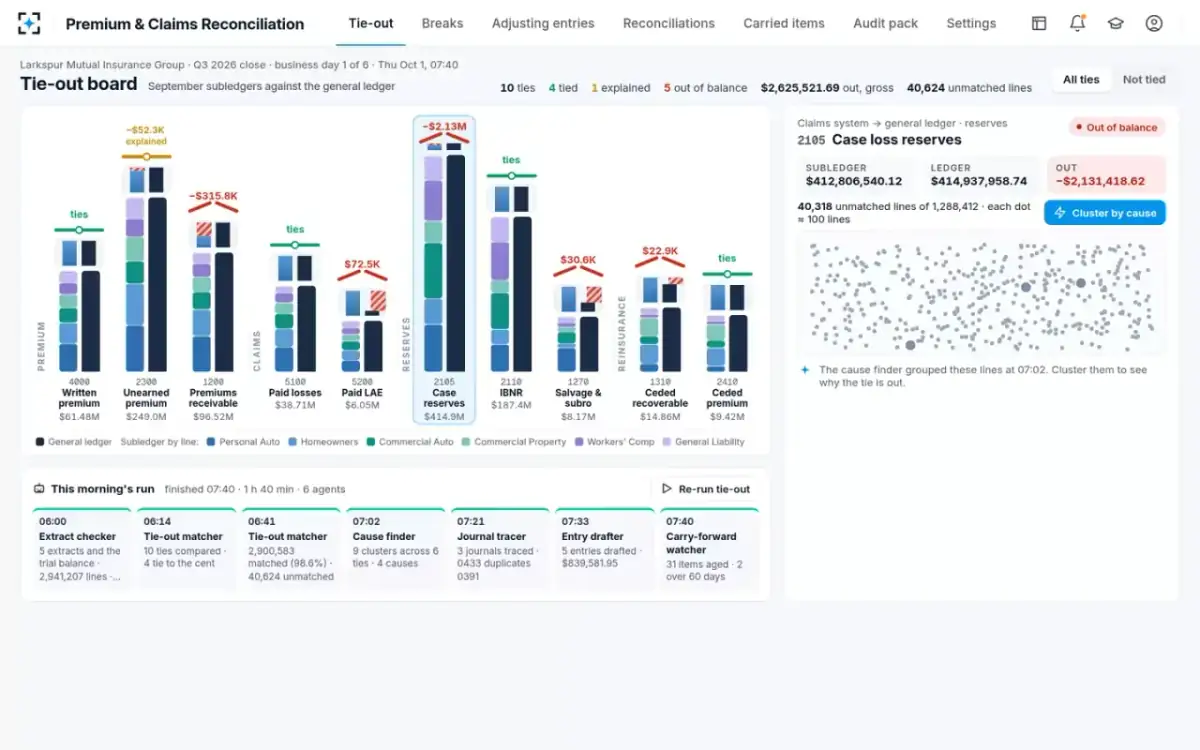
The receivable side of the same close is annotated line by line in uncollected premiums and agents' balances. To see all ten ties, from written premium to ceded balances, start from Premium & Claims Reconciliation.
Questions people ask
Is earned premium the same as collected premium?
No. Earned premium depends on how much of the coverage period has passed; collected premium depends on whether the policyholder or agent has paid. A policy can be fully earned and unpaid, or paid in advance and mostly unearned. Unpaid premium sits in premiums receivable, and over ninety days due it becomes nonadmitted.
What is the difference between gross and net written premium?
Gross written premium is direct premium plus reinsurance assumed; net written premium deducts premium ceded to reinsurers. Each has its own earned and unearned amounts, and each is tied separately: ceded premium against the reinsurance system, direct premium against policy administration.
Why can earned premium exceed written premium in a period?
Because earned premium in a period comes from all policies in force, including those written in earlier periods. An insurer whose new business is shrinking will earn more than it writes as last year's premium runs off; one that is growing will write more than it earns.
What system records written premium?
The policy administration system records written premium, by policy and endorsement on the effective date, and usually calculates earned and unearned premium too. Billing records installments and cash, and the general ledger receives daily summaries from both. The three are tied at each close.
What is earned but unbilled premium?
It is the estimated extra premium that audits will produce on policies rated on payroll, sales or other exposure measured after the policy period ends. It is recorded before it is billed, sits with deferred premiums on the statutory assets page, and part of it is nonadmitted under the NAIC's premium standard.