Statutory accounting principles (SAP) are the accounting rules that insurers in the United States follow when they report to state insurance regulators, set out by the National Association of Insurance Commissioners in its Accounting Practices and Procedures Manual and adjusted by each state's law. Their purpose is solvency: statutory statements are built to show whether an insurer has enough to pay policyholders, which is why they are more cautious than US GAAP about what counts as an asset and how liabilities are measured. That difference is also why insurers that report under more than one basis spend so much time reconciling them, and why Botminds built Statutory, GAAP & IFRS 17 Reconciliation: its agents read the statutory statement beside the GAAP and IFRS 17 results, and explain every difference with the rule that causes it.
The examples on this page come from statutes, NAIC documents and a fictional sample life and annuity insurer as its third quarter of 2026 runs through the solution.
What are statutory accounting principles?
Statutory accounting principles are, in the NAIC's own definition, "a set of accounting principles set forth by the National Association of Insurance Commissioners used to prepare statutory financial statements for insurance companies" (NAIC glossary). They apply to most insurers: "Most insurers authorized to do business in the United States and its territories must prepare financial statements using Statutory Accounting Principles (SAP). These principles are outlined in the NAIC Accounting Practices and Procedures Manual" (NAIC, Statutory Accounting Principles).
State law turns the manual into an obligation. Minnesota's statute is typical: insurers file the NAIC's verified annual statement blank, prepared under the NAIC's instructions and following the practices in its accounting manual (Minn. Stat. § 60A.13; the filing dates are in NAIC quarterly statement due dates). The rules are national in content and state by state in force.
Why do insurers use statutory accounting?
Insurers use statutory accounting because their regulators require it, and regulators require it because they need a measure of solvency rather than of earnings. The NAIC gives SAP "two main purposes": "to make financial reporting more consistent across insurers, and" "to help state insurance regulators monitor the financial condition of insurance companies" (NAIC).
At its core, statutory accounting helps regulators determine whether an insurer is financially sound, or solvent. Solvency means the company has enough resources to pay policyholders and meet its obligations when they come due.
NAIC, Statutory Accounting Principles
That purpose explains the rest. A regulator reading a statutory balance sheet is asking what would be left for policyholders if the company stopped writing business tomorrow, so the statement leaves out assets that could not be turned into claim payments and measures liabilities with margins. An investor reading GAAP statements is asking what the company earned this period, so GAAP matches costs to revenue and carries assets at values that reflect their economic worth to a going concern.
Conservatism, recognition and consistency: the three ideas, with examples
Statutory accounting rests on three concepts, and almost every difference from GAAP can be traced to one of them. The NAIC lists them, and Texas, when it adopted the NAIC manual by rule in 2000, defined them in some detail: "The SSAPs are designed to capture the accounting concepts of conservatism, recognition, and consistency" (Texas Department of Insurance, 2000).
The three ideas of statutory accounting, in the regulators' words, with one example each
| Concept | What the regulators say | What it does in practice | Example from a sample walk |
|---|---|---|---|
| Conservatism | NAIC: "Financial reporting should take a cautious approach to valuing assets and estimates." Texas: measurement "should be cautious and prudent until the given situation is more certain." | Expense costs when paid rather than defer them; hold reserves with prescribed margins | Acquisition costs of $1,126.4 million expensed under statutory accounting were capitalised under GAAP |
| Recognition | NAIC: only assets available to pay policyholders count; liabilities "must also be recognized as they are incurred". | Charge nonadmitted assets to surplus; book mandated liabilities | $214.8 million of nonadmitted assets, from deferred tax over the admission limit to office equipment, added back under GAAP |
| Consistency | NAIC: insurers "should apply accounting principles in a consistent way so regulators can meaningfully compare financial results across companies and over time." | One manual, one annual statement blank, the same schedules for every company | Every line of the statement maps to the same step of the walk each quarter, so steps can be compared quarter to quarter |
Texas's definition of conservatism is the one most worth remembering: "Conservatism is a concept which mandates that when there is exposure to uncertainty and risk, a company's accounting measurement and disclosure should be cautious and prudent until the given situation is more certain." It is a rule about uncertainty, not a preference for low numbers. Where the outcome is certain, statutory and GAAP figures often agree; where it is not, statutory accounting waits.
Recognition does the most visible work. Assets that cannot readily pay claims are left off the balance sheet and reduce surplus instead (the NAIC's words are quoted in nonadmitted assets), and the excluded amounts are the nonadmitted assets that every stat to GAAP walk adds back. Nonadmitted assets lists the common categories and the statutes behind them.
Conservatism in one step: acquisition costs expensed on one basis, deferred on the other

Who sets statutory accounting principles?
The NAIC's Statutory Accounting Principles (E) Working Group writes and maintains them, and each state decides how far they apply. The NAIC describes the working group as "responsible for developing, maintaining, and updating statutory accounting guidance through the Accounting Practices and Procedures Manual (AP&P Manual)", and its output, Statements of Statutory Accounting Principles, as "the highest level of authoritative guidance within the statutory accounting framework" (NAIC).
The state keeps the last word. "The AP&P Manual sets a national framework for statutory accounting, but it does not override state laws." Texas made the same point when it adopted the manual: "To the extent the Manual conflicts with Texas law and regulations, Texas law and regulations prevail" (Texas Department of Insurance).
What is the Accounting Practices and Procedures Manual?
It is the NAIC's book of statutory accounting: in Texas's description, "The Manual contains a preamble, Statements of Statutory Accounting Principles (SSAPs), and Appendices", and it was previously known as Codification, after the NAIC project that consolidated the states' differing practices into one framework. Texas called it "a single source intended to replace three accounting manuals" and the accounting guidance in the NAIC examiners' handbook that the department had previously adopted (Texas Department of Insurance, 2000).
Each SSAP covers one topic, and the numbers are the industry's shorthand: SSAP No. 26 for bonds, SSAP No. 55 for unpaid claims and loss adjustment expenses, SSAP No. 71 for policy acquisition costs and commissions, SSAP No. 101 for income taxes. The manual itself is sold by the NAIC, but some statements and many working-group documents are public. SSAP No. 26, effective 1 January 2025, is one: it carries most bonds at amortized cost, with the lower of amortized cost or fair value for the weakest NAIC designations (NAIC, SSAP No. 26).
What are prescribed and permitted practices?
Prescribed practices are a state's own rules, set in its statutes or regulations, that apply to every insurer domiciled there; permitted practices are exceptions a regulator approves for one insurer. The NAIC defines them as "Rules set by state laws or regulations that apply to all insurers based in that state" and "Exceptions approved by a state regulator that allow an insurer to use accounting methods that differ from standard SAP and/or state prescribed accounting practices" (NAIC).
Admission of office equipment shows how far states can differ. Florida's insurance code expressly disallows furniture, fixtures, vehicles and supplies as assets (the list is quoted in nonadmitted assets), and admits a data processing system only up to 3 percent of capital and surplus (Fla. Stat. § 625.031; § 625.012). Texas's 2000 rule, by contrast, let furniture and office equipment be admitted where its insurance code allowed. The Texas rule anticipated exactly this: a domestic insurer "need only prepare one set of statutory documents for the department and prepare a reconciliation indicating the differences between Texas' accounting requirements and the Manual for other states."
Questions to ask about any statutory number that looks unusual
- Is it the NAIC manual, a prescribed practice of the domiciliary state, or a permitted practice?
The notes to the statutory statements disclose prescribed and permitted practices that differ from the manual.
- Which of the three concepts explains it?
Conservatism for measurement, recognition for admission, consistency for presentation.
- What would GAAP do instead?
Every statutory treatment has a GAAP counterpart; the difference is a line in the walk.
- Has the NAIC considered the related GAAP standard?
Each SSAP and Appendix D say whether a GAAP standard was adopted, modified or rejected.
How does statutory accounting treat GAAP standards?
The NAIC reviews every US GAAP standard and adopts it, adopts it with modification, or rejects it. "As part of this process, the SAPWG evaluates all authoritative U.S. GAAP guidance for its relevance to statutory accounting", and the decisions "are also summarized in Appendix D – GAAP Cross-Reference to SAP of the AP&P Manual" (NAIC).
The FASB's long-duration targeted improvements, ASU 2018-12, show the process at work. The NAIC staff's 2019 agenda item summarised the standard, noted that its key changes revised GAAP guidance "previously rejected for statutory accounting", and recommended rejecting it (NAIC SAPWG, agenda item 2019-06). By 2023 the staff were treating a later amendment, ASU 2022-05, the same way, because the standard it adjusted had already been rejected (NAIC SAPWG, March 2023; the effective dates are in the difference between statutory and GAAP reserves). Since then, life insurers' GAAP reserves have updated assumptions at least annually while their statutory reserves have not.
Statutory accounting principles and US GAAP, side by side
Statutory accounting principles: Solvency: can the insurer meet its obligations to policyholders?
US GAAP: Information for investors, often with the emphasis on income.
Statutory accounting principles: The NAIC's working group, subject to each state's law.
US GAAP: The FASB, with the SEC overseeing public companies.
Statutory accounting principles: The balance sheet and surplus.
US GAAP: The income statement and earnings emergence.
Statutory accounting principles: Only admitted assets count; the rest reduce surplus.
US GAAP: All assets meeting the definition, with impairment and allowances.
Statutory accounting principles: Expensed when incurred.
US GAAP: Deferred and amortized.
Statutory accounting principles: Valuation Manual minimums.
US GAAP: Current-assumption liability for future policy benefits since LDTI.
Statutory statements: the deadlines and the audit
Statutory accounting principles are applied on a fixed calendar set by state law. Florida's rule is representative: the annual statement by 1 March, and quarterly statements for the periods ending 31 March, 30 June and 30 September within 45 calendar days (Fla. Admin. Code r. 69O-137.001; the full calendar is in NAIC quarterly statement due dates). The annual statement is then audited: the NAIC's Model Audit Rule requires an independent CPA's audit and an audited financial report filed by 1 June, and larger insurers add a report on internal control over financial reporting.
The calendar matters for anyone reconciling the bases, because statutory figures are final on the regulator's timetable while GAAP and IFRS figures run to the group's, which is usually earlier. The statutory accounting manager's seat, and how the other reporting seats depend on it, is described in statutory accounting manager: one quarter, three bases, four seats.
Where statutory accounting principles meet GAAP and IFRS 17 in practice
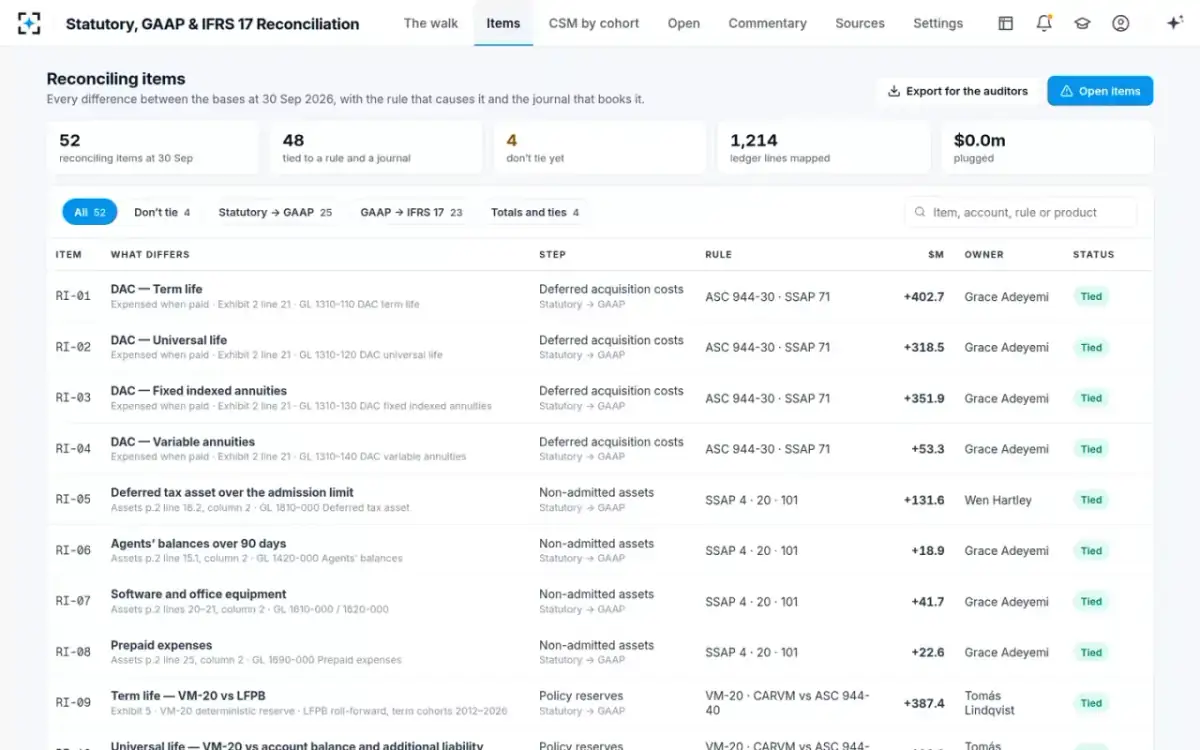
In a multi-basis insurer, every statutory principle becomes a reconciling item somewhere. The sample insurer's statutory capital and surplus of $1,842.6 million became $2,962.2 million of US GAAP equity and $1,677.7 million of IFRS 17 equity; conservatism explains the acquisition-cost and reserve steps, recognition the nonadmitted step, and the IFRS 17 steps are a third set of rules again. The walk from surplus to equity is worked line by line in stat to GAAP adjustments.
Statutory principles as reconciling items, each with its rule
Questions people ask
Is statutory accounting the same in every state?
Largely, but not entirely. The NAIC's manual sets a national framework, and states follow it subject to their own prescribed practices and to permitted practices approved for individual insurers; where a state's law conflicts with the manual, the state's law prevails, as Texas's adoption rule states expressly.
What is the difference between SAP and GAAP?
SAP measures solvency for regulators and focuses on the balance sheet; GAAP measures performance for investors and focuses on income. The NAIC's glossary calls statutory accounting the more conservative of the two (quoted in nonadmitted assets), and the differences show up as adjustments in any reconciliation between the two.
What is statutory surplus?
It is the statutory measure of an insurer's net worth: admitted assets minus liabilities. The NAIC's glossary defines capital and surplus as "a company's assets minus its liabilities", and its capital and surplus requirement as generally measured as admitted assets minus liabilities "determined on a statutory accounting basis".
Who uses statutory financial statements?
State insurance regulators and examiners first, then the NAIC's financial analysts, rating analysts and reinsurers assessing counterparties. The annual statement, in the NAIC's words, "provides a snapshot of the financial condition of a company and significant events which occurred throughout the reporting year".
What is an SSAP?
A Statement of Statutory Accounting Principles: one numbered topic in the NAIC's manual, such as SSAP No. 26 on bonds or SSAP No. 71 on acquisition costs. The NAIC describes SSAPs as the highest level of authoritative guidance in the statutory framework, and each states whether related GAAP guidance was adopted, modified or rejected.