IFRS 17 implementation support, for an insurer that has already gone live, means help with the quarters that follow: tying the IFRS 17 results to the general ledger and to the other bases the company reports, explaining the movements, and producing commentary an audit committee can rely on. The best way to choose that support is to run it on a quarter you have already closed, because your signed walk between statutory, US GAAP and IFRS 17 is an answer key no demonstration can fake. Botminds tests Statutory, GAAP & IFRS 17 Reconciliation this way: in about two weeks, its agents rebuild last quarter's walk from your own statement, trial balance and IFRS 17 results, and you count what it explained without help, what it could not, and what it found that your team had not.
The figures in the opening panel come from a fictional sample life and annuity insurer as its third quarter of 2026 runs through the solution. A pilot on your own quarter produces the same counts for your own book.
What one sample quarter produces, and what a pilot counts on yours
1,214
lines from three bases mapped to 15 walk steps
48/52
reconciling items tied to their rule and journal; 4 left open with owners
$0.0m
plugged: an amount the walk cannot explain stays visible
44min
from reading the last basis to a drafted commentary
What does IFRS 17 implementation support include?
IFRS 17 implementation support covers three different jobs, and buyers often get the wrong one. Project support helps design the accounting policies and build the engine and data; actuarial support helps run and validate the measurement; reporting support helps turn each quarter's results into tied statements and explanations. The IASB's own cost analysis put the first two at the start of the journey: "project design and implementation", "systems set-up", "process changes" and "education and communication" (IASB, IFRS 17 Effects Analysis).
After go-live the need shifts to the third job, and it recurs every quarter. IFRS 17 has applied to annual periods beginning on or after 1 January 2023 (IFRS 17, paragraph C1), so an insurer that adopted it then has more than a dozen quarter-ends behind it. Each produced a movement analysis, a set of reconciliations and a commentary. That archive is the raw material for testing any new support honestly.
The two-week pilot, day by day
A pilot on last quarter takes ten working days and about a day and a half of your team's time. It loads the results you signed, rebuilds the walk without seeing your bridge, then compares the rebuilt walk with the signed one, item by item.
Ten working days on last quarter, from loading the bases to the scorecard
- Load and tiedays 1–2
- Map linesdays 3–4
- Match rulesdays 5–6
- CSMday 7
- Breaksday 8
- Draftday 9
- Scoreday 10
The first six days carry the set-up work that a live quarter does not repeat. The basis map, which assigns each statement line, account and movement-analysis row to one step of the walk, is built once from your chart of accounts and last bridge, then reused. The accounting policy papers are read once, so that each reconciling item can be tied to the section that governs it. Days seven to nine run exactly what a live quarter would run, and day ten is the part that decides.
Why last quarter is the honest test
Last quarter is the honest test because you already know the answer, and so does your auditor. A demonstration shows software on data designed to make it look good; a pilot on a closed quarter shows it on data you have signed, with differences you already explained, breaks you already chased and a commentary your audit committee already read.
A demonstration and a pilot on last quarter: what each can prove
Demonstration: Prepared sample data that is internally consistent.
Pilot on your closed quarter: Your statutory statement, GAAP trial balance and IFRS 17 output, with their real inconsistencies.
Demonstration: None: the vendor decides what success looks like.
Pilot on your closed quarter: Your signed walk, reconciling items and commentary.
Demonstration: Planted, and always found.
Pilot on your closed quarter: Real: the pilot either finds the ones you found, or does not, and may find some you missed.
Demonstration: Read well; cannot be checked.
Pilot on your closed quarter: Checked sentence by sentence against what your actuary and controller actually wrote.
Demonstration: How the product is meant to work.
Pilot on your closed quarter: How much of your quarter it would have done, and where it needed help.
The IASB expected some insurers to run parallel systems after adoption, noting that "Implementation activities may involve significant time and effort if a company chooses to run parallel systems and processes to understand detailed differences between IFRS 17 and IFRS 4 data and perform consistency checks for a few years" (IASB). A pilot on a closed quarter is a parallel run in miniature: one quarter, with the differences counted rather than lived with.
What data does an IFRS 17 pilot need?
An IFRS 17 pilot needs what your team used to close the quarter, in the form it was used. If the pilot asks for a new data model or re-run results, it is testing an implementation project, not support for the quarter.
The files a two-week pilot on last quarter needs
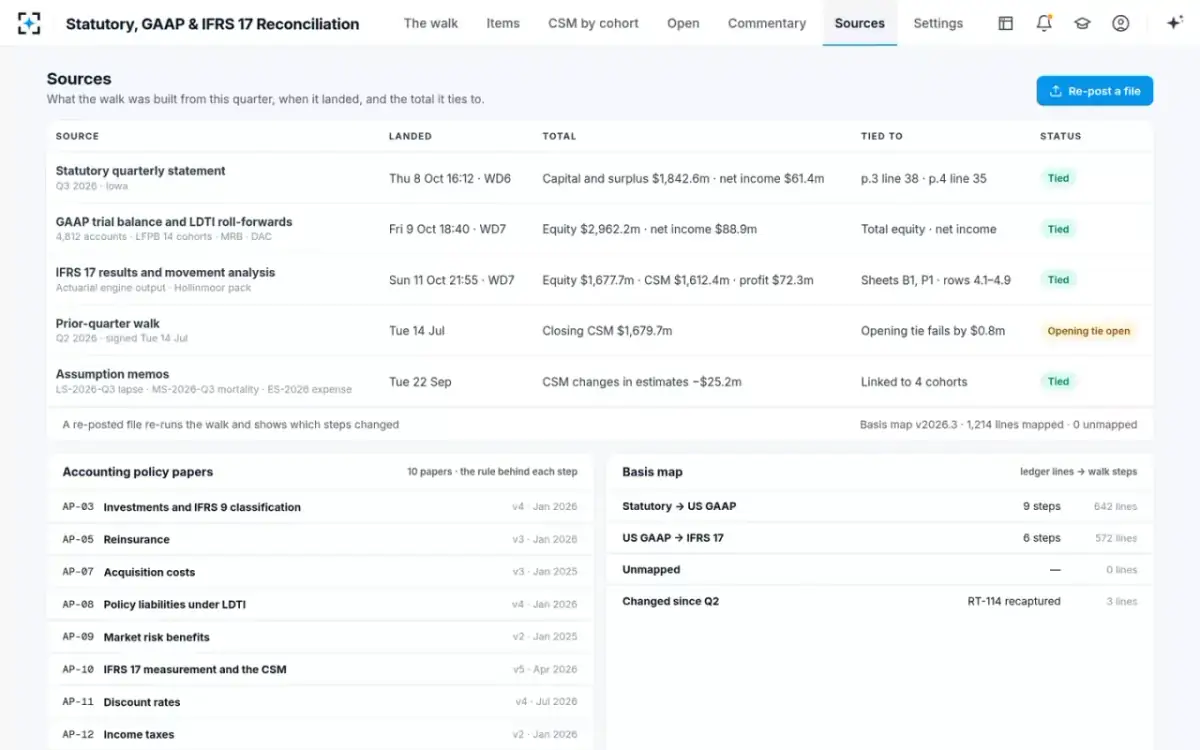
- The statutory quarterly statement as filed
Pages, exhibits and schedules, so totals tie to page and line, and nonadmitted assets and reserves can be read by line.
- The US GAAP trial balance and long-duration roll-forwards
Including deferred acquisition costs, the liability for future policy benefits and market risk benefits where they apply.
- The IFRS 17 results and movement analysis from your engine
By group and annual cohort, with the transition groups identified.
- Your accounting policy papers for each basis
The rule behind each step of the walk, at the versions in force that quarter.
- The assumption memos for the quarter
Lapse, mortality and expense studies, so changes in estimates can be linked to their cause.
- Last quarter's signed walk and the one before it
The prior one to test the opening ties; the signed one as the answer key, kept back until day ten.
Each source shown with when it landed and the total it ties to
What pass rate should a reconciliation pilot reach?
Some pass marks are absolute and some are yours to set. A total that does not tie, a line left unmapped or a plug in the walk is a failure at any amount; how many reconciling items the pilot should explain without help depends on how unusual your quarter was. Set the second kind before the pilot starts, so that the scorecard cannot be argued after it.
The pilot scorecard: what is absolute, and what you set in advance
| Measure | Pass mark | Why |
|---|---|---|
| Each basis total ties to its source | 100%, no tolerance | Everything else is built on these three numbers |
| Lines mapped to a walk step | 100%; none unmapped | An unmapped line is an unexplained amount by another name |
| Plug in the walk | $0 | A plug hides the difference the walk exists to explain |
| Reconciling items tied to a rule and a journal | Set in advance; the solution's design target is every item | Measures how much of the bridge the agents could support |
| Items matching your signed walk in amount and step | Set in advance | Differences are either pilot errors or errors in the signed walk; both are worth knowing |
| Breaks found that your team also found | All of them | A pilot that misses a known break would miss an unknown one |
| Breaks found that your team did not | Counted, not required | Each one is examined on day ten; some will be real |
| Commentary figures linked to a step | 100% | An unlinked figure cannot be checked by a reviewer |
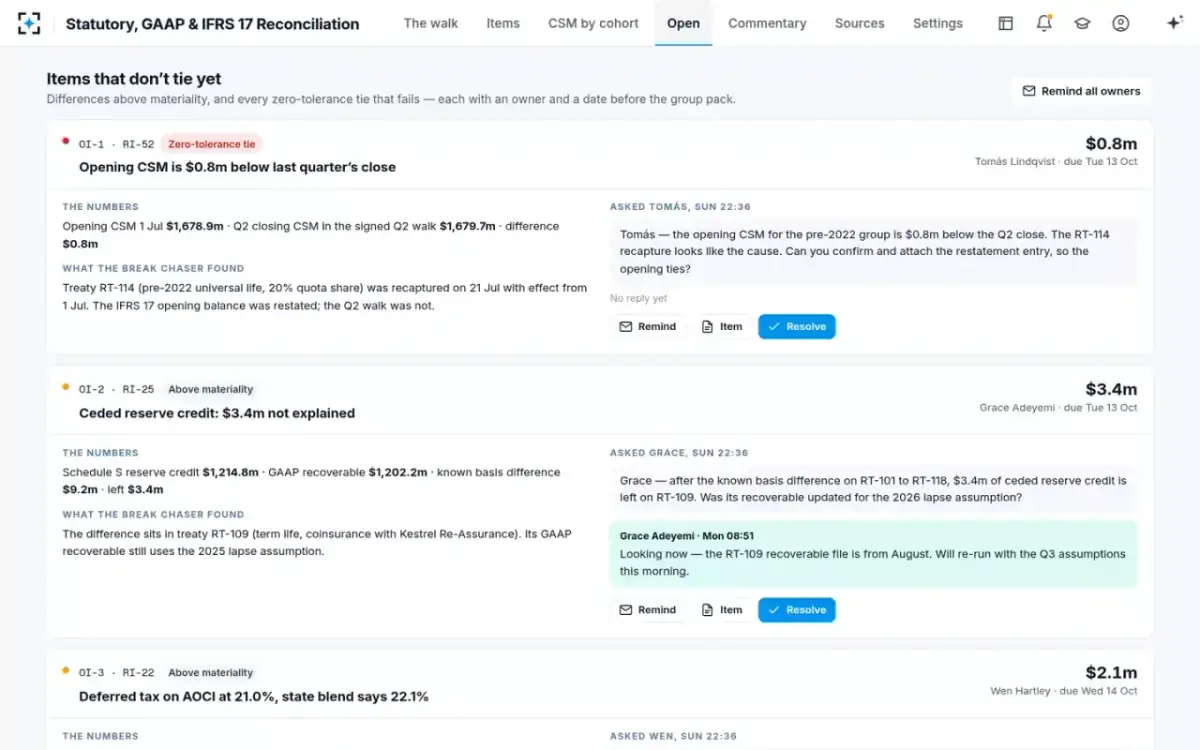
The difference column deserves time on day ten. Not every difference between bases is an error, and the regulators say so: the NAIC's actuarial opinion working group names non-tabular discounting as one legitimate source of difference (quoted in the difference between statutory and GAAP reserves), where reserves in one statutory document are gross of discount and in another net (NAIC, 2026 Regulatory Guidance). A good pilot labels each difference as legitimate, explained, or open, and gives the open ones an owner.
Breaks the agents could not close, each with numbers, a likely cause and an owner
What is multi-GAAP reporting, and why does it need its own test?
Multi-GAAP reporting is preparing the same entity's results under more than one accounting basis, and for a US insurer the usual set is statutory accounting for the regulator, US GAAP for investors or lenders, and IFRS 17 for a parent that reports under IFRS. The parent's obligation is the reason for the third: IFRS 10 requires consolidated statements "using uniform accounting policies for like transactions and other events in similar circumstances" (IFRS 10, paragraph 19).
Each basis has its own authority, so the differences between them are structural rather than errors. The NAIC's Statutory Accounting Principles Working Group reviews every US GAAP standard and adopts it, adopts it with changes, or rejects it (NAIC; how those decisions show up in a walk is in stat to GAAP adjustments). Reconciliation between bases is also a regulatory habit: Texas, adopting the NAIC manual, required audited statutory statements to be reconciled to the annual statement filed with the department (Texas Department of Insurance, 2000). A pilot that tests only IFRS 17 against itself misses where a US subsidiary's hardest questions sit: between the bases.
What a pilot cannot show
A two-week pilot shows whether the agents can rebuild and explain a quarter; it cannot show everything a production rollout must. It does not test your measurement, because it reads the engine's output rather than re-running it, and it will not fix data quality inside the engine, though it will surface the differences bad data causes. It does not prove production controls: insurers above the NAIC's $500 million premium threshold must report on internal control over financial reporting under Model Regulation #205 (NAIC Model #205), and the controls around a new tool belong in that assessment after the pilot, not instead of it.
Nor does one quarter show how the explanations hold over time. The disclosures that enforcers found weakest in first-year reports were judgements and transition: ESMA found that "31% of issuers provided very limited explanations on the use of the modified retrospective approach (MRA)" (ESMA, 2024). A pilot should include at least one transition group, so the scorecard covers the part of the margin that will need explaining for years.
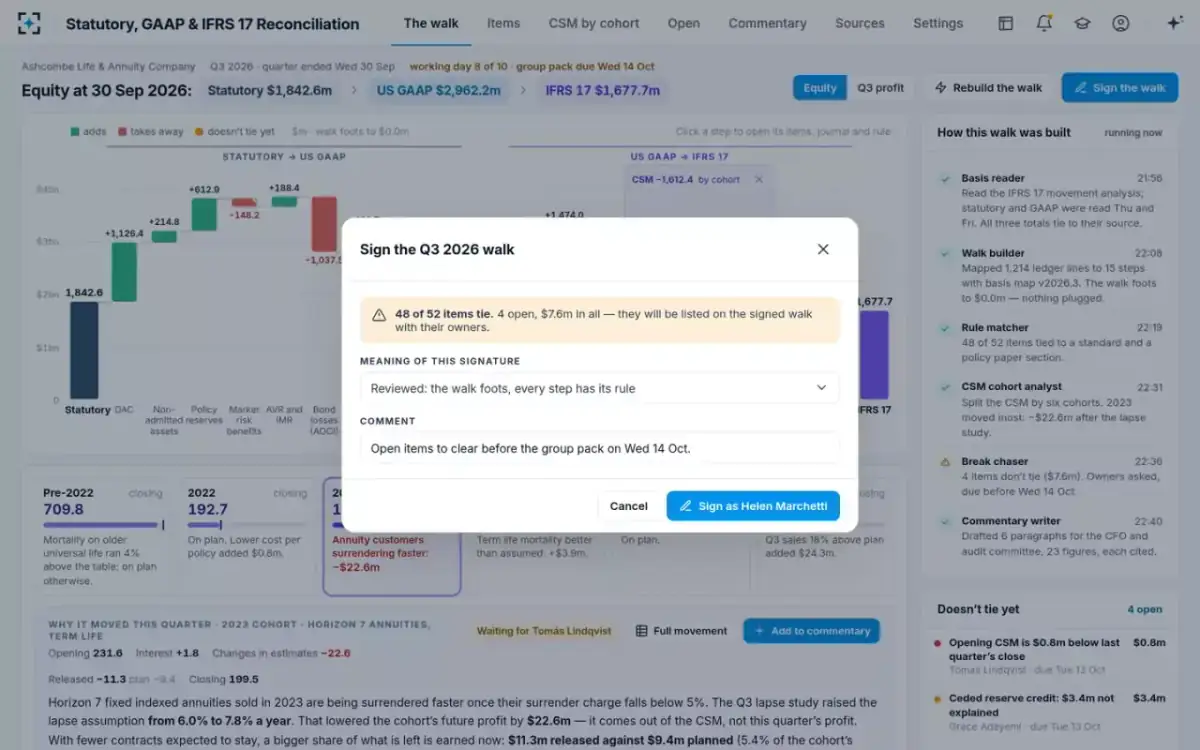
Signing the rebuilt walk records what the signature means
Who should run an IFRS 17 pilot?
The head of financial reporting should own the pilot, because the scorecard is a judgement about the walk they sign. The valuation actuary should review the cohort notes, because the explanations of changes in estimates are theirs; a group reporting accountant should own the basis map and answer the break questions. The external auditor can be invited to read the results: an export of every reconciling item, with its rule, journal and owner, is the same file they would ask for in a live quarter. The four seats of a multi-basis quarter describes who does what in more detail, and IFRS 17 software: engine, suite or explanation layer sets the pilot against the alternatives.
Questions people ask
How long should an IFRS 17 reporting pilot take?
Two weeks is enough for one legal entity and one closed quarter: about six working days to set up the basis map and policy papers, three to run the quarter, and one to compare and score. A longer pilot usually means the product needs data the quarter did not use, which is a finding in itself.
What is a basis-to-basis walk?
It is the bridge that explains why equity and profit differ between two accounting bases, step by step: for a life insurer, from statutory capital and surplus to US GAAP equity, then to IFRS 17 equity. In the sample quarter it runs from $1,842.6 million to $2,962.2 million to $1,677.7 million in fifteen steps.
Can we use the pilot results with our auditors?
Yes, as information rather than assurance. The pilot's export lists every reconciling item with its source line on each basis, its rule and its owner, and the comparison with your signed walk shows where the two differ; auditors will still test the live quarter under their own procedures.
What if the pilot finds an error in our signed walk?
Treat it like any post-close finding: confirm it with the owner, size it, and decide under your own policies whether it needs correction. The NAIC's 2026 guidance shows that some differences between documents are legitimate, such as non-tabular discounting, so confirm before you conclude.
Do we need IFRS 17 implementation support after go-live?
Most of the remaining effort after go-live is analysis rather than calculation, which the IASB expected when it said the main ongoing cost would come from analysing what the systems produce. Whether you need outside support depends on how long your team takes to explain a quarter and how much of that time is mapping and tying.