A statutory accounting manager prepares and defends the financial statements an insurer files with its state regulators: the NAIC quarterly statements, due 45 days after each quarter, and the annual statement, due by 1 March in states such as New York and Minnesota, built under statutory accounting principles rather than US GAAP. The job is hard less because of any single rule than because the same book is also being reported, on other days and from other systems, by a US GAAP team, often an IFRS 17 team for a foreign parent, and a valuation actuary whose numbers feed all three. Botminds' Statutory, GAAP & IFRS 17 Reconciliation exists for the space between those seats: its agents read the three sets of results, build the walk that explains why equity and profit differ, and route each difference to the person who owns it.
The worked figures on this page come from a fictional sample life and annuity insurer as its third quarter of 2026 runs through the solution. The rules and labour statistics come from state statutes, the NAIC, the IASB and the US Bureau of Labor Statistics, linked where they appear.
The seat in numbers
45days
after quarter-end for the NAIC quarterly statement, in states such as Minnesota
1 Mar
annual statement deadline; the CPA-audited report follows by 1 June
$93,290
median pay of accountants and auditors in finance and insurance, May 2025
2officers
must swear to a New York annual statement
What does a statutory accounting manager do?
A statutory accounting manager owns the statutory financial statements from trial balance to filed blank: the balance sheet, the summary of operations, the capital and surplus account, the exhibits and schedules behind them, and the notes. The framework is statutory accounting, which the NAIC says most insurers authorised in the United States and its territories must use (NAIC, Statutory Accounting Principles; the framework is explained in statutory accounting principles).
Statutory statements answer a different question from GAAP statements. In the NAIC's description, statutory accounting looks at the balance sheet and whether the insurer can pay, while US GAAP serves investors and leans on the income statement. In practice the statutory seat spends its quarter on the items GAAP never asks about: which assets are nonadmitted and taken out of surplus, how reserves follow the state's valuation law, how investments are carried, and how every line ties to the schedules a regulator will read. Statutory accounting principles, in plain words covers the framework itself; this page is about the people who run it.
The Bureau of Labor Statistics has no occupation called statutory accountant, but its description of controllers fits the senior end of the seat: "Controllers also are in charge of preparing reports required by governmental agencies that regulate businesses" (BLS, Financial Managers). For an insurer, the governmental agency is the domiciliary insurance department, and the report is the NAIC statement.
Four seats share one quarter: statutory, US GAAP, IFRS 17 and the valuation actuary
A life or annuity writer with public debt or a foreign parent rarely has one set of books. It reports statutory results to its regulator, US GAAP results to investors or lenders, and, if its parent reports under IFRS, IFRS 17 results into the group pack. IFRS 10 is the reason the third basis exists for a US subsidiary: a parent must consolidate using uniform accounting policies, so the subsidiary's numbers have to be restated onto the parent's basis (IFRS 10, paragraph 19; how a group runs all three is in IFRS 17 implementation support).
Four seats, one quarter: what each owns, waits for and hands off
Today
Owns the quarterly and annual statements, nonadmitted assets, statutory reserves as booked, and the tie of every page to its schedule. Waits for the actuary's statutory reserves and the investment schedules. Hands the closed statement to GAAP and group reporting.
With agents
Gets each statutory line already mapped to its step in the walk, and a specific question with the numbers when a GAAP or IFRS 17 figure does not reconcile to it.
Still theirs: the statement, the admitted-asset calls, the officers' sign-off
Today
Owns the GAAP trial balance and the long-duration roll-forwards for deferred acquisition costs, policy benefits and market risk benefits. Waits for statutory to close and for the actuary's GAAP runs. Hands GAAP equity to the walk.
With agents
Sees each GAAP-to-statutory difference itemised against its accounting policy, with the journal that books it.
Still theirs: policy choices, adjusting entries
Today
Owns the IFRS 17 results, the movement analysis and the disclosure tables for the parent. Waits for engine output, often last of all. Hands the group pack to the parent.
With agents
Starts from a drafted explanation of the contractual service margin by cohort and a list of what does not tie.
Still theirs: the group submission, disclosure judgements
Today
Owns the reserves and assumptions on every basis. Answers the same question about the same cohort in three formats each quarter.
With agents
Reviews one plain-words note per cohort, linked to the assumption study behind it, and approves it once.
Still theirs: assumptions, cohort notes, the reserve opinion
The IASB anticipated that IFRS 17 work would need all of these skills at once. Its effects analysis expected implementation "to be carried out by project teams comprising individuals with accounting, actuarial and systems knowledge and experience" (IASB, IFRS 17 Effects Analysis). What it did not say is that after go-live the same mix of people must explain every quarter to each other, in each basis's own vocabulary.
The dates a statutory accounting manager answers to
The statutory seat runs to statute, not to the group's preferred close. Minnesota's law is typical: quarterly statements for the first three quarters are due within 45 days of each quarter-end, and the annual statement by 1 March (Minn. Stat. § 60A.13; every date is set out in NAIC quarterly statement due dates). The audited statutory report follows by 1 June under the NAIC's Model Audit Rule.
The statutory year, and who else needs the numbers first
| Deliverable | When | Rule | What the other seats need from it |
|---|---|---|---|
| Quarterly statement, Q1 to Q3 | Within 45 days of quarter-end | State law, e.g. Minn. Stat. § 60A.13 | GAAP and IFRS 17 reporting usually need statutory reserves and investment values earlier, inside the group timetable |
| Annual statement | On or before 1 March | State law; NAIC annual statement blank and instructions | Year-end GAAP and IFRS 17 statements rely on the same reserves and asset values |
| Audited statutory financial report | On or before 1 June | NAIC Model Regulation #205 | Auditors test the statutory figures that the walk starts from |
| Report on internal control over financial reporting | With the audited report, for insurers at $500 million or more of premium | NAIC Model Regulation #205 | Controls over the statutory-to-GAAP adjustments sit in the same control set |
The timing problem is that the other seats cannot wait 45 days. A group pack is usually due within the first two weeks after quarter-end, so statutory reserves, investment values and tax have to be final, or close to it, well before the statutory filing itself. The sample insurer's statutory quarterly statement was ready on the sixth working day; its GAAP and IFRS 17 results followed over the next three days, and the group pack was due on the tenth. The statutory manager's real deadline was set by the parent, not the state.
Who signs the statutory statements, and what the signature covers
Officers sign the statutory statement under oath, and an independent CPA audits it once a year. New York's law requires the annual statement to be "verified by the oath of at least two of its principal officers" (N.Y. Ins. Law § 307), and the Model Audit Rule requires every insurer to have an annual audit by an independent CPA and to file the audited report by 1 June (NAIC Model #205; what the auditor asks for is in the PBC request list for a reserve audit).
The statutory accounting manager rarely signs the jurat personally, but prepares everything the signing officers rely on. That is why the seat is cautious about anything that changes a statutory number after it is reported: a late adjustment discovered in the GAAP walk is, for the statutory manager, a question about whether a filed statement was right. For larger insurers the same regulation adds a management report on internal control over financial reporting, so the controls over the hand-offs between bases are audited too.
How a statutory accounting job differs from a GAAP reporting job
The statutory seat reports to a regulator about solvency; the GAAP seat reports to investors about earnings. The NAIC frames it the same way: statutory accounting is there to tell regulators whether the insurer is solvent (NAIC). The difference shows in what each seat argues about.
Statutory accounting manager and GAAP reporting lead: the same book, different questions
Statutory seat: The domiciliary regulator, examiners, the NAIC analysts and rating analysts reading the blank.
US GAAP seat: Investors, lenders and the SEC, if the company or its parent files.
Statutory seat: Can the insurer pay its policyholders? Surplus and its adequacy.
US GAAP seat: What did the business earn this period? Income and its emergence.
Statutory seat: The NAIC's Statutory Accounting Principles (E) Working Group, through the AP&P Manual, plus state law.
US GAAP seat: The FASB, through the Accounting Standards Codification.
Statutory seat: Is this asset admitted? Does the reserve meet the valuation law? Does page 2 tie to Schedule D?
US GAAP seat: Which costs are deferred? Which assumptions are unlocked? What goes through other comprehensive income?
Statutory seat: Each GAAP standard is adopted, adopted with modification or rejected. The NAIC rejected the FASB's long-duration improvements (LDTI) for statutory use.
US GAAP seat: Adopts FASB standards as issued, such as LDTI for long-duration insurance contracts.
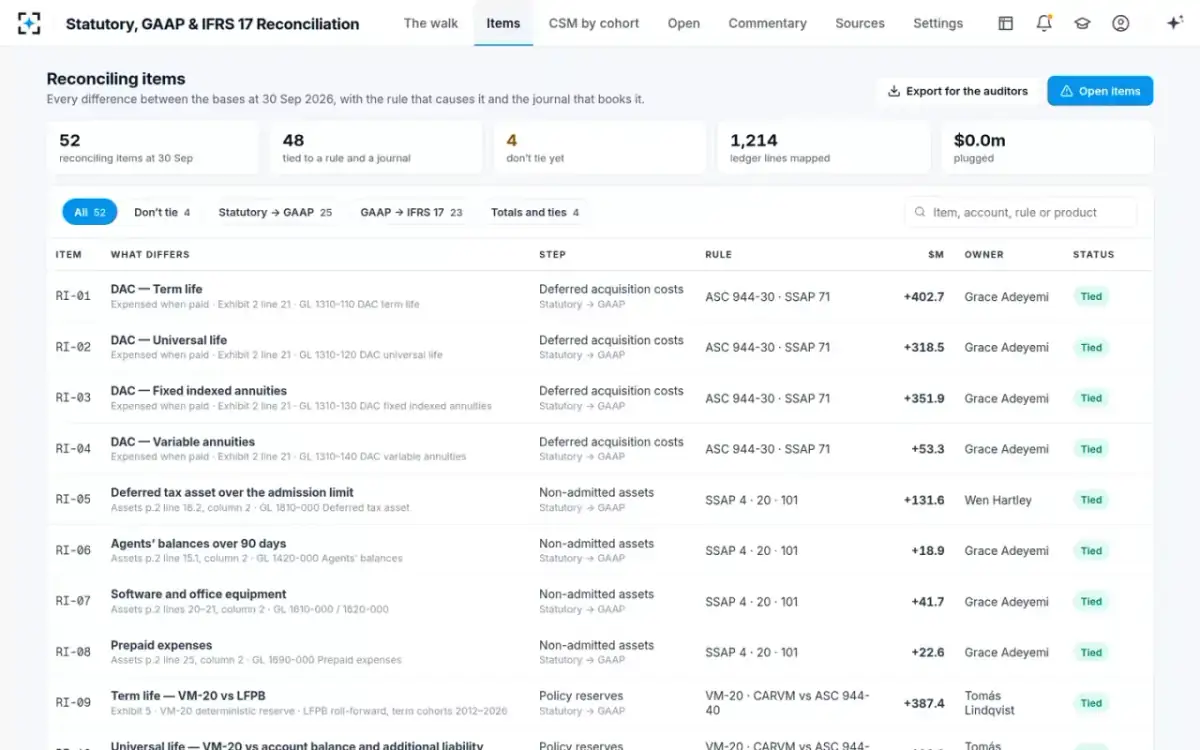
The practical consequence is that the two seats rarely disagree about a number, and often disagree about what it means. The sample insurer's statutory manager sees $214.8 million of nonadmitted assets, from deferred tax over the admission limit to office equipment, as surplus that cannot pay claims; the GAAP lead sees the same assets as perfectly good, and adds them back. Stat to GAAP adjustments, line by line follows the sample insurer from statutory surplus to GAAP equity.
Where the hand-offs between the seats break
The hand-offs break at the edges of each basis, where one team's closing number becomes another team's opening one. Four places account for most of the chasing in a multi-basis quarter, and none of them is a calculation error.
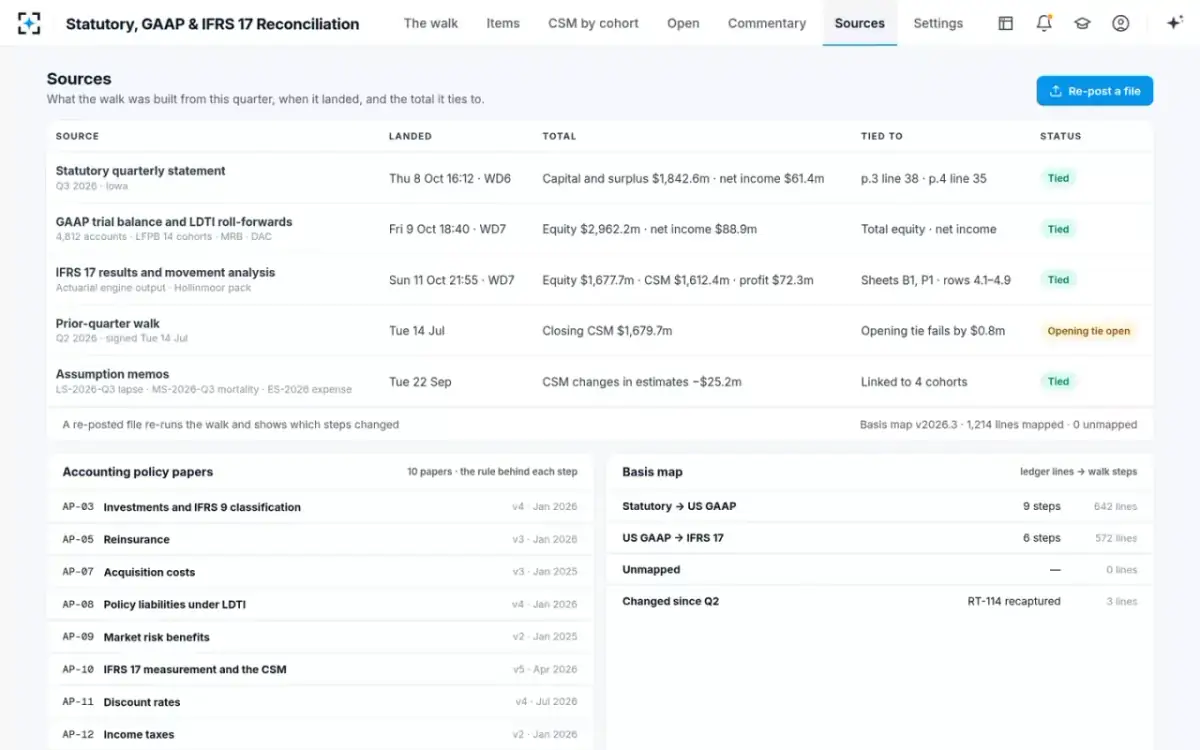
The first is the opening balance. If last quarter's walk was signed and then a number on one basis was restated, this quarter's opening no longer equals last quarter's close, and nobody notices until the walk fails to foot. In the sample quarter the opening contractual service margin was $0.8 million below the signed prior close, a small amount on a $1.68 billion balance, but one that should never be accepted without an explanation. The IFRS 17 CSM roll forward shows why the opening tie matters more than the closing one.
The second is the grain. The statutory statement speaks in pages and lines, the GAAP trial balance in accounts, the IFRS 17 results in movement-analysis rows and cohorts. Somebody has to map 1,214 lines of the sample insurer's three bases to 15 steps of the walk before a single difference can be explained. The third is the assumption change that lands in one basis before another, such as a ceded reserve credit still computed on last year's lapse assumption while the direct reserves use this year's. The fourth is the late top-side entry that one team posts and another does not hear about.
What landed, when, and the total each source ties to
What skills does a statutory accountant need?
A statutory accountant needs the GAAP foundation every accountant has, and then three things GAAP does not teach: the NAIC's statements of statutory accounting principles, the annual statement blank and its instructions, and enough actuarial literacy to read a reserve. The BLS describes the entry route as a bachelor's degree in accounting or a related subject, with a CPA licence improving the prospects (BLS, Accountants and Auditors).
The actuarial literacy matters more each year. Life reserves under principle-based reserving are no longer a formula the accountant can recompute: the NAIC describes insurers holding the greater of a formula reserve and a reserve modelled across many economic scenarios (NAIC, Principle-Based Reserving; set out in the difference between statutory and GAAP reserves). The statutory manager does not run those models, but must be able to ask why a reserve moved and recognise an answer that does not add up. The same is true of IFRS 17, where the IASB requires the fulfilment cash flows to be updated "at each reporting date, using current estimates that are consistent with relevant market information" (IASB, IFRS 17 Project Summary).
The labour market reflects the mix. Accountants and auditors held about 1.6 million jobs in 2025 with a median wage of $83,680, and $93,290 in finance and insurance; financial managers, the occupation that includes controllers, earned a median of $166,570 (BLS; BLS). Actuaries, the valuation seat, held about 31,200 jobs, 78% of them in finance and insurance (BLS, Actuaries).
What changes for the seat when agents read the three bases
Agents change the mechanical half of the quarter and leave the judgement half where it is. In Botminds' estimate of a three-basis quarter, about 4.75 working days pass between the last basis landing and an explained walk when the work is done by spreadsheet; mapping lines to steps alone takes more than a day. With Statutory, GAAP & IFRS 17 Reconciliation, the design target is one day.
From the last basis landing to an explained walk: where the days go
| Step | By spreadsheet | With the solution | What is left for people |
|---|---|---|---|
| Tie each basis total to its source | 0.5 days | 0.1 days | Nothing, unless a total fails to tie |
| Map statement lines, accounts and rows to walk steps | 1.25 days | 0.1 days | Approving a new line the basis map has not seen |
| Match each item to its rule and policy paper | 0.75 days | 0.1 days | Deciding a policy question when no paper applies |
| Explain the contractual service margin by cohort | 0.75 days | 0.25 days | The valuation actuary approves each note |
| Chase what does not tie | 0.75 days | 0.25 days | Owners explain or correct; entries are posted by people |
| Write the commentary | 0.75 days | 0.2 days | The CFO approves it |
| Total | 4.75 days | 1.0 day | Review, answers and three approvals |
What does not move is the signature. The agents read the statutory statement, the GAAP trial balance and the IFRS 17 results, but never post a journal entry or change an assumption, and a difference on a zero-tolerance tie, such as the opening margin, stays open until its owner explains it. The statutory accounting manager still decides what is admitted; the valuation actuary still owns every assumption; the head of financial reporting still signs the walk.
Every difference between the bases, with its rule and its owner
Questions people ask
What is the salary of a statutory accounting manager?
The BLS does not publish a figure for that title. The nearest published figures are the May 2025 medians for accountants and auditors in finance and insurance, $93,290, and for financial managers across all industries, $166,570; a statutory manager's pay usually sits between the two, depending on the size of the insurer and whether the role leads a team.
Who prepares the NAIC annual statement?
The insurer's statutory reporting team prepares it, with reserves from the appointed or valuation actuary and investment schedules from the investment accounting team. At least two principal officers verify it under oath in states such as New York, and it is filed with the domiciliary regulator by 1 March.
What is a statutory reporting manager?
Usually the same job under another name: the person accountable for the statutory quarterly and annual statements and the regulatory filings around them. In some groups the title covers several legal entities' statements, each filed with its own domiciliary state, which multiplies the filings but not the principles.
How many bases does an insurer report on?
Every US insurer reports statutory results to its regulator. Many also report US GAAP, because the insurer or its parent has public securities or lenders who require it, and a subsidiary of a group that reports under IFRS also reports IFRS 17 figures into the group consolidation. Three bases, plus tax, is common for a life writer with a foreign parent.
Does a statutory accountant need to be a CPA?
Not by law for most in-house roles. The BLS says CPA licensing "may improve job prospects", and any accountant who files a report with the SEC must be a licensed CPA; the independent auditor who signs the statutory audit opinion under the Model Audit Rule must be a CPA, but the preparer need not be.
What does a valuation actuary do for IFRS 17?
The valuation actuary produces the measurements IFRS 17 is built on: the estimates of future cash flows, the risk adjustment for non-financial risk and the contractual service margin for each group of contracts, updated at each reporting date. In a multi-basis quarter the same actuary usually explains the statutory and GAAP reserve movements too, which is why one approved note per cohort saves the most time.