NAIC quarterly statement due dates fall 45 days after the end of the first, second and third calendar quarters: 15 May, 14 August and 14 November. There is no fourth-quarter quarterly statement, because the annual statement, due on or before 1 March, covers the full year. Those are the dates in state law, and they are only the start of the statutory season. Behind the annual statement come the confidential actuarial opinion summary by 15 March, the actuarial report by 1 May, the audited financial report by 1 June and, for larger insurers, management's report on internal control over financial reporting about two months later. Every one of those filings rests on a quarter-end or year-end close that has to finish weeks earlier, so the statutory calendar is really a set of deadlines for the close. Botminds' Financial Close Management exists for that close: it puts every task, input and sign-off behind a filing on one timeline with its dependencies, so a late file shows up the day it slips rather than the day it blocks.
The rules below come from state law, NAIC model laws and the actuarial profession's own practice note, each linked where it is used. The close examples come from a fictional sample insurance group, Northvale Casualty Group, as it runs through the solution.
The statutory filing year in four numbers
45days
after 31 March, 30 June and 30 September: the quarterly statements
1 Mar
the annual statement, with the actuarial opinion inside it
1 Jun
the CPA-audited statutory financial report
$500M
of direct written and assumed premium: the line for a management report on internal control
When are NAIC quarterly statements due?
Quarterly statements are due 45 days after each of the first three quarter-ends, in the domiciliary state's law rather than in any NAIC rule of its own. The NAIC writes the statement blank and its instructions; each state makes filing it a legal duty. Minnesota's statute is typical: domestic insurers "must also file quarterly statements with the commissioner for the first, second, and third calendar quarter on or before 45 days after the end of the applicable quarter". Florida says the same in calendar days, for periods ending 31 March, 30 June and 30 September.
"Filed" means filed electronically. Florida's rule treats a statement as filed with the state once it has been transmitted electronically to the NAIC and the signed jurat page has reached the state's own system, and it makes "the date affixed by the Office's electronic data processing system" the evidence of timeliness. A statement finished on the due date but transmitted the next morning is late, whatever the close calendar said.
NAIC quarterly statement due dates and the filings behind them, 2026 and 2027
| Filing | Rule | 2026 | 2027 |
|---|---|---|---|
| Annual statement, with the Statement of Actuarial Opinion | On or before 1 March | Sun 1 Mar | Mon 1 Mar |
| Actuarial Opinion Summary (confidential, to the domiciliary state) | By 15 March, or a later date the state sets | Sun 15 Mar | Mon 15 Mar |
| Actuarial Report available | By 1 May, or 2 weeks after a commissioner asks | Fri 1 May | Sat 1 May |
| First-quarter statement | 45 days after 31 March | Fri 15 May | Sat 15 May |
| Audited financial report; Corporate Governance Annual Disclosure | On or before 1 June | Mon 1 Jun | Tue 1 Jun |
| Accountant’s internal control communication; management’s ICFR report ($500M+) | 60 days after the audited report is filed | by Fri 31 Jul if filed 1 Jun | by Sat 31 Jul if filed 1 Jun |
| Second-quarter statement | 45 days after 30 June | Fri 14 Aug | Sat 14 Aug |
| Third-quarter statement | 45 days after 30 September | Sat 14 Nov | Sun 14 Nov |
What is the 45 day rule for quarterly statements, and how do you count it?
The 45 days are calendar days from the quarter-end, so the third-quarter statement for 2026 is due on Saturday 14 November. Neither Minnesota's statute nor Florida's rule, as quoted here, moves a deadline that falls on a weekend. In 2027 all three quarterly dates land on a weekend: Saturday 15 May, Saturday 14 August and Sunday 14 November. A close calendar that assumes the next business day is making an assumption the statute does not state.
The securities side is explicit where state law is silent. Under the SEC's filing rule, a deadline that lands on a weekend or holiday moves to the next business day (17 CFR 240.0-3(a); how it plays out in an earnings season is in when companies release earnings). An insurance group that files both statutory statements and SEC reports therefore works to two counting conventions in the same week. Its 10-Q is due 40 or 45 days after quarter-end, depending on filer status, under the Form 10-Q instructions.
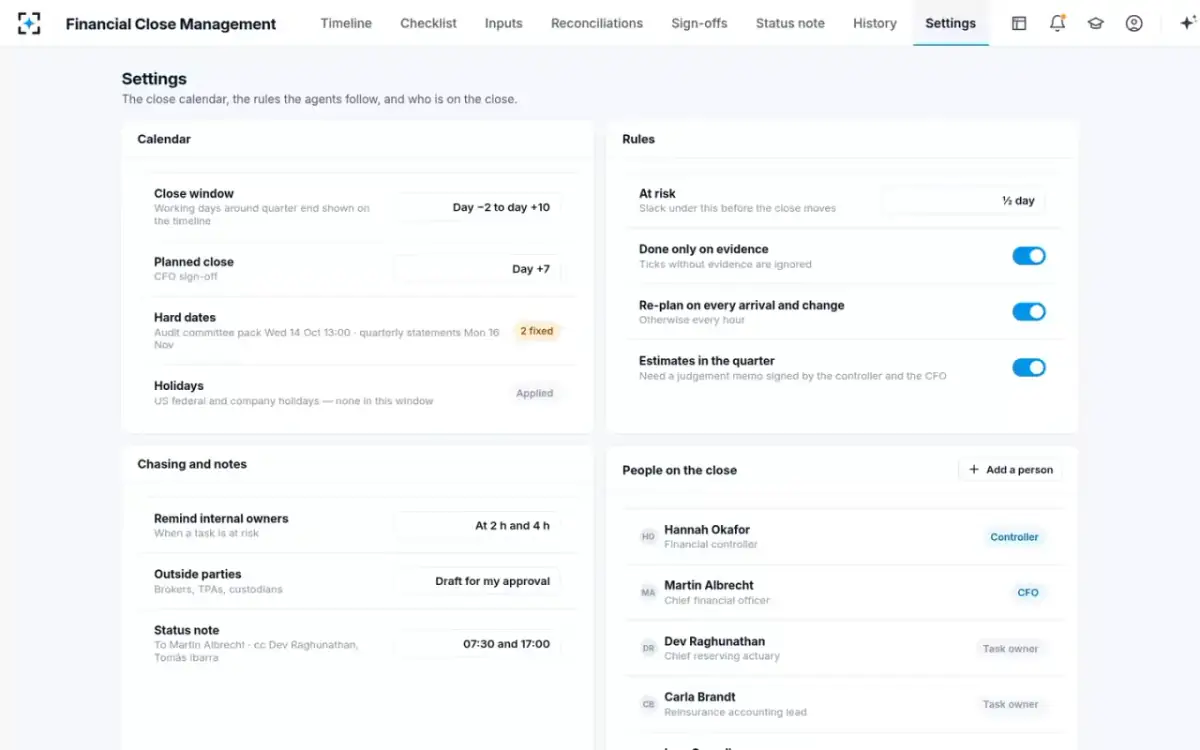
The practical answer is to set the internal date by the strictest reading, and to write the weekend assumption down once, in the close calendar, where the controller and the audit committee can see it. In the sample group's calendar the third-quarter statement is a fixed hard date, and it is the controller's setting, changed only by her, with each change kept as a new calendar version.
The hard dates a close calendar is planned back from
When is the NAIC annual statement due? 1 March, and what follows it
The annual statement is due on or before 1 March for the year ended 31 December, and it carries the appointed actuary's opinion inside it. Minnesota requires each insurer to file "annually, on or before March 1, the appropriate verified National Association of Insurance Commissioners' annual statement blank". For property and casualty insurers, the NAIC's opinion model law requires every company to "annually submit the opinion of an Appointed Actuary", so the year-end reserve work has to be finished, reviewed and booked before the statement can be signed.
Two actuarial documents follow on their own dates. The confidential Actuarial Opinion Summary goes to the domiciliary state, and according to the NAIC instructions, as the American Academy of Actuaries' practice note quotes them, it "shall be filed with the domiciliary state by March 15 (or by a later date otherwise specified by the domiciliary state)". The Actuarial Report, which supports the opinion with the actuary's methods and data, "must be available by May 1" of the following year, or within two weeks of a request from a state commissioner. Neither is filed with the annual statement, but both depend on the same year-end numbers. A reserve booked late in the close is a reserve the actuary documents late.
The year-end close is therefore the longest of the four, and it sits inside the shortest window. A group whose CFO signs off the year-end close on day +13 after 31 December, as the sample group did for 2025, has about six weeks left for statements, schedules, opinions and sign-offs before 1 March. The close timeline that runs through the actuary shows why the reserve chain usually sets that date.
What is due on 1 June for insurers?
Two filings fall on 1 June: the CPA-audited statutory financial report and, where the state has adopted the NAIC's governance model, the Corporate Governance Annual Disclosure. The Model Audit Rule requires every insurer apart from the smallest to have its statements audited each year by an independent CPA and to "file an audited financial report with the commissioner on or before June 1 for the year ended December 31 immediately preceding". The commissioner may also ask for it earlier, with 90 days' notice. The governance model separately requires the insurer or its group to submit its disclosure by 1 June each year, signed by the chief executive or corporate secretary (NAIC Model #305; the disclosure itself is covered in the corporate governance annual disclosure model act).
The audit report has a feature the close team feels in March: its notes must reconcile any differences between the audited statements and the annual statement filed on 1 March, with a written description of each. A correction found after the annual statement went in is not lost; it surfaces in the audited report, explained line by line. That is one reason the year-end close does not end when the annual statement is filed.
The internal control filings come next. The accountant's communication of any unremediated material weaknesses is prepared within 60 days after the audited report is filed, and insurers with $500 million or more of direct written and assumed premium file management's report on internal control over financial reporting with it. For a report filed on 1 June, that is 31 July. What that report must say, and how it maps to a public company's Sarbanes-Oxley work, is set out in SOX controls for insurance companies. The enterprise risk report under the NAIC's ORSA model has no fixed date: an insurer files it "Upon the commissioner’s request, and no more than once each year", so its timing follows the group's own planning cycle and the lead state's request.
Can an insurer get an extension on statutory filings?
Yes, but narrowly, and the grounds differ by filing. For the annual and quarterly statements, Florida's rule says the state "shall grant an extension of time for filing an annual or quarterly statement if there exist conditions beyond the control of the authorized insurer", giving rehabilitation and severe damage to the insurer's premises by disaster as examples. A slow close is not a condition beyond the insurer's control.
The audited report has a formal route. Under the Model Audit Rule, the commissioner may extend the 1 June date in thirty-day periods, on a showing by the insurer and its accountant of good cause, and the written request must arrive "not less than ten (10) days prior to the due date". When the audit date is extended, the management report on internal control gets a similar 30 days. In practice that means an audit that is slipping has to be called by about 22 May, which is a decision the controller needs to see coming in April, not discover in the last week.
A slow close is not a condition beyond the insurer's control. The only reliable extension is a close calendar that leaves room before the date.
The filing year by team: who peaks in each season
The filing calendar puts its weight on different people at different times, and a close plan that treats every quarter alike misses that. Statutory reporting peaks four times. The actuarial team peaks hardest from December to March, when the year-end reserve review, the opinion and the summary come due within ten weeks of each other. Internal audit and the controls team peak from April to July, between the audited report and the internal control report. The controller carries all of them.
The statutory filing year, team by team: where each one's peaks sit
- Annual statement1 Jan–1 Mar
- Q1 to 15 May45 days after 31 Mar
- Q2 to 14 Aug45 days after 30 Jun
- Q3 to 14 Nov45 days after 30 Sep
- Year-end prep15 Nov–31 Dec
- Opinion, summary, report1 Mar · 15 Mar · 1 May
- Quarterly reviewsMay–Nov
- Year-end reviewNov–Dec
- Year-end audit fieldworkto the 1 Jun report
- ICFR reportto 31 Jul
- Interim control testingAug–Dec
The peaks matter for the close because the same people own close tasks. The chief reserving actuary who signs the reserve view on day +4 of a quarter close is the person writing the Actuarial Report in April. A first-quarter close that runs into the last fortnight before 1 May puts both on one desk at once.
Four roles in the statutory season, and what changes when the close is planned on one timeline
Today
Holds every filing date in a spreadsheet and learns a quarter is tight when a team asks for more time.
With agents
Sees the projected close against each hard date every morning, with the buffer in working days.
Still theirs: the calendar, and every decision to move it
Today
Waits for the general ledger, then compresses schedules and notes into whatever days remain before the 45th.
With agents
Sees the day the general ledger is forecast to lock, and which input is holding it, as soon as it slips.
Still theirs: the statement and its sign-off
Today
Learns the reserve committee date moved after it has, in the same weeks as the opinion work.
With agents
Gets a note the morning an input to the reserve view changes, with the committee’s new time.
Still theirs: the reserve view and the opinion
Today
Asks after the event who signed what, and when, during the close.
With agents
Reads each sign-off with its preparer, reviewer and the evidence it rests on.
Still theirs: the testing and the opinion on controls
Working back from the filing date: the internal close date that protects it
The useful date is not the filing date but the internal close date it implies. Every statutory filing sits at the end of a chain: inputs arrive, the actuary's indication is reviewed, reserves are booked, journals post, the general ledger locks, the statements and schedules are built, and the people who sign, sign. A quarterly statement due on the 45th day leaves room only if the close finishes well before it, with the review, the audit committee and the statement build behind it.
Take the sample group's third quarter of 2026. Quarter-end was Wednesday 30 September. The planned close, the CFO's sign-off, was Friday 9 October, day +7 in working days. The audit committee pack was a fixed date, Wednesday 14 October, and the quarterly statement sat a month after that. On the morning of day +3 the projected close was on plan with two working days of buffer before the audit committee pack. An hour later a re-run of the ceded loss file had pushed the projection to day +9 with no buffer at all, and the controller's choice of recovery brought it back to day +8.
None of that put the 14 November filing at risk. It put the audit committee date at risk, which is the date the statement depends on. That is the general pattern: the statutory deadline is usually protected by an internal date several weeks earlier, and it is the internal date that slips. A close tool earns its place by watching those internal dates, not the filing date. How to put a price on each day that slips is the subject of fast close accounting for insurers.
Five closes of working days to CFO sign-off, against the plan
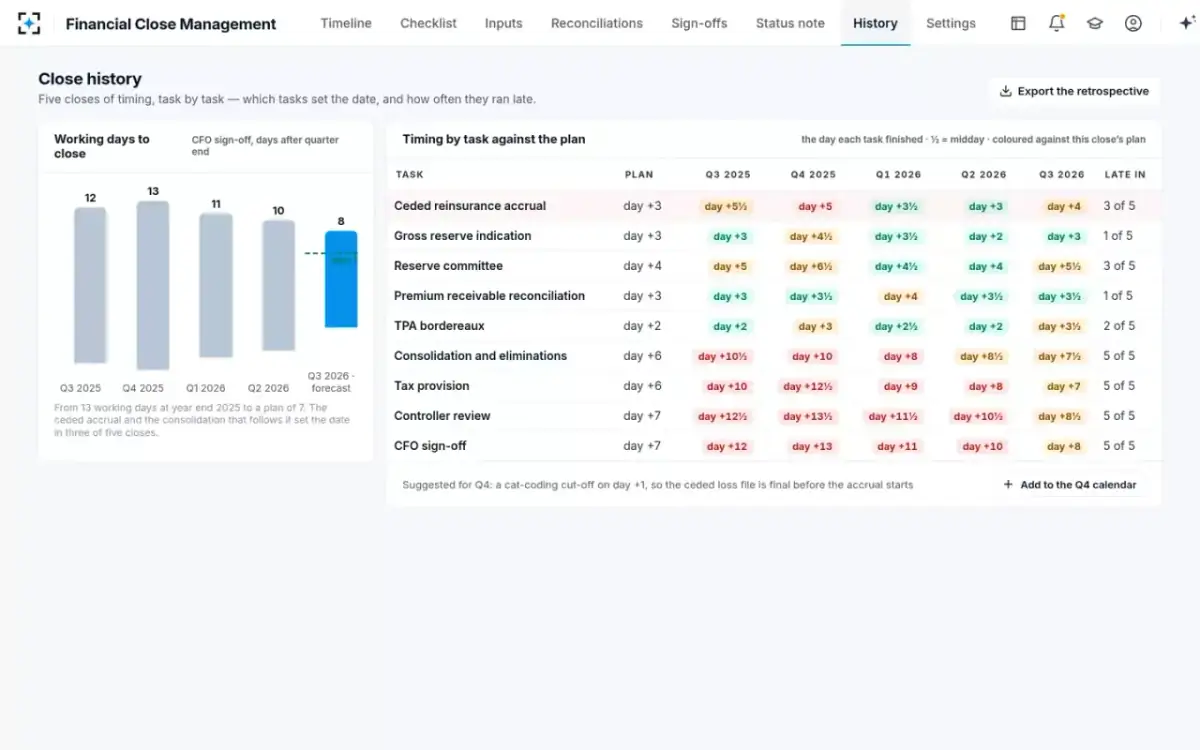
The history makes a second point about the season. The longest close in the sample was the year-end, the one with the least room before its filing date. A plan that sets the same day +7 target for every quarter is easier to remember, but the year-end usually needs either more working days or work moved earlier, such as a cut-off for late catastrophe coding before the accrual starts, which is what the sample's retrospective suggests for the fourth quarter.
Questions people ask
When are NAIC quarterly statements due?
Forty-five days after 31 March, 30 June and 30 September, which is 15 May, 14 August and 14 November. The deadline comes from the domiciliary state's law, such as Minnesota § 60A.13 or Florida rule 69O-137.001, not from the NAIC itself. There is no fourth-quarter statement; the annual statement covers it.
When is the NAIC annual statement due?
On or before 1 March for the year ended 31 December, under state law. For property and casualty insurers it includes the appointed actuary's Statement of Actuarial Opinion. The Actuarial Opinion Summary follows by 15 March and the Actuarial Report must be available by 1 May, unless the state sets other dates.
When is the audited financial report due?
On or before 1 June for the previous calendar year, under the NAIC Model Audit Rule as states adopt it. The commissioner can grant extensions in thirty-day periods for good cause, and the request has to be made in writing at least ten days before the due date.
What is due on June 1 for insurers?
The CPA-audited statutory financial report and, in states that have adopted the NAIC's governance model, the Corporate Governance Annual Disclosure. Insurers with $500 million or more of direct written and assumed premium then file management's report on internal control over financial reporting with the accountant's communication, within 60 days of the audited report.
What happens if a filing date falls on a weekend?
For SEC reports, a rule lets the filing be made on the next business day. The state rules quoted on this page count calendar days and say nothing about weekends, and in 2027 all three quarterly dates fall on one. Ask your domiciliary regulator, and record the answer in the close calendar.
Can an insurer get an extension on its quarterly statement?
Only for serious cause. Florida's rule grants one for conditions beyond the insurer's control, such as rehabilitation or severe damage to its premises from a disaster. A late internal close does not qualify, so the protection has to come from the close calendar itself.