US companies release earnings in the weeks after each quarter ends, typically three to six weeks later, and typically outside market hours: early in the morning before the open, or in the late afternoon after the close. The release is usually a press release on a newswire and the company's website, furnished to the SEC on Form 8-K under Item 2.02 within four business days, and often followed by a conference call. The full quarterly report, Form 10-Q, follows within 40 days of quarter-end for large and accelerated filers and 45 days for the rest. For a buy-side research team, the hours between a release and the next open are where the work has to happen. Botminds' Equity Research Automation is built for that window: its agents catch each release within seconds, update the analyst's model, tie the figures and draft a cited note for the analyst to sign before the market opens.
The examples on this page come from the solution's fictional sample firm, Quillfield Capital, and its sample issuers. Rule text is quoted from the SEC's own forms and the eCFR; the filing-time data is our count from the SEC's Financial Statement Data Sets.
When June-quarter 2026 10-Qs arrived: median filing day and the deadline, by filer status
- Median filing: day 35, Aug. 4
- Median filing: day 37, Aug. 6
- Median filing: day 44, Aug. 13
When do companies release earnings?
Companies release earnings when their books for the quarter are closed and reviewed, and before the SEC's deadline for the quarterly report. In practice the first large companies report two or three weeks after the quarter ends, the bulk report in the following three weeks, and the smallest filers cluster near the 45-day deadline. Most US companies share calendar quarter-ends, so for the quarter ending September 30, 2026 the season runs from mid-October into mid-November; the guide to earnings season sets out the full calendar.
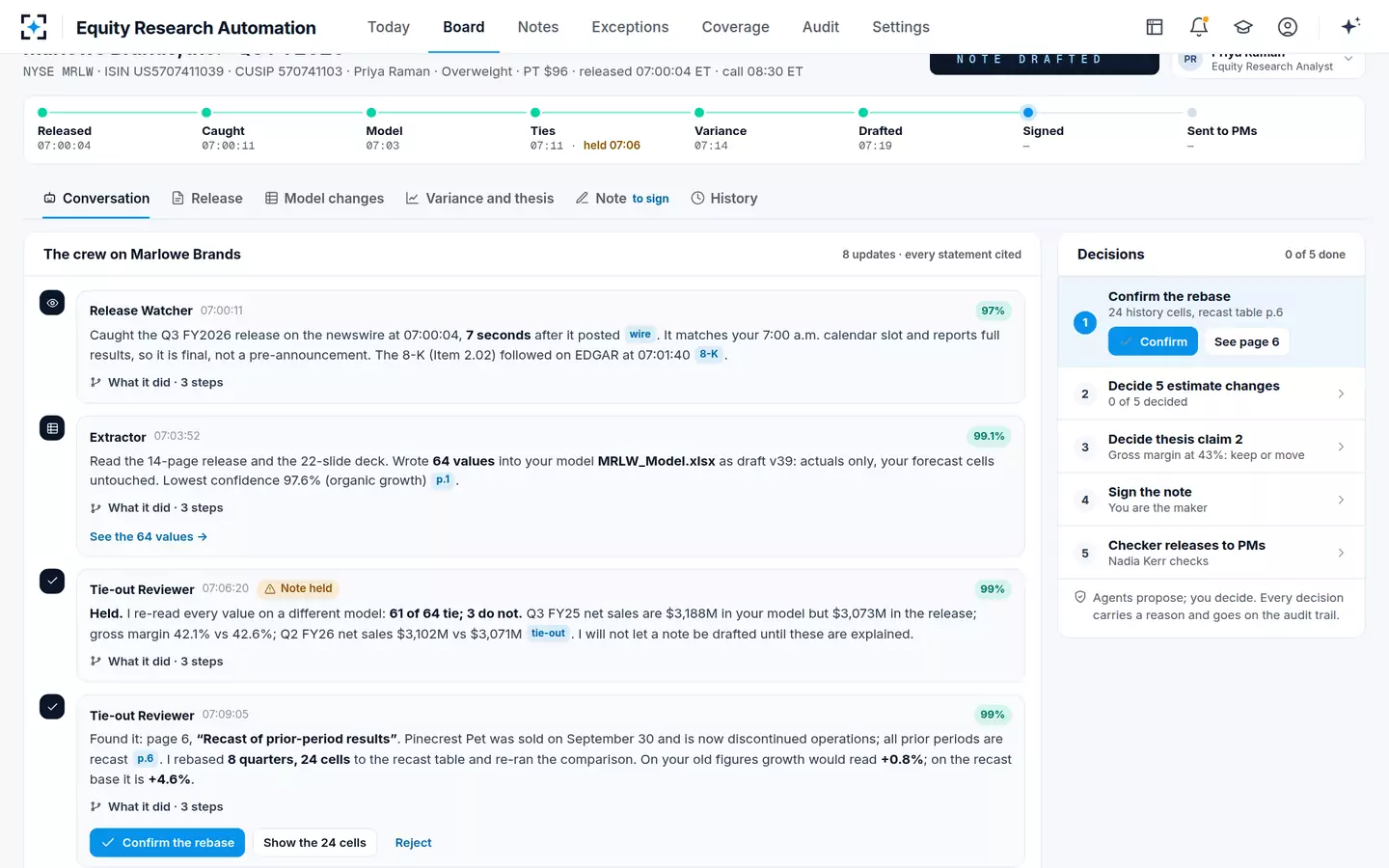
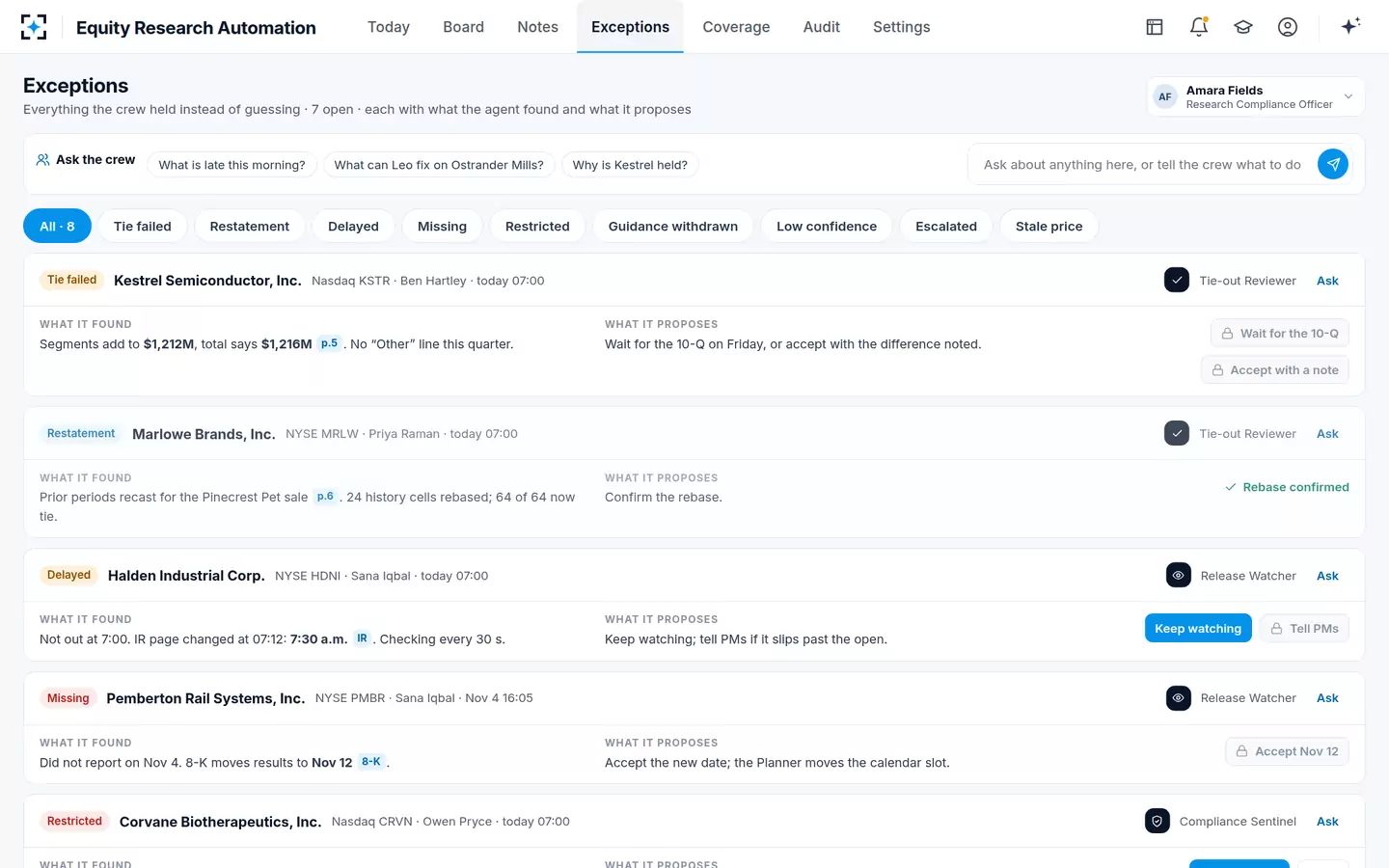
Each company picks its own date within that window and usually announces it in advance, along with the time of the release and any call. The date is not fixed by rule, and it moves. On the sample firm's board for Thursday, November 5, 2026, one company's investor relations page changed at 7:12 a.m. to say its results would come at 7:30 rather than 7:00; another had not reported on November 4 as expected and filed an 8-K moving its results to November 12. Catching those changes is part of the job.
Do companies release earnings before or after the market?
US companies typically release earnings outside regular trading hours, either before the open or after the close, so that every investor gets the news at the same moment and the market has time to absorb it before trading. Which side of the day a company chooses has been studied for decades, and the findings are mixed.
Doyle and Magilke summarise the starting point: "several papers have documented that earnings announcements made after the market closes and/or on Fridays tend to contain worse earnings news than those made at other times." Testing companies that switched their timing, they found "no evidence that managers opportunistically report worse news after the market closes or on Fridays", and "some evidence that more complex firms tend to announce earnings after the market closes", with greater trading volume afterwards (The Accounting Review 84(1), 2009).
deHaan, Shevlin and Thornock reached a different conclusion with different tests. Their findings are "consistent with managers reporting bad news after market hours, on busy days, and with less advance notice, and with earnings receiving less attention in these settings" (SSRN working paper, 2015; published in the Journal of Accounting and Economics 60(1), 2015). For a research team, the practical point survives the disagreement: an after-close release on a busy day is exactly the case where a timely, checked reading is worth most, and where the reading has to happen overnight.
What is Form 8-K Item 2.02?
Item 2.02 of Form 8-K, "Results of Operations and Financial Condition", is the SEC requirement that makes a company's earnings release part of its SEC record. If a company "makes any public announcement or release ... disclosing material non-public information regarding the registrant's results of operations or financial condition for a completed quarterly or annual fiscal period", it must disclose the date, identify the release "and include the text of that announcement or release as an exhibit" (SEC Form 8-K, Item 2.02(a)). Unless an item sets a different deadline, a Form 8-K is due within four business days of the event; what each of the form's items tells a holder is mapped in Form 8-K items, read as a holder.
Three details matter to an analyst. First, the release is furnished, not filed: unless the company says otherwise, Item 2.02 information is not treated as filed for the liability provisions of Section 18 of the Exchange Act (Form 8-K, General Instruction B.2). Second, a results call that follows the release closely, is open to the public and was announced in advance does not need a separate 8-K, under conditions set out in Item 2.02(b). Third, the release is subject to the non-GAAP rules: Regulation G requires the most directly comparable GAAP measure and a reconciliation alongside any non-GAAP figure (17 CFR 244.100), and Item 2.02's instructions apply the prominence rule in Item 10(e) as well. The guide to Regulation FD covers the call and what an issuer may say privately.
Equity Research Automation caught the release 7 seconds after it posted; the 8-K followed 96 seconds after the release
What is the difference between an earnings release and a 10-Q?
An earnings release is the company's announcement of its results, written for investors and furnished on Form 8-K; a 10-Q is the full quarterly report, filed with the SEC, with interim financial statements, notes and management's discussion. The release usually comes first and moves the price; the 10-Q comes later with more detail and stronger legal standing.
Earnings release and Form 10-Q, side by side
Earnings release (Form 8-K, Item 2.02): No rule requires a release; if a company makes one with material results information, Item 2.02 requires it to be furnished.
Quarterly report (Form 10-Q): Required for each of the first three fiscal quarters of a domestic reporting company.
Earnings release (Form 8-K, Item 2.02): 8-K within four business days of the release; the release itself has no SEC deadline.
Quarterly report (Form 10-Q): 40 days after quarter-end for large accelerated and accelerated filers, 45 for all others.
Earnings release (Form 8-K, Item 2.02): Furnished: not deemed "filed" for Section 18 purposes unless the company says so.
Quarterly report (Form 10-Q): Filed with the SEC.
Earnings release (Form 8-K, Item 2.02): Headline results, often adjusted measures with GAAP reconciliations, guidance, segment tables, sometimes a recast of prior periods.
Quarterly report (Form 10-Q): Interim financial statements and notes, MD&A, risk factor updates and controls disclosures.
Earnings release (Form 8-K, Item 2.02): Usually: it is the first public disclosure.
Quarterly report (Form 10-Q): Usually less: the SEC notes markets react less to repeated information.
The SEC made the price point itself in its 2026 proposal on semiannual reporting, citing research that markets react mostly to the first disclosure of information.
"For example, there might be a significant reaction to news in the earnings release but not to the Form 10-Q filed a week later, even though they both reflect the same financial information."
SEC, Semiannual Reporting proposal, Federal Register, May 7, 2026
That is why a research team builds its morning around the release, not the 10-Q. But the 10-Q is not redundant: it carries the notes that explain a segment change or a one-off item, and it can resolve a figure in the release that does not add up. On the sample morning, one company's segments added to $1,212 million while its release said $1,216 million; the agents proposed waiting for the 10-Q, due that Friday, or accepting the figure with the difference noted.
How long after quarter end do companies report?
The quarterly report is due 40 or 45 days after quarter-end and the annual report 60, 75 or 90 days after year-end, depending on the company's size; earnings releases generally come before those deadlines. The deadlines are in the forms' own instructions: Form 10-Q is due "40 days after the end of the fiscal quarter for large accelerated filers and accelerated filers" and "45 days after the end of the fiscal quarter for all other registrants" (Form 10-Q, General Instruction A.1).
The data shows how close to the deadline the 10-Q comes. For the June 2026 quarter, the median large accelerated filer filed its 10-Q on day 35, August 4; the median non-accelerated filer on day 44, August 13, a day before its deadline. A company whose release came on day 28 and whose 10-Q came on day 35 gave the market a week between the headline and the detail, the week the SEC's example describes.
Release and report deadlines, by filer status
| Filer status | Public float test | Form 10-Q due | Form 10-K due |
|---|---|---|---|
| Large accelerated filer | $700 million or more | 40 days after quarter-end | 60 days after year-end |
| Accelerated filer | $75 million to under $700 million | 40 days after quarter-end | 75 days after year-end |
| All other registrants | Neither of the above | 45 days after quarter-end | 90 days after year-end |
When the 10-Q is the announcement
Not every company issues a separate earnings release. A company may simply file its 10-Q and let that be the announcement, and the SEC's form accommodates it: Instruction 4 to Item 2.02 says the item "does not apply in the case of a disclosure that is made in a quarterly report filed with the Commission on Form 10-Q" or an annual report on Form 10-K (Form 8-K, Item 2.02, Instruction 4).
For a research team that means the calendar cannot be the only trigger. A watcher that waits for a press release will miss a company that files its 10-Q without one, and one that watches only EDGAR will be minutes behind a company that posts its release on the wire first. In the solution, the Release Watcher watches the newswire, EDGAR (8-K Item 2.02, 6-K and 10-Q), exchange disclosure feeds and the investor relations pages of all 486 covered companies, and treats a pre-announcement as preliminary until the full release posts.
Foreign private issuers: no 8-K, no 10-Q
A foreign private issuer listed in the US does not file Forms 8-K or 10-Q; it furnishes the reports its home market requires on Form 6-K. The 8-K rule excludes, in its own paragraph (b), foreign private issuers that report on Form 6-K (17 CFR 240.13a-11(b)). Its results timing follows its home market's rules, and its release may come first in another language. The guide to foreign private issuers' calls explains the test that decides who counts.
Exceptions in Equity Research Automation: a delayed release, a moved date, a figure that does not add up
Will companies report semiannually?
Not yet: optional semiannual reporting for US companies is an SEC proposal, not a rule. On May 5, 2026 the SEC proposed letting companies file a semiannual report on a new Form 10-S instead of quarterly 10-Qs, with a deadline of 40 or 45 days; comments were due by July 6, 2026 (Federal Register, May 7, 2026). On October 27, 2026 the SEC's rulemaking page lists only the proposed rule (SEC, File S7-2026-15).
If it is adopted, a company that opts in would file one semiannual report a year, plus its 10-K, in place of three Forms 10-Q. The SEC's own estimate of the population is useful context: it counts 5,976 companies required to file 10-Qs in 2024. Until the SEC acts, every one of them reports quarterly, and a research calendar should assume four seasons a year.
The research window: the night between a release and the open
For a buy-side team, the timing rules reduce to one window: the hours between a release and the next market open, when the note that matters most has to be written. An after-close release gives the team the evening; a pre-open release, such as Marlowe Brands' at 7:00 a.m. on the sample morning, gives it two and a half hours to the open, with the company's call landing in the middle at 8:30.
In the solution that window is managed rather than hoped for. The sample firm sets a target of two hours from release to signed note, and escalates an unsigned note to the Director of Research after four. On the sample morning the Marlowe note was signed 26 minutes after the release and released to portfolio managers at 7:29, before the call and well before the open. The cost of one covered name sets out what those hours cost when they are spent by hand.
To see the window run on your own coverage, start from Equity Research Automation.
Questions people ask
What time do companies release earnings?
Usually outside trading hours: early morning before the open or late afternoon after the close, Eastern time for US companies. The exact time is the company's choice and is normally announced in advance with the date. In the solution's sample, fourteen companies released at 7:00 a.m. on one Thursday, and another at 4:05 p.m.
Why do companies release earnings after hours?
So that the news reaches every investor at once and the market can absorb it before trading resumes. Research is split on whether timing also hides bad news: Doyle and Magilke found no evidence of opportunistic timing among companies that switched, while deHaan, Shevlin and Thornock found bad news more likely after hours and on busy days.
Do earnings releases have to be filed with the SEC?
They have to be furnished, not filed. If a company publicly releases material results for a completed quarter or year, Item 2.02 requires a Form 8-K, usually within four business days, with the release as an exhibit; that information is not deemed filed for Section 18 purposes unless the company says so.
Is the earnings release the same as the earnings report?
People use "earnings report" for both. Strictly, the earnings release is the announcement furnished on Form 8-K, and the quarterly report is the Form 10-Q filed with the SEC, which carries the full interim financial statements and usually arrives later.
How do I know when a company will report earnings?
From the company's own announcement of its date, usually on its investor relations site and the newswire, and from the SEC deadlines, which give the latest a 10-Q can arrive. Dates move, so a research calendar should be watched, not just entered once.
Can a company report earnings late?
A company that cannot file on time can notify the SEC under Rule 12b-25; if it meets the rule's conditions, its 10-Q is treated as timely if filed no later than the fifth calendar day after the due date, and its 10-K by the fifteenth (17 CFR 240.12b-25). An earnings release has no SEC deadline of its own, but the 8-K for a release is due within four business days.