The best AI tools for equity research are the ones a research team can prove: they write into the analyst's own model without touching the forecast, tie every figure to the page it came from, check the restricted list before a word is drafted, and leave a record an examiner can read. Most demonstrations show the opposite end, a fluent summary of an earnings release, which is the easiest part to do and the hardest to trust. The twelve questions below are the ones that separate tools that save an analyst's morning from tools that add a review step to it. They come from the rules a US investment adviser already lives under and from what supervisors have said about AI since 2024. Botminds' Equity Research Automation is one answer to them, built as a crew of agents for buy-side earnings work; the last section says plainly where it fits and where another kind of tool is the better buy.
Product examples on this page come from the solution's fictional sample firm, Quillfield Capital. Rule and research figures are linked where they appear; nothing here is legal advice. If the job is answering questions across a firm's notes, broker research and filings rather than earnings-season models and notes, the acceptance test in best AI for investment research fits better.
Twelve questions to ask any AI tool for equity research
- 1. Does it write into our own model, as a new version, and leave forecast cells alone?
Analysts keep their own models. A tool that rebuilds the model elsewhere, or overwrites estimates, creates a second model nobody owns.
- 2. Does every value carry its page and a confidence, and what happens below the line?
Ask to see a value it was unsure of. The right answer is a person checking it, not a guess.
- 3. Does it read the release in the issuer's own language, with the original beside the English?
A figure translated without its source cannot be checked by the analyst who signs.
- 4. Does a second, independent reader re-tie every figure, and does a failed tie stop the note?
One model checking its own output is not a check. A tie that fails should hold the draft.
- 5. Does it find recast or restated prior periods, and ask before rebasing history?
A recast changes growth. The rebase should be cited and confirmed by the analyst.
- 6. Does it say which consensus snapshot it compared against?
Consensus moves and feeds lag. A beat is only meaningful against a named, timed number.
- 7. Does it check the restricted and watch lists before drafting, not after publishing?
A note on a restricted name is a compliance event even if nobody trades.
- 8. Can the tool clear a restricted name, or use expert-call content without clearance?
The answer should be no. Clearance belongs to Research Compliance.
- 9. Is every agent step and human decision on a record that cannot be silently changed?
Rule 204-2 asks advisers to safeguard electronic records from loss, alteration or destruction.
- 10. Can we export the evidence for one note, sources to signatures, for an examiner?
If the evidence for a note has to be reassembled by hand, it will be incomplete.
- 11. Can an agent change an estimate, rating or target, or send a note? Who signs, who releases?
Agents should propose; a named analyst signs and a different person releases.
- 12. Who can change a threshold, and is the change tested on past releases before it applies?
Settings are policy. A change should be proposed, tested and approved, with a record.
What are the best AI tools for equity research? Start with what you must prove
The best AI tool for an equity research team is the one whose every output the team can verify and defend, because the team, not the tool, remains answerable for the note. Supervisors have been consistent on this. ESMA told EU investment firms in May 2024 that its expectations cover staff using public chatbots and other third-party AI tools, whether or not senior management knows or has approved it (ESMA public statement, May 30, 2024). FINRA reminded broker-dealers in June 2024 that its rules, "which are intended to be technology neutral", continue to apply when firms use generative AI (FINRA Regulatory Notice 24-09).
The profession's standard says the same in its own terms. CFA Institute Standard V(A) requires members to "make reasonable efforts to test the output of investment models and other preprogrammed analytical tools they use", and adds that "such validation must occur before incorporating the process into their methods, models, or analyses" (CFA Institute Standard V(A)). A buyer's first question, then, is not which model a tool uses. It is how the team will test what the tool produces, before and after it goes live; a pilot that replays last season is one way to do that.
Three kinds of AI tool for equity research, and what each is good for
Tools sold as AI for equity research fall into three broad kinds, and they solve different problems. A general chat assistant answers questions over documents you give it. A research platform adds AI search and summaries over its own content: filings, transcripts, broker research. An agent crew works inside your own workflow: your calendar, your model, your lists, your sign-off. None is wrong; each is right for a different job.
Chat assistant, research platform, agents in the workflow
Chat assistant or research platform with AI search: Documents you upload, or the platform's own library of filings, transcripts and research.
Agents inside the research workflow: Your coverage universe as it reports: newswire, EDGAR, exchange feeds and IR pages, in the issuer's language.
Chat assistant or research platform with AI search: Answers and summaries, which the analyst copies into the model and the note.
Agents inside the research workflow: Actuals into the analyst's own model as a new version; a cited draft note; proposals for estimates.
Chat assistant or research platform with AI search: Usually by the analyst, by eye.
Agents inside the research workflow: By a second, independent reader that re-ties every value and holds the note when one fails.
Chat assistant or research platform with AI search: Outside the tool; the analyst must remember.
Agents inside the research workflow: Checked before drafting; a restricted name is blocked until compliance clears it.
Chat assistant or research platform with AI search: Chat history, if kept, often in the vendor's system.
Agents inside the research workflow: Every step and decision with who, what, when, why and evidence, exportable per note.
Chat assistant or research platform with AI search: Ad hoc questions, idea work, reading a long filing fast.
Agents inside the research workflow: Quarterly earnings work across a full coverage list, every quarter.
The difference shows most clearly on accuracy. In the FinanceBench test of models answering questions about filings, the same model's success rate moved from 19% to 79% depending on how documents were fed to it, and the authors concluded that every model they examined showed weaknesses, hallucinations among them, that limited its use in firms (Islam et al., arXiv 2311.11944, November 2023; not peer reviewed; 2023 models). A tool's architecture, retrieval and checks matter as much as the model behind it. That is why the questions below ask about checks, not about models.
Can AI update my Excel model? Questions 1 to 3
Yes, if the tool writes actuals into your own workbook as a new version and leaves your forecasts alone; that is what to test. Analysts' models are their working memory: the formulas, the segment build and the assumptions are theirs. A tool that extracts figures into its own template and asks the analyst to re-key them saves little; a tool that overwrites forecast cells destroys the analyst's view.
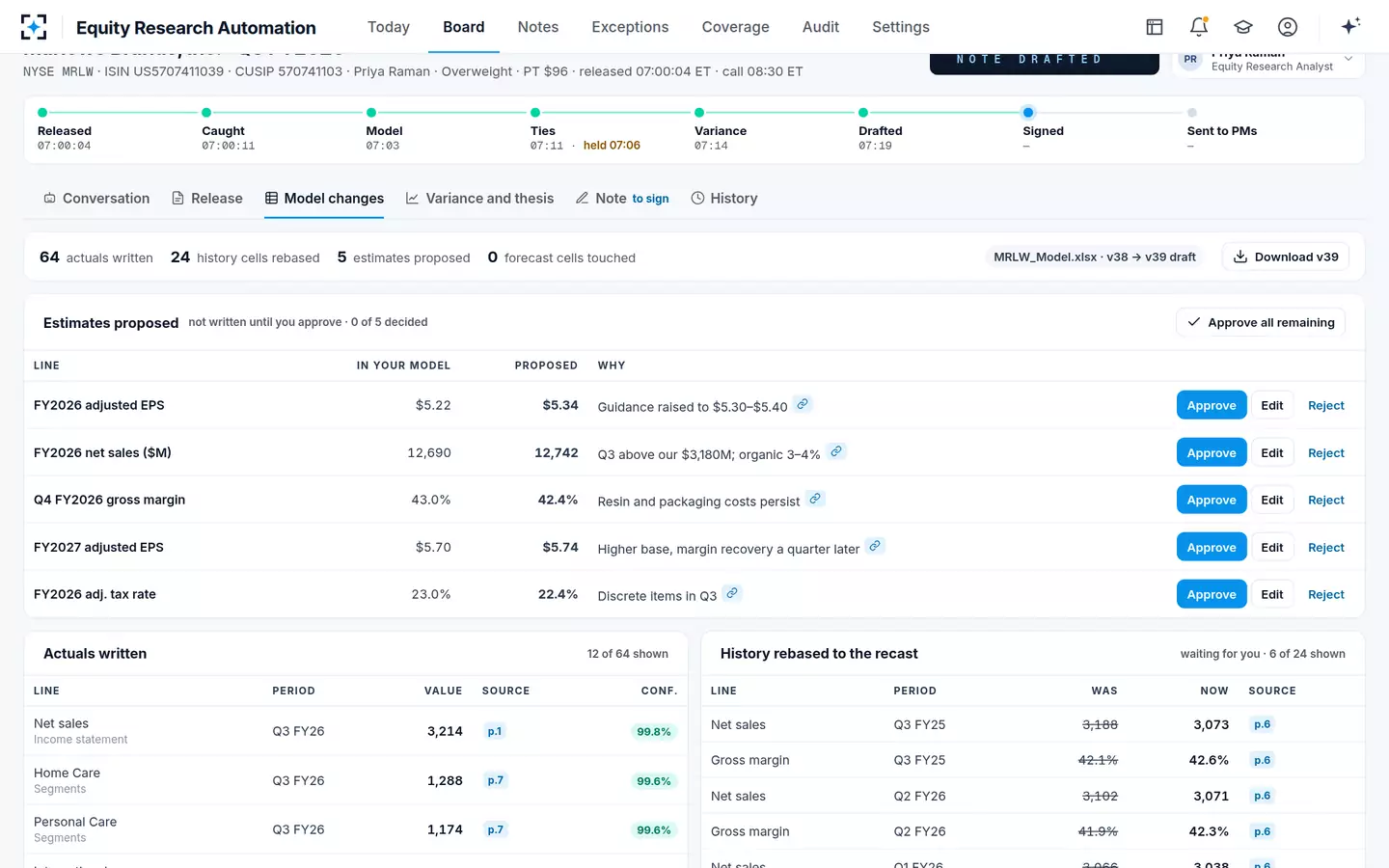
Ask the vendor to update one of your models on a past release, and inspect three things: whether a new version was created; whether any forecast cell changed; and whether each written value links to the page it came from, with a confidence. In the solution's sample, the Extractor wrote 64 values into the analyst's model "as draft v39: actuals only, forecast cells untouched", and five estimate changes sat in a separate block, not written until she approved them.
The model update in Equity Research Automation: 64 actuals written, 0 forecast cells touched
Question 3 matters for any team with non-US names. A Japanese results summary or a German quarterly statement should be read in the original, with each English figure checked digit for digit against it. Translation that loses the link to the source turns every figure into something the analyst must re-verify.
Numbers you can tie: questions 4 to 6
A tool earns trust on numbers by having a second reader check them and by stopping when a check fails. Self-checking, where the same model re-reads its own output, tends to repeat its own mistakes. In the solution, the Tie-out Reviewer re-reads every value with a different AI model, re-adds segments and subtotals, compares history with the model and looks for recast tables; a tie it cannot explain holds the note.
Recasts are the test case. On the sample morning, three of 64 values did not tie. The cause was on page 6: a business sold on September 30 was now a discontinued operation and prior periods were recast, so last year's third-quarter sales moved from $3,188 million to $3,073 million. On the old base, growth would have read +0.8%; on the recast base it was +4.6%. The tool's job was to find the page, propose the rebase and ask; the analyst's job was to confirm.
Question 6 is the one buyers forget. Consensus is not a single number; it is a feed that updates through the morning and sometimes lags. The sample screen labels the comparison as "the 06:45 snapshot" because the feed ran six minutes behind. The guide to consensus estimates explains why the timestamp matters.
How do AI tools handle the restricted list? Questions 7 and 8
A tool fit for research checks the firm's restricted and watch lists before it drafts anything, and cannot clear a name itself. Section 204A requires every adviser to keep and enforce written policies against the misuse of material nonpublic information, fitted to the nature of its business (15 U.S.C. 80b-4a). An AI tool that drafts notes is now part of that business.
The SEC's examiners have also shown how list controls fail in practice: in an April 2022 risk alert they "observed instances where employees traded investments that were on the adviser's restricted list" (SEC Division of Examinations, April 26, 2022; staff statement, not a rule). A list is only a control if it is checked at the moment it matters. In the solution, the Compliance Sentinel checks every draft against the restricted and watch lists from the compliance system, public sources only, and expert-call content cleared; it "blocks; never clears a restricted name". The restricted list guide sets out the method in full.
Records an examiner can read: questions 9 and 10
The record should show every agent step and every human decision, with the evidence, kept for at least as long as the firm's rules require and protected from silent change. For a US investment adviser, Rule 204-2 requires written communications about any recommendation, made or only proposed, to be kept in an easily accessible place for at least five years from the end of the fiscal year of the last entry, the first two of them in an appropriate office of the adviser (17 CFR 275.204-2(a)(7) and (e)(1), eCFR current to Oct. 23, 2026). Which research records that reaches, paragraph by paragraph, is set out in investment adviser recordkeeping requirements, applied to research.
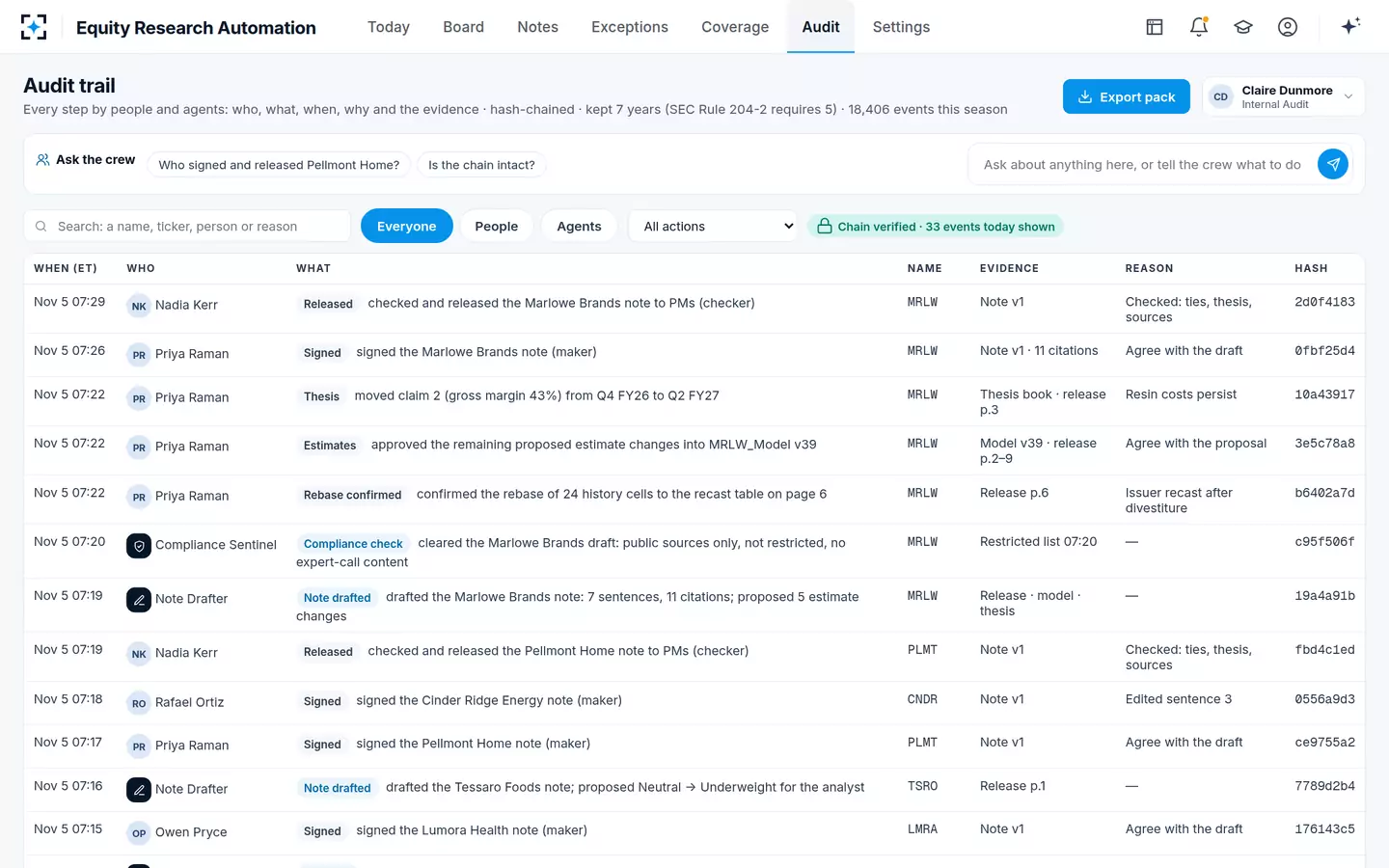
For electronic records, the adviser must have procedures that keep the records safe from loss, alteration or destruction, limit who can reach them, and reproduce them completely when asked (17 CFR 275.204-2(g)). A chat history in a vendor's system rarely meets that on its own. In the solution, the audit trail is hash-chained, kept seven years by default against the rule's five, and exports an evidence pack per note: sources, model changes, signatures and compliance checks.
The audit trail: every step by people and agents, hash-chained
Who decides, and who changes the settings: questions 11 and 12
The agents should propose and named people should decide, and the tool should make that structural rather than a matter of etiquette. In the solution, agents never write a forecast cell, change an estimate, rating, target or thesis claim, send a note or clear a restricted name; every human decision carries a reason code. The analyst signs as the maker, a different person releases as the checker, and rating changes or price-target changes over 10% need the Director of Research.
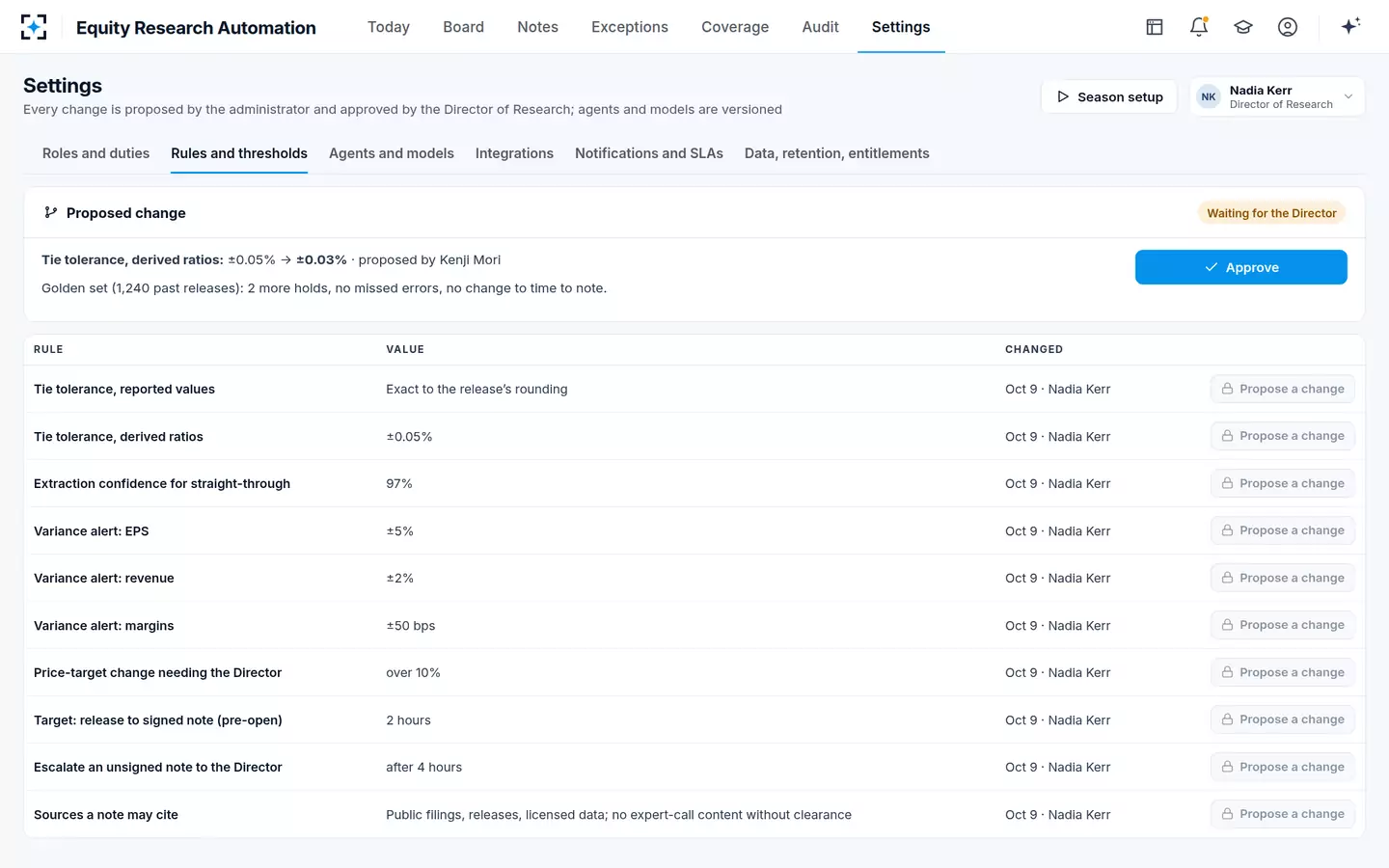
Settings deserve the same discipline, because thresholds are policy. Ask who can change the tie tolerance or the confidence line, and how a change is tested. In the sample, a proposed tightening of the tolerance on derived ratios from ±0.05% to ±0.03% waits for the Director with its test result attached: re-run on a set of 1,240 past releases with known answers, it added two holds, missed no errors and left the time to a note unchanged.
A proposed threshold change, tested on 1,240 past releases, waiting for the Director
What is AI washing, and does the SEC examine AI claims?
AI washing is claiming to use artificial intelligence in ways a firm does not, and the SEC both prosecutes it and examines for it. On March 18, 2024 the SEC settled charges against two advisers, Delphia and Global Predictions, for false statements about their use of AI, with $400,000 in combined penalties. The Enforcement Director's warning was direct: "if you claim to use AI in your investment processes, you need to ensure that your representations are not false or misleading" (SEC press release 2024-36).
What the SEC has said about AI, and what it costs to get wrong
$400K
combined civil penalties in the first two "AI washing" cases against advisers, March 2024
FY2026
exam priorities: review "for accuracy" firms' representations about their AI capabilities
FY2027
exam priorities use the SEC's own term, "super intelligence", for the technology
The Division of Examinations' fiscal 2026 priorities said it "will review for accuracy registrant representations regarding their AI capabilities or AI" (SEC, FY2026 Examination Priorities, November 17, 2025). Its fiscal 2027 priorities, published on October 23, 2026, describe the technology in the SEC's own new term.
"Registrants are increasingly using super intelligence (SI) in core business operations and systems, including investment analysis, customer management, and code development."
SEC Division of Examinations, Fiscal Year 2027 Examination Priorities, October 23, 2026
For automated investment tools, the same document says its assessments "generally will include whether: (1) representations are fair and accurate; (2) operations and controls are consistent with disclosures made to investors". A buyer should apply the same test to a vendor. What the tool says it does in the sales deck should match what the audit trail shows it did, and what your firm then tells clients about its research process should match both. There is no pending SEC rule specific to advisers' use of AI: the 2023 proposal on predictive data analytics was withdrawn in June 2025.
Where Equity Research Automation fits, and where it does not
Equity Research Automation fits a buy-side research team that covers dozens to hundreds of listed names, keeps its own Excel models, and needs every earnings note checked, signed and recorded before portfolio managers act on it. It is built for the recurring quarterly work: catching releases, writing actuals into models, tying figures, testing the thesis and drafting the note, across a whole coverage list and in the issuer's own language.
It is not the right buy for several jobs, and a fair evaluation should say so. It is not a market-data terminal or a consensus provider: it reads the consensus feed and the market data you already license. It does not replace a research management system or CRM; it works with them. It is not a trading-signal engine: its agents never trade, and the analyst decides every estimate. And it is not a publishing system for a broker-dealer's research to clients, which carries Regulation AC certifications and FINRA Rule 2241 disclosures of its own. For open-ended exploration of a new idea, a chat assistant or research platform may serve better; many teams will want both.
The fastest way to answer the twelve questions for any tool is to watch it on your own names. We will run Equity Research Automation on last season's releases for your covered names and your analysts' models.
Questions people ask
Can I use ChatGPT for equity research?
Many analysts do for exploration, but a firm remains responsible for how staff use it. ESMA's 2024 statement covers staff use of third-party tools such as ChatGPT with or without management's knowledge, and an adviser's MNPI and recordkeeping duties still apply to what goes into and comes out of the tool.
How do you evaluate AI tools for research?
On your own data and against known answers: run the tool on last season's releases for names you cover, compare every figure with the page it came from, count the errors it caught and missed, and check the record it leaves. CFA Standard V(A) asks members to test a tool's output before relying on it.
Do AI research tools need to be on the restricted list workflow?
Any tool that drafts research on named companies should check the restricted and watch lists before drafting. The SEC's 2022 risk alert found employees trading names on their own adviser's restricted list, a reminder that a list only works if it is checked at the point of use.
How accurate are AI tools on financial filings?
It depends heavily on how they retrieve information. In FinanceBench, a 2023 test of 16 model configurations, GPT-4-Turbo answered 19% of a 150-question sample correctly with one shared document store and 79% with the filing placed in its context window. Accuracy has to be measured on your own documents.
Do AI tools for equity research keep records for SEC exams?
Only if they are built to. Rule 204-2 requires advisers to keep records relating to recommendations for at least five years, two in an appropriate office, and to safeguard electronic records from loss, alteration or destruction. Ask whether the tool's record meets that, and whether you can export it.
Is there an SEC rule on AI for investment advisers?
Not a specific one. The SEC withdrew its 2023 predictive data analytics proposal in June 2025. Existing duties apply: MNPI policies under Section 204A, the compliance program rule, books and records, and accurate statements about what a firm's technology does.