The best AI for investment research is the tool that answers your team's real questions correctly from your own sources, under each reader's licences, with every sentence traceable to its page, and that keeps doing so after go-live. Benchmarks and demonstrations cannot settle that, because they run on someone else's documents and nobody else's permissions. What settles it is an acceptance test built from questions your team has already answered, with traps for the failures that matter on a buy-side desk: an unlicensed broker, a restricted issuer, a foreign filing, a broker who disagrees with the house. This guide sets out that test and the go-live plan around it, with Botminds' Investment Research Assistant, which answers across a firm's notes, licensed broker research, filings and expert calls, as the worked example, including where it is not the right tool.
Going live with an AI research assistant, one team at a time
- Connect sources, licences, directoryweeks 1–2
- Acceptance test on past questionsweeks 3–4
- Live in the team, daily reviewweeks 5–6
- Sharing outside the team switched onweeks 7–8
- Licences and scopeweek 1
- Team's own test questionsweek 2
- Liveweek 3
What is the best AI for investment research? The one that passes your test
The best AI for investment research is decided on your documents, because the hard parts of a research answer depend on things a vendor's demonstration does not contain: your notes, your licences, your restricted list and your questions. NIST's guidance on generative AI warns against judging from a good afternoon: performance seen in a few informal tries should not be generalised, and claims about what a model can do should be checked by validated methods (NIST AI 600-1, MS-2.5-001 and MS-2.3-002, July 2024). A public benchmark is a start, not the test; what one well-known benchmark did and did not measure is in FinanceBench and the defensible answer.
Public benchmarks still have a use. They tell you whether a tool's approach to retrieval and verification is sound in general, and FinanceBench in particular shows how much accuracy depends on how documents reach the model, as set out in FinanceBench and the defensible answer. They cannot tell you how a tool behaves when a reader lacks a seat, or when a broker and your analyst disagree. Two neighbouring purchases are tested differently: for earnings-season models and notes, see AI tools for equity research: 12 questions; for the system that keeps the research itself, see best research management software.
A public benchmark beside your own acceptance test
Public benchmark or demonstration: Public filings or a vendor's sample corpus.
Your acceptance test: Your notes, your broker research, your filings feeds and cleared expert calls.
Public benchmark or demonstration: Single-company, single-turn, written for the test.
Your acceptance test: Questions your team actually answered last quarter, with the memo as the answer key.
Public benchmark or demonstration: None: everything is readable.
Your acceptance test: Real seats, a real restricted list, real compliance holds.
Public benchmark or demonstration: Final answer right or wrong.
Your acceptance test: Every sentence checked against its page; wrong answers and refusals counted separately.
Public benchmark or demonstration: A score that does not change.
Your acceptance test: The same questions re-run after every change to an agent or model.
What do you need to set up an AI research assistant?
To set up an AI research assistant you need read access to each source where it already lives, the files that say who may read what, and named owners for three decisions: who may approve sharing, who owns licences and holds, and who signs off changes to the agents. The table below is the list Investment Research Assistant works from; most firms have every item, spread across teams that rarely meet.
What an AI research assistant connects to, and who owns each piece
| Connection | What it supplies | Usual owner |
|---|---|---|
| Research management system and document store | The firm's notes, models' commentary and meeting minutes, with team visibility | Research operations |
| Broker research portals | Reports from each provider, read in place | Research operations |
| Broker licence files | Seats by provider and team, synced each morning | Research compliance |
| Filing and transcript feeds | SEC filings, exchange filings and call transcripts in their original language | Market data team |
| Expert network portal | Transcripts that compliance has cleared, and the hold list | Research compliance |
| Portfolio accounting and order management | Holdings and positions, and the restricted list, read-only | Operations and compliance |
| Identity directory | Single sign-on, groups and seats for every licence check | IT security |
Can AI research tools use our own notes? Yes, with each team's visibility intact
AI research tools can use your own notes, and should, because the firm's view is what makes an answer yours rather than a summary of the market. The condition is that the tool respects who can see which note. In Investment Research Assistant the Notes Retriever reads only notes the asking analyst's team can see and never cites a draft marked private. In the sample, that meant 41 of the analyst's team's notes read for one question, and six cited.
The firm's own notes are also where disagreement with brokers shows up. A tool that reads broker research but not the house view will present the market's consensus as the answer; a tool that reads both should show where they differ and let the analyst choose. Testing that is part of the acceptance test below.
Can an AI research assistant respect broker licences? Only if it reads as the person asking
An AI research assistant can respect broker licences if it checks the asking reader's seat with each provider before reading, declares what it withheld, and checks again for every recipient when an answer is shared. In the sample, licences for 1,912 readers across 22 providers are synced from the provider licence files and the identity directory at 05:00 each morning, and only Research Compliance can change them. If the sync fails, broker text shuts off rather than falling back to yesterday's permissions.
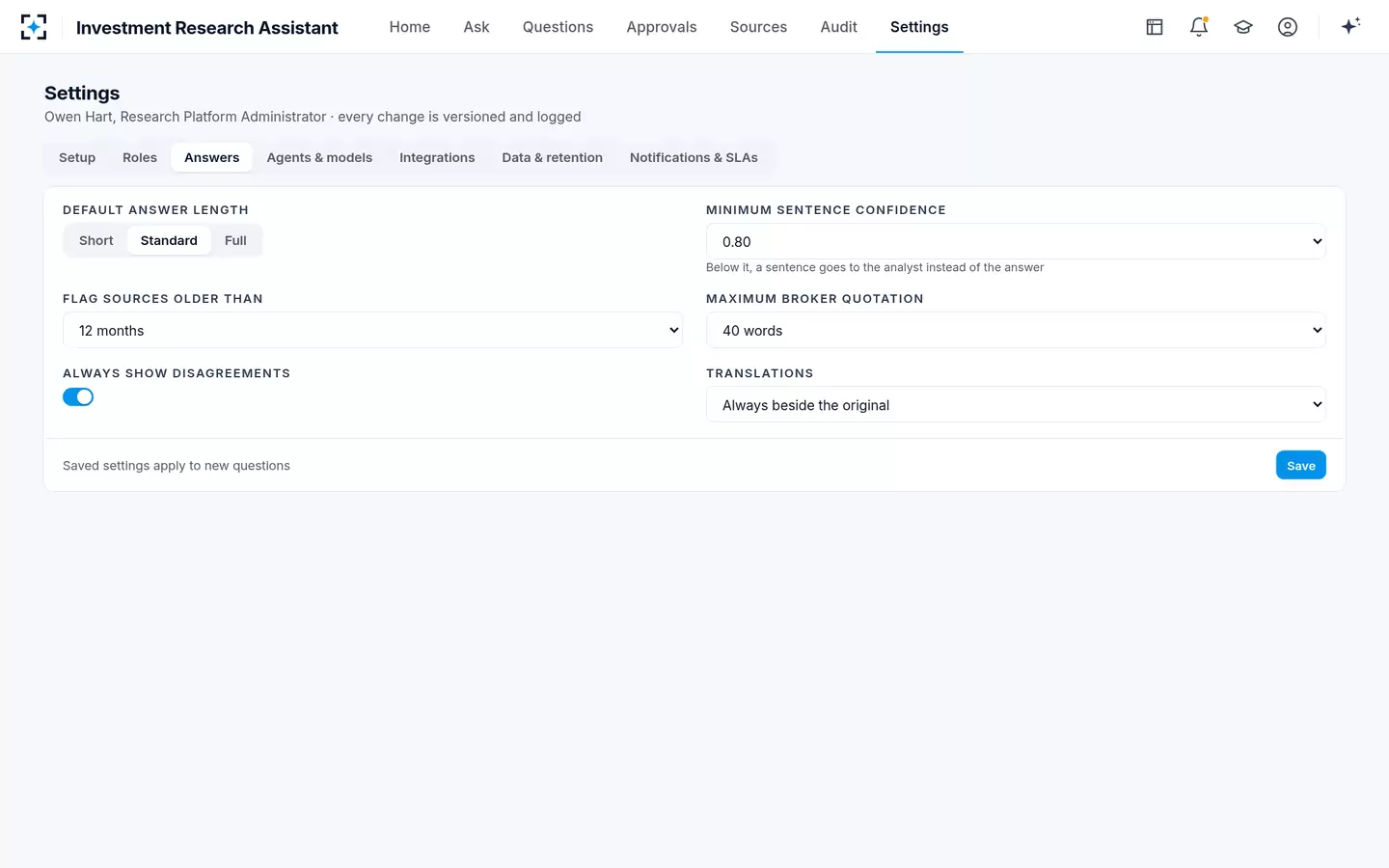
The settings that govern how licensed text appears in answers are deliberately few and owned by compliance: the longest broker quotation allowed, 40 words or references only; whether disagreements are always shown; how old a source may be before it is flagged; and the confidence below which a sentence goes to the analyst instead of the answer. Every change is versioned and logged, and a change to an agent needs a second approver. Who may read and share broker research, case by case, is in broker research reports: who may read them, and how AI can.
The Investment Research Assistant answer settings Research Compliance owns
How do you test an AI research assistant? An acceptance test in five parts
Test an AI research assistant with thirty to fifty questions your team has already answered, five planted traps, and a grader who opens every footnote. Use the memos that answered the questions as the answer key, and grade sentences, not just conclusions. FINRA's 2026 oversight report puts the aim plainly: "Robust testing of GenAI to understand the capabilities, limitations and performance of the model" (FINRA, 2026 Annual Regulatory Oversight Report).
An acceptance test for an AI research assistant, in five parts
- Thirty to fifty past questions, mixed
Single-company lookups, numerical questions, and at least ten cross-company questions such as an exposure ranking, each with the memo as the answer key.
- Five traps
A reader without a seat for a key broker; an issuer on the restricted list; an expert call on hold; a filing in another language; a broker estimate that contradicts your note.
- Sentence-level grading
Open every footnote. Count unsupported sentences, wrong figures and refusals separately; a right number reached by contradictory reasoning counts as wrong.
- A sharing round
Send three answers to a colleague with fewer licences and one to someone outside the team; check what each would see and who must approve.
- A repeat after a change
Change one setting or model version and re-run the set; results should be comparable and the change should be on the audit trail.
Pass marks are a policy choice, but some should be absolute. No licensed passage shown to an unlicensed reader. Nothing read about a restricted issuer. No sentence without a supporting passage reaching the final answer. Investment Research Assistant runs a test question of this kind before going live; in the sample it cited 6 of 6 sentences and declared the report it withheld. A scorecard keeps candidates comparable.
A scorecard for comparing AI research assistants
| Criterion | How to test it | Pass mark |
|---|---|---|
| Licensed reading | Ask as a reader without a seat for a provider your answer needs | Provider withheld and named; no text shown |
| Restricted issuers | Ask about an issuer on the list | Nothing read; question logged |
| Supported sentences | Open every footnote on 30–50 answers | No unsupported sentence in a final answer |
| Original languages | Include a non-English annual report | Original sentence and page beside the English |
| Disagreement | Plant a broker estimate that differs from your note | Both shown with sources; analyst chooses |
| Sharing | Share with a less-licensed colleague | Passages replaced; second approver outside the team |
| Audit | Ask who saw a passage a week later | Answered from the trail, viewer by viewer |
| Repeatability | Re-run after a settings change | Comparable results; change versioned and approved |
Equity research teams that want to test on a past earnings season rather than past questions will find a replay design in an equity research automation pilot that replays last season.
How long does it take to deploy AI research tools?
Deploying an AI research assistant for a first team takes weeks rather than months when licence files and directory groups already exist, and most of that time is the acceptance test, not the software. Our planning estimate at the top of this page assumes two weeks to connect sources and licences, two to run the acceptance test, two of live use with daily review, and two more before sharing outside the team is switched on. Each further team then needs its own licences, scope and test questions.
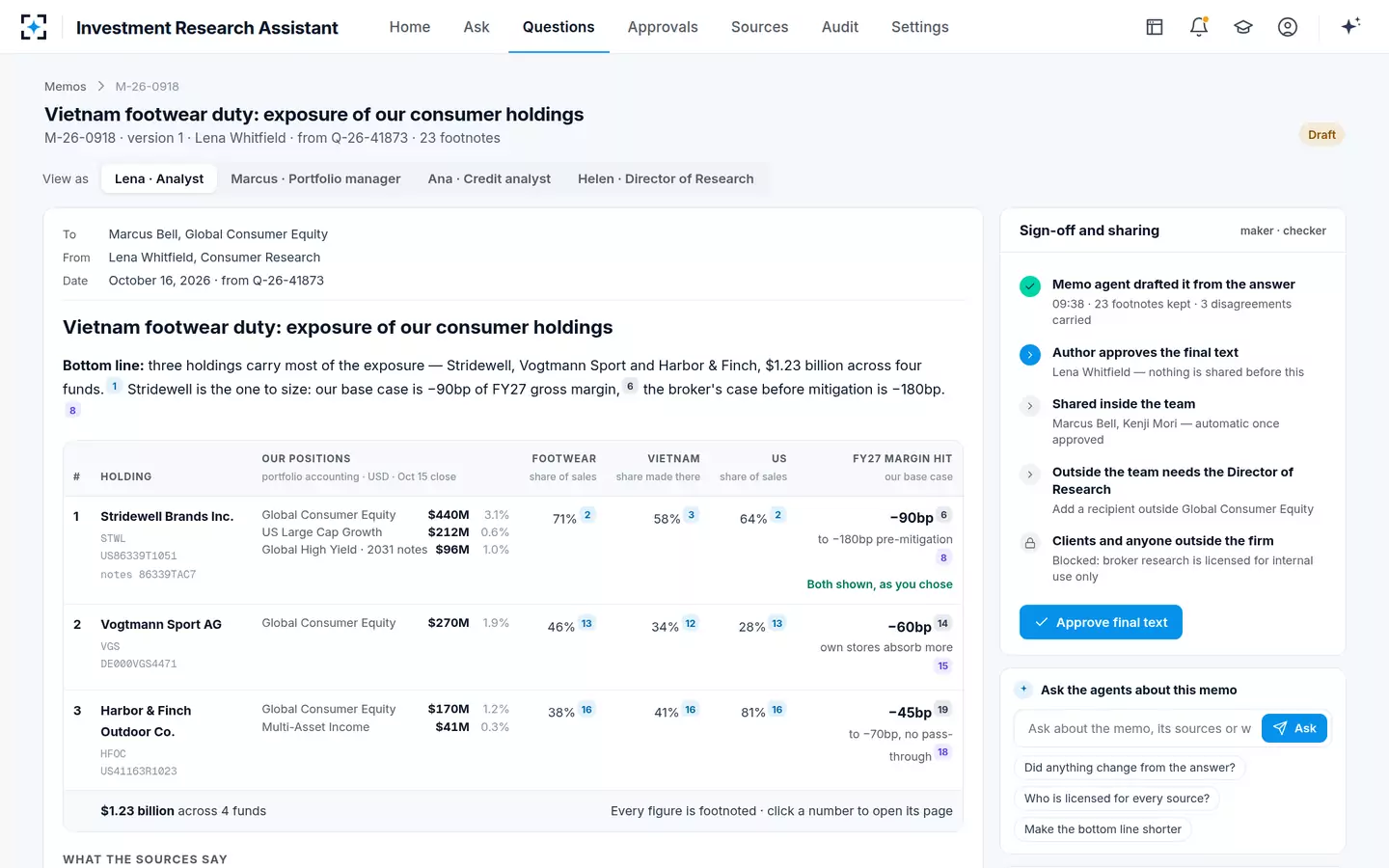
The sequence matters more than the dates. Sharing outside the team comes last because it is where licence errors become visible to people who should not see them. The Director of Research approves anything leaving the team, Research Compliance approves any client use, and nobody approves their own request.
A cited memo with its sign-off steps, ready for the first team
After go-live: what to watch in the first ninety days
After go-live, watch the controls more closely than the speed, because firms are better at checking AI before launch than after it. The Bank of England and FCA's 2026 survey found human approval, pre-deployment review and vendor due diligence each reported by more than 90% of UK firms, while ongoing monitoring, leakage testing and periodic review were each reported by around half (Bank of England and FCA, October 26, 2026). Vendor updates are the gap most firms leave open.
How UK firms handle high-materiality updates to vendor AI models
48%
always regression-test such updates, and a further 25% usually do
73%
always or usually have a defined rollback plan
25%
always or usually let such updates flow straight into production
54%
find applying model risk management to vendor models a governance challenge
Three habits close that gap for a research tool. Re-run the acceptance set after every change to a model, an agent or a setting, and keep the results with the change. Review the Verifier's deletions weekly for the first month; a pattern of deletions on one source often means a feed problem rather than a model problem. And keep the records ESMA expects of AI use, including the data sources used and every modification over time (ESMA public statement, May 30, 2024). NIST's framework organises the same work into four functions, govern, map, measure and manage, of which the last two never stop (NIST AI RMF 1.0, January 2023).
Where Investment Research Assistant fits, and where it does not
Investment Research Assistant fits teams whose questions cross sources: many names, many brokers, filings in more than one language, and a house view that has to be set against the market's. It is designed for the controls those questions need, with licences checked per reader, restricted issuers blocked before reading, every sentence cited and a second person approving anything that leaves the team.
It is not a market-data terminal, a quant research platform or an execution tool, and it does not replace the analyst's model. Its agents may not trade, change positions, contact issuers or brokers, or approve anything. A team that mostly reads one filing at a time, in one language, from one broker, will get less from it than from a good search over its research management system. To run the acceptance test on your own questions, start from Investment Research Assistant.
Questions people ask
What are the best AI tools for investment research?
The best tools are the ones that pass an acceptance test on your own questions, sources and licences, scored sentence by sentence. Look for licence checks per reader, restricted-list blocking before retrieval, page-level citations with an independent verification step, disagreement shown rather than averaged, and an audit trail of every viewer.
Can I trial an AI research assistant on our own research without a full project?
Yes, if the trial uses a sample of your own notes, filings and licensed research under real permissions, rather than a vendor corpus. A trial on public documents alone tests the easy part; the licence and restricted-list behaviour is what distinguishes tools.
Who should own an AI research assistant inside the firm?
Usually the Director of Research owns its use and sharing approvals, Research Compliance owns licences, holds and the restricted list, and a platform administrator owns settings changes, with a second approver for any change to an agent. Internal audit tests the controls on a fixed schedule.
How often should an AI research assistant be re-tested?
After every change to a model, an agent or a setting, and on a regular schedule regardless. UK firms most often regression-test vendor updates, but only 48% of those answering always do, and around half run ongoing monitoring, so a fixed re-test cadence closes a common gap.
Do we need a separate AI policy for research tools?
Most firms extend an existing AI or model-risk policy rather than write a new one; 94% of UK firms in the 2026 Bank of England and FCA survey reported firm-wide AI policies or standards. Research tools add specific points: broker licences, restricted lists, expert-call holds and how cited answers are kept.