MiFID II research unbundling is the 2018 rule that made investment firms in the EU and UK pay for third-party research separately from trade execution, either from their own resources or from a research payment account funded by a charge to clients. It has since been made optional rather than repealed. The UK allowed joint payments for research and execution from 1 August 2024, extended to fund managers from 9 May 2025, and the EU's Listing Act reforms apply from 6 June 2026. Both regimes attach conditions, and both keep a yearly assessment of the quality, use and value of the research bought. For a research budget owner the question is no longer only how research is paid for, but whether the firm can show what it used. That evidence is a by-product of the way Botminds' Investment Research Assistant works: every sentence of every answer is footnoted to its source, so research use can be counted by provider.
Research payment rules, 2018 to 2028: two regimes, one direction
- Separate payment only (MiFID II)Jan 2018 – Jul 2024
- FirmsAug 2024
- Joint option, fund managers toofrom 9 May 2025
- Separate payment onlyJan 2018 – Feb 2021
- Joint option for issuers up to EUR 1bnDirective 2021/338 to Jun 2026
- Joint option for all researchfrom 6 Jun 2026
What is MiFID II research unbundling?
MiFID II research unbundling is the requirement, in force from January 2018, that an investment firm managing money for clients pay for third-party research separately from the commissions it pays brokers to execute trades. The FCA summarises the regime it replaced in the UK: firms "were required to either pay for research themselves from their own resources (P&L model) or agree a separate research charge with their clients (RPA model)" (FCA PS24/9, July 2024). The aim was to stop research being paid for invisibly out of clients' dealing costs, so that managers bought research on its merits and clients could see what it cost.
The rule sits in the inducements regime. Research from a third party counts as a prohibited inducement unless it is paid for in one of the permitted ways, which is why the reforms that followed changed the list of permitted ways rather than the definition of research. A research payment account, the second route, is a dedicated account funded by a specific research charge to clients and spent against a research budget the firm sets.
What did unbundling do to research? The evidence
Unbundling reduced analyst coverage, mostly of large companies, and the research that remained appears to have become more accurate. Studying the EU rule, Guo and Mota found that "unbundling causes fewer research analysts to cover a firm", that the decrease "is concentrated in large firms", and that "the reduction in analyst coverage is accompanied by a decrease in forecast error", which they attribute to competition: "inaccurate analysts drop out" (Guo and Mota, Journal of Financial Economics, 2021).
The UK government's Investment Research Review, chaired by Rachel Kent and published in July 2023, reached a mixed verdict. It found "general acceptance" that unbundling "had some adverse impacts on the provision of investment research", while noting that the decline in UK coverage "pre-dates MiFID II unbundling rules" and that the reforms had positive effects, "in particular by reducing the amount of relatively unsophisticated and duplicative research" (UK Investment Research Review, July 10, 2023). Among its main concerns was the second payment route.
The main basis on which client funds can be used to pay for research under MiFID II, the research payment account, “is considered unnecessarily complex and therefore is rarely used.”
UK Investment Research Review (Rachel Kent), July 2023, paragraph 1.32(b)
The review also recorded "a widely held (but not uncontested) view" that lower research budgets led to a "juniorisation" and reduction in the number of sell-side analysts. Its Recommendation 2, an option to pay for research and execution together, is what the FCA took forward.
Has MiFID II unbundling been reversed? In part: it is now optional
MiFID II unbundling has not been reversed so much as made optional, in both the UK and the EU. Firms that prefer to keep paying from their own resources or through a research payment account may do so; the new option is a third route with conditions of its own. The FCA's policy statement says the new option "would exist alongside those already available", and its rules confirm that research services are not an execution factor, so best-execution duties are unchanged (FCA PS24/9; COBS 2.3B.29R).
The conditions are what make "optional" different from "repealed". A firm that pays jointly takes on a written policy, a budget, cost allocation rules and client disclosures it did not need when it paid from its own resources. A firm that pays from its own resources still faces the annual assessment of research in the EU, which now applies however research is paid for. Some UK managers that absorbed research costs in 2018 have little reason to switch; others, particularly smaller firms, may find the joint route simpler than a research payment account.
Three ways to pay for research, and what each now requires
| Route | Who bears the cost | What the firm must keep doing |
|---|---|---|
| Own resources (P&L) | The firm | No client charge to justify; in the EU, the annual assessment of research quality, usability and value still applies. |
| Research payment account | Clients, through a separate research charge | Set and regularly assess a budget; disclose the budget and estimated charge in advance and total costs annually; refund or carry forward any surplus. |
| Joint payment with execution | Clients, within dealing costs, identified separately | Written policy; budget not linked to trading volumes; fair cost allocation; at least annual value assessment; client disclosures. |
What is the FCA joint payment option?
The FCA joint payment option lets a UK firm pay for third-party research and execution together, provided it meets conditions set out in COBS 2.3B.25R. The FCA lists the guardrails as being there for "budgeting for research spending, assessing the value of research purchased, fair allocation of costs among clients, transparency and disclosure to clients, and preserving best execution requirements unchanged" (FCA PS24/9, paragraph 1.14).
The rule text is specific. The firm must have a written policy that covers governance and controls "maintained separately from those for trade execution"; a method for identifying research costs within the joint charge; a structure for allocating payments between research providers, including those with no execution business; and a budget set at least annually "not linked to the expected volumes or values of transactions executed on behalf of clients". It must allocate costs fairly between clients, and at least annually "assess the value, quality and use of research purchased using joint payments and its contribution to the investment decision-making process" (COBS 2.3B.25R). Disclosures to clients include the most significant research services bought, measured by amount paid, the types of provider they came from, and total costs each year.
The FCA received 44 responses to its consultation, and the main objections were practical: budgeting, price benchmarking, provider disclosures and cost allocation. The final rules loosened several of those details. A second policy statement, PS25/4 of May 2025, extended the option to UK fund managers, including UCITS management companies and alternative investment fund managers, from 9 May 2025 (FCA PS25/4).
What does the Listing Act change for research in the EU?
The EU's Listing Act lets investment firms pay jointly for research and execution whatever the size of the companies covered, removing the cap introduced in 2021. Under the 2021 Capital Markets Recovery Package, joint payment had been allowed only for research on issuers "whose market capitalisation did not exceed EUR 1 billion"; the Listing Act Directive, (EU) 2024/2811, removed that limit (ESMA technical advice, April 8, 2025).
ESMA's advice sets out three conditions that apply whatever payment route a firm chooses: an agreement with the provider establishing a methodology for remuneration; information to clients about the firm's choice and its payment policy; and that the firm "assesses the quality, usability and value of the research used, as well as the ability of the research used to contribute to better investment decisions, on an annual basis". The Commission's delegated directive of February 2026 writes that assessment into Article 13 and goes further: it must rest on "robust quality criteria", and firms must take "the necessary remedial actions" when research falls short (Commission Delegated Directive C(2026) 994).
For firms that keep a research payment account, the same text tightens the bookkeeping. Controls must include "a clear audit trail of payments made to research providers and of how the amounts paid were determined with reference to the quality criteria". A separate delegated regulation adopted by the Commission on 21 May 2026 sets a code of conduct for issuer-sponsored research and requires firms to obtain enough information to assess research labelled as issuer-sponsored before distributing it under that label (C(2026) 3226, Council document 9701/26).
Joint payment for research: UK rules beside the EU's
United Kingdom (COBS 2.3B): 1 August 2024 for investment firms; 9 May 2025 for fund managers.
European Union (MiFID II as amended): Member states apply the new rules from 6 June 2026.
United Kingdom (COBS 2.3B): None.
European Union (MiFID II as amended): None; the 2021 EUR 1 billion market-capitalisation cap is removed.
United Kingdom (COBS 2.3B): At least annually, of value, quality, use and contribution to decisions, for research bought jointly.
European Union (MiFID II as amended): Annually, of quality, usability, value and contribution to better decisions, on robust quality criteria, whatever the payment route.
United Kingdom (COBS 2.3B): Set at least annually, not linked to trading volumes or values.
European Union (MiFID II as amended): Required for research payment accounts; based on a reasonable assessment of the need for research.
United Kingdom (COBS 2.3B): Policy, expected and actual costs, and the most significant providers by amount and type.
European Union (MiFID II as amended): The firm's choice of payment method and its policy on payments for execution and research.
When do the new EU research rules apply? From 6 June 2026
The EU's new research payment rules apply from 6 June 2026. The Commission's delegated directive requires member states to adopt and publish their implementing measures "by 5 June 2026 at the latest" and states: "They shall apply those provisions from 6 June 2026." It aligns its dates with the Listing Act Directive so that firms and supervisors adapt once (C(2026) 994, Article 2 and recital 7).
Two later dates matter for planning. The Listing Act Directive requires ESMA to prepare "a comprehensive assessment of the market developments by 5 December 2028"; ESMA has said it agrees that take-up of the new option and the quality and availability of research are worth monitoring (ESMA technical advice, paragraph 16). And national transposition is not uniform; a firm with entities in several member states should confirm each one's implementing text.
Are you bound by MiFID II research unbundling rules?
You are bound if you are an investment firm authorised in the EU that provides portfolio management or investment advice and receives third-party research, or a UK firm under the FCA's Conduct of Business rules, which since May 2025 include fund managers. The EU delegated directive is addressed to "investment firms that provide portfolio management or other investment or ancillary services". A manager authorised in neither the EU nor the UK is not bound by these rules directly, though an EU or UK affiliate, or a mandate delegated by one, can bring them into its arrangements; that is a question for counsel on each structure.
Being bound now means less about the payment route and more about the evidence. Whichever route you choose, someone has to show, each year, which research was used, how much it contributed and what it cost.
What a research policy must now show, whichever way you pay
A research payment policy now needs to show how research is chosen, budgeted, assessed and disclosed, and the assessment needs evidence a supervisor would accept. The checklist below combines the UK and EU requirements with the professional standard most research teams already apply to outside providers.
Nine things a research payment policy should be able to evidence
- The payment route for each entity and client type
Own resources, research payment account or joint payment, and how they combine.
- A budget based on need, not trading volume
Set at least annually; in the UK, explicitly not linked to transactions executed for clients.
- How research costs are separated from execution
A methodology agreed with each provider, and separate governance from trade execution.
- How payments are allocated between providers
Including independent providers with no execution business.
- Fair allocation of costs between clients
Relative costs commensurate with relative benefits received.
- Written quality criteria
Robust and objective, as the EU text now requires; CFA Institute Standard V(A) asks for measurable criteria for outside providers.
- Evidence of use, by provider
Which research was read, cited and relied on in decisions, not a survey of impressions.
- Remedial action when research falls short
Ask the provider to improve, stop using it, or switch provider, and note which.
- Client disclosures, on time
Before the service, at least annually, and when the budget is exceeded or increased.
Evidence of research use from Investment Research Assistant, without a spreadsheet
Evidence of use is the hardest item to produce, because research is consumed in reading, not in transactions. The usual proxies are portal log-ins, analyst votes and download counts, which show attention but not reliance. A stronger measure is citation: which provider's passages ended up in answers and memos that reached a decision. How a broker vote turns that evidence into payments under each route is covered in payment optionality for investment research, and why some managers are paying through commissions again in rebundling research.
That measure comes free when answers are footnoted. In Investment Research Assistant every sentence carries its source, and reports show broker research used in answers by provider. Take the sample firm's question on a proposed footwear tariff: of 23 citations, 6 came from broker research, 6 from the firm's own notes, 9 from filings and transcripts and 2 from expert calls. One broker's report was withheld because the analyst holds no licence for it, a fact that is itself useful when deciding whether a seat is worth buying.
Investment Research Assistant's source mix under every answer, by provider type
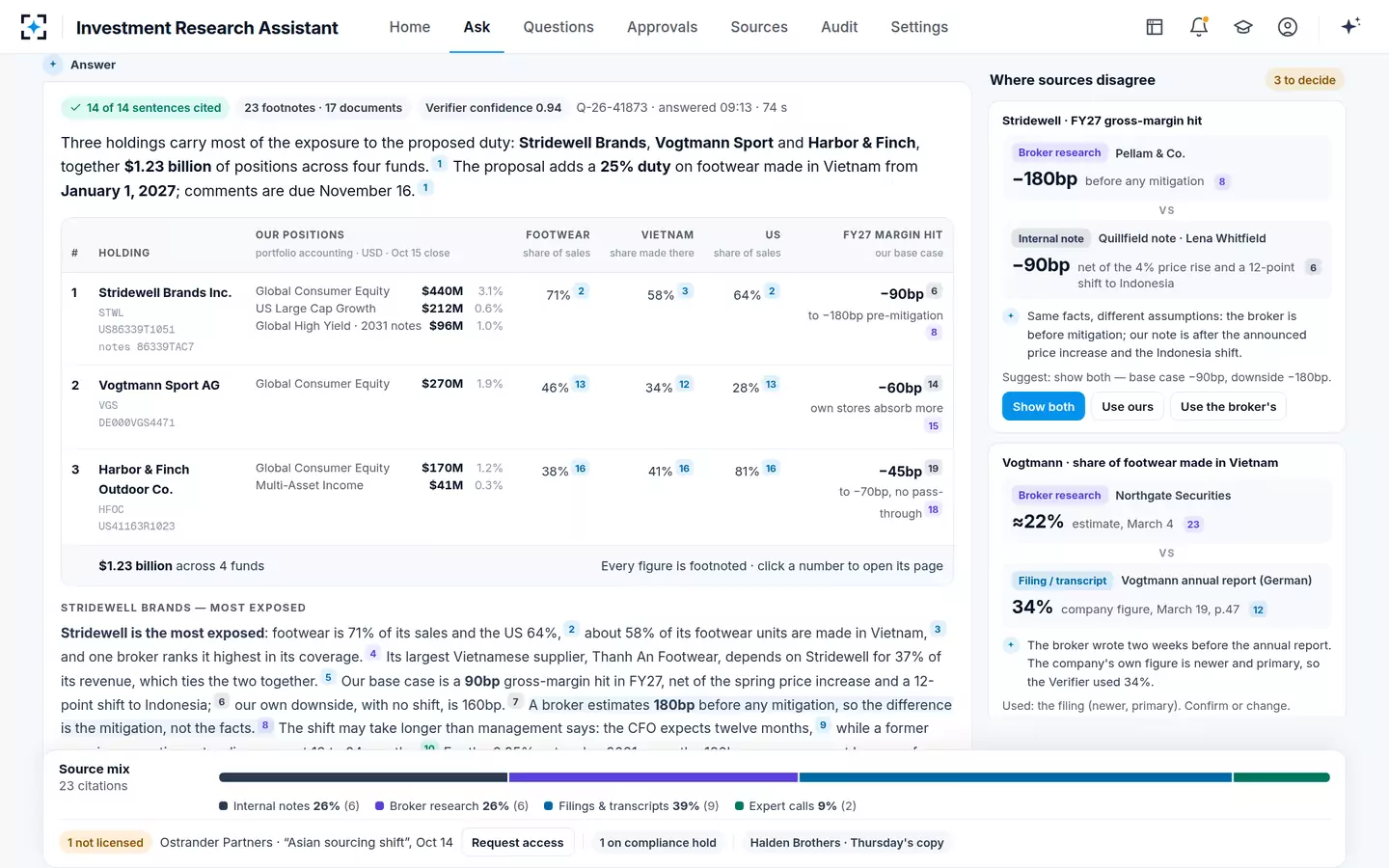
Across a year, those counts become the use half of the annual assessment: by provider, by team and by the decisions the memos fed. Who may read each provider's reports in the first place is covered in broker research reports: who may read them, and how AI can; how the counts feed a research programme's numbers is in investment research tools: pricing the programme and six KPIs. To see the provider reports on your own research, start from Investment Research Assistant.
Questions people ask
What is a research payment account?
A research payment account is a dedicated account, funded by a specific research charge agreed with clients, from which a firm pays for third-party research against a budget it sets and regularly assesses. The EU's 2026 text requires firms to disclose the budget and each client's estimated research charge in advance and total research costs annually. The UK review of 2023 found the route complex and rarely used.
Did the UK abolish research unbundling?
No. Since 1 August 2024 the FCA has allowed joint payments for research and execution as an additional option, alongside payment from a firm's own resources and research payment accounts. Firms using it must meet conditions in COBS 2.3B, including a written policy, a budget and annual assessment of research value.
Do US asset managers have to unbundle research?
US advisers are not subject to MiFID II as such. The question arises where a US manager has EU or UK entities, manages money delegated by an EU or UK firm, or deals with brokers serving such clients; each structure needs its own legal view.
Does joint payment affect best execution?
The FCA's rules say research services must not be treated as an execution factor, so best-execution duties under COBS 11.2A apply unchanged. A firm must not enter research arrangements that would compromise its ability to meet them.
What happens if research is judged poor value in the annual assessment?
The EU text requires firms to take remedial action, such as asking the provider to improve the research, stopping its use or distribution, or choosing another provider. In the UK, the value assessment also feeds the check that research charges to clients are reasonable against comparable services.