AI washing is making false or misleading claims about using artificial intelligence, and the SEC treats it as it treats any other misstatement to investors. In March 2024 it settled charges against two investment advisers, Delphia and Global Predictions, for $400,000 in combined penalties; since then it has brought cases against an adviser that raised money on a non-existent AI trading platform and a listed company whose "AI" drive-thru relied on people, and has sued a start-up founder over an app it says ran almost entirely by hand. Its examiners now check whether firms' AI representations match their operations. For an investment research team the lesson runs both ways: be able to prove what you say about your own use of AI, and ask the same proof of any vendor. Botminds' Investment Research Assistant is designed so that its claims can be checked: it shows where each answer came from, sentence by sentence, and keeps every check it makes.
Five SEC AI-washing matters, 2024–2025: the claim, the reality, the outcome
Delphia (USA) Inc.Adviser · order of March 18, 2024
What was claimedFrom 2019 to 2023, that it used AI and machine learning on clients' spending and social media data to pick investments.
What the SEC found or allegesIt never used client data with AI or machine learning, or as inputs to its algorithms at all; it kept making the claims after telling examiners in 2021 it would stop.
OutcomeCensure, cease-and-desist, $225,000 penalty
Global Predictions Inc.Adviser · order of March 18, 2024
What was claimedTo be the "first regulated AI financial advisor", offering "[e]xpert AI-driven forecasts".
What the SEC found or allegesThe forecasts claim was false and the "first" claim could not be substantiated; tax-loss harvesting it advertised did not exist.
OutcomeCensure, cease-and-desist, $175,000 penalty
Rimar Capital and two individualsAdviser and parent · order of October 10, 2024
What was claimedAn artificial intelligence-driven trading platform for stocks and crypto assets, used to raise $3.725 million from 45 investors.
What the SEC found or allegesThe firm had no trading application at the time and never had a platform for stocks or crypto assets.
Outcome$310,000 in penalties ($250,000 and $60,000 from the two individuals); a bar for the owner
Presto Automation Inc.Listed company · order of January 14, 2025
What was claimedIts own AI took drive-thru orders and largely removed the need for human order taking.
What the SEC found or allegesEarly units ran on a third party's speech recognition; later units relied on human order takers abroad for most orders.
OutcomeCease-and-desist; no penalty, given its financial condition and cooperation
Founder of Nate, Inc.Private company · complaint filed April 9, 2025
What was claimedA shopping app that completed purchases with AI, with an automation rate said to be above 90%.
What the SEC found or allegesAlleged: virtually all orders were placed manually by contract workers. An allegation in pending litigation, not a finding.
OutcomeCivil complaint seeking injunctions, a bar and penalties
What is AI washing?
AI washing is overstating or inventing the use of artificial intelligence in a product, process or business to attract investors or clients. The SEC's Investor Advisory Committee, recommending AI disclosure rules for issuers in December 2025, used a working definition.
“AI-washing is defined as the making misleading claims about a firm’s AI integration into operations or business lines or its capabilities.”
SEC Investor Advisory Committee, recommendation on disclosure of AI's impact on operations, approved December 4, 2025
The committee's recommendation is advice to the Commission, not a rule. The law that AI washing breaks is older: the anti-fraud provisions of the securities laws and, for advisers, the Marketing Rule. When it announced the first two cases, then-Chair Gary Gensler said: "Investment advisers should not mislead the public by saying they are using an AI model when they are not. Such AI washing hurts investors" (SEC press release 2024-36, March 18, 2024).
What did the SEC charge Delphia with?
The SEC charged Delphia, a Toronto-based adviser, with false and misleading statements about its use of AI, with violating the Marketing Rule, and with failing to keep adequate compliance policies. Its order finds that "From at least August 2019 to August 2023, Delphia represented that it used artificial intelligence and machine learning to analyze its retail clients’ spending and social media data to inform its investment advice when, in fact, no such data was being used in its investment process" (SEC order, Advisers Act Release 6573).
The order's detail is instructive. Delphia did collect some client data, but "never used that data with artificial intelligence or machine learning or otherwise used that data in any way as inputs into its investing algorithms". Its website promised to "make our artificial intelligence smarter so it can predict which companies and trends are about to make it big". During an examination it admitted in July 2021 that it had not used client data and promised to correct its disclosures, and then continued to make similar statements in emails, social media and a press release until 2023. The SEC also found it lacked policies for social media and "a clear advertising review and approval process". Delphia agreed, without admitting or denying the findings, to a censure, a cease-and-desist order and a $225,000 penalty.
Global Predictions: a claim it could not substantiate
Global Predictions, a San Francisco robo-adviser, was charged with false AI claims on its website and social media, among other failings. The order finds it claimed its technology incorporated "[e]xpert AI-driven forecasts" when "in fact it did not", and that it called itself the "first regulated AI financial advisor" and "could not produce documents to substantiate this claim" (SEC order, Advisers Act Release 6574). Its platform used a chatbot to communicate allocation recommendations, but, the order notes, "the chatbot does not generate allocation recommendations".
The other findings show how AI claims sit among ordinary marketing failures. The firm advertised tax-loss harvesting it did not offer, claimed more than $6 billion of assets on its platform while reporting no regulatory assets under management, presented hypothetical performance to a general audience, and could not substantiate a claim that its models "outperform[] IMF forecasts by 34%". It agreed to a censure, a cease-and-desist order and a $175,000 penalty, paid in four instalments.
How much were the AI washing penalties?
The penalties have been modest, from nothing to a few hundred thousand dollars, because the firms were small and settled; the larger cost was a public order describing the misstatements. Delphia paid $225,000 and Global Predictions $175,000. In the Rimar matter, the owner agreed to a $250,000 penalty and a board member to $60,000, with the owner also barred from the industry, with a right to reapply after five years. Presto Automation paid no penalty: the Commission said it considered the company's financial condition, remedial acts and cooperation.
AI-washing penalties in four settled SEC orders
$225,000
Delphia, investment adviser, March 2024
$175,000
Global Predictions, investment adviser, March 2024
$310,000
Rimar owner and board member combined, October 2024
$0
Presto Automation, listed company, January 2025: cease-and-desist only
Beyond advisers: Rimar, Presto and an allegation against Nate's founder
The SEC has applied the same logic to fundraising and to listed companies. In Rimar, an owner and a board member raised $3.725 million from 45 investors for an adviser that marketing materials "repeatedly referred to" as "having an artificial intelligence-driven platform for trading"; the order finds "the firm had no trading application at all at the time of the fundraising" (SEC order, Securities Act Release 11316, October 10, 2024). The same claims were used to win advisory clients.
Presto Automation, then a listed restaurant-technology company, described its drive-thru product as running on its own AI. The SEC found that from November 2021 to September 2022 every unit it deployed used speech recognition "owned and operated by a third party", and that later units "lacked the capability to take orders on their own and required substantial human involvement", with order takers in the Philippines and India handling most orders (SEC order, Securities Act Release 11352, January 14, 2025). The violations were of the Securities Act's anti-fraud provision and the Exchange Act's reporting requirements, a reminder that issuers' AI claims are disclosures like any other.
In April 2025 the SEC sued Albert Saniger, founder of the shopping app Nate, alleging he raised over $42 million partly on claims that the app completed purchases with AI. The complaint alleges he told one investor the "automation rate was above 90%" when virtually all orders were placed manually (SEC v. Saniger, complaint filed April 9, 2025). These are allegations in litigation; no court has found them true.
Does the SEC examine AI claims? Yes, and it looks at operations too
The SEC's examiners review AI claims as part of their priorities, and they compare what firms say with what their systems and controls actually do. The Division of Examinations' fiscal 2026 priorities said it would review registrants' representations about their AI capabilities for accuracy and assess whether firms have policies and procedures "to monitor and/or supervise their use of AI technologies" (SEC, FY2026 Examination Priorities, November 17, 2025). For fiscal 2027, in its own new term, the Division says it will prioritise examinations of policies and procedures relating to monitoring "super intelligence (SI)", and that for automated investment tools it will consider whether representations are fair and accurate and whether operations and controls match disclosures (SEC, FY2027 Examination Priorities, October 23, 2026).
For advisers, the rule that turns a claim into a duty is the Marketing Rule. It prohibits any advertisement that includes "a material statement of fact that the adviser does not have a reasonable basis for believing it will be able to substantiate upon demand by the Commission" (17 CFR 275.206(4)-1(a)(2)). Global Predictions' "first regulated AI financial advisor" fell at exactly that point. A firm describing its research process as AI-assisted needs the evidence before it publishes the sentence, not after an examiner asks.
The rules behind the AI-washing cases, and what each requires
| Provision | Applies to | What it requires |
|---|---|---|
| Advisers Act Section 206(2) | Investment advisers | No transaction, practice or course of business that operates as a fraud or deceit on clients; negligence is enough. |
| Advisers Act Section 206(4) and Rule 206(4)-1 (Marketing Rule) | SEC-registered advisers | No untrue or unsubstantiated statements of material fact in advertisements. |
| Advisers Act Rule 206(4)-7 | SEC-registered advisers | Written compliance policies reasonably designed to prevent violations, reviewed at least annually. |
| Securities Act Section 17(a) | Anyone offering or selling securities | No untrue statements or misleading omissions in offers or sales. |
| Exchange Act Section 13(a) and rules | Reporting companies | Accurate periodic and current reports, and disclosure controls. |
What is the predictive data analytics rule? A proposal, withdrawn in 2025
The predictive data analytics rule was a 2023 SEC proposal that would have required broker-dealers and advisers to eliminate or neutralise the effect of conflicts of interest arising from their use of predictive analytics and similar technologies with investors. It never became law. The Commission withdrew it, with a group of other pending proposals, in a notice dated June 12, 2025 and published on June 17, 2025, noting that any future action in these areas would need a new proposal (90 FR 25531).
The withdrawal changed less than it might seem for AI washing. The cases above rest on long-standing rules about truthful statements, not on any AI-specific rule, and the examination priorities continue to treat AI representations as a review area. What a firm says about its AI is held to the same standard as anything else it says.
How do you prove an AI claim? Keep a substantiation file
You prove an AI claim by keeping, before the claim is made, the evidence an examiner would ask for: what the system does, on which data, with what human involvement, and how you know. The profession's code makes the same point from the other side. CFA Institute's guidance on Standard I(C), Misrepresentation, includes a case in which a manager used a chatbot to write the AI section of a request for proposal and so misrepresented his firm's capabilities; the standard was breached by the misrepresentation, whatever tool wrote it (CFA Institute, Standard I(C)).
A substantiation file for any claim about AI in research
- The exact wording of every AI claim
Website, pitch books, due diligence questionnaires, Form ADV and client letters, kept with dates.
- What the system actually does
Which steps are automated, which are done by people, and which by a third party's technology.
- The data it uses
Sources, permissions and licences, matching what the claim says it uses.
- Evidence it works as described
Test results on your own questions, with the date, version and who ran them.
- Logs that show it running
Questions, passages read, checks made and outputs, so a claim can be traced to activity.
- Human involvement, stated honestly
Where people review, decide or correct; claims of automation should match the logs.
- Third-party dependencies
Whose models and services the system uses; Presto's case turned on an undisclosed supplier.
- A review before publication
Compliance sign-off on every AI statement, as for any other advertisement.
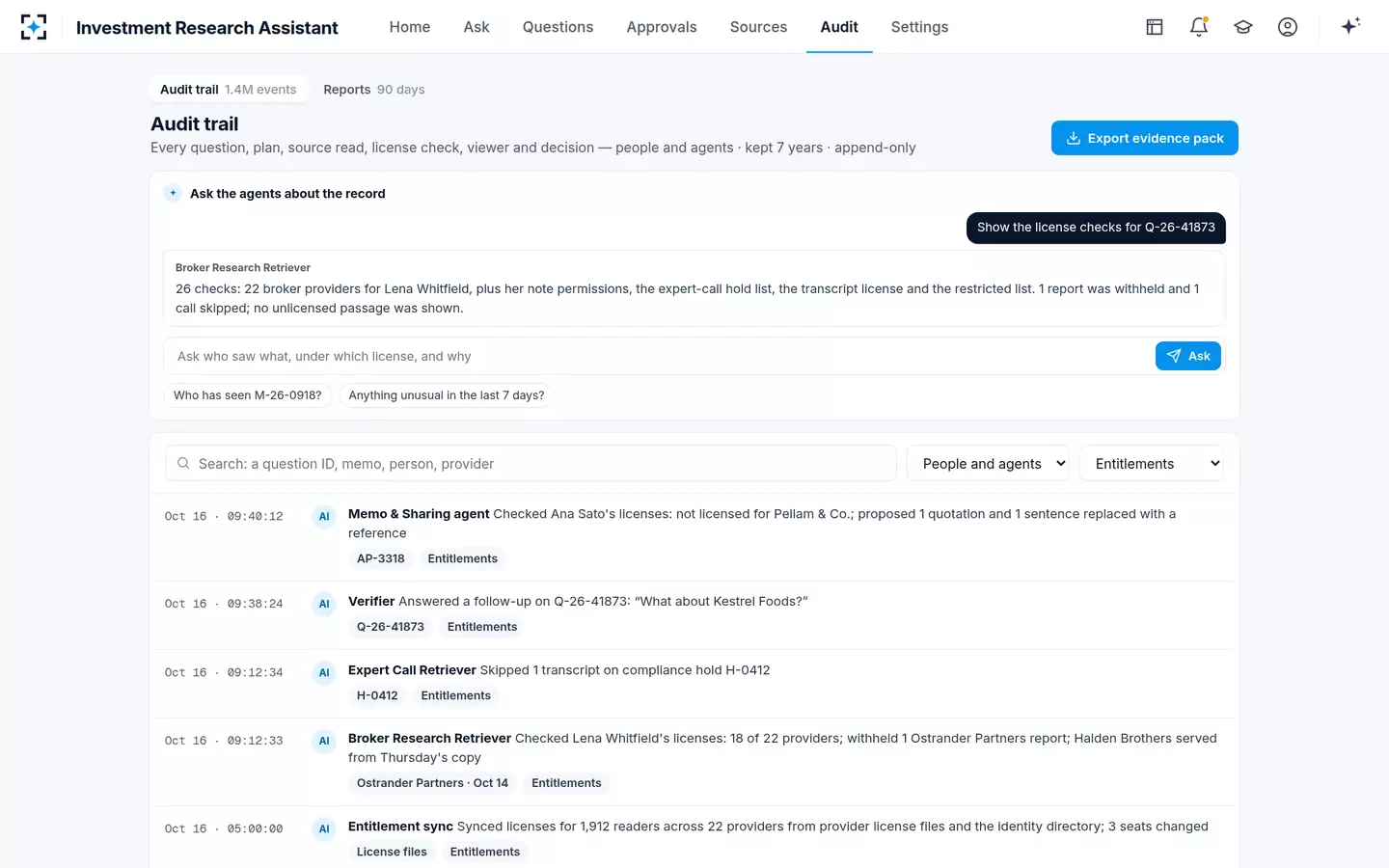
A tool that keeps its own evidence makes the file easier to build. Investment Research Assistant records every question, plan, passage read and cited, licence check, viewer and decision in an append-only trail kept seven years by default, and an auditor can export an evidence file sealed with a SHA-256 hash.
Investment Research Assistant's audit trail, which can substantiate what the agents did
What to ask any AI research vendor, including Investment Research Assistant
Ask any vendor to show, on your own documents, each capability it claims, and to say which of its published figures are measured, which are targets and which are sample data. Investment Research Assistant's own public figures follow that rule: the 74 seconds to a cited answer and the 14 of 14 cited sentences on the tariff question were seen running the solution on fictional sample data; zero broker passages shown to a reader not licensed for them is a design target, to be measured in your deployment; and the time saved per question is Botminds' estimate.
Three questions separate a substantiated claim from a washed one. What happens, step by step, between the question and the answer, and which steps are people? What does the system do when it cannot find support for a sentence? And can it show, for a question asked last week, every source it read and every check it made? Why citation alone is not proof of support is covered in FinanceBench and the defensible answer; what regulators' data shows about how firms are actually using AI is in how asset managers are using AI. To test our claims on your own research, start from Investment Research Assistant.
Questions people ask
Was the first SEC AI-washing case against an investment adviser?
Yes. The SEC's first settled AI-washing actions, announced together on March 18, 2024, were against two registered investment advisers, Delphia and Global Predictions, with $400,000 in combined penalties. Later matters reached a private adviser's fundraising, a listed company and a start-up founder.
Can a firm be charged for AI claims even if it uses some AI?
Yes, if what it says is materially untrue or misleading. Presto did use AI speech recognition, but the SEC found it misleading to describe a third party's technology as its own and to claim orders were taken without people when most were handled by human order takers.
Do AI-washing rules apply to research vendors?
A vendor's marketing is its own responsibility, but an adviser that repeats a vendor's claim to clients makes the claim its own under the Marketing Rule. Ask vendors for evidence you could show an examiner, and describe your use of their tools only as far as you can substantiate it.
Is AI washing a crime?
The SEC's actions are civil. Misstatements to investors can also be prosecuted criminally where the facts support fraud, which is for prosecutors and courts; the cases summarised here are SEC civil matters, four settled and one in litigation.
Does the SEC require advisers to disclose their use of AI?
There is no AI-specific disclosure rule for advisers; the 2023 predictive data analytics proposal was withdrawn in June 2025. Existing duties still apply: disclosures and advertisements must be accurate, and examiners review AI representations against operations. The SEC's Investor Advisory Committee has recommended AI disclosure guidance for issuers, which is advice, not a rule.