Investment research tools are the systems a buy-side team uses to find, read, compare and keep research: market data platforms, broker research portals, research management systems for the firm's own notes, and, more recently, AI research assistants that answer questions across all of them. The useful way to judge them is not the licence fee but what they do to the scarcest resource on a research desk, the analyst's hours, and to two things regulators and clients now ask about: whether paid-for research is used, and whether licensed research reaches only licensed readers. Botminds' Investment Research Assistant is built around those three measures, and this guide uses its sample data to show how to price a research tool programme and which six numbers to track once it is running.
Six KPIs for an investment research tool programme
1Time to a cited answer
What it measuresMinutes from a question to an answer whose every sentence opens its source page.
How to measure itTimestamps on the question and the answer, per question type.
Sample value or target74 seconds on the sample tariff question; target: minutes, not days
2Names covered per analyst
What it measuresCompanies an analyst follows to the firm's standard, at the same research budget.
How to measure itCoverage lists against headcount, quarter on quarter.
Sample value or target41 names for the sample analyst; target: 20–30% more on the same budget
3Supported sentences
What it measuresShare of answer sentences that survive an independent check against their passage.
How to measure itVerifier deletions and rewrites per hundred sentences, and the analyst's own overrides.
Sample value or target14 of 14 cited after 2 of 16 drafted sentences were struck
4Licensed research used
What it measuresWhich paid providers' research is actually cited in answers and memos.
How to measure itCitations by provider, against seats and spend.
Sample value or target6 of 23 citations from broker research; 18 of 22 providers licensed for the sample analyst
5Shares without a licence breach
What it measuresAnswers shared with no passage shown to a reader not licensed for it.
How to measure itLicence checks at each share; passages replaced; exceptions found by audit.
Sample value or targetTarget: 0 broker passages shown to an unlicensed reader
6Hours moved to judgment
What it measuresAnalyst time freed from opening portals and reconciling, reinvested in decisions.
How to measure itTime studies before and after, on the same question types.
Sample value or targetEstimate: ≈ 3.5 days by hand to ≈ 0.6 day per cross-sector question
What are investment research tools? Four kinds, one job each
Investment research tools fall into four kinds, and each answers a different question. Data platforms answer "what is the number": prices, estimates, fundamentals in bulk. Broker research portals answer "what does this broker think", one provider at a time. Research management systems answer "what did we think", holding the firm's notes, models and meeting minutes. AI research assistants answer questions that cut across all three, such as which holdings a proposed tariff hits and why the brokers disagree with the firm.
The kinds overlap less than their marketing suggests, which is why a programme should price each against the work it removes rather than against each other. A firm rarely replaces its data platform with an AI assistant; it uses the assistant to stop analysts spending days stitching the other three together by hand.
Four kinds of investment research tools, and what each leaves to the analyst
What it is good at: Prices, consensus estimates, fundamentals and screening across thousands of companies.
What it leaves to the analyst: Reading the documents behind the numbers, and the firm's own view.
What it is good at: Each broker's reports, models and ratings, under that broker's licence.
What it leaves to the analyst: Opening each portal in turn and reconciling one broker against another.
What it is good at: The firm's own notes, minutes and models, searchable and kept.
What it leaves to the analyst: Joining the firm's view to outside research and new filings.
What it is good at: One question across notes, licensed broker research, filings and expert calls, cited to the page.
What it leaves to the analyst: Choosing between views, approving what is shared, and the investment decision.
What do investment research tools cost? Price the analyst hours, not the seats
Vendors of research tools rarely publish prices, and no regulator or independent study tracks them, so the reliable way to cost a programme is from the inside: the hours it frees and what those hours cost. The public anchor for the hours is pay. The US Bureau of Labor Statistics puts the median annual wage for financial and investment analysts at $102,740 in May 2025, with the highest-paid tenth above $180,860; about 377,200 people held those jobs in 2025 (BLS Occupational Outlook Handbook). The median works out at about $49 an hour before benefits and bonus; a buy-side firm should use its own loaded rate.
The analyst hour, in public numbers
$102,740
median annual wage, financial and investment analysts, May 2025
$49.39
the same median per hour: $102,740 ÷ 2,080 working hours
$180,860
wage above which the highest-paid tenth earn
377,200
financial and investment analyst jobs in the US, 2025
Against that, set what the tool removes. Botminds' own estimate for one cross-sector question, such as a tariff's exposure across a portfolio, is about three and a half days by hand, opening broker portals, searching notes, reading local-language annual reports and reconciling, against about six-tenths of a day with the agents reading, most of it the analyst's own reading and approval. A cost-per-name view of the same economics for earnings-season work is in AI earnings report analysis: the cost per covered name.
How do you measure ROI on research tools? A formula with four terms
ROI on a research tool is hours freed times the cost of an hour, plus the value of research spend put to use, less the tool's full cost, with licence and recordkeeping risk counted separately rather than priced. The formula below makes each term explicit so that a CIO can replace our assumptions with the firm's own.
The research tool ROI formula, term by term
Hours freed per question
≈ 2.9 days × 8 h
Botminds' estimate: about 3.5 days by hand to about 0.6 day with the agents, on a cross-sector question. Replace with your own time study.
Estimate, Botminds
Cost of an analyst hour
≈ $49.39 + your load
BLS May 2025 median annual wage for financial and investment analysts divided by 2,080 hours, before benefits and bonus. Your own fully loaded rate is the right number.
BLS figure, your load
Questions per analyst per year
× your own count
Count the cross-source questions your team actually answers; single-document lookups save little.
Research spend put to use
+ seats you can now justify or drop
Citations by provider show which licences earn their place at renewal.
The programme's cost
− subscription, set-up, change
Licence, implementation, licence-file and directory work, and the team's time on the acceptance test.
Two terms are deliberately left out of the arithmetic. The first is risk: a broker passage shown to an unlicensed reader, or a restricted issuer searched, has a cost that no average captures. Treat it as a pass-or-fail condition, which is why the fifth KPI is a target of zero. The second is quality: whether the freed hours produce better decisions. That shows up slowly, in hit rates and in the investment committee, and no tool should be credited with it in the first year.
The six KPIs a research team should track
A research team should track six KPIs: time to a cited answer, names covered per analyst, supported sentences, licensed research used, shares without a licence breach, and hours moved to judgment. Each is defined in the table at the top of this page, with a way to measure it and a sample value from the solution.
Three of them measure speed and capacity, and they move first. The sample tariff question was answered 74 seconds after the analyst ran the plan; the design target for coverage is 20 to 30% more names per analyst on the same research budget. Three measure control, and they matter most when something goes wrong: how many drafted sentences the Verifier struck or rewrote, which providers' research was actually cited, and whether any licensed passage reached a reader without a seat. A programme that reports only the first three is reporting a demo.
The supported-sentence KPI needs a word of care. A rising number of Verifier deletions is not a failure of the tool; it is the tool doing its job on harder questions. What should fall over time is the rate of unsupported sentences reaching the analyst, and the rate of analyst overrides of the Verifier.
How do you prove research is used? Count citations, by provider
You prove research is used by counting where it was relied on, provider by provider, rather than surveying analysts once a year. The rules now ask for it. A UK firm paying for research jointly with execution must at least annually assess the research's value, quality, use and contribution to investment decisions (FCA COBS 2.3B.25R(7)), and from 6 June 2026 EU firms must base their annual assessment, however they pay, on robust and objective quality criteria (Commission Delegated Directive C(2026) 994). CFA Institute's Standard V(A) asks firms to set measurable criteria for outside providers, including the accuracy of their information over time (CFA Institute, Standard V(A)).
When every sentence of every answer is footnoted, use becomes a byproduct. In Investment Research Assistant, reports show broker research cited in answers by provider, team and period; a provider read often but never cited is a different case from one cited in memos that reached the investment committee. The audit trail behind those counts is the same one a compliance officer uses to answer who saw which passage.
Investment Research Assistant's audit trail, which turns research use into counts
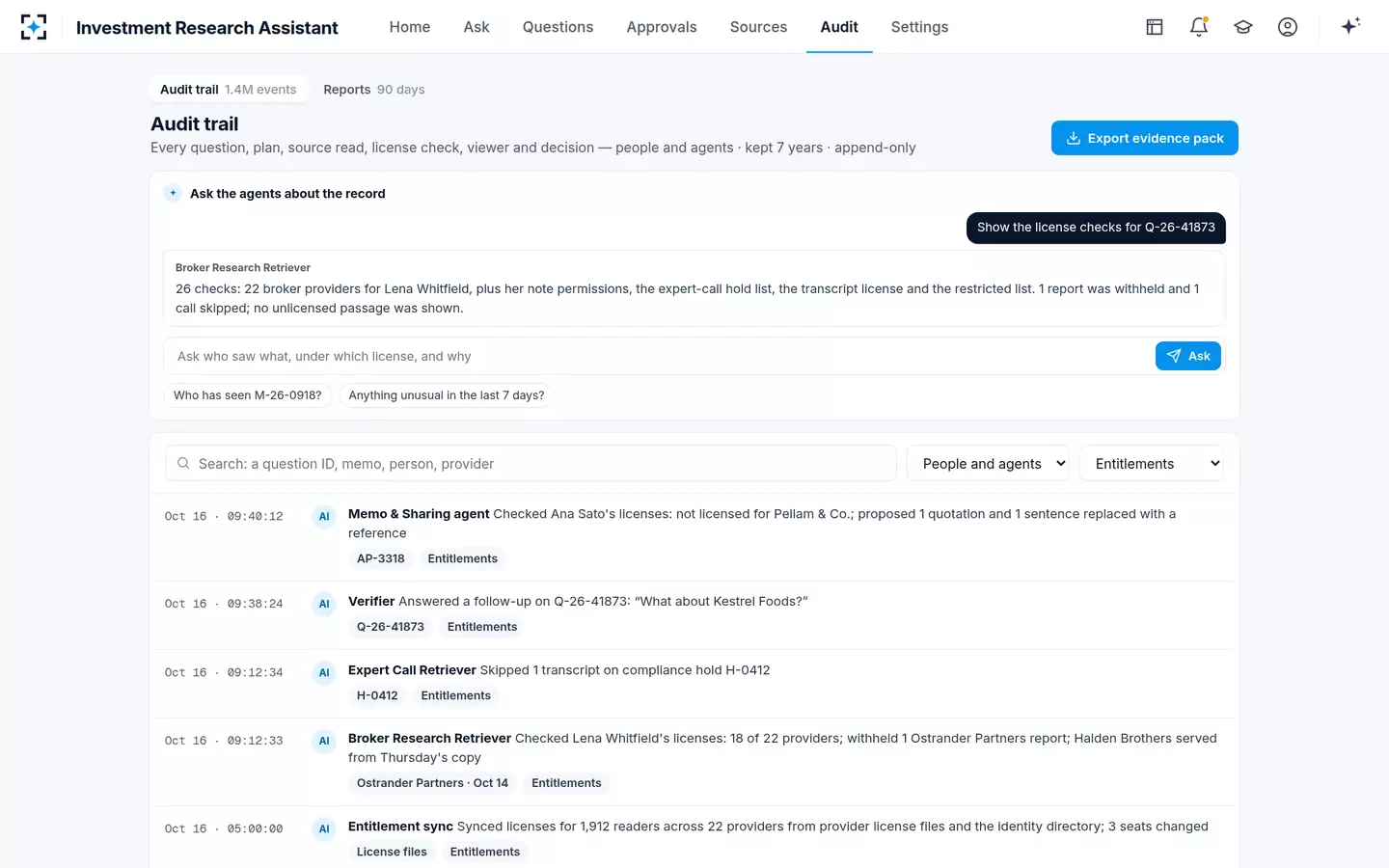
What each regime asks the assessment to cover, and how the UK and EU rules differ, is set out in MiFID II research unbundling after 2024.
What regulators' surveys say firms actually measure
Firms using AI mostly measure what users say about it and how accurate it is, and far fewer measure its effect on customers or risk. The Bank of England and FCA's 2026 survey of UK financial firms asked which metrics they routinely monitor for AI systems. The answers suggest where a research programme's reporting is likely to be thin.
What UK financial firms routinely monitor for their AI systems
The same survey found pre-deployment controls far more common than post-deployment ones: human approval, pre-deployment review and vendor due diligence were each reported by more than 90% of firms, while ongoing monitoring, leakage testing and periodic review were each reported by around half. For a research programme the lesson is to agree the six KPIs before go-live and report them monthly, so that the control measures do not fade once the launch is over.
Is AI research worth it? What firms expect, and when it is not
AI research is worth it where questions cross many sources and the cost of a wrong or unlicensed answer is high; it is much less worth it for single-document lookups. Firms' own expectations are modest. In ESMA's survey of EU securities-market firms in summer 2025, the average expected cost saving from generative AI over two to three years was 2.1 on a scale of 0 to 5, investment firms trailed at 1.8, and 23% of firms expected no saving at all; expected revenue gains averaged 1.2 (ESMA TRV Risk Analysis, February 20, 2026).
Those averages hide the shape of the gain. A team whose analysts each cover a few names in one market, mostly from English-language filings, will save little. A team covering many names across markets, with research from many brokers and filings in several languages, spends most of its time on exactly the reading and reconciling that agents do well. The honest test is to time five real questions by hand and with the tool before signing anything.
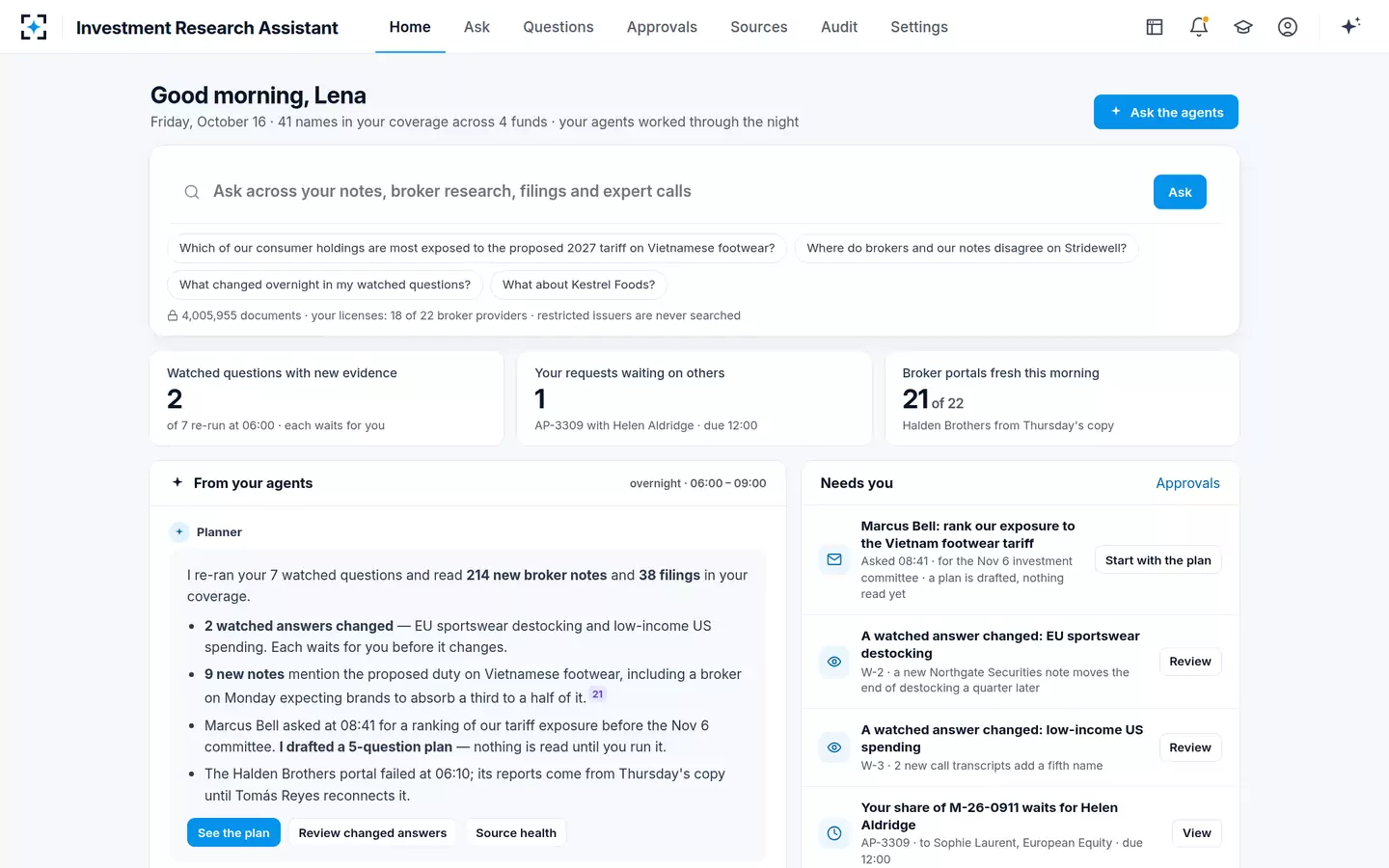
What Investment Research Assistant's agents did overnight, on the analyst's home screen
Running the programme: a review cadence that holds
A research tool programme holds its value when it is reviewed on a fixed cadence, with each KPI owned by a named person. Monthly, the Director of Research reviews time to a cited answer, supported sentences and shares without a breach. Quarterly, the CIO reviews names per analyst and hours moved to judgment against the original time study. Annually, ahead of broker renewals, research operations and compliance review licensed research used by provider, which also feeds the research assessment the payment rules require.
The same cadence answers the question every programme eventually faces: whether to widen it to another team. A team whose questions are cross-source and whose control KPIs held at target for two quarters is the next candidate. To price a programme on your own questions and coverage, start from Investment Research Assistant; how to run the acceptance test before go-live is in best AI for investment research: prove it on your own sources.
Questions people ask
What are the best investment research tools?
The best set depends on the questions a team answers: a data platform for numbers in bulk, the brokers' portals for their research, a research management system for the firm's own view, and an AI research assistant for questions that cut across all of them. Judge each on the hours it frees and the controls it keeps, measured on your own questions.
How much do investment research tools cost?
Vendors rarely publish prices, and no regulator or independent study tracks them, so cost a programme by what it frees: at the BLS median of about $49 an hour for financial and investment analysts, before benefits, each day of analyst time is worth roughly $400 in salary alone. Set that against the subscription, set-up and the team's own time on the acceptance test.
What KPIs should a research team track?
Six: time to a cited answer, names covered per analyst, share of sentences that survive an independent check, licensed research actually cited by provider, shares with no licence breach, and analyst hours moved to judgment. The last three are control measures and matter most when something goes wrong.
How long before a research tool pays back?
It depends on how many cross-source questions a team answers and on a subscription price that vendors quote privately. Multiply your own count of such questions by the hours a time study shows are saved, at your loaded rate, and set that against the quote; a team that mostly reads single filings may never pay back.
Does an AI research tool replace analysts?
No. A peer-reviewed study of AI and human stock analysts found the most accurate forecasts came from combining the two, and supervisors expect a named person to decide. The aim is more names covered and more time on judgment for the same team, with the analyst choosing between views and approving every memo.